I came late to The New Forest National Park and it has found a nest in my heart. This 550sq km patch of ancient England is an all-year-round destination, but autumn is particularly alluring when the russet woodland plays host to Pannage. This is the practice of releasing domestic pigs into a forest (also known as ‘common of mast’), dating back to the reign of William the Conqueror, who founded The New Forest in 1079.

In this case up to 600 pigs are released to eat fallen acorns, beechmast, chestnuts and other nuts, which are poisonous to the ponies, donkeys and cattle which roam the forest. The season started in September and finishes on 18 November. It is the only time of year that the pigs are allowed to ‘roam’ – around the same time those commoner-owned native ponies are rounded up, some headed for auction. 

This New Forest breed is most often associated with this former royal hunting ground. Pigs, though, have their own special status, too. Just to watch the wilded beasties wolfing down acorns is enough to induce dreams of free range pork products There is a good reason celebrated hotel/restaurant chain The Pig, with its stalwart commitment to local produce, first took root in the heart of the Forest, just outside Brockenhurst. 

A glance at the original Pig’s ’25 mile’ menus reveals a Saddleback crackling snack, starters of Pannage Coppa or home-made black pudding, a Tile Bar Farm pork chop main and my favourite, Crispy Chilli Pork Belly, Garden Leaves, Makers Honey and Greenhouse Chilli – locally reared and grown ingredients, with zero-mile produce picked from their own kitchen garden.

A whole chapter of founder Robert Hutson’s The Pig Cookbook (Octopus, £30) is given over to ‘Porkology’, a snout to tail guide tackling the various breeds they farm and their kitchen uses, particularly charcuterie. Chef Director at The Pig James Golding even teamed up with a third generation local family butcher, Alan Bartlett, to create a curing company called A Pinch of Salt.

Which brings us to a more traditional outlet for all that pork. ‘Mr Bartlett’s Hampshire Hogs’ have a case to be the perfect bangers to match with mash. The recipe date back to Alan’s great grandfather. Jame and his team can’t resist updating the ‘secret’ blend with the addition of (my favourite spice) fennel pollen plus elephant garlic (think a cross between standard garlic and leek).

Hampshire Hogs

Ingredients: 100g breadcrumbs, rapeseed, 25g seasoning (roughly 20g salt, 5g sugar, a pinch each of sage, thyme and garlic powder), 700g boneless pork shoulder (80% lean, 20% fatty), 150ml cold water, sausage casings.

Method: Fry the breadcrumbs with a little oil until golden brown. Mince the meat straight onto the crumbs, adding the water. Mince again. Tie one end of a sausage casing with string, then insert the narrow part of a wide-necked funnel in the other end. With the back of a wooden spoon push the meat through the funnel into the skin. Once it’s full remove the funnel and tie the end. Pinch and twist into four individual sausages, then link and tie with with string. Overnight in the fridge. Best cooked over charcoal.

Enough ‘snouts in the trough’. So who needs Vermont when you’ve got the New Forest?

There are are many good places to walk and witness the autumn colours. Try the following. Hightown Common, located near Poulner in the Forest’s north, is perfect for experiencing colour on trees, from the brilliant yellow of the birches to the last clumps of purple heather and the delicate tracery of the dying brackens. The walk starts off by passing a clump of gorse bushes, which provide beautiful colour and a distinctive coconut scent. Rhinefield Ornamental Drive is probably the best-known road in the whole of the forest.  Considered by many as the ultimate autumn colour-burst, the drive was planted in 1860 and offers colour and wonder all year round, as well as the Forest’s tallest tree. Time it right, and you can also proceed on to Blackwater Arboretum to see the falling leaves twirl and float into the pond there.

Staying in the New Forest

Many of the forest’s accommodation providers offer good deals to fill beds in the autumn ‘shoulder season’, and quieter roads, pubs and restaurants make it the perfect time for a short break. One place I’d heartily recommend is the four-star Balmer Lawn Hotel (above). This is currently offering three nights for the price of two until the end of November 2022. The break costs from £145 per person, B&B, based on two people sharing a room, and  also includes full use of the leisure facilities including indoor and outdoor pools, sauna, jacuzzi and gym. Pigs can be spotted very close to the hotel, and some rooms are dog friendly (though dogs should be on leads where there are pigs.)

We stayed at Balmer Lawn on our pre-Pandemic voyage of discovery. Here’s my report on that equally enchanting spring visit – Tall Trees and A Small Dog in The New Forest. For further information on the area visit the New Forest website.

Fish heads? I have form for devouring them. Witness the board below at the late, lamented Umezushi in Manchester. That was 2018 (note the prices) and I went for the hamachi. So the dish-determined-to-surprise on the menu at Fallow held no fears. Dowsed in a sriracha emulsion, the smoked cod’s head held plenty of crannies from which to prise collagen-rich morsels. Crumbled charcuterie adding an extra swoosh of umami. Messy, mind, but they reportedly sold 10,000 in their first five months of Fallow’s meteoric rise.

More a dish the likes of which you might find a short walk away in London’s Chinatown. Definitely not one for the pre-theatre crowd en route to Phantom of the Opera further down Haymarket. In that context this all-day restaurant/bar, created by two Heston Blumenthal alumni, should feel like a fish out of water (sic). Especially since it flaunts a sustainability ethos that’s as brazen as its prices. Given all this, it possesses a flamboyant yet democratic buzz. 

Not what you’d always expect from a joint perched at No.13 in the Estella Damm Top 50 Restaurants list. That’s a place behind my beloved Angel at Hetton, though its sense of theatre leans towards numero uno Ynyshir.

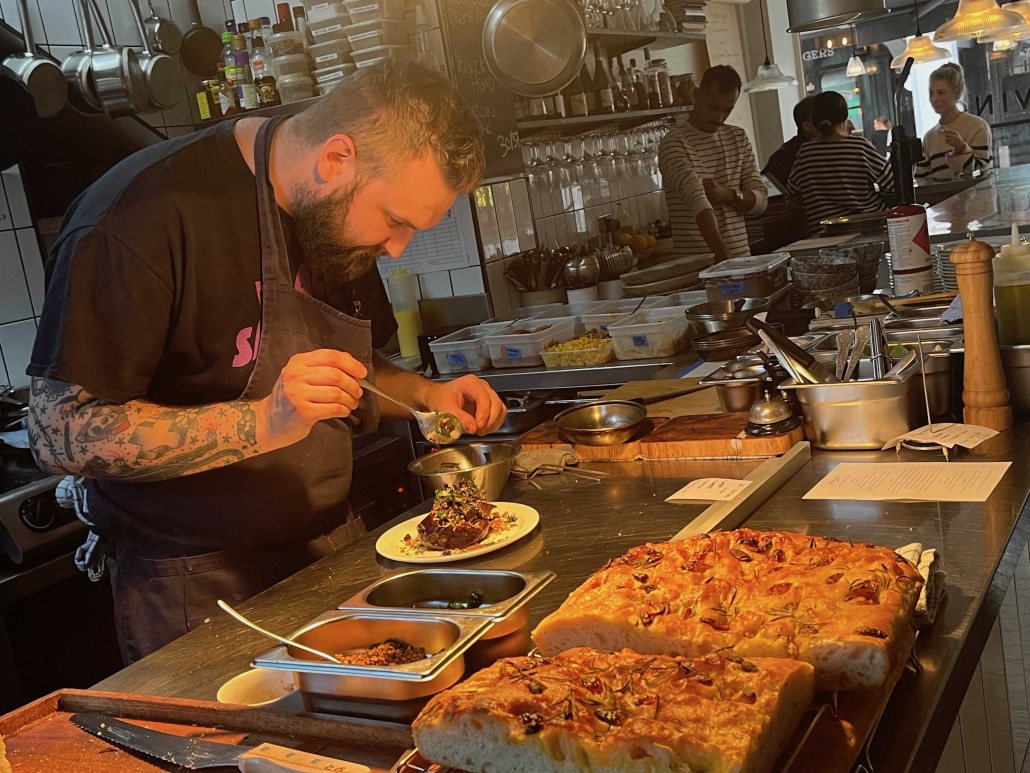
I had a front row seat for all this – at the Chef’s Counter, the hectic pass just to my right. None of your The Bear/Boiling Point chaos, though,about this operation, which started in 2020 as a residency at 10 Heddon Street, off Regent Street, before moving to St James’s this year. It was a bold move, smacking of serious investment at a time when the hospitality industry is facing horrendous challenges. Even so this week, hearteningly, its trade body reaffirmed its commitment to sustainability and reducing food waste with a 10 point plan. Fallow is already an object lesson in combining such principles with top quality dining. Their website calls it ‘conscious gastronomy’. Nothing gets thrown away and ‘nose to tail’ ‘farm to fork guides everything they cook.

All of which I contemplate as I gaze up at the hand foraged seaweed, dried flowers and recycled paper decorations dangling from the ceiling, a decor of repurposed materials including mussel and oyster shells and consider the provenance of my mushroom parfait, created from fungi farmed in the basement.

Originally co-founders Will Murray and Jack Croft would buy wonky mushrooms from their suppliers; now they use their own in-house lion’s mane along with smoked shitake. They caramelise them down, adding mirin and tamari. Puréed, butter and eggs are mixed in to create a sustainable mirror image of a classic liver parfait (with further mushrooms draped over. Not dissimilar really, at a fraction of the cost, to the booze and foie-gras laden Meat Fruit, at Dinner by Heston Blumenthal, where the two young chefs met.

There’s a similar decadent aura from frugal ingredients about my next, equally glorious course, where a fatty salmon belly cut has been whipped into a mousse. It is served in a marrow bone, whose dripping contents add the ooze factor to an accompanying brioche bun. What a belting dish.

This is undoubtedly rich, quite heavy food. Even the corn ribs ‘pop-up signature dish’ I snaffle with an aperitif of Guinness has made a big statement. Chunks of sweetcorn are first deep-fried then sprinkled with kombu. It shouldn’t work, but it does. Alternatively there is a brace of real ribs (back, dairy cow, smoked) as a heftier snack. I still eye with envy the Carlingford oysters being shucked across the counter, but £25 for half a dozen feels too much. 

If you reject the good value Monday-Friday £35 three course offer at lunch the bill can mount up (there’s a £12 truffle supplement on that £24 parfait), especially if you get stuck into the drinks list. I stay with the £8 pint of stout and add a £9 glass of Mencia for my final dish, a beef carpaccio. Fallow’s steaks and burgers are all trumpeted as 45-day aged ex-dairy cow, so I presume my generous helping of anchovy mayo-dressed carpaccio, topped with grated horseradish and gherkin, is no different. From my up-close stool I have watched the sous chef deftly assemble little ‘spoons’ of chicory leaf I am to scoop up my beef with. I was glad of them. The wild-farmed sourdough with fermented potato flour is the one disappointment of an exemplary lunch.

So where to next? A matinee of The Phantom? No. Lucian Freud: New Perspectives at the equally close National Gallery. All for the price of a half dozen Carlingfords.

Fallow, 2 St James’s Market, London, SW1Y 4RP. T Main image (with truffles) from Fallow Facebook page.

Giles Coren famously wrote that he’d walk to Manchester barefoot in the rain for one more mouthful of Simon Rogan’s chopped raw rib-eye in coal oil at The French. That was amazingly a decade ago and, to put it kindly, his return visits to the city have been sporadic since. The Times critic’s most recent foray saw him perversely spurning any number of impressive new wave restaurants to seek out a niche old stager, the Ethiopian cafe called Habesha on the fringe of the Gay Village. The reason? His passion for a bread that had passed me by.

No longer. I’ve been on my own Injera quest, sparked by the arrival of House of Habesha as a pop-up at the same city’s Contact Bar & Kitchen. It offers a suitably dramatic cuisine for a theatre setting. Lovely approachable food. Habesha, by the way, is a term that Ethiopians and Eritreans use to refer to themselves, specifically related to predominantly Orthodox Christian peoples found in the Highlands. From it sprang the old European name for the country – Abyssinia. 

The two Manchester culinary rivals sharing the name are not related. But their bread providers engage in the daily, labour-intensive creation of Injera – the foundation of most meals in Ethiopia and neighbouring Eritrea. Think of it as a springy sourdough flatbread, defined by its legion of tiny surface bubbles. It offers a perfect spongy texture for absorbing flavours as you scoop up a meat or veg accompaniment with your hands, as tradition demands. 

The key grain is the ubiquitous drought-resistant teff. Protein and mineral rich, while fundamentally gluten-free, it was one of the earliest grasses domesticated. The injeras it produces come in light and (richer) dark versions. House of Habesha’s ‘Full House’ platter drapes the bread as a base, the assorted constituent dishes interspersed with further, rolled breads. 

Samson will delight you with his mighty mesobs

On our visit HoH founder Samson Yitbareck presents this sharing plate with a cloche-like flourish from under a colourful, cone-shaped palm straw ‘mesob’, which means bread basket. The injera has fermented for a week, some rice flour/self-raising to hurry it along. Manchester temperatures aren’t the same as Eritrea’s.

Samson grew up in Manchester and does not feel entirely governed by tradition. The Contact pop-up makes compromises, offering a series of loaded fries and tortilla wraps under the label ‘Habesha Twist’, but always using herbs and spices redolent of the homeland. The country’ s proprietary spice blend, berbere, consists of red chillies, fenugreek, and ginger, with the addition of warm spices such as coriander, cardamom, allspice, cumin, peppercorns, cloves, cinnamon, and some lesser-known indigenous spices such as korarima, ajwain, and long pepper. House of Habesha’s slow-cooked sliced lamb dish called kulwa keyh made a fine showcase or the berbere. Milder is the spice treatment for hekla, grilled lamb chops on the bone. Vegan dishes get equal billing here and the majority of dishes are gluten-free, too.

Certainly the offering was the equal of (and cheaper than) a long-established Ethiopian restaurant I visited recently in Tufnell Park, London. I must admit it was the name that drove me to Lalibela, an artefact cluttered homage to the old country. More specifically to the mountainous region of that name that is famous for its cluster of medieval churches hewn out of rock faces. It’s also home to an oat flour based cousin of injera called Aja Kita that is literally whistled up by the natives, according to Yohanis Gebreyesus’ definitive Ethiopia: Recipes and traditions from the Horn of Africa (Octopus, £30).

The whistlers of ancient Lalibela and their bubbling  batter

Globetrotting chef Gebreyesus recounts: “When we bake injera, there are shattered bubbles (ayen in the Amharic language) on top of the bread, which give it a very spongy texture, and the more the better. That’s how we value it, aesthetically and in terms of taste as well. To make aja kita (thin oat flatbreads) with similar features, cooks in the countryside of Lalibela huddle around the hot griddle, pucker their lips and whistle, directing their shrill breath towards the bubbling batter.”

There is a quasi-scientific explanation. Oats contain a protein called avenin, which (like gluten) creates elasticity in dough; stretching and entrapping gas bubbles as they form. The vibration emitted by whistling is thought to help to burst these bubbles and create plentiful ‘eyes’ on the surface of the bread.

Visiting Lalibela, the restaurant, did allow me to order a kitfo, a kind of steak tartare, dressed with more of that berbere and fresh cream cheese… plus a side of gomen greens. Wot (stews) and tibs (hybrid stir-fries and stews) of meat and chicken are the mainstay of the menu with chickpeas and fava beans as veggie alternatives.

This London place has a strong family feel to it and the same applies to House of Habesha, which was nominated for ‘Best Food Trader’ in the 2002 Manchester Food and Drinks Festival. A young Samson fled war-time Eritrea with his father in 2013 and grew up in Manchester, studying at both universities and becoming a web developer. Food was always a passion. Hence House of Habesha, which has had successful pop-ups at the Northern Quarter’s Mala and The Eagle Inn, Salford. This October for two weeks and again before Christmas it will be returning to Stretford Food Hall alongside the Contact gig, which currently runs until January.

Good to know then that there is family support on hand. The Red Cross located Samson’s mother and sister in Stoke on Trent and his brother in Germany to reunite a family scattered by conflict. A happy ending for this particular House of Habesha. 

House of Habesha, at the GRUB-run Contact Bar & Kitchen. Open 10am-late, Monday to Saturday. Contact Theatre, Oxford Road, Manchester M15 6JA.  

Lalibela, 137 Fortess Rd, London NW5 2HR.

It was the start of a voyage of discovery that took in cultivating my own King Blue mushrooms and encountering bizarrely beautiful beetles in a former iron foundry, the complexities of the World Wood Web and the future of insects as our planet’s food. Stockport was where the trail began…

No meal at Where The Light Gets In is complete without at least one mushroom dish. The newly crowned Manchester Food and Drink Awards Restaurant of the Year has been a key player in revitalising the town and trumpeting the use of local produce. So at a dinner there we tackled chef-patron Sam Buckley about the provenance of the fungi on the plate he’d just served us. 

His reply: “They grew in floorboard cracks beneath us.” WTLGI resides in an old mill, so plenty of growing matter there. Yet that wasn’t the answer we’d expected. We knew Sam’s team had kick-started the fungal phenomenon that is the Polyspore project by some creative outsourcing of pleurotus ostreatus (oyster mushroom to you).

After which word spread and demand for Polyspore’s products just, well, mushroomed. If Cinderwood Market Garden near Nantwich is key fruit and veg supplier to Manchester’s most savvy new eating places, these Altrincham-based specialists boast their own kitchen champions.

Check out the above treatment of seven different Polyspore fungi by Another Hand, MFDF Newcomer of the Year. They are lightly sautéed with buttered radicchio, then topped with an emulsion of 18 month fermented, unripened pine cone syrup and sherry vinegar plus hazelnuts and horseradish. Glorious food, made from the freshest of raw materials. They have to be. Polyspore is rated as a ‘prime food producer’, not a business, so aren’t allowed to dry or refrigerate the mushrooms. Hence it’s straight from harvesting to table inside 25 minutes.

It’s all an unlikely but heartwarming success story that began messily in a Fallowfield communal bathroom. Not much more than a year on from starting growing from scratch founders Mike Fothergill and Dylan Pybus were shortlisted for Indie Food Producer of the Year at those same MFDF Awards.

Time to catch up with them at their Radium House Unit 2 base, just a 10 minute walk from the Navigation Road Metrolink station. Except that Dylan was off poorly. His absence was compensated for by the presence of Dale Gee, beetle expert extraordinaire and co-pilot with the pair on an exciting new adventure. About which more anon.

How did it all start, Mike? “I’d been working at Port Street Beer House and Dylan was a chef. Both of us were made redundant during the COVID crisis and were desperate for a new direction. We were living in a damp, mouldy house in Fallowfield. Friends joked it was only for for growing mushrooms in. So eventually we did. Using the bath!”

But how did you get the knowledge? “Mostly via YouTube and some rednecks on the internet who will try to teach you anything. There’s always a close-knit community of mushroom growers always ready to assist. We learnt all about mycelium, this network of fungal threads or hyphae. They grow underground or in rotting tree trunks. The fruiting bodies of fungi, such as mushrooms, can sprout from a mycelium.”

Any teething troubles, Mike? “You bet. We soon discovered that if you’re not doing it in a lab with filtered air, it’s very difficult. You end up growing a lot of green mould and not many mushroom. A bath certainly wasn’t ideal. Sterilising everything became vital. I’d failed to complete a chemistry degree but that scientific background was important.”

The duo went up a level, tripling capacity, when they moved into their current home at Radium House, once an iron foundry, now divided into workshop units. Here is their 2m x 3m growing tent, fitted with an extractor fan and subdued lighting, which provide the perfect temperature, humidity and conditions in which to grow. 

They purchase liquid cultures of different mushroom species and, using a syringe, inoculate the cloned mycelium into a substrate mix of sustainable birch sawdust and soya bean hulls, rich in nitrogen to create the biomass perfect for fungi growth. This is wrapped in biodegradable bags. Allow a few days to germinate, cut open a flap and allow the mushrooms to fruit out into the fresh air within days.

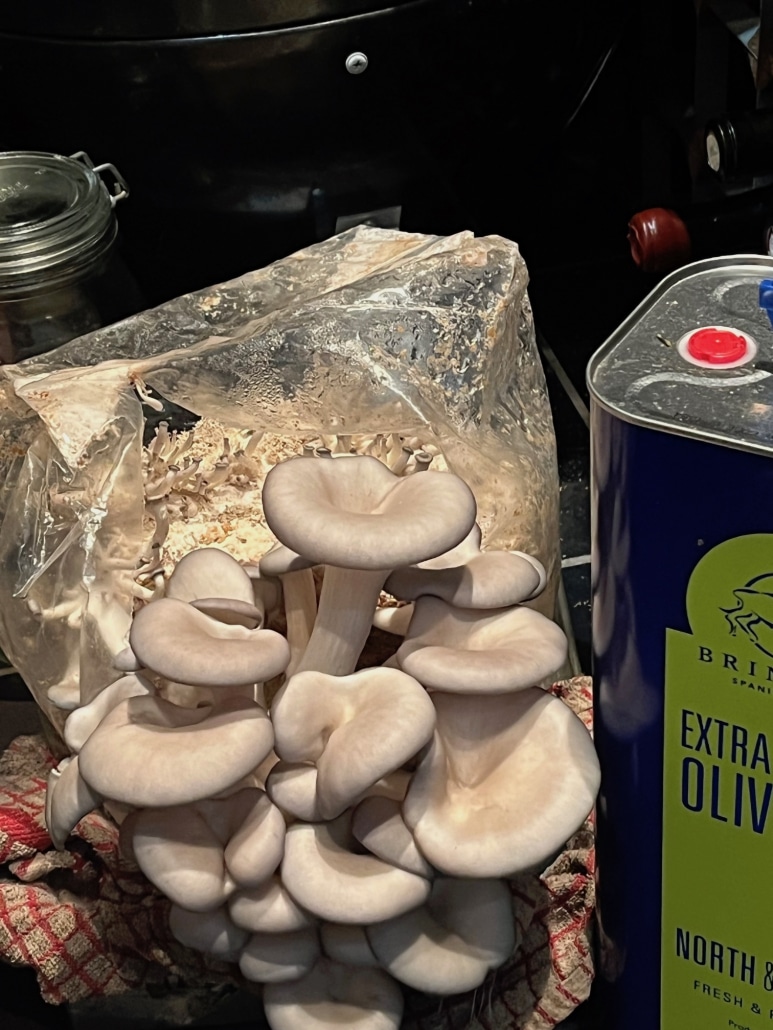
Mike kindly gave me a bag of coveted King Blues to take home. After a worryingly fallow period in the cellar they finally exploded into a glut this week (above). Polyspore’s signature earner is the oyster mushroom and its kin, but they are always experimenting. Look at the kaleidoscopic array of rivals – watercolour oysters, black king pearls and lion’s mane,

Mike pointed out an elm oyster they are trialling. Some of their mushrooms have been supplied to Balance Brewing and Blending who are currently brewing a mushroom beer. (What a pity the name ‘Breakfast of Champignons’ has already been used for an ale.) 

And it’s not just about culinary. The duo have been looking at reishi, a cortisone-reducing fungus that is important in Chinese medicine. You sense this is a labour of love, not just a commercial exercise. Still the duo plan to expand to three grow tents, so they can rotate them. All this is down to a recent £30,000 windfall that has pushed them towards a groundbreaking new project. They have secured this grant from Innovate UK, a government organisation that funds bio-technology. Step forward Dale Gee and his stable of stag beetles. Until this point in my life I didn’t realise how lucrative the beetles-as-pets markets could be. Not that that’s the driving force behind Dale’s move into an adjacent unit at Radium House.

The draw is that exploratory joint venture, full title Mushroom and Beetle Symbiosis for a Circular Economy. Essentially seeking to use beetles to break down substrate fibres into edible gourmet protein and fertiliser. It will take six months to set up this attempt to transform the current situation where industrial level mushroom producers find it difficult to biodegrade their core growing material. “Also with the food implications it could prove globally important,” Mike said. 

I told him I was ready to feast on grubs and crunchy crickets and had been thwarted by post-Brexit bureaucracy during a spring visit to Pembrokeshire’s ground-breaking Dr Benyon’s Bug Farm restaurant. Hard, though, on site at Radium House to consider as snacks the beautiful Obsidian Stag or Japanese Rhino beetles scuttling gingerly onto Dale’s fingers.

At home 10 days later, less challengingly, I slice my freshly harvested King Blues and sauté them with garlic and parsley before strewing them on a saffron, parmesan and and bone marrow rich risotto alla Milanese.

So what else can mycelium do for our planet?

I read in on learned report that “A fungal bio-mass equivalent to about 15 sheep lives under each football pitch sized piece of English permanent organic pasture. Thus, despite being microscopic, the biomass of mycelia in these grasslands matches and possibly outweighs that of animals.

“Some mycelia can be massive in both age and size. Perhaps the largest organism on earth is a 2,200-year-old Armillaria root-rot fungus that grows in 2,400 acres of forest soil in eastern Oregon—a veritable behemoth that periodically kills the forest, producing deep rich soil in which taller trees can grow before their turn comes to be felled by their fungal recycler. The biomass of these fungal networks is immense: several tonnes of mycelium can exist in one hectare of Swedish forests. Other fungi are tiny, such as the unicellular yeast, Saccharomyces cerevisiae, without whose help there would be no baking or brewing.”

It all feels very complex, like the allied concept of the World Wood Web, an underground ‘social’ network found in forests and other plant communities, created by the hyphae of mycorrhizal fungi joining with plant roots. This network connects individual plants together and transfers water, carbon, nitrogen, and other nutrients and minerals between participants.

A good introduction to this remarkable parallel universe underneath our feet is Merlin Sheldrake’s Entangled Life: How Fungi make our worlds, change our minds and shape our futures (The Bodley Head, £20). But the acknowledged fungi guru is Ohio’s Paul Stamets (above right). No shrinking violet, he sometimes sports a crown made by Transylvanian artisans from a spongey mushroom derivative called Amadou. 

In his 2005 gospel, Mycelium Running), he trumpets the capacity of mushrooms to clean up soil and rid land from various forms of pollution. The name for this is mycoremediation. Oil spills, even radioactive contamination – mycelium can tackle them, removing toxins and releasing the movement of nutrients and water through the soil.

On a local ecological level the Polyspore team have proposed their own Manchester clear-up projects, notably Highfield Country Park, a 70-acre area of open land bordering Levenshulme. Parts of it are seriously degraded after half a century of clay extraction, landfill, and as a site for dye and bleaching operations and a tripe factory. Could the insertion of mycelian mats help reclaim its health? 

Beware sweeping put-downs. “All border towns bring out the worst in people.” The words of Mexican detective Vargas, hero of Orson Welles’ classic film noir, A Touch of Evil, which is set (though not filmed there) in a widescreen approximation of Tijuana.

Shadowy, seedy, violent, borderline – movie stereotypes stick. Chuck in the country’s more recent reputation for drug cartels and organised crime along with Trump’s fixation on That Wall, 30ft prototypes of which are still in place near Tijuana, despite enterprising locals nicking the razor wire, and there’s a bad press to overcome.

Our intrepid band overcame it instantly on a glorious day trip to this capital of Baja (Lower) California state, which has so much in common with its richer Northern namesake. Not least the food. Which brings us to Caesar Salad.

Back in the 1920s Tijuana was called Satan’s Playground by American preachers aghast at their fellow countrymen fleeing Prohibition to have a Las Vegas style wild time just across the border. 

Caesar Cardini ran restaurants here and in San Diego, USA, 20 miles up the the road. On the Fourth of July 2024 a rush of customers depleted kitchen supplies in Tijuana, so Italian-born Caesar tossed together at table all the salad ingredients left. It was a hit, word spread and even Hollywood stars flew down regularly to order a ‘Caesar Salad’. I the crush the obligatory tableside service eased pressure on the kitchen.

Whether today’s recipe was there from the start I’m not sure, but a major pleasure of our visit to the historic Hotel Caesar’s on Avenida Revolucion was to watch our waiter stirring together lemon juice, garlic, olive oil, egg, Worcester Sauce, anchovies, Dijon mustard, Parmegiano and black pepper to enhance a simple green salad with croutons. 

Oh and they didn’t enhance it with strip of chicken. And some purists still question the necessity for anchovies with Worcester Sauce already in the emulsion. Some favour cup-style large leaves, messy finger food style; I’m happy with chopped. Whatever, it is pure theatre.

The great Julia Child recalled a childhood encounter: “My parents were so excited, eating this famous salad that was suddenly very chic. Caesar himself was a great big old fellow who stood right in front of us to make it. I remember the turning of the salad in the bowl was very dramatic. And egg in a salad was unheard of at that point.” 

These days it all seems very ‘heritage’ against the backdrop of Mexico’s fifth largest city with many poor districts that are less than charming. Compensations are some seriously authentic local dishes such as aguachile shrimp, spicy goat birria and breakfast snack chilaquiles.

All of which seem quite inappropriate as I prepare a swift autumnal lunch in a deluged Pennine mill town. So, store cupboard open, a batch of romaine from Aldi at the ready, Caesar Salad it is…

My chosen Caesar recipe is a hybrid from two versions in my quarter-of-a-century old Dean & DeLuca Cookbook (Ebury Press). The deli chain itself expanded way beyond its original New York base and came a financial cropper in recent years, but I still love the eclectic recipe roster in my faithful smudged kitchen companion.

Author David Rosengarten provides the classic version, minus anchovy fillets but he does parboil rather than leave the egg raw. Alongside he includes an alternative recipe with crispy walnuts replacing croutons and crumbled Roquefort instead of Parmegiano  shavings. I crave both cheeses, so straddled the middle ground. I also philistinely added a burrata and basil on the side. Sorry Caesar. At least I didn’t resort to a bottled dressing.

Ingredients 2 big heads of romaine or cos lettuce, 50ml olive oil, 350g garlic-rubbed croutons (I cheated with focaccia cubes), salt and pepper, curls of Parmegiano cheese. For the dressing: 4 anchovy fillets, no egg, 2tsp sherry vinegar, 2tsp lemon juice, 1tsp Worcestershire sauce, ½tsp dry mustard, 125ml extra-virgin olive oil and 125g Roquefort cheese.

Method Make the dressing by mashing the anchovies and garlic into a paste. Whisk together this paste with vinegar, lemon juice, Worcestershire sauce, mustard ad crumbled Roquefort in a small bowl. Add olive oil in a stream, further whisking the mix until is is emulsified. In a large bowl toss the lettuce chunks with the dressing. Fold in the croutons and liberally garnish with the Parmegiano curls.

While we await the eventual unveiling of a Manchester Town Hall fit for 21st century purpose we can welcome Exhibition bar/food hall, a more modest repurposing of a nearby building on Museum Street that is part of the rich heritage of the city centre. Just look at the glorious Art Nouveau facade of St George’s House, the dragon slayer celebrated by a terracotta version of Donatello’s sculpture. 

Once home to the YMCA, it was previously the site of the Peterloo Massacre and the city’s first Natural History Museum, whose most bizarre incumbent was Hannah Beswick, the ‘Manchester Mummy’, This wealthy 18th century woman with a pathological fear of premature burial asked for her body after death to be embalmed and kept above ground to be periodically checked for signs of life.

The signs of life at Exhibition are far more encouraging with the announcement of a wholly appealing trinity of independent food kitchens across its 6,000sqft space alongside two bars and dedicated exhibition spaces for local artists, all set to open this November. Its creators already run the coffee shop/wine bar Haunt in the building.

With all due respect, the arriving Osma, Caroline Martins and Baratxuri are in a different league. More enticing than the line-up at Society, down the road next to the Bridgewater Hall, or at the newly opened New Century Hall. A beer offering headed up by Manchester Union Lager suggests the 400 capacity venue also has the nearby Albert’s Schloss in its sights.

So what to expect foodwise from Exhibition?

Admission: I’ve never made it to the Scandi-influenced, Michelin Guide rated Osma in Prestwich despite glowing reports all round. Baratxuri, though has been on my regular radar ever since this Basque fire cookery fave sprang from big brother Levanter in Ramsbottom in 2015. It has since pushed its boundaries with city residencies at Escape to Freight Island and more recently at Kampus. The infectious, innovative skills of Brazilian Caroline Martins have been a more recent addition to Manchester’s foodscape. As the Great British Menu chef’s Sao Paulo Project pop-up nears its close at Blossom Street Social, Exhibition looks to offer a further showcase for some of the city’s most exotic ingredients.

• OSMA during the day will serve open sandwiches with fillings such as cured Scottish salmon, golden beetroots, spinach and mustard, or rump of beef with onion jam, rocket and parmesan, all alongside fresh salads and hearty soups. In the evening, there will be new small plates such as Avruga caviar pots with toasted brioche, a sashimi plate served with caper and shallot sauce, whole lobster (above) with herb butter or a dish of roasted and pickled beetroots with raspberry and rose.

• BARATXURI will offer sharing plates such as Capricho Oro’ Txuleton, a 1kg bone-in rib steak, from the Asado oven alongside fire-roasted short rib with crushed garlic chickpeas and pomegranate molasses salsa plus raciones of boquerones and Jamon Iberico de Bellota and an extensive range of pintxos at lunchtime. 

• THE SAO PAULO BISTRO promises a more relaxed spin on her Brazilian-British fusion with local suppliers at the heart of the new menu. Caroline will work closely with Platt Fields Market Garden, Dormouse Chocolates, Northern Cure, The Flat Baker and much more. Menu highlights include hand-dived scallops with creamy cassava sauce, Sao Paulo steak sandwich made with Lancashire ribeye and Garstang blue sauce, and a showstopper chocolate dessert using liquid nitrogen. My tip: don’t miss her Carlingford oyster with passion fruit sorbet.

The drinks offering also looks a winner. General manager Gethin Jones has masterminded spectacular cocktail offerings at the likes of Cottonopolis, Edinburgh Castle and Ducie Street Warehouse, while a a dedicated rotational line for Manchester breweries such as Sureshot, Cloudwater and Pomona sends out all the right signals. Topping that, the main bar will be the first in the city to offer Manchester Union straight from in-venue tanks. There’ll be wine on draught, too, with high quality Verdejo promised and by the bottle and glass an emphasis on low intervention wine.

After dark, Exhibition will transform into a late night bar with DJs, live singers and instrumentalists taking centre stage. Expect an eclectic mix of genres and a roster of local and international DJs, every Wednesday-Sunday. Seven dedicated areas will see a new local artist exhibiting their work every season.

Is it fanciful to judge chefs from the books on their restaurant shelves? Obviously there to make a statement. True, what they put on the plate is paramount, but any committed artist is in part the sum of their influences. Take the wondrous Moorcock Inn at Norland. Among some hefty cookbooks in the bar you’ll find the (out of print) eponymous cookbook of Kobe Desramaults. At his legendary Michelin-starred In de Wulf in Belgium he was once mentor to Moorcock chef/patron Alisdair Brooke-Taylor and the legacy shows.

Aspirational younger chefs are keen to display an inventory of their own inspirations. Just a couple of impressive examples I recall – Steven Halligan at Restaurant Metamorphica in Haslingden and Paul Sykes at Hyssop in Glossop. 

A shout-out for the latter restaurant which was gutted by fire recently. Paul and his partner Jess have launched a Crowdfunder “to help raise the funds to get us trading again, on a smaller scale, while the bigger project of rebuilding Hyssop starts.” Well worth supporting.

Newly crowned Manchester Chef of the Year Eddie Shepherd’s own book collection sits in his living room – as do we at one of his acclaimed Walled Gardens dining experiences along with eight other foodies. He calls it his ‘Underground Restaurant’ suggesting some Hobbit hole or a homage to the Beat Poets, but the bijou setting is in a Whalley Range housing development. To call it a ‘gated community’ would bely its charm. There is something otherworldly about it. His enclosed garden is home to the beehives and herbs that fuel his perception-challenging project. His home is his laboratory. The knives on the wall he forged himself, few domestic kitchens could host his cutting edge molecular gastronomical kit (a £10,000 electric homogeniser, anyone?) and the names on those book spines above our table … El Bulli, Noma, Alinea, El Celler de Can Roca. It’s a roll call of the runes of experimental cuisine. 

So how does self-taught Eddie, a philosophy graduate who found his kitchen calling by chance, fit into the lineage of Ferran Adrià, René Redzepi, Grant Achatz and the brothers Roca? 

Impossible to compare a solo suburban explorer like Eddie – let’s call him the Alchemist of Alexandra Park – against their beefed up brigades and well-stoked international hype. He is a one-off.

For starters let’s explore one of the 13 dishes in the £85 tasting menu he serves us across a Sunday afternoon of recurrent delights. A visual feast too. Made all the more enchanting by his modest refusal to detail at length the intricacies of preparation for each dish, though he was happy to answer questions from the exclusive gathering. For all the answers visit his exhaustive You Tube channel.

With BYOB the meal itself is an absolute steal. He’s been doing it here for six years, three long weekends a month and has no plans to open a conventional restaurant.

Cured mushrooms with vanilla and beetroot is a stand-out among stand-outs. He explained its gestation to my Manchester Confidential colleague, Davey Brett: “Eddie takes a mixture of mushrooms, thinly slices them, dehydrates them and soaks them in umami stock to rehydrate them, taking on the stock’s flavour. He then sets them in a block with an enzyme and this compressed block is cooked for two hours, cut into small pieces, smoked with oak, before finally being seasoned and marinated in oil.

“The whole process takes several days and concentrates a punnet’s worth of fungi into roughly two mouthfuls of cured mushrooms. It’s a ridiculously luxurious dish, but when you consider the steps and processes that go into a raw Wagyu steak or traditional cured meats, is it really that bonkers?”

It tastes as extraordinary as it sounds, coming after he has served us a lemon verbena and grapefruit G&T with his own gin and infused tonic and an ultra-instagrammable dandelion petal fruit pastille each. Soundtracked deliriously by REM’s Shiny Happy People. Northern Soul and Gomez also feature in Eddie’s eclectic playlist, which adds a surreal homely feel.

Next up is even more visual (see main image), his latest in a series of dishes investigating the culinary potential of blue algae. Yes, this miso is very blue, a light below exaggerating the effect as it cradles a cube of tofu garnished with pickled mushrooms. Another glowing (sic) report for the extraordinary range and subtlety of the plant-based palette of flavours.

The sole dairy presence comes with the only ugly course. Split open that black charcoal carapace and inside it is a rose and koji marinated halloumi. To accompany, a pot of rhubarb molasses. It’s a playful rejoinder to the bad old days of the grilled Cypriot cheese as token veggie dish on a menu.

Playful also sums up carrot charcuterie as a dead taste ringer for the real thing, topped with a show-stopping dehydrated carrot tuile. It is cultured with koji and cured with juniper and black pepper, and smoked before drying. Not necessarily all in order. I smudged my notepad.

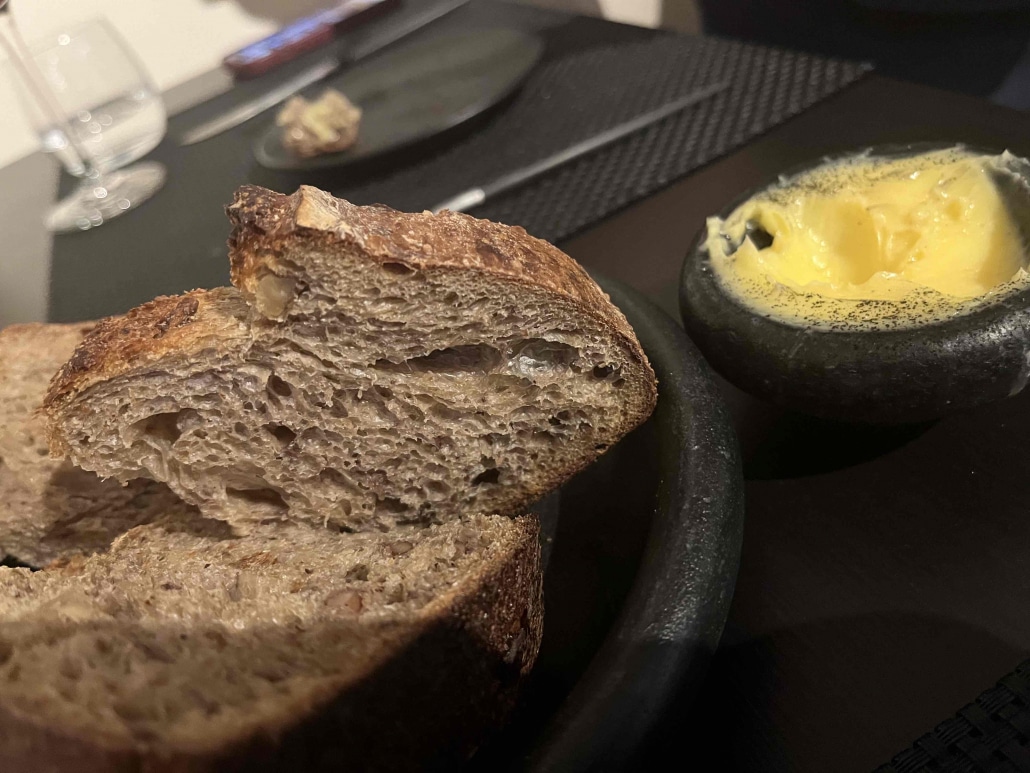
Superficially more conventional nettle soup, a fluffy aligot featuring potato, truffle and Blue Wensleydale and a glorious treacle and walnut bread provide ample comfort eating. Eddie bakes every day, but he admits none of his own cultured butter can match the bright yellow ‘Bungay’ he has set before us.

This is hand made in Suffolk by the folk behind Baron Bigod cheese using the same raw milk from their grass-fed Montbeliarde cattle. For my close encounter with this breed in their native Jura follow this link.

Another daily task in the Shepherd household is the preparation of proper tortillas, inspired by Eddie’s travels in Mexico. Most Gringos wouldn’t trouble to grind corn into masa to make their own. I’ve tried it in Tijuana once; it’s messy. You have to niximalise in an alkaline solution the corn (in this case heirloom olitillo blanco from Oaxaca), grind it to make fresh masa and then press and cook the tortillas fresh at service.

During this visit our host takes Mexican fave one authentic step further with his huitlacoche (pronounced whee-tla-KOH-cheh) topping – a direct link with the Aztecs, They prized this staple, thought to have more protein than than regular corn and high amounts of lysine, an essential amino acid.

Whatever its attributes huitlacoche – also known as corn smut, fungus or Mexican truffle – is essentially a plant disease that grows on ears of corn around the kernels in puffy, grey clouds. I looked all this up afterwards. A meal at the Walled Gardens is nothing if not thought provoking. The taste? Mushroomy, a hit of smoked chipotle, a dash of gooseberry salsa that works a treat. Gone in one. 

Puddings are equallly left-field obviously. Chamomie and Raspberry, Honey and Wildflowers (bees are his current passion along with knife construction), Pinecone Sorbet and finally another example of mind-blowing technique with a purpose. 

Scotch Bonnet Truffles are created by distilling the searingly hot chillies at low temperature in the rotary vacuum evaporator to capture their flavour but remove any spice and heat.

The resulting distillation is blended with double fermented Valrhona Itakuja chocolate to make the truffles. All the vivid aromas of the chillies without the burn. The dish is finished off with shards of fruit glass, in this instance made from passion fruit. I think. For more information on Eddie’s Youtube there’s a video and a printed recipe if you want to attempt it at home. I’d suggest instead you high-tail it down to the Walled Gardens. Eddie will soon be offering slots into 2023. What has been a hard booking to arrange probably got that little bit harder.

For a full list of winners at the Manchester Food and Drink Awards and my thoughts on the event visit this link.

Back to normal, post-pandemic? Well, not quite. Manchester’s food drink scene faces further unprecedented pressures with the current cost of living and energy crises. Yet the daring, innovative flame still burns bright and hell, do they all know how to party. My morning after lifesaver was the recuperative vibe of the city’s glorious new Mayfield Park.

That’s the ‘back garden’ of Escape to Freight Island, again the venue for the Manchester Food and Drink Awards, where there was a rapturous reception for a parade of independent heroes. As fascinating a set of winners as I can recall. Name me another UK city where the big four awards would have gone to such an eclectic quartet as Where The Light Gets In, Eddie (Walled Gardens) Shepherd, Another Hand and Speak In Code. 

These winners were chosen by a combination of a ‘mystery shopping panel’ selected from MFDF judges, including yours truly, with a measure of public input. Independent Food Producer and Independent Drinks Producer were judged by a panel taste test. The rest of the awards followed last year’s precedent and were solely the result of the (impressively large) public vote. 

Across the board there was evidence of a strong commitment to sustainability, local sourcing, cultural diversity and community values. Buzz words all but sometimes just talking the talk. Not here.

Take the aforementioned ‘big four’. Stockport’s Where The Light Gets In sources produce from The Landing, its own urban gardening space on top of the town’s Merseyway Shopping Centre. Eddie Shepherd is even more hyper-local; his plant-based ‘underground restaurant’ in Whalley Range is driven by the bee hives and herbs in his (walled) garden diners look out on.

In the city centre Another Hand is a committed purchaser of fruit, veg and herbs from Cheshire’s groundbreaking Cinderwood market garden, which supplies several of the establishments on the Awards shortlists. Vegan cocktail specialists Speak In Code, a four minute walk away from Another Hand, is remarkably hands-on. The bartending staff craft the various veg, fruit and spice-led cocktail concoctions alongside plant-based snacks and their own customised ice.

Finally a hugely deserved award cementing the resurgence of Stockport as a gastronomic destination. Restaurant of the Year WTLGI and its baked goods sibling, Yellowhammer, which was also up for an award, had to share the limelight with two of the North’s canniest events operators. I’ve known John and Rosemary Barratt for nigh on three decades and Foodie Fridays, packing the cobbled ginnels around Stockport Market Place, is their benchmark achievement. On the night it earned them both Pop Up/ Project of the Year and the coveted Outstanding Achievement Award. Their on-stage celebration, below, was a fitting climax to a special night.

Here is the list of this year’s winners…

Restaurant of the Year – Where The Light Gets In

Shortlisted: 10 Tib Lane, Erst, The Sparrows, Another Hand, Mana, The Firehouse, Where the Light Gets In.

Chef of the Year – Eddie Shepherd (The Walled Gardens)

Shortlisted: Caroline Martins (Sao Paulo Project), Joseph Otway (Flawd), Sam Buckley (Where the Light Gets In) Patrick Withington (Erst), Adam Reid (The French), Julian Pizer (Another Hand), Eddie Shepherd (The Walled Gardens).

Newcomer of the Year – Another Hand

Shortlisted: The Alan, The Black Friar, Bundobust Brewery, Flawd, Yellowhammer, 10 Tib Lane, Another Hand.

Bar of the Year – Speak In Code

Shortlisted: Blinker Bar, Flawd 9, Henry C, Ramona, Schofield’s Bar, 10 Tib Lane, Speak in Code.

Pub or Craft Ale Bar of the Year – The King’s Arms, Salford

Shortlisted:Bridge Beers, Heaton Hops, House of Hops, Nordie, Track Taproom, Station Hop, The King’s Arms (Salford),

Independent Food Producer of the Year – Dormouse Chocolates

Shortlisted: Great North Pie Co, Holy Grain, La Chouquette, Long Boi’s Bakehouse, Polyspore, Yellowhammer, Dormouse Chocolates.

Independent Drinks Producer of the Year – Hip Pop

Shortlisted: Cloudwater Brew Co, Into the Gathering Dusk, Bundobust Brewery, Stockport Gin, Steep Soda, Track Brewing, Hip Pop.

Pop Up/ Project of the Year – Foodie Fridays, Stockport

Shortlisted: Platt Fields Market Garden, Sao Paulo Project, Suppher, Eat Well Spring Festival, Bungalow at Kampus, Heart and Parcel, Foodie Fridays. 

Neighbourhood Venue of the Year – Bar San Juan, Chorlton

Shortlisted: Baratuxi, The Easy Fish Co, Nila’s Burmese Kitchen, Ornella’s Kitchen, Osma, The Perfect Match, Bar San Juan.

Food Trader of the Year – Burgerism

Shortlisted – House of Habesha, Little Lanka, Lovingly Artisan, Mira, New Wave Ramen, Pico’s Tacos, Burgerism.

Affordable Eats of the Year – Salt & Pepper MCR

Shortlisted: Aunty Ji’s, Bahn Mi Co Ba, Cafe Sanjuan, Levenshulme Bakery, Go Falafel, Mama Flo’s, Salt & Pepper MCR.

Coffee Shop of the Year – Pollen

Shortlisted: Cafe Sanjuan, Factory Coffee, Grind and Tamp, Grapefruit, Just Between Friends, Station South, Pollen

Plant-based Offering of the Year – Wholesome Junkies

Shortlisted: Four Side Pizza, Herbivorous, Otto Vegan Empire, Ruyi, Sanskruti, The Walled Gardens

Wholesome Junkies.

Food and Drink Retailer of the Year – Chorlton Cheesemongers

Shortlisted: Ad Hoc, Hello Oriental, Coopers Lets Fress Deli, Le Social, Out of the Blue, Wandering Palate, Chorlton Cheesemongers.

Foodie Neighbourhood of the Year – Ancoats

Shortlisted; Chapel Street Salford, Monton, Prestwich, Ramsbottom, Sale, Stockport, Ancoats.

Great Service Award – Dishoom

Shortlisted: Bull & Bear, Hawksmoor, Flawd, Schofield’s Bar, Speak in Code, 10 Tib Lane, Dishoom.

Howard and Ruth’s Outstanding Achievement Award – John and Rosemary Barratt (Foodie Fridays, Stockport)

The Manchester Food and Drink Festival, delayed for a week by the Period of National Mourning, continues until Sunday, October 2. Here is my lowdown.  Event images mostly courtesy of Carl Sukonik

And finally a plug for the 25 Eventful Years of The Manchester Food and Drink podcast, which I did with festival founder Phil Jones, top food PR Siobhan Hanley and the doyen of Blue Badge guides, Jonathan Schofield. It was a hoot. Listen here.

Though Samuel Pepys remains the diarist closest to my heart (with a dishonourable mention for the entertaining Alan Clark) it is Pepys’ Restoration contemporary, John Evelyn, to whom I consistently turn in penning my vignettes about food. Not so much to his Diaries proper but to his horticultural treatises. In my Quest for Cobnuts I invoked his Sylva (1664); while for Scorzonera it’s his Acteria: A Discourse of Sallets from five years later.

Many of those ‘sallets’ he grows in his stately country garden are salad stalwarts to this day – beetroots, spring onions, lettuces, radishes. His spellings may differ but artichaux and sparagus are no strangers to us either. Elsewhere there’s a strong interface between wild and cultivated, medicinal and culinary, and many plants mentioned (Jack o’ the Hedge, hogweed, seakale, wood sorrel, dock) are four centuries on now consigned to the forager’s domain.

That’s not the case with scorzonera – praised by Evelyn – and the inexorably yoked salsify. Not that it’s easy to buy either of these edible roots, distantly related, that are similar in appearance (long, thin, tapering) and taste (mild and sweet, a hint of oysters, some claim). Autumn is their season but they’re hardly a fixture in greengrocers or on the market. 

Three years ago Waitrose chose to stock Salsify, “both the black variety of the vegetable, grown in Cambridgeshire and Norfolk and a small amount of the white variety, grown in Ayrshire in Scotland.” The black variety is indeed scorzonera, the white the true salsify, though when both are peeled the flesh is ivory cream and must be instantly plunged into lemon water to prevent browning.

Whenever I locate either, usually from an enterprising organic grower, they’re caked in mud, making purchase a kind of Root Roulette.

Scorzonera has traditionally been reckoned the superior in taste. Evelyn’s Acteria entry is keen to stress its wellness attributes (it is indeed full of vitamins)  but he allows it place at the dining table: “Viper-graſs, Tragopogon, Scorzonera, Salſifex, &c. tho’ Medicinal, and excellent againſt the Palpitation of the Heart, Faintings, Obſtruction of the Bowels, &c. are beſides a very ſweet and pleaſant Sallet; being laid to ſoak out the bitterneſs, then peel’d, may be eaten raw, or Condited; but beſt of all ſtew’d with Marrow, Spice, Wine, &c. as Artichoak, Skirrets, &c. ſliced or whole. They likewiſe may bake, fry, or boil them; a more excellent Root there is hardly growing.

Scorzonera belongs to the Asteraceae family, a sibling of artichokes and Jerusalem artichokes. The best known species is the Scorzonera hispanica, native to southern Europe, known as winter asparagus, as it is harvested from October and throughout winter season. The plant has large green leaves and edible daisy-like yellow flowers. ‘Viper-gras’ refers to the legend that it was a cure for poisonous snake bites.

Salsify (Tragopogon porrifolius) boasts purple flowers and is a larger relative of the common wild plant, goat’s beard and share it hairy seed ‘clocks’. Domestic cultivation started in the 16th century in Italy and France, where it has always been more popular than in England. Until now when it has been take up by chefs such as Richard Corrigan, Simon Rogan and Michel Roux.

So what to do with these interchangeable rare treats? Boil, serve in wedges with lemon, or in fritters, tempura, puree, roasted or in  gratin (my favourite at home is baked in an earthenware pot, layered with oozing Ogleshield cheese), which doesn’t overwhelm the subtle root taste.

Still I bow to one of my favourite scholarly professional chefs, Jeremy Lee of Soho’s Quo Vadis for his superior salsify nibbles. Hugely pleased to meet him pre-Pandemic at Bistrotheque In Manchester’s Native Hotel, where he was guest chef, cooking a three-course homage to Elizabeth David. Jeremy blanches the salsify roots, smothers them in parmesan and butter before rolling them in in feuille de brick Tunisian pastry (sturdier than filo) and bakes until golden. It’s one of the sumptuous recipes in his recently published instant classic, Cooking, Simply and Well, For One or Many (4th Estate, £30), in which he devotes a whole chapter to salsify.

Ingredients: To serve 4-6 as a nibble: six sticks salsify, juice of one lemon, salt and pepper, 120g melted butter, 90g grated parmesan, three sheets of feuilles de brick pastry.

Method: Preheat the oven to 200C/gas mark 6. Wash the salsify. Peel swiftly and brush lightly with lemon juice. Bring a pan of water to the boil and salt lightly. Drop in the salsify and simmer until tender, around 12 to 15 minutes. Remove from the pan when cooked and cool.

Lay the feuilles de brick sheets on a surface, cut each in half so they are half-moon shapes, anoint with butter, liberally season with salt and pepper, and strew with parmesan. Lay the salsify along the flat side and roll very tightly towards the curved side. Lay the wrapped salsify upon a baking sheet. Brush with any remaining butter and bake for 12 minutes or until golden brown and interesting.

Lift carefully from the oven and remove to a board. To serve, cut into three or four pieces, adding a little more grated parmesan.

Grow your own

If this glorious celebration of under the radar roots makes you want to access them more easily follow Evelyn’s lead and grow your own. Sow the freshest seed possible in sandy soi,l either in autumn or spring. They can also be raised in pots and planted out in spring. Contrary to the last, salsify is a biennial plant, scorzonera a perennial. 

Up on an eighth floor rooftop with a leaden Manchester skyline all around I’m talking ‘terroir’ with Chris Laidler. He gives me Montagny; I raise him Mercurey. We both agree solidly on Macon in the search for affordable Burgundy wine regions. He confirms Domaine de la Romanée-Conti (average retail price price £25,000) won’t be on the 250-strong wine list planned for Climat, described by my esteemed and wine savvy oppo Kelly as “the most exciting opening on our horizon.” And who am I to disagree?

Still a cluttered ‘work in progress’ at the top of Bridgewater House when I popped up a couple of weeks ago, Chris’s £500,000 wine-friendly dream project, with equally stellar food, is expected to open mid-November. Across Blackfriars Street from where the Treehouse Hotel will sprout next year with a Mary-Ellen McTague helmed restaurant, which will provide a major shot in the arm for the Cathedral end of Deansgate. 

The old Renaissance Hotel that Treehouse will transform remains an eyesore, but the rest of the panorama is urban invigorating. Personal preference: I much prefer restaurant views from this height – Le Mont/Rabbit In The Moon, Manchester House – to 20 Stories.

Chris’s plan is to have 40 per cent of Climat’s list sourced from Burgundy – reds (Pinot Noir and Gamay), whites (Chardonnay, Aligoté) and some surprisingly sophisticated sparklers. Unlike at Chris’s Michelin-rated Covino in Chester, there will be an actual wine list on the website and maybe in print. Rather than scanning the range of enticing, price-tagged  bottles ranked in country order on a ledge up near the ceiling.

To check out the whole project’s credentials we made the pilgrimage to that cosy but cool wine bar on Northgate, the city’s foodie main drag. Think Porta (now extended into what was Joseph Benjamin), The Cheese Shop, Francis Thomas greengrocer’s, Jaunty Goat Coffee.

Covino’s chef Luke Richardson (in the main picture) has moved up to be exec chef across both sites and while Chris enthuses about wine, his forte is food sourcing. Maybe a recent foraging foray into beech sap tapping has yielded a scant bounty, but there’s quality guaranteed from his regular commercial suppliers – Cornwall’s Flying Fish, Growing @Field 28 from up the road in Daresbury and one of my personal faves, Swaledale Butchers in Skipton.

I didn’t ask, but presumed our hogget had come from there. Everything we tried from the reassuringly compact menu was a delight, but this t-bone of teenage lamb was sublime, paired with crisped komatsuna, that mustardy Japanese green and barbecued cucumbers (£16.50). It bookended a meal that began with the fleshiest of Ortiz sardines, spinkled with dried wild oregano flowers and doused in olive oil (£10) and a (very) special of pink cod crudo (£14.50) served with creme fraiche and tiny flavour bomb elderberries. “Hard labour to gather. but worth it,” lamented Luke, standing in front of house. A debutant fellow server, up from London, told me had been recruited for Manchester and was very excited.

There was a pollock’s head dish on the specials board but we chose to order their other take on that undervalued fish. Two taut fillets on a bed of kuri squash were given some punch by a chimichurri sauce (£15.50). For 50p more a roast whole quail was more satisfying, if a little challenging to dismember to its bloodied core.  

My cold rice pudding with sticky damson jam was challenging in that it was such  substntial dollop. The works though was the Valrhona chocolate ganache with plums, the tiny morsel I was allowed to taste from across the table. Each cost £7.50 on a bill that mounted up but felt value. After two glasses of properly dry German Riesling we spent £43 on a bottle of Olga Raffault Chinon Les Barnabes, my kind of go-to late summer red, earthy and smoky. Vinous temptations were all around, a foretaste of things to come in Manchester.

So what to expect from Climat?

Well, a 100 cover restaurant is a big leap upwards (literally) from Covino, which started life as a 300 sq ft wine bar/shop in 2016. It soon expanded, moving site in 2018 to set up on Northgate Street adding small plates to its menu. They were matched by over 130 bottles from around the world ranging from the classics to the funky naturals. Holder of a wine degree, Chris may lean towards classic Burgundies but his 250-strong Manchester list should also reflect mutating wine trends.

As we surveyed the cityscape from the ‘bioclimatic pergola’ (it’s a feature of the terrace, whose plants will service resident bees in four hives on the actual roof) Chris told me: “It’s great to get our foot in the door in Manchester. It represents a big step up for us. The site has so much to offer and we’re going to add something special to a great city. The space will be unique to others with its panoramic views and we can’t wait to share our progress during the build leading up to opening in autumn. Ultimately we want our guests to have a great dining experience and come and share our passion for really good food and drink.”

The addition of Climat caps the final stage of Bruntwood Works’ multi-million-pound renovation of its Blackfriars site. The 1920s-built edifice has been transformed to accommodate workspaces of varying sizes, an auditorium, podcasting studio, ground floor lounge area and coffee shop.

Ye the Climat site really stands out, primarily being constructed of metal and glass, with  limestone floor that yearns to suggest a North Burgundian ‘climat’. Like me, Chris is a Chablis lover and bemoans how global warming is diluting the flintiness of this most mineral of whites. Yes, you can tell I’m really gearing up for this particular Manchester arrival.

Climat, Blackfriars House St Marys, Parsonage, Manchester M3 2JA.

©2021-26 Copyright Neil Sowerby unless otherwise indicated. All right reserved.