It was the start of a voyage of discovery that took in cultivating my own King Blue mushrooms and encountering bizarrely beautiful beetles in a former iron foundry, the complexities of the World Wood Web and the future of insects as our planet’s food. Stockport was where the trail began…

No meal at Where The Light Gets In is complete without at least one mushroom dish. The newly crowned Manchester Food and Drink Awards Restaurant of the Year has been a key player in revitalising the town and trumpeting the use of local produce. So at a dinner there we tackled chef-patron Sam Buckley about the provenance of the fungi on the plate he’d just served us. 

His reply: “They grew in floorboard cracks beneath us.” WTLGI resides in an old mill, so plenty of growing matter there. Yet that wasn’t the answer we’d expected. We knew Sam’s team had kick-started the fungal phenomenon that is the Polyspore project by some creative outsourcing of pleurotus ostreatus (oyster mushroom to you).

After which word spread and demand for Polyspore’s products just, well, mushroomed. If Cinderwood Market Garden near Nantwich is key fruit and veg supplier to Manchester’s most savvy new eating places, these Altrincham-based specialists boast their own kitchen champions.

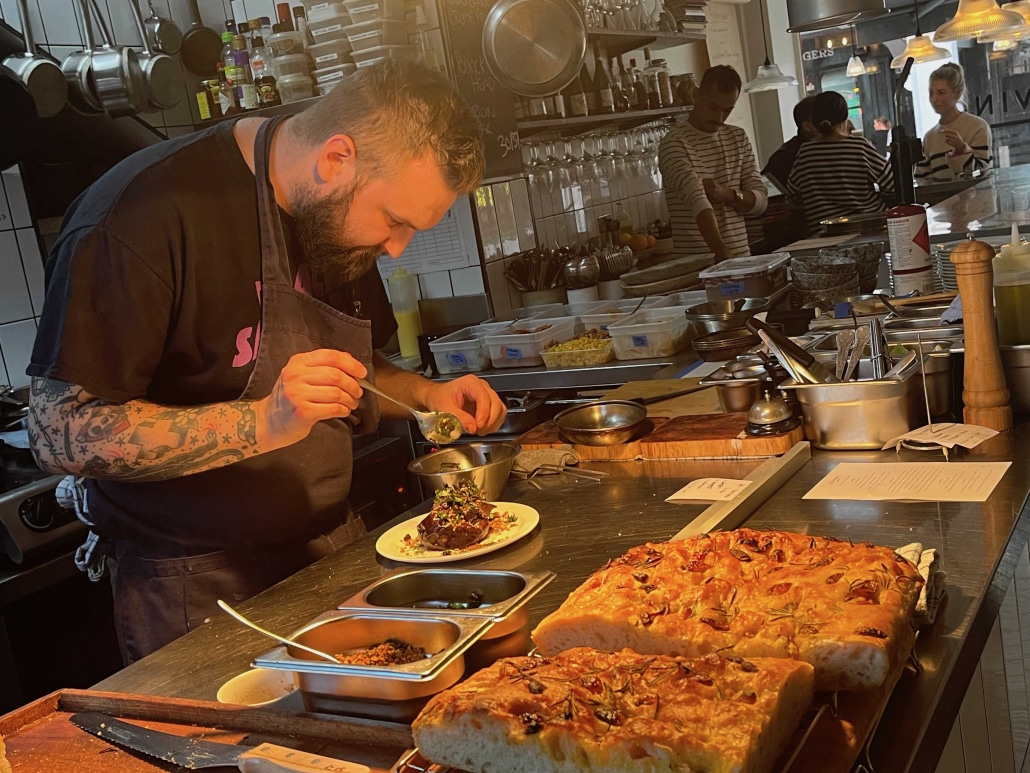
Check out the above treatment of seven different Polyspore fungi by Another Hand, MFDF Newcomer of the Year. They are lightly sautéed with buttered radicchio, then topped with an emulsion of 18 month fermented, unripened pine cone syrup and sherry vinegar plus hazelnuts and horseradish. Glorious food, made from the freshest of raw materials. They have to be. Polyspore is rated as a ‘prime food producer’, not a business, so aren’t allowed to dry or refrigerate the mushrooms. Hence it’s straight from harvesting to table inside 25 minutes.

It’s all an unlikely but heartwarming success story that began messily in a Fallowfield communal bathroom. Not much more than a year on from starting growing from scratch founders Mike Fothergill and Dylan Pybus were shortlisted for Indie Food Producer of the Year at those same MFDF Awards.

Time to catch up with them at their Radium House Unit 2 base, just a 10 minute walk from the Navigation Road Metrolink station. Except that Dylan was off poorly. His absence was compensated for by the presence of Dale Gee, beetle expert extraordinaire and co-pilot with the pair on an exciting new adventure. About which more anon.

How did it all start, Mike? “I’d been working at Port Street Beer House and Dylan was a chef. Both of us were made redundant during the COVID crisis and were desperate for a new direction. We were living in a damp, mouldy house in Fallowfield. Friends joked it was only for for growing mushrooms in. So eventually we did. Using the bath!”

But how did you get the knowledge? “Mostly via YouTube and some rednecks on the internet who will try to teach you anything. There’s always a close-knit community of mushroom growers always ready to assist. We learnt all about mycelium, this network of fungal threads or hyphae. They grow underground or in rotting tree trunks. The fruiting bodies of fungi, such as mushrooms, can sprout from a mycelium.”

Any teething troubles, Mike? “You bet. We soon discovered that if you’re not doing it in a lab with filtered air, it’s very difficult. You end up growing a lot of green mould and not many mushroom. A bath certainly wasn’t ideal. Sterilising everything became vital. I’d failed to complete a chemistry degree but that scientific background was important.”

The duo went up a level, tripling capacity, when they moved into their current home at Radium House, once an iron foundry, now divided into workshop units. Here is their 2m x 3m growing tent, fitted with an extractor fan and subdued lighting, which provide the perfect temperature, humidity and conditions in which to grow. 

They purchase liquid cultures of different mushroom species and, using a syringe, inoculate the cloned mycelium into a substrate mix of sustainable birch sawdust and soya bean hulls, rich in nitrogen to create the biomass perfect for fungi growth. This is wrapped in biodegradable bags. Allow a few days to germinate, cut open a flap and allow the mushrooms to fruit out into the fresh air within days.
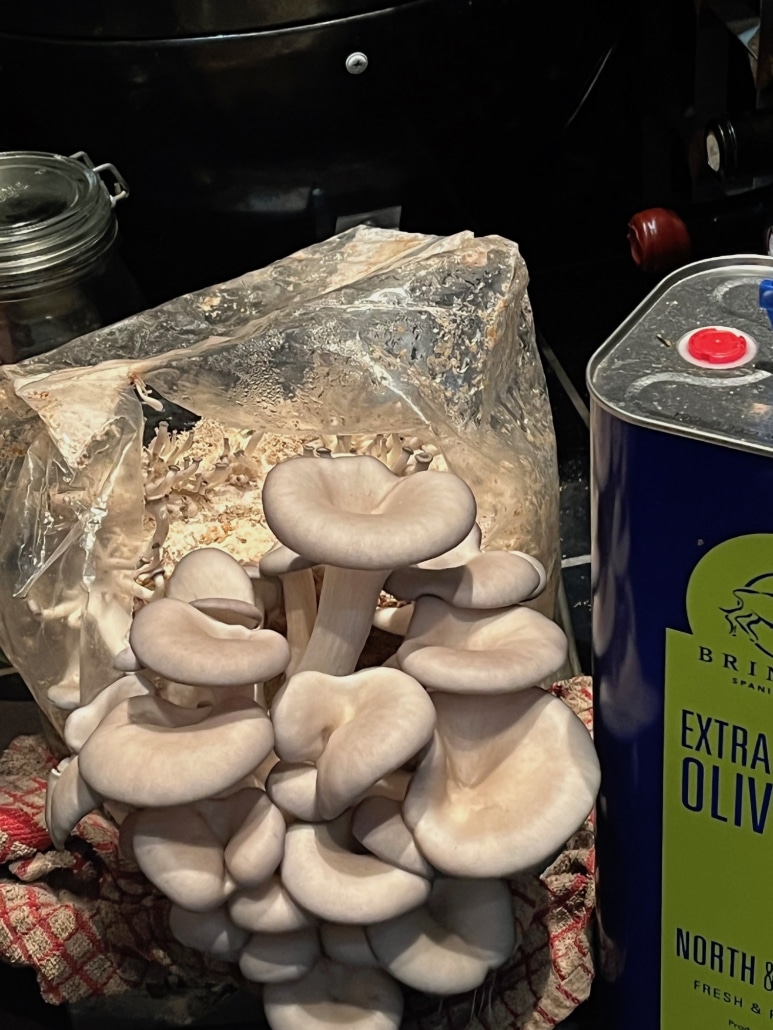
Mike kindly gave me a bag of coveted King Blues to take home. After a worryingly fallow period in the cellar they finally exploded into a glut this week (above). Polyspore’s signature earner is the oyster mushroom and its kin, but they are always experimenting. Look at the kaleidoscopic array of rivals – watercolour oysters, black king pearls and lion’s mane,

Mike pointed out an elm oyster they are trialling. Some of their mushrooms have been supplied to Balance Brewing and Blending who are currently brewing a mushroom beer. (What a pity the name ‘Breakfast of Champignons’ has already been used for an ale.) 

And it’s not just about culinary. The duo have been looking at reishi, a cortisone-reducing fungus that is important in Chinese medicine. You sense this is a labour of love, not just a commercial exercise. Still the duo plan to expand to three grow tents, so they can rotate them. All this is down to a recent £30,000 windfall that has pushed them towards a groundbreaking new project. They have secured this grant from Innovate UK, a government organisation that funds bio-technology. Step forward Dale Gee and his stable of stag beetles. Until this point in my life I didn’t realise how lucrative the beetles-as-pets markets could be. Not that that’s the driving force behind Dale’s move into an adjacent unit at Radium House.

The draw is that exploratory joint venture, full title Mushroom and Beetle Symbiosis for a Circular Economy. Essentially seeking to use beetles to break down substrate fibres into edible gourmet protein and fertiliser. It will take six months to set up this attempt to transform the current situation where industrial level mushroom producers find it difficult to biodegrade their core growing material. “Also with the food implications it could prove globally important,” Mike said. 

I told him I was ready to feast on grubs and crunchy crickets and had been thwarted by post-Brexit bureaucracy during a spring visit to Pembrokeshire’s ground-breaking Dr Benyon’s Bug Farm restaurant. Hard, though, on site at Radium House to consider as snacks the beautiful Obsidian Stag or Japanese Rhino beetles scuttling gingerly onto Dale’s fingers.

At home 10 days later, less challengingly, I slice my freshly harvested King Blues and sauté them with garlic and parsley before strewing them on a saffron, parmesan and and bone marrow rich risotto alla Milanese.

So what else can mycelium do for our planet?

I read in on learned report that “A fungal bio-mass equivalent to about 15 sheep lives under each football pitch sized piece of English permanent organic pasture. Thus, despite being microscopic, the biomass of mycelia in these grasslands matches and possibly outweighs that of animals.

“Some mycelia can be massive in both age and size. Perhaps the largest organism on earth is a 2,200-year-old Armillaria root-rot fungus that grows in 2,400 acres of forest soil in eastern Oregon—a veritable behemoth that periodically kills the forest, producing deep rich soil in which taller trees can grow before their turn comes to be felled by their fungal recycler. The biomass of these fungal networks is immense: several tonnes of mycelium can exist in one hectare of Swedish forests. Other fungi are tiny, such as the unicellular yeast, Saccharomyces cerevisiae, without whose help there would be no baking or brewing.”

It all feels very complex, like the allied concept of the World Wood Web, an underground ‘social’ network found in forests and other plant communities, created by the hyphae of mycorrhizal fungi joining with plant roots. This network connects individual plants together and transfers water, carbon, nitrogen, and other nutrients and minerals between participants.

A good introduction to this remarkable parallel universe underneath our feet is Merlin Sheldrake’s Entangled Life: How Fungi make our worlds, change our minds and shape our futures (The Bodley Head, £20). But the acknowledged fungi guru is Ohio’s Paul Stamets (above right). No shrinking violet, he sometimes sports a crown made by Transylvanian artisans from a spongey mushroom derivative called Amadou. 

In his 2005 gospel, Mycelium Running), he trumpets the capacity of mushrooms to clean up soil and rid land from various forms of pollution. The name for this is mycoremediation. Oil spills, even radioactive contamination – mycelium can tackle them, removing toxins and releasing the movement of nutrients and water through the soil.

On a local ecological level the Polyspore team have proposed their own Manchester clear-up projects, notably Highfield Country Park, a 70-acre area of open land bordering Levenshulme. Parts of it are seriously degraded after half a century of clay extraction, landfill, and as a site for dye and bleaching operations and a tripe factory. Could the insertion of mycelian mats help reclaim its health? 

Beware sweeping put-downs. “All border towns bring out the worst in people.” The words of Mexican detective Vargas, hero of Orson Welles’ classic film noir, A Touch of Evil, which is set (though not filmed there) in a widescreen approximation of Tijuana.

Shadowy, seedy, violent, borderline – movie stereotypes stick. Chuck in the country’s more recent reputation for drug cartels and organised crime along with Trump’s fixation on That Wall, 30ft prototypes of which are still in place near Tijuana, despite enterprising locals nicking the razor wire, and there’s a bad press to overcome.

Our intrepid band overcame it instantly on a glorious day trip to this capital of Baja (Lower) California state, which has so much in common with its richer Northern namesake. Not least the food. Which brings us to Caesar Salad.

Back in the 1920s Tijuana was called Satan’s Playground by American preachers aghast at their fellow countrymen fleeing Prohibition to have a Las Vegas style wild time just across the border. 

Caesar Cardini ran restaurants here and in San Diego, USA, 20 miles up the the road. On the Fourth of July 2024 a rush of customers depleted kitchen supplies in Tijuana, so Italian-born Caesar tossed together at table all the salad ingredients left. It was a hit, word spread and even Hollywood stars flew down regularly to order a ‘Caesar Salad’. I the crush the obligatory tableside service eased pressure on the kitchen.

Whether today’s recipe was there from the start I’m not sure, but a major pleasure of our visit to the historic Hotel Caesar’s on Avenida Revolucion was to watch our waiter stirring together lemon juice, garlic, olive oil, egg, Worcester Sauce, anchovies, Dijon mustard, Parmegiano and black pepper to enhance a simple green salad with croutons. 

Oh and they didn’t enhance it with strip of chicken. And some purists still question the necessity for anchovies with Worcester Sauce already in the emulsion. Some favour cup-style large leaves, messy finger food style; I’m happy with chopped. Whatever, it is pure theatre.

The great Julia Child recalled a childhood encounter: “My parents were so excited, eating this famous salad that was suddenly very chic. Caesar himself was a great big old fellow who stood right in front of us to make it. I remember the turning of the salad in the bowl was very dramatic. And egg in a salad was unheard of at that point.” 

These days it all seems very ‘heritage’ against the backdrop of Mexico’s fifth largest city with many poor districts that are less than charming. Compensations are some seriously authentic local dishes such as aguachile shrimp, spicy goat birria and breakfast snack chilaquiles.

All of which seem quite inappropriate as I prepare a swift autumnal lunch in a deluged Pennine mill town. So, store cupboard open, a batch of romaine from Aldi at the ready, Caesar Salad it is…

My chosen Caesar recipe is a hybrid from two versions in my quarter-of-a-century old Dean & DeLuca Cookbook (Ebury Press). The deli chain itself expanded way beyond its original New York base and came a financial cropper in recent years, but I still love the eclectic recipe roster in my faithful smudged kitchen companion.

Author David Rosengarten provides the classic version, minus anchovy fillets but he does parboil rather than leave the egg raw. Alongside he includes an alternative recipe with crispy walnuts replacing croutons and crumbled Roquefort instead of Parmegiano  shavings. I crave both cheeses, so straddled the middle ground. I also philistinely added a burrata and basil on the side. Sorry Caesar. At least I didn’t resort to a bottled dressing.

Ingredients 2 big heads of romaine or cos lettuce, 50ml olive oil, 350g garlic-rubbed croutons (I cheated with focaccia cubes), salt and pepper, curls of Parmegiano cheese. For the dressing: 4 anchovy fillets, no egg, 2tsp sherry vinegar, 2tsp lemon juice, 1tsp Worcestershire sauce, ½tsp dry mustard, 125ml extra-virgin olive oil and 125g Roquefort cheese.

Method Make the dressing by mashing the anchovies and garlic into a paste. Whisk together this paste with vinegar, lemon juice, Worcestershire sauce, mustard ad crumbled Roquefort in a small bowl. Add olive oil in a stream, further whisking the mix until is is emulsified. In a large bowl toss the lettuce chunks with the dressing. Fold in the croutons and liberally garnish with the Parmegiano curls.

While we await the eventual unveiling of a Manchester Town Hall fit for 21st century purpose we can welcome Exhibition bar/food hall, a more modest repurposing of a nearby building on Museum Street that is part of the rich heritage of the city centre. Just look at the glorious Art Nouveau facade of St George’s House, the dragon slayer celebrated by a terracotta version of Donatello’s sculpture. 

Once home to the YMCA, it was previously the site of the Peterloo Massacre and the city’s first Natural History Museum, whose most bizarre incumbent was Hannah Beswick, the ‘Manchester Mummy’, This wealthy 18th century woman with a pathological fear of premature burial asked for her body after death to be embalmed and kept above ground to be periodically checked for signs of life.

The signs of life at Exhibition are far more encouraging with the announcement of a wholly appealing trinity of independent food kitchens across its 6,000sqft space alongside two bars and dedicated exhibition spaces for local artists, all set to open this November. Its creators already run the coffee shop/wine bar Haunt in the building.

With all due respect, the arriving Osma, Caroline Martins and Baratxuri are in a different league. More enticing than the line-up at Society, down the road next to the Bridgewater Hall, or at the newly opened New Century Hall. A beer offering headed up by Manchester Union Lager suggests the 400 capacity venue also has the nearby Albert’s Schloss in its sights.

So what to expect foodwise from Exhibition?

Admission: I’ve never made it to the Scandi-influenced, Michelin Guide rated Osma in Prestwich despite glowing reports all round. Baratxuri, though has been on my regular radar ever since this Basque fire cookery fave sprang from big brother Levanter in Ramsbottom in 2015. It has since pushed its boundaries with city residencies at Escape to Freight Island and more recently at Kampus. The infectious, innovative skills of Brazilian Caroline Martins have been a more recent addition to Manchester’s foodscape. As the Great British Menu chef’s Sao Paulo Project pop-up nears its close at Blossom Street Social, Exhibition looks to offer a further showcase for some of the city’s most exotic ingredients.

OSMA during the day will serve open sandwiches with fillings such as cured Scottish salmon, golden beetroots, spinach and mustard, or rump of beef with onion jam, rocket and parmesan, all alongside fresh salads and hearty soups. In the evening, there will be new small plates such as Avruga caviar pots with toasted brioche, a sashimi plate served with caper and shallot sauce, whole lobster (above) with herb butter or a dish of roasted and pickled beetroots with raspberry and rose.

BARATXURI will offer sharing plates such as Capricho Oro’ Txuleton, a 1kg bone-in rib steak, from the Asado oven alongside fire-roasted short rib with crushed garlic chickpeas and pomegranate molasses salsa plus raciones of boquerones and Jamon Iberico de Bellota and an extensive range of pintxos at lunchtime. 

THE SAO PAULO BISTRO promises a more relaxed spin on her Brazilian-British fusion with local suppliers at the heart of the new menu. Caroline will work closely with Platt Fields Market Garden, Dormouse Chocolates, Northern Cure, The Flat Baker and much more. Menu highlights include hand-dived scallops with creamy cassava sauce, Sao Paulo steak sandwich made with Lancashire ribeye and Garstang blue sauce, and a showstopper chocolate dessert using liquid nitrogen. My tip: don’t miss her Carlingford oyster with passion fruit sorbet.

The drinks offering also looks a winner. General manager Gethin Jones has masterminded spectacular cocktail offerings at the likes of Cottonopolis, Edinburgh Castle and Ducie Street Warehouse, while a a dedicated rotational line for Manchester breweries such as Sureshot, Cloudwater and Pomona sends out all the right signals. Topping that, the main bar will be the first in the city to offer Manchester Union straight from in-venue tanks. There’ll be wine on draught, too, with high quality Verdejo promised and by the bottle and glass an emphasis on low intervention wine.

After dark, Exhibition will transform into a late night bar with DJs, live singers and instrumentalists taking centre stage. Expect an eclectic mix of genres and a roster of local and international DJs, every Wednesday-Sunday. Seven dedicated areas will see a new local artist exhibiting their work every season.

Is it fanciful to judge chefs from the books on their restaurant shelves? Obviously there to make a statement. True, what they put on the plate is paramount, but any committed artist is in part the sum of their influences. Take the wondrous Moorcock Inn at Norland. Among some hefty cookbooks in the bar you’ll find the (out of print) eponymous cookbook of Kobe Desramaults. At his legendary Michelin-starred In de Wulf in Belgium he was once mentor to Moorcock chef/patron Alisdair Brooke-Taylor and the legacy shows.

Aspirational younger chefs are keen to display an inventory of their own inspirations. Just a couple of impressive examples I recall – Steven Halligan at Restaurant Metamorphica in Haslingden and Paul Sykes at Hyssop in Glossop. 

A shout-out for the latter restaurant which was gutted by fire recently. Paul and his partner Jess have launched a Crowdfunder “to help raise the funds to get us trading again, on a smaller scale, while the bigger project of rebuilding Hyssop starts.” Well worth supporting.

Newly crowned Manchester Chef of the Year Eddie Shepherd’s own book collection sits in his living room – as do we at one of his acclaimed Walled Gardens dining experiences along with eight other foodies. He calls it his ‘Underground Restaurant’ suggesting some Hobbit hole or a homage to the Beat Poets, but the bijou setting is in a Whalley Range housing development. To call it a ‘gated community’ would bely its charm. There is something otherworldly about it. His enclosed garden is home to the beehives and herbs that fuel his perception-challenging project. His home is his laboratory. The knives on the wall he forged himself, few domestic kitchens could host his cutting edge molecular gastronomical kit (a £10,000 electric homogeniser, anyone?) and the names on those book spines above our table … El Bulli, Noma, Alinea, El Celler de Can Roca. It’s a roll call of the runes of experimental cuisine. 

So how does self-taught Eddie, a philosophy graduate who found his kitchen calling by chance, fit into the lineage of Ferran Adrià, René Redzepi, Grant Achatz and the brothers Roca? 

Impossible to compare a solo suburban explorer like Eddie – let’s call him the Alchemist of Alexandra Park – against their beefed up brigades and well-stoked international hype. He is a one-off.

For starters let’s explore one of the 13 dishes in the £85 tasting menu he serves us across a Sunday afternoon of recurrent delights. A visual feast too. Made all the more enchanting by his modest refusal to detail at length the intricacies of preparation for each dish, though he was happy to answer questions from the exclusive gathering. For all the answers visit his exhaustive You Tube channel.

With BYOB the meal itself is an absolute steal. He’s been doing it here for six years, three long weekends a month and has no plans to open a conventional restaurant.

Cured mushrooms with vanilla and beetroot is a stand-out among stand-outs. He explained its gestation to my Manchester Confidential colleague, Davey Brett: “Eddie takes a mixture of mushrooms, thinly slices them, dehydrates them and soaks them in umami stock to rehydrate them, taking on the stock’s flavour. He then sets them in a block with an enzyme and this compressed block is cooked for two hours, cut into small pieces, smoked with oak, before finally being seasoned and marinated in oil.

“The whole process takes several days and concentrates a punnet’s worth of fungi into roughly two mouthfuls of cured mushrooms. It’s a ridiculously luxurious dish, but when you consider the steps and processes that go into a raw Wagyu steak or traditional cured meats, is it really that bonkers?”

It tastes as extraordinary as it sounds, coming after he has served us a lemon verbena and grapefruit G&T with his own gin and infused tonic and an ultra-instagrammable dandelion petal fruit pastille each. Soundtracked deliriously by REM’s Shiny Happy People. Northern Soul and Gomez also feature in Eddie’s eclectic playlist, which adds a surreal homely feel.

Next up is even more visual (see main image), his latest in a series of dishes investigating the culinary potential of blue algae. Yes, this miso is very blue, a light below exaggerating the effect as it cradles a cube of tofu garnished with pickled mushrooms. Another glowing (sic) report for the extraordinary range and subtlety of the plant-based palette of flavours.

The sole dairy presence comes with the only ugly course. Split open that black charcoal carapace and inside it is a rose and koji marinated halloumi. To accompany, a pot of rhubarb molasses. It’s a playful rejoinder to the bad old days of the grilled Cypriot cheese as token veggie dish on a menu.

Playful also sums up carrot charcuterie as a dead taste ringer for the real thing, topped with a show-stopping dehydrated carrot tuile. It is cultured with koji and cured with juniper and black pepper, and smoked before drying. Not necessarily all in order. I smudged my notepad.

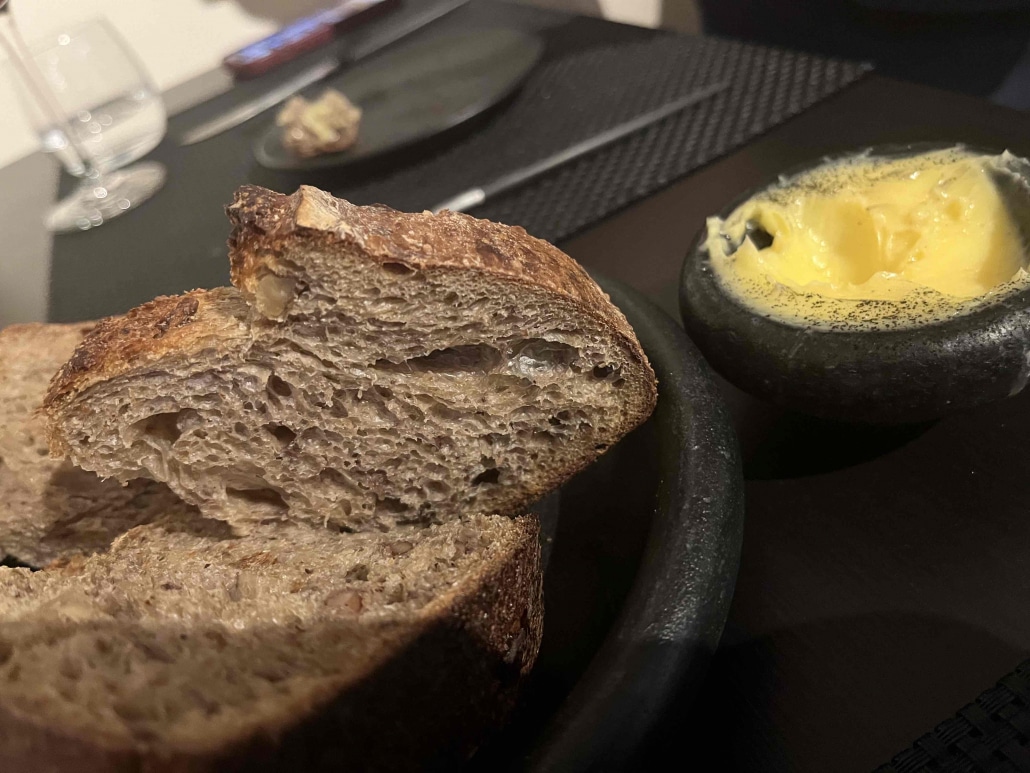
Superficially more conventional nettle soup, a fluffy aligot featuring potato, truffle and Blue Wensleydale and a glorious treacle and walnut bread provide ample comfort eating. Eddie bakes every day, but he admits none of his own cultured butter can match the bright yellow ‘Bungay’ he has set before us.

This is hand made in Suffolk by the folk behind Baron Bigod cheese using the same raw milk from their grass-fed Montbeliarde cattle. For my close encounter with this breed in their native Jura follow this link.

Another daily task in the Shepherd household is the preparation of proper tortillas, inspired by Eddie’s travels in Mexico. Most Gringos wouldn’t trouble to grind corn into masa to make their own. I’ve tried it in Tijuana once; it’s messy. You have to niximalise in an alkaline solution the corn (in this case heirloom olitillo blanco from Oaxaca), grind it to make fresh masa and then press and cook the tortillas fresh at service.

During this visit our host takes Mexican fave one authentic step further with his huitlacoche (pronounced whee-tla-KOH-cheh) topping – a direct link with the Aztecs, They prized this staple, thought to have more protein than than regular corn and high amounts of lysine, an essential amino acid.

Whatever its attributes huitlacoche – also known as corn smut, fungus or Mexican truffle – is essentially a plant disease that grows on ears of corn around the kernels in puffy, grey clouds. I looked all this up afterwards. A meal at the Walled Gardens is nothing if not thought provoking. The taste? Mushroomy, a hit of smoked chipotle, a dash of gooseberry salsa that works a treat. Gone in one. 

Puddings are equallly left-field obviously. Chamomie and Raspberry, Honey and Wildflowers (bees are his current passion along with knife construction), Pinecone Sorbet and finally another example of mind-blowing technique with a purpose. 

Scotch Bonnet Truffles are created by distilling the searingly hot chillies at low temperature in the rotary vacuum evaporator to capture their flavour but remove any spice and heat.

The resulting distillation is blended with double fermented Valrhona Itakuja chocolate to make the truffles. All the vivid aromas of the chillies without the burn. The dish is finished off with shards of fruit glass, in this instance made from passion fruit. I think. For more information on Eddie’s Youtube there’s a video and a printed recipe if you want to attempt it at home. I’d suggest instead you high-tail it down to the Walled Gardens. Eddie will soon be offering slots into 2023. What has been a hard booking to arrange probably got that little bit harder.

For a full list of winners at the Manchester Food and Drink Awards and my thoughts on the event visit this link.

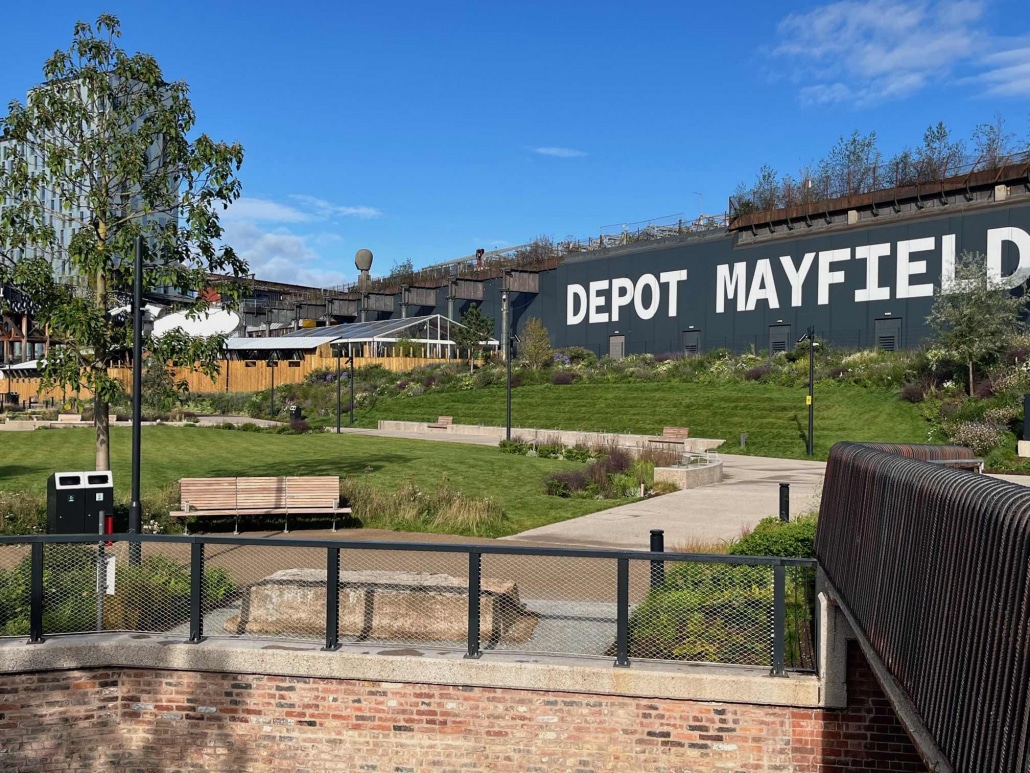
Back to normal, post-pandemic? Well, not quite. Manchester’s food drink scene faces further unprecedented pressures with the current cost of living and energy crises. Yet the daring, innovative flame still burns bright and hell, do they all know how to party. My morning after lifesaver was the recuperative vibe of the city’s glorious new Mayfield Park.

That’s the ‘back garden’ of Escape to Freight Island, again the venue for the Manchester Food and Drink Awards, where there was a rapturous reception for a parade of independent heroes. As fascinating a set of winners as I can recall. Name me another UK city where the big four awards would have gone to such an eclectic quartet as Where The Light Gets In, Eddie (Walled Gardens) Shepherd, Another Hand and Speak In Code. 

These winners were chosen by a combination of a ‘mystery shopping panel’ selected from MFDF judges, including yours truly, with a measure of public input. Independent Food Producer and Independent Drinks Producer were judged by a panel taste test. The rest of the awards followed last year’s precedent and were solely the result of the (impressively large) public vote. 

Across the board there was evidence of a strong commitment to sustainability, local sourcing, cultural diversity and community values. Buzz words all but sometimes just talking the talk. Not here.

Take the aforementioned ‘big four’. Stockport’s Where The Light Gets In sources produce from The Landing, its own urban gardening space on top of the town’s Merseyway Shopping Centre. Eddie Shepherd is even more hyper-local; his plant-based ‘underground restaurant’ in Whalley Range is driven by the bee hives and herbs in his (walled) garden diners look out on.

In the city centre Another Hand is a committed purchaser of fruit, veg and herbs from Cheshire’s groundbreaking Cinderwood market garden, which supplies several of the establishments on the Awards shortlists. Vegan cocktail specialists Speak In Code, a four minute walk away from Another Hand, is remarkably hands-on. The bartending staff craft the various veg, fruit and spice-led cocktail concoctions alongside plant-based snacks and their own customised ice.

Finally a hugely deserved award cementing the resurgence of Stockport as a gastronomic destination. Restaurant of the Year WTLGI and its baked goods sibling, Yellowhammer, which was also up for an award, had to share the limelight with two of the North’s canniest events operators. I’ve known John and Rosemary Barratt for nigh on three decades and Foodie Fridays, packing the cobbled ginnels around Stockport Market Place, is their benchmark achievement. On the night it earned them both Pop Up/ Project of the Year and the coveted Outstanding Achievement Award. Their on-stage celebration, below, was a fitting climax to a special night.

Here is the list of this year’s winners…

Restaurant of the Year – Where The Light Gets In

Shortlisted: 10 Tib Lane, Erst, The Sparrows, Another Hand, Mana, The Firehouse, Where the Light Gets In.

Chef of the Year – Eddie Shepherd (The Walled Gardens)

Shortlisted: Caroline Martins (Sao Paulo Project), Joseph Otway (Flawd), Sam Buckley (Where the Light Gets In) Patrick Withington (Erst), Adam Reid (The French), Julian Pizer (Another Hand), Eddie Shepherd (The Walled Gardens).

Newcomer of the Year – Another Hand

Shortlisted: The Alan, The Black Friar, Bundobust Brewery, Flawd, Yellowhammer, 10 Tib Lane, Another Hand.

Bar of the Year – Speak In Code

Shortlisted: Blinker Bar, Flawd 9, Henry C, Ramona, Schofield’s Bar, 10 Tib Lane, Speak in Code.

Pub or Craft Ale Bar of the Year – The King’s Arms, Salford

Shortlisted:Bridge Beers, Heaton Hops, House of Hops, Nordie, Track Taproom, Station Hop, The King’s Arms (Salford),

Independent Food Producer of the Year – Dormouse Chocolates

Shortlisted: Great North Pie Co, Holy Grain, La Chouquette, Long Boi’s Bakehouse, Polyspore, Yellowhammer, Dormouse Chocolates.

Independent Drinks Producer of the Year – Hip Pop

Shortlisted: Cloudwater Brew Co, Into the Gathering Dusk, Bundobust Brewery, Stockport Gin, Steep Soda, Track Brewing, Hip Pop.

Pop Up/ Project of the Year – Foodie Fridays, Stockport

Shortlisted: Platt Fields Market Garden, Sao Paulo Project, Suppher, Eat Well Spring Festival, Bungalow at Kampus, Heart and Parcel, Foodie Fridays. 

Neighbourhood Venue of the Year – Bar San Juan, Chorlton

Shortlisted: Baratuxi, The Easy Fish Co, Nila’s Burmese Kitchen, Ornella’s Kitchen, Osma, The Perfect Match, Bar San Juan.

Food Trader of the Year – Burgerism

Shortlisted – House of Habesha, Little Lanka, Lovingly Artisan, Mira, New Wave Ramen, Pico’s Tacos, Burgerism.

Affordable Eats of the Year – Salt & Pepper MCR

Shortlisted: Aunty Ji’s, Bahn Mi Co Ba, Cafe Sanjuan, Levenshulme Bakery, Go Falafel, Mama Flo’s, Salt & Pepper MCR.

Coffee Shop of the Year – Pollen

Shortlisted: Cafe Sanjuan, Factory Coffee, Grind and Tamp, Grapefruit, Just Between Friends, Station South, Pollen

Plant-based Offering of the Year – Wholesome Junkies

Shortlisted: Four Side Pizza, Herbivorous, Otto Vegan Empire, Ruyi, Sanskruti, The Walled Gardens

Wholesome Junkies.

Food and Drink Retailer of the Year – Chorlton Cheesemongers

Shortlisted: Ad Hoc, Hello Oriental, Coopers Lets Fress Deli, Le Social, Out of the Blue, Wandering Palate, Chorlton Cheesemongers.

Foodie Neighbourhood of the Year – Ancoats

Shortlisted; Chapel Street Salford, Monton, Prestwich, Ramsbottom, Sale, Stockport, Ancoats.

Great Service Award – Dishoom

Shortlisted: Bull & Bear, Hawksmoor, Flawd, Schofield’s Bar, Speak in Code, 10 Tib Lane, Dishoom.

Howard and Ruth’s Outstanding Achievement Award – John and Rosemary Barratt (Foodie Fridays, Stockport)

The Manchester Food and Drink Festival, delayed for a week by the Period of National Mourning, continues until Sunday, October 2. Here is my lowdown.  Event images mostly courtesy of Carl Sukonik

And finally a plug for the 25 Eventful Years of The Manchester Food and Drink podcast, which I did with festival founder Phil Jones, top food PR Siobhan Hanley and the doyen of Blue Badge guides, Jonathan Schofield. It was a hoot. Listen here.

Though Samuel Pepys remains the diarist closest to my heart (with a dishonourable mention for the entertaining Alan Clark) it is Pepys’ Restoration contemporary, John Evelyn, to whom I consistently turn in penning my vignettes about food. Not so much to his Diaries proper but to his horticultural treatises. In my Quest for Cobnuts I invoked his Sylva (1664); while for Scorzonera it’s his Acteria: A Discourse of Sallets from five years later.

Many of those ‘sallets’ he grows in his stately country garden are salad stalwarts to this day – beetroots, spring onions, lettuces, radishes. His spellings may differ but artichaux and sparagus are no strangers to us either. Elsewhere there’s a strong interface between wild and cultivated, medicinal and culinary, and many plants mentioned (Jack o’ the Hedge, hogweed, seakale, wood sorrel, dock) are four centuries on now consigned to the forager’s domain.

That’s not the case with scorzonera – praised by Evelyn – and the inexorably yoked salsify. Not that it’s easy to buy either of these edible roots, distantly related, that are similar in appearance (long, thin, tapering) and taste (mild and sweet, a hint of oysters, some claim). Autumn is their season but they’re hardly a fixture in greengrocers or on the market. 

Three years ago Waitrose chose to stock Salsify, “both the black variety of the vegetable, grown in Cambridgeshire and Norfolk and a small amount of the white variety, grown in Ayrshire in Scotland.” The black variety is indeed scorzonera, the white the true salsify, though when both are peeled the flesh is ivory cream and must be instantly plunged into lemon water to prevent browning.

Whenever I locate either, usually from an enterprising organic grower, they’re caked in mud, making purchase a kind of Root Roulette.

Scorzonera has traditionally been reckoned the superior in taste. Evelyn’s Acteria entry is keen to stress its wellness attributes (it is indeed full of vitamins)  but he allows it place at the dining table: “Viper-graſs, Tragopogon, Scorzonera, Salſifex, &c. tho’ Medicinal, and excellent againſt the Palpitation of the Heart, Faintings, Obſtruction of the Bowels, &c. are beſides a very ſweet and pleaſant Sallet; being laid to ſoak out the bitterneſs, then peel’d, may be eaten raw, or Condited; but beſt of all ſtew’d with Marrow, Spice, Wine, &c. as Artichoak, Skirrets, &c. ſliced or whole. They likewiſe may bake, fry, or boil them; a more excellent Root there is hardly growing.

Scorzonera belongs to the Asteraceae family, a sibling of artichokes and Jerusalem artichokes. The best known species is the Scorzonera hispanica, native to southern Europe, known as winter asparagus, as it is harvested from October and throughout winter season. The plant has large green leaves and edible daisy-like yellow flowers. ‘Viper-gras’ refers to the legend that it was a cure for poisonous snake bites.

Salsify (Tragopogon porrifolius) boasts purple flowers and is a larger relative of the common wild plant, goat’s beard and share it hairy seed ‘clocks’. Domestic cultivation started in the 16th century in Italy and France, where it has always been more popular than in England. Until now when it has been take up by chefs such as Richard Corrigan, Simon Rogan and Michel Roux.

So what to do with these interchangeable rare treats? Boil, serve in wedges with lemon, or in fritters, tempura, puree, roasted or in  gratin (my favourite at home is baked in an earthenware pot, layered with oozing Ogleshield cheese), which doesn’t overwhelm the subtle root taste.

Still I bow to one of my favourite scholarly professional chefs, Jeremy Lee of Soho’s Quo Vadis for his superior salsify nibbles. Hugely pleased to meet him pre-Pandemic at Bistrotheque In Manchester’s Native Hotel, where he was guest chef, cooking a three-course homage to Elizabeth David. Jeremy blanches the salsify roots, smothers them in parmesan and butter before rolling them in in feuille de brick Tunisian pastry (sturdier than filo) and bakes until golden. It’s one of the sumptuous recipes in his recently published instant classic, Cooking, Simply and Well, For One or Many (4th Estate, £30), in which he devotes a whole chapter to salsify.

Ingredients: To serve 4-6 as a nibble: six sticks salsify, juice of one lemon, salt and pepper, 120g melted butter, 90g grated parmesan, three sheets of feuilles de brick pastry.

Method: Preheat the oven to 200C/gas mark 6. Wash the salsify. Peel swiftly and brush lightly with lemon juice. Bring a pan of water to the boil and salt lightly. Drop in the salsify and simmer until tender, around 12 to 15 minutes. Remove from the pan when cooked and cool.

Lay the feuilles de brick sheets on a surface, cut each in half so they are half-moon shapes, anoint with butter, liberally season with salt and pepper, and strew with parmesan. Lay the salsify along the flat side and roll very tightly towards the curved side. Lay the wrapped salsify upon a baking sheet. Brush with any remaining butter and bake for 12 minutes or until golden brown and interesting.

Lift carefully from the oven and remove to a board. To serve, cut into three or four pieces, adding a little more grated parmesan.

Grow your own

If this glorious celebration of under the radar roots makes you want to access them more easily follow Evelyn’s lead and grow your own. Sow the freshest seed possible in sandy soi,l either in autumn or spring. They can also be raised in pots and planted out in spring. Contrary to the last, salsify is a biennial plant, scorzonera a perennial. 

Up on an eighth floor rooftop with a leaden Manchester skyline all around I’m talking ‘terroir’ with Chris Laidler. He gives me Montagny; I raise him Mercurey. We both agree solidly on Macon in the search for affordable Burgundy wine regions. He confirms Domaine de la Romanée-Conti (average retail price price £25,000) won’t be on the 250-strong wine list planned for Climat, described by my esteemed and wine savvy oppo Kelly as “the most exciting opening on our horizon.” And who am I to disagree?

Still a cluttered ‘work in progress’ at the top of Bridgewater House when I popped up a couple of weeks ago, Chris’s £500,000 wine-friendly dream project, with equally stellar food, is expected to open mid-November. Across Blackfriars Street from where the Treehouse Hotel will sprout next year with a Mary-Ellen McTague helmed restaurant, which will provide a major shot in the arm for the Cathedral end of Deansgate. 

The old Renaissance Hotel that Treehouse will transform remains an eyesore, but the rest of the panorama is urban invigorating. Personal preference: I much prefer restaurant views from this height – Le Mont/Rabbit In The Moon, Manchester House – to 20 Stories.

Chris’s plan is to have 40 per cent of Climat’s list sourced from Burgundy – reds (Pinot Noir and Gamay), whites (Chardonnay, Aligoté) and some surprisingly sophisticated sparklers. Unlike at Chris’s Michelin-rated Covino in Chester, there will be an actual wine list on the website and maybe in print. Rather than scanning the range of enticing, price-tagged  bottles ranked in country order on a ledge up near the ceiling.

To check out the whole project’s credentials we made the pilgrimage to that cosy but cool wine bar on Northgate, the city’s foodie main drag. Think Porta (now extended into what was Joseph Benjamin), The Cheese Shop, Francis Thomas greengrocer’s, Jaunty Goat Coffee.

Covino’s chef Luke Richardson (in the main picture) has moved up to be exec chef across both sites and while Chris enthuses about wine, his forte is food sourcing. Maybe a recent foraging foray into beech sap tapping has yielded a scant bounty, but there’s quality guaranteed from his regular commercial suppliers – Cornwall’s Flying Fish, Growing @Field 28 from up the road in Daresbury and one of my personal faves, Swaledale Butchers in Skipton.

I didn’t ask, but presumed our hogget had come from there. Everything we tried from the reassuringly compact menu was a delight, but this t-bone of teenage lamb was sublime, paired with crisped komatsuna, that mustardy Japanese green and barbecued cucumbers (£16.50). It bookended a meal that began with the fleshiest of Ortiz sardines, spinkled with dried wild oregano flowers and doused in olive oil (£10) and a (very) special of pink cod crudo (£14.50) served with creme fraiche and tiny flavour bomb elderberries. “Hard labour to gather. but worth it,” lamented Luke, standing in front of house. A debutant fellow server, up from London, told me had been recruited for Manchester and was very excited.

There was a pollock’s head dish on the specials board but we chose to order their other take on that undervalued fish. Two taut fillets on a bed of kuri squash were given some punch by a chimichurri sauce (£15.50). For 50p more a roast whole quail was more satisfying, if a little challenging to dismember to its bloodied core.  

My cold rice pudding with sticky damson jam was challenging in that it was such  substntial dollop. The works though was the Valrhona chocolate ganache with plums, the tiny morsel I was allowed to taste from across the table. Each cost £7.50 on a bill that mounted up but felt value. After two glasses of properly dry German Riesling we spent £43 on a bottle of Olga Raffault Chinon Les Barnabes, my kind of go-to late summer red, earthy and smoky. Vinous temptations were all around, a foretaste of things to come in Manchester.

So what to expect from Climat?

Well, a 100 cover restaurant is a big leap upwards (literally) from Covino, which started life as a 300 sq ft wine bar/shop in 2016. It soon expanded, moving site in 2018 to set up on Northgate Street adding small plates to its menu. They were matched by over 130 bottles from around the world ranging from the classics to the funky naturals. Holder of a wine degree, Chris may lean towards classic Burgundies but his 250-strong Manchester list should also reflect mutating wine trends.

As we surveyed the cityscape from the ‘bioclimatic pergola’ (it’s a feature of the terrace, whose plants will service resident bees in four hives on the actual roof) Chris told me: “It’s great to get our foot in the door in Manchester. It represents a big step up for us. The site has so much to offer and we’re going to add something special to a great city. The space will be unique to others with its panoramic views and we can’t wait to share our progress during the build leading up to opening in autumn. Ultimately we want our guests to have a great dining experience and come and share our passion for really good food and drink.”

The addition of Climat caps the final stage of Bruntwood Works’ multi-million-pound renovation of its Blackfriars site. The 1920s-built edifice has been transformed to accommodate workspaces of varying sizes, an auditorium, podcasting studio, ground floor lounge area and coffee shop.

Ye the Climat site really stands out, primarily being constructed of metal and glass, with  limestone floor that yearns to suggest a North Burgundian ‘climat’. Like me, Chris is a Chablis lover and bemoans how global warming is diluting the flintiness of this most mineral of whites. Yes, you can tell I’m really gearing up for this particular Manchester arrival.

Climat, Blackfriars House St Marys, Parsonage, Manchester M3 2JA.

Delayed by a week out of respect for the national mourning period for Queen Elizabeth II, the programme for the 25th Manchester Food and Drink Festival has emerged remarkably unscathed. Amid much rearrangement only the MFDF Curry Club has been postponed and will be rescheduled as soon as possible, while the the MFDF Wine Fest will now be taking place October 7 and 8 just after the Festival at the amazingly refurbished New Century.

Following guidance from Manchester City Council the The Festival will now start on Thursday, September 22 and run until Sunday, October 2. The Awards Gala Dinner,customarily the closing event of the Festival, remains on its scheduled day, Monday, September 26, at Escape To Freight Island.

The free-to-enter Festival Hub is once again on Cathedral Gardens, but the dates have been switched to Thursday September 22-Sunday September 25 and Thursday September 29-Sunday October 2. The Hub is closed Monday to Wednesday. The full programme is now as follows… 

AT THE FESTIVAL HUB, CATHEDRAL GARDENS

The Manchester Beer Bar x Joseph Holt 12pm-11pm.
Brewing up the road since 1849 and with 127 pubs across the region, Holts are official lager partner and will brew a special 25th Anniversary Festival beer and ale. The bar will also be serving beers from 25 further Manchester breweries.

MFDF Street Food Village 

THU SEPT 22–SUN SEPT 25

Il Forno – pizzas from the wood-fired oven and Italian classics.

Super Bao – fluffy buns with savoury fillings.

House of Habesha – Eritrean and Ethiopian soul food.

Cyprus Kouzina – Greek Cypriot regional treats.

Hip Hop Chip Shop – chippy tea with a twist from the ‘hood. Recommended.

Meksikan – handcrafted tacos.

Mi & Pho – Award-winning Vietnamese food. 

Heavenly Indian – authentic street faves.

Cafe Cannoli – Sicilian pastry tubes of joy.

Guzzle – Vintage caravan with ice cream and a retro espresso machine.

THU SEPT 29–SUN OCT 2.

Senor Paella – Spanish rice kings.

I Knead Pizza – Neapolitan wood-fired pizzas.

What’s Your Beef – Ethically sourced, grass-fed beef burgers. 

Parmogeddon – North East’s parmos with their own twists.

Herbivorous – 100 per cent vegan comfort food.

Bab K – Korean using fresh, local ingredients.

Mama Sue’s – Dogs with an array of toppings.

Cha Cha Churros – Vegan take on the fried dough.

Spoon Desserts – Crepes and waffles.

MASTERCLASS KITCHEN AT THE HUB

Octopus Cookbook Confidential with top chefs and industry experts

Saturday September 24, Festival Hub Kitchen

12.30pm – Pip Payne and Nicky Corbishley: dinner budgeting tips.

1.30pm – Joe Woodhouse, Josh Katz & David Bez: veggie recipe inspiration.

2.30pm – Edd Kimber and Rahul Mandal: discussing their love of puddings.

3.30pm – School of Wok’s Jeremy Pang: giving a demo from his latest book and introducing his simple Wok Clock cooking technique.

4.30pm – Kate Humble and Lia Leendertz: talking about their books Home Cooked and The Almanac respectively.

6.pm – Jaega Wise (pictured above) v Joel Harrison in conversation with Neil Ridley: a friendly debate about booze. Theme: beer v cocktails.

MFDF Cookery School at the MFDF Masterclass Kitchen
Sunday September 25 and Sunday October 2

Come and join a selection of local chefs and expert producers as they share their tips. Join the likes of Tampopo and Ancoats Coffee as they share some of their secrets.

The Leftovers Kitchen with Recycle for Greater Manchester

Saturday October 1, Festival Hub Kitchen

This year, MFDF are teaming up with Recycle for Greater Manchester and Open Kitchen MCR to host ‘The Leftover Kitchen’ – a full-day event surrounding demonstrations on how to ditch excess food waste and cook amazing meals with leftovers from the fridge. 

MFDF ARTISAN MARKET
Festival Hub, Cathedral Gardens, 12pm-11pm

Thursday September 22-Sunday September 25 and Thursday September 29-Sunday October 2.

Split across two weekends you can expect….

Dghnt MCR – Freshly made brioche doughnuts.

Paradiso Authentic Italian – Italian desserts including tiramisu.

The Flat Baker – Brazilian-influenced breads and pastries.

DevilDog Sauces – Small batch chilli sauces and seasonings.

Prodjuice Juicery – Cold pressed raw juices.

Gourmet Jay – Rolls, pies and pastries.

Two Lasses – Made-from-scratch British rum and rum liqueurs.

Small Farmers Coffee – Jamaican Blue Coffee specialists.

The Doughnuteers – Handcrafted doughnuts.

Global Nomad – Sauces, spices and preserves.

Ancoats Distillery – Gins, rums, vodka and ales.

The Chocolate Cafe – Popular Ramsbottom dessert spot come to the city.

Prendi il Biscotti – Italian biscuits and sweet treats handmade in Saddleworth.

World Famous Hot Sauce – Small batch all natural, gluten free and vegan hot sauce. from DJ Elliot Eastwick.

Root2Ginger – Alcohol-free ginger drinks. 

Prestwich Gin – Award-winning local small batch craft gin.

FESTIVAL FIREPIT

Thursday September 22-Sunday September 25 and Thursday September 29-Sunday October 2.

A Festival first, coming to the Hub for both long weekends to create the ultimate British barbie. Sponsored by Weber, the Festival Fire Pit will invite some of the region’s best loved chefs to cook over fire for a massive festival feast. Among the line-up Caroline Martins, founder of the Sao Paolo Project, Francisco Martinez from Fazenda and Robert Owen Brown. 

Coffee Rave with Factory Coffee
Friday September 30, 12pm-3pm
MFDF Coffee Shop of the Year nominee Factory Coffee, will be serving the ultimate pick-me-up with their viral ‘Coffee Rave’. Enjoy a free espresso or flat white. Or, in partnership with Rogue Artisan ice cream, a complimentary affogato. All soundtracked by a local DJ.

OUTSIDE THE HUB… THE FESTIVAL FRINGE

A fantastic programme of events is taking place across the city too showcasing some of Manchester’s most exciting restaurants, bars, cafes and chefs. Highlights from the Festival Fringe are below. For the full programme, details and T&Cs visit this link.

Wine Fest

New Century, Friday October 7-Saturday October 8

The first event to take place at the revamped New Century in Manchester’s NOMA district features the best win retailer line-up in years – the local likes of Its Alive, Sip, Suppher, Grape to Grain, Cork of the North, Italy Abroad, UkiYO Republic and Isca Wines,. Tickets can be purchased from the MFDF website and are £15 a had.

Unicorn Grocery, Chorlton

Saturday September 24
Wholefood legends Unicorn Grocery are celebrating 26 years of providing M21 and beyond with wholesome groceries and fresh produce. Expect free food from Tibetan Kitchen – Authentic Tibetan Food and music by genre bending brass outfit Twisted Tubes.

Platt Fields will host a Harvest Festival celebrating urban market gardening

Eat Well MCR Harvest Festival

Platt Fields, September 17-18. 

Platt Fields Market Garden is the venue celebrating a variety of autumnal produce alongside lovely food, drink, music and amazing vibes. 

£25 for 25 years Offer
To celebrate MFDF’s 25 years, Manchester’s restaurant community has put together a host of special menus to showcase what they do at an appropriate special price. All restaurants taking part will provide a meal and drink offer for £25 per person. Venues include:

District – The Thai barbecue cookery experts are serving up three new wave Thai dishes. Embankment Kitchen – The brasserie’s ‘A Taste of Embankment’ for two offer includes a host of dishes from the seasonal menu with a couple of their win cocktails thrown in.

Mi&Pho – Northenden’s award-winning Vietnamese restaurant is offering any to starters and any two mains for the 25 quid.

20 Stories – Enjoy a three course dinner and glass of wine with a spectacular view.

Harvey Nichols – Antipasti fanatics should head over to the Deli Bar @ Harvey Nichols, where £25 a head will provide a charcuterie board, accompanied by two glasses of white, red or rose wine.

Head to theMFDF website for details on all offers. 

The Festival Fundraising Banquet with Eatwell MCR Hello Oriental will now take place on Wednesday, November 30, 7.30pm-10.30pm. 

Non-profit, social enterprise Eat Well MCR’s fund-raiser is hosted by underground Chinese market hall Hello Oriental, showcasing Manchester’s best East Asian and Southeast Asian food producers. The line-up includes…

Hello Oriental – The hosts celebrate East Asian street food across three floors. Comprising a restaurant, bar, cafe, bakery, events space and fully-stocked supermarket, it received a rave review from Sunday Times critic Marina O’Loughlin, who called it a ‘northern powerhouse… grungy, futuristic and fun’.
Neon Tiger – A new urban drinking and dining space serving rural Thai barbecue snacks and small plates. Neon Tiger will curate a gin-based cocktail using Manchester Gin.
Rice Over Everything – Burmese-born home cook May Kyi Noo is best known for her range of incredible chilli oils that focus on complex flavours, not just heat.

New Wave Ramen – Nominated for ‘Best Food Trader’ at this year’s Manchester Food and Drink Awards for their umami-rich ramen bowls served up at the Mackie Mayor food hall.
Tampopo – The East Asian street food pioneers have been delighting customers for 25 years with their vibrant flavours, their influences stretching from Yangon to Kuala Lumpur.
WowYauChow – Not your standard Chinese, Henry Yau’s operation sets its sights on impeccable street food combined with British Chinese favourites.
Diners can expect platters of sushi and sashimi, dim sum, salads, umami-rich ramen, fiery aromatic curries and platters of fragrant rice, followed by a selection of desserts.
Tickets are £70 per person and are currently available to purchase here. All proceeds from tickets will help provide meals to people in need across Greater Manchester.


MFDF AWARDS

Don’t forget to vote for your favourite food heroes in the Awards via the website. But make haste. Closing date for votes is midnight on September 16. The Gala Dinner presentation is sponsored by Bruntwood and is taking place at Escape to Freight Island on Monday, September 26.  

Midnight at Colombo Airport, stepping out into the humid, slightly foetid tropical night after an 11 hour flight. The usual welcome on such trips, a taxi driver flourishing a card with my name, misspelt. All is not as it was meant to be, alas. A small group press trip has turned out to be just solo me after the others bailed out and the Sri Lankan tourist folk have buggered up the itinerary, too.

My scheduled B&B is taken; my host is under the impression I was arriving the previous night. He shows pity, though, pours us some wine and accommodates me in a box room come cupboard. Over breakfast he tells me a government minister had recently been assassinated in his own swimming pool along the road. My good fortune? The airport runway has been patched up after yet another Tamil Tigers bombing raid.

All this is long ago. The island once known as Serendib and, in colonial times, Ceylon, is in volatile chaos once again as I write, but not with the sense of danger pervading that 2005 visit. It was post the horrors of Tsunami but peace with Tamil rebels was yet several years away. As vivid as the elephant sanctuary, tea plantations and temples of Kandy was an encounter in a hotel outside that Buddhist stronghold. Karen was a former Norwegian police officer seconded to control (with an ever diminishing team) a breakaway Tamil territory. She was driving back there after ferrying a wounded rebel colonel by airbus to hospital captivity in the capital.

Despite all this turbulent back story I was greeted warmly in every village and fed royally, my chilli heat tolerance a great help. Looking back, though, I never really got to grips with the country or its cuisine.

That’s where Cynthia Shanmugalingam comes in. Her recently published, beautifully illustrated Rambutan: Recipes from Sri Lanka (Bloomsbury, £26) explores both, from the perspective of a Tamil expatriate in England. Coventry, where her parents arrived in the Sixties, is a far cry from her family’s origins in Point Pedro at the northern tip of Sri Lanka but the anecdotes that link each life are at the core of an evocative narrative that transcends mere cookbook. 

“I felt it was a special honour to be able to tell the real story of an immigrant Tamil kid like me, and I didn’t want to do a sort of tourist idea of Sri Lanka. I wanted to write a cookbook with all the melancholy and joy that comes with losing a homeland,” the former Treasury economist told the Independent newspaper. So, yes, it doesn’t fight shy of addressing the internecine conflict that overshadowed her growing up, while still conveying the sheer sensuous joy of the places she knew, the food she ate.

The 80 recipes are revelatory, too, making it easier to recreate at home the raw and pickled dishes, sambols, curries, rice and rotis, coconut and, yes,  that are at the heart of Sri Lankan cuisine.

Cynthia will be showcasing all of these when her own restaurant, Rambutan, naturally, opens in Borough Market in October, capitalising (and perhaps improving? upon the success of groundbreaking London Sri Lankan restaurants such as the Hoppers chain, Paradise and, my own favourite in Kingly Street, Soho, Kolamba. Meanwhile, flying the flag in the North West is Stockport-based Little Lanka, shortlisted for ‘Food Trader of the Year’ in the 2022 Manchester Food and Drink Awards.

What I can’t see on the Little Lanka take-out menu is Mutton Rolls, a hugely popular street food dish I first encountered when I finally arrived at the prime reason for my Sri Lanka trip, the Colombo Food and Drink Festival. So good I ate three. The name suggest there’s bread involved; think again. Let’s turn to page 266 of Rambutan for a proper evaluation – and a recipe I really didn’t do justice to when I attempted it recently.

Cynthia suggests Colombo’s benchmark mutton rolls are to be found in the quirky Hotel Nippon – consisting of a slow-cooked mutton curry, wrapped in a Chinese pancake, breaded and then fried into a crisp, red-hot snack. The hotel is in an area known as Slave Island, home to the 40,000 strong Sri Lankan Malay community, whose cafes serve deep-fried cow’s lung and a tripe curry. Let’s admit I’m happy just to pursue the mutton (I used hogget) roll, recipe below (my version and how it should look)…

Ingredients

2tbsp coconut or veg oil; 1 finely diced red onion; 10 fresh curry leaves; 1 garlic clove, finely chopped; 2cm fresh root ginger, finely chopped; 300g mutton (or lamb) trimmed of fat an diced into 2cm cubes; 2cm piece of cinnamon stick; ½tsp sugar; 2tbsp SL curry powder (below); 100g waxy potatoes diced into 1cm cubes; 100ml coconut milk; ¼ whole nutmeg grated.

Coating: 100g panko breadcrumbs; 1tsp ground turmeric; 250g plain white flour; 1tsp salt; 3 large organic or free range eggs; 200ml milk; 200ml water; 100ml veg oil for shallow frying; ½tsp meat powder (below).

Sri Lankan curry powder: 30g coriander seeds,15g cumin seed,15g black peppercorns 2tbsp coconut or vegetable oil 2, 10 fresh curry leaves, 70g dried Kashmiri or medium hot red chillies, ¼ tsp ground turmeric.

Meat powder: 4 whole cardamom pods; 2tsp fennel seeds; 4 cloves; 2.5cm piece of cinnamon stick; ¼ nutmeg, grated.

Method (condensed)

Fry the onion over medium heat until translucent. Add curry leaves garlic and ginger for a minute, then the hogget, cinnamon, sugar, salt and SL curry powder. Just cover the lamb with cold water and bring it to a gentle simmer, to last for a couple of hours.

While the lamb is cooking boil the seasoned potatoes for six minutes, drain. 

Scoop the cooking liquid from the meat. Reduce it in a small saucepan for 10 minutes, to thicken, then add drained potatoes and coconut milk, stirring in nutmeg and meat powder. Combine with meat again and remove cinnamon stick.

Make coating by slightly crushing the panko and half the turmeric together. Put the flour, the remaining turmeric and salt in a mixing bowl. Break the eggs, whisk in then gradually add milk until smooth; whisk in the water now, a third at a time.

Heat veg oil in a small pan, pour enough batter into the pan so that it’s 2mm thick. Swirl it around to let it cook for around 30 second so it’s cooked. Transfer and keep warm and repeat until you have eight pancakes. To make the rolls take one one warm pancake and place two tablespoons of the meat mixture. Fold the pancake tightly around like a burrito to seal. Repeat. Coat them all with breadcrumbs. 

Fry two mutton rolls in a heavy-based pan with oil to a depth of 1cm, two minutes on each side, using tongs to hold and tun them. Repeat with the rest of the rolls. Keep warm, serve with sriracha.

So what’s a rambutan and what can you do with it?

The name of Cynthia’s book and imminent restaurant is Rambutan. Oddly this lychee-like fruit has a rather minor role in the narrative, taking centre stage in a dessert recipe I’m eager to attempt – ‘Rambutan and Rose frozen Falada’. 

It features first in one of the most vivid chapters, ‘Eat Fruit with Salt and Chilli’, introduced by her favourite uncle: “One day Athappa put a small hairy, red and yellow fruit into my hands from a brown paper bag and told me to crack it open. A rambutan. I dug my nails into the crisp, spiky shell and prised out a translucent orb, a meaty scented jelly, all sugar and perfume and a faint sourness at the same time.”

This woman can write. My main picture is from the book, taken by the brilliant San Francisco-based photographer, Alex Lau.

Paul Jackson Pollock, born January 28 1912, Cody, Wyoming, died Springs, New York, August 11 1956; Caroline Gameiro Lopes Martins, born February 26 1986, São Paulo, Brazil, currently running a fine dining pop-up in Ancoats, Manchester, named after her birth city.

Bespattered. It is one of my favourite words. Usually the ensuing messy chaos is accidental but in certain hands maybe it transcends random… Take Abstract Expressionism, that jazzy, canvas-bespattering art movement that caused quite a splash when it sprang up in mid-1940s New York. Its mythic master Jackson Pollock said of it: “I think they should look not for, but look passively…it should be enjoyed just as music is enjoyed”.

A typical Jackson Pollock canvas – inspiration for edible art forms?

Maybe the climactic dessert of Caroline Martins’ new 12 course tasting menu at the Sao Paulo Project is in a minor key alongside Pollock’s provocative Mahleresque symphonies in squirted household paint, but it has the advantage of being hugely tasty, too, thanks in no small part to the flavours of her native Brazil that pervade Caroline’s culinary art. 

That £58 tasting menu. currently available at her residency at Blossom Street Social in Ancoats (opposite Sugo and the Hip Hop Social), showcases exotic ingredients such as cumaru (tonka beans), jilo (slightly bitter tomato-aubergine cross), papaya seeds, artisanal dende (palm) oil, preserved Brazilian green fig, farofa (cassava crumble) and jambu flower alongside some cleverly sourced local ingredients.

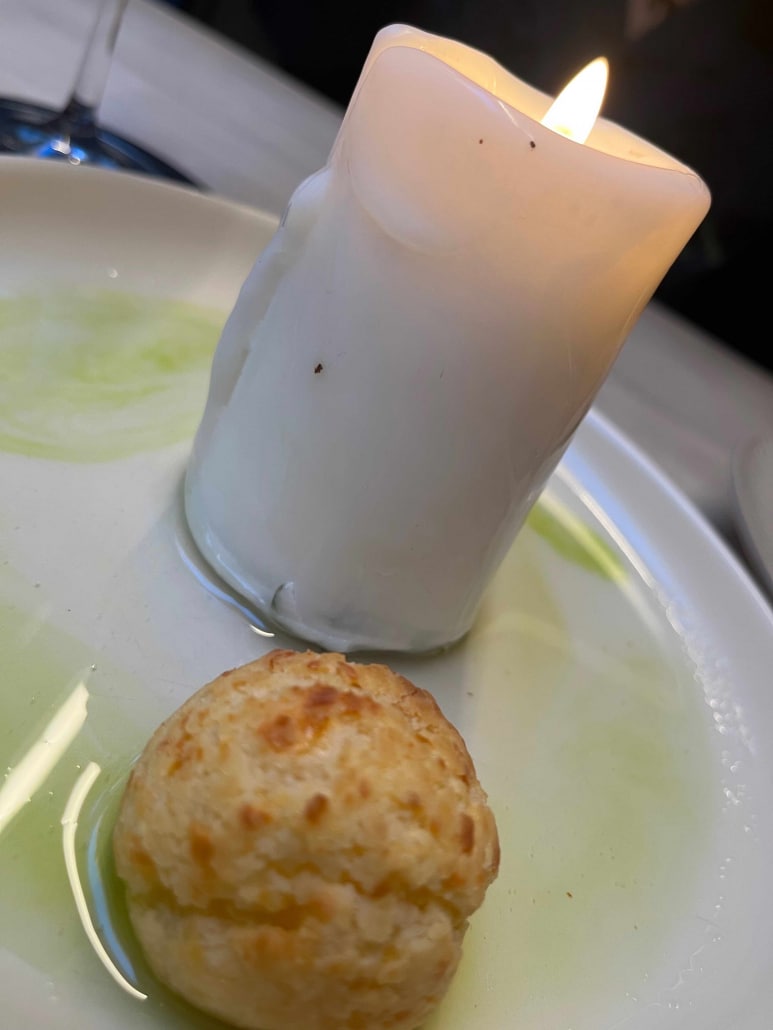
Great to see a newcomer in her repertoire, vegetables from Cinderwood Market Garden, served simply with a parmesan sauce, brazil nut hummus and an olive crumble. Quite a contrast to the stalwart rosemary-scented edible beef fat candle, crafted out of beef rump cap dripping, where another herb, lovage, colours the moat of melted fat to dip your Brazilian cheese rolls into.

Lobster tail moqueca, Caroline’s take on a traditional seafood stew, and dry aged rib-eye feel surprisingly straightforward in contrast but the pre-dessert is the harbinger of wackiness ahead. A lime ice lolly, accompanied by a Brazilian honey liqueur is a kind of cool counterpoint to the candle, offering a chance in essence to construct your own Caipirinha.

Then the fireworks begin. Maybe in her fleeting appearance on BBC’s Great British Menu her sheer ambition perhaps undid her in her low-scoring ‘fish course’ but she is undeterred in playfully pushing back the boundaries. Hence what is literally a ‘signature’ dish with the likes of basil custard and coconut yoghurt scrawled across a huge black base. Dotted with  cubes of coconut candy, cassava biscuit, guava candy and banana candy, the centrepiece is a smashed ‘bowl’ of Manchester’s finest artisan chocolate, Dormouse (from specially imported Brazilian beans), containing passion fruit mousse, rose petals, coconut granola, merengue and marshmallow. 

Our seen-it-all chihuahua companion, Captain Smidge had kept his equipoise after a surfeit of flash-freezing liquid nitrogen in the build-up. The completed version did look the kind of spread best suited to his natural tongue action; we spooned it all up determinedly.

Six months on since first tasting it, the Sao Paulo food offering has forged ever stronger bonds between British and Brazilian raw materials. Unique? Possibly. It has certainly earned her a nomination for Chef of the Year in the 2022 Manchester Food and Drink Awards.

Of course, there’s nothing new under the sun. That expansive chocolate pud is descended from the presentational adventures of Grant Achatz. Not to be confused with the unpalatable Grant Schapps, Achatz has now held three Michelin star for 12 years at Alinea in Chicago. And yes his approach has led to some ‘serious analysis’. 

Grant Achatz has perfected a scattergun approach to presentation of his stellar food at Alinea

If you really must, delve into Hungry for Art‘a semiotic reading of food signifying art in the episode Grant Achatz (2016) in the documentary Chef’s Table’. The first chapter focuses on the intertextuality between a dish presented in Netflix’s Chef’s Table and the paintings of Jackson Pollock.

Better use of your time? Check out our own next chapter, Ancoats Expressionism According to Caroline Martins’ Great Brazilian Menu.

Caroline Martins’ Sao Paolo Project is at Blossom Street Social, 51 Blossom Street, Ancoats, Manchester M4 6AJ.