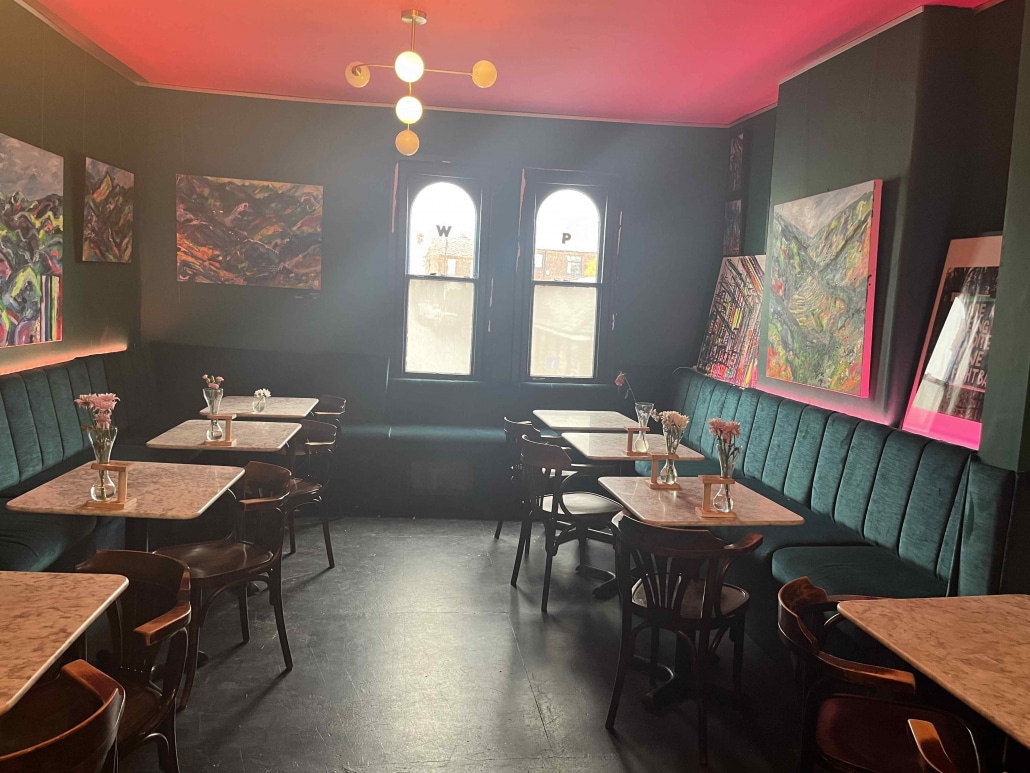
It’s three years since an abandoned 200-year-old boozer off Cutting Room Square, Ancoats, was exhumed. Another reminder of my own imminent decrepitude – I’d propped up the bar at the Edinburgh Castle as a national hack working out of the nearby Express Building in the 1980s. Not the friendliest of street corner locals then; today’s stylishly restored version is infinitely preferable, even if some question if it recreates a true pubby vibe. But do any of us yearn for sticky carpets, nicotine-stained ceilings, neolithic toilets? The new model was doing something right, though, since it won Pub of the Year in the 2021 Manchester Food and Drink Awards

Inevitably it has been the upstairs gastropub element that catches the attention in a neighbourhood feted as a foodie destination. Cosy and candlelit, the 36-cover restaurant has had aspirations from the start, either side of the lockdowns, but culinary continuity has been lacking.

Two chefs who have headed up the EC kitchen I count as friends. Kiwi Julian Pizer launched with his signature bee’s wax aged beef but moved on and remains a real contender, running Another Hand in Deansgate Mews. Similar acclaim greeted Iain Thomas at The Alan Hotel before his recent departure to run private dining/pop-up operation Our Place. A year ago when he was head chef at the Edinburgh Castle he hosted a quietly daring ‘Trust The Chef’ blind tasting game dinner featuring venison, woodcock and partridge.

The baton has now been passed to Shaun Moffat, still in his mid-thirties but with a wealth of experience, in the South West and then London, latterly at Manteca in Shoreditch (No.11 in the National Restaurant Awards). His new exec chef remit covers not jus the Edinburgh Castle but also sister bar/restaurants Cottonopolis and Libertine, which I welcomed recently – Cooking on Sizzlng Hot Coals.

Live fire cooking features heavily in his CV at London’s John Salt and the trail-blazing Middle Eastern grill house, Berber & Q. So is he going to set Manchester on fire? I caught up with him after cooked an exquisite ‘soft launch’ dinner at the Castle (mussels, chicken parfait, slip sole, Tamworth pork chop, treacle tart – he may become my friend, too) and quizzed him on his culinary philosophy and plans for the group…

Tell us about your journey to Manchester (and I’m not talking Avanti West Coast) I spent time working in small independent restaurants in the South West, Bath mainly. For Jamie Oliver, too. Moving to London I worked for Mark Hix at both his Soho site and the original Oyster & Chop house. I spent two years at The Conduit (private member’s club), Nest in Hackney and at Berber & Q. I finished my tenure in the city with Chris Leach and David Carter at Manteca.

Where did you originally call home? I am originally from South Africa, living there until I was 13 and relocating to the UK with my mother. Both my parents are British citizens and in turn so am I. I am now bordering on the age of 35. My wife Natalie is from Manchester and since we’ve had our child a few years ago the move out of London for a better quality of life was always on the agenda.

Are you an admirer of the city’ food and dink scene? Name names! Definitely. I’ve followed what’s been going on here for a long time. There’s a real clear drive from the industry here. I’m a massive fan of the team and offering at Erst, I have frequented it a lot in the past. The team at Suppher have been doing some great work as well. Everything the Flawd team are putting out looks amazing and also just a lovely bunch of individuals there. With the scene being a smaller pool than I’m used to there is a real sense of support and involvement from everyone. 

Who/what are your culinary inspirations in your career? A tough one to answer, I’ve taken inspiration from basically everyone I’ve worked with and had conversations. There’s an abundance of really talented people in this industry and it would be an injustice to only name a few. Personally my aspirations are to cook food that I want to eat and that people want to eat. I get excited by great produce and producers who generally care about what they’re growing, farming, harvesting or rearing in sustainable ways. Moving forward as community, I feel there is a real need for this connection between people and produce.

You are in overall charge of the three very different kitchens up here. What changes will you make? In particular at Cottonopolis with its Asian-inspired menus? Cottonopolis will be altered to align with the ethos of the other sites. The menu and offering will be more concise and sustainable and using British sourced ingredients

from fish to soy sauces and misos, using preservations for its dashis and XOs. But there will be obviously some produce from abroad as we’re not trying to change the DNA of Cotton. There’s a lot of character there. 

Who are your prime suppliers? I’ve been luckily enough to secure supply from some amazing places. Our bread comes from Pollen, who arguably are putting out the best bread in the city. We are using Wildfarmed flour for all of our flour work here at the Castle and at Libertine. It’s Henderson’s Seafood for our dayboat fish. They have a massive focus on sustainability and not over fishing the waters. We are sourcing chalk stream trout through them as well. And we’ll be using Keltic Seafare in Dingwall for a Scottish shellfish supply .

Fruit and vegetables come from Cinderwood market garden and we are also utilising the British produce on offer from Organic North. Relying on their seasonal lists helps steer the direction of the menu. Meatwise we source from Swaledale in Skipton, who are working with some really incredible farmers based in the Dales. And we get our mushrooms from Polyspore in Altrincham. 

We loved the simplicity of the slip sole and Tamworth off the new menu. Is that a key to your cooking style? I appreciate that, To a point I think simplicity is crucial a lot of the time. I dislike busy, crowded plates filled with a list of items. I feel nothing gets a chance to shine. The way I cook concentrates on the flavours that are already there, only elevating and accentuating with items that tie into the main product naturally.  I feel that food should be sourced well, seasoned well, cooked well and served well. 

You have a history of cooking with fire. What does this bring to the party? It seems an important part of the Libertine. It’s one of my favourite ways to cook. We have a small Konro (Japenese grill) at Edinburgh Castle as well. The majority of the menu at Libertine is either cooked over the coals or through the wood-fired oven. I generally find it very a natural and organic means of cooking, there’s just so much that can be done and offered.

Edinburgh Castle, 19 Blossom St, Ancoats, Manchester M4 5EP; Cottonopolis Food & Liquor, Newton Street, Manchester, M1 2AE; Libertine, 437 Wilmslow Rd, Withington, Manchester M20 4AN.

Main shot of Shaun Moffat by @lateefphotography. Pork chop and parfait images by Olivia Morgan

I’m on a puff pastry roll at the moment. So to speak. No sooner had I hymned the praises of the vol au vent than I was grappling with another traditional French pie. Thanks to the arrival of a remarkable debut cookbook called simply Butter (Headline, £26). Spread the word (sic). Its author Olivia  Potts, The Spectator magazine’s ‘Vintage Chef’ and ‘Table Talk’ podcaster, is a bright new star in the cookery writer firmament. Already I’ve followed her book’ advice to make my own cultured butter, recycling the buttermilk created into a soda bread loaf; funkier till, twice I’ve filled hasselback potatoes with her signature kimchi and blue cheese butter.

With a glut of mushrooms on my hand what better next than her fungi-filled pithivier recipe? A big welcome to Wild Mushroom, Tarragon and Crème Fraîche Pithivier, which ticks so many of my boxes.

Originating in the eponymous town south of Paris that is twinned with Ashby-de-la-Zouch, the pithivier can accommodate savoury or sweet fillings under its distinctive fluted pastry dome. My own rather tasty effort (main picture) didn’t quite attain the classic round shape (see Olivia’s version below) thanks to my clumsy cutting of bought-in puff pastry. Olivia, though, is no stickler over the necessity to make your own. 

Indeed she offers a cautionary tale in the book. Volunteering to work in a Crisis at Christmas kitchen, she arrived to realise that she was in charge and no ready-made puff was in the walk-in fridge for the pies she had promised – just the separate ingredients. For a former criminal barrister this was judgement day! She rose to the occasion, making 6kg of pastry by hand, but admits: “I just about had RSI by the end but have rarely been prouder.”

If you must follow her lead, albeit on a smaller scale, Butter offers various versions, from decidedly flaky ‘rough’ to the smoothly laminated classic recipe and, finally ‘inverse’, which swaps the method. Rather than the base dough being wrapped around  butter block, and then folded to distribute even layers of the butter, the butter is wrapped around a dough block and then folded similarly.

As I said, I bought in mine, pure butter, of course, but with the proviso from an organic supplier, dorset pastry, which has no truck with the controversial and possibly harmful commercial additive, L-Cysteine (E920) (a dough relaxant derived from animal hair and feathers), which legally need not be disclosed on a pastry or bread label. It’s commonly used in the Chorleywood bread-making process. Think white pap. Say no more.

For something genuinely worth eating let’s visit Olivia’s recipe for Wild Mushroom, Tarragon and Crème Fraîche Pithivier (serves four) …

“Pithiviers are round puff pastry pies, with filling sandwiched between them. I think the word ‘pie’ in any context immediately summons up the idea of something heavy, something sturdy.While sturdiness is no bad thing, that is not what we’re dealing with here: pithiviers are the spiderwebs of pies, light, fragile, a feat of architecture. Pithiviers tend to be intricately decorated with knife marks, radiating or zig-zagging out from the centre, like fractals.

“As a pie, you can fill it with anything that takes your fancy… but for the best results, I use a filling that you can chill firm, so that when you shape the pastry round it and bake it, it will retain its beautiful domed shape. I use inverse puff pastry here, because the pithivier is such a handsome, proud dish that it makes the most of my hard laminating work, but you can use any puff you have – shop-bought is, of course, completely fine.”

Ingredients

20g dried porcini mushrooms; 150g oyster mushrooms; 250g chestnut mushrooms; 15g butter; 1tbsp cider or white wine vinegar; 3tbsp crème fraiche; 1 tbsp shredded fresh tarragon; ½tsp fine salt; freshly ground black pepper; 300g puff or inverse puff pastry; 1 egg yolk, beaten, to glaze.

Method

1. First, cover the dried porcini mushrooms in boiling water, and leave to soak while you cook the other mushrooms.

2. While the porcini are soaking, halve the oyster mushrooms and slice them, and slice the chestnut mushrooms. Heat a heavy-based frying pan over a medium-high heat and melt the butter in it. Sauté the oyster mushrooms until golden-brown, add the vinegar, let it cook off, then set the mushrooms to one side. Cook the chestnut mushrooms in the same pan until they have given up their water and begun to sizzle.

3. Drain and roughly chop the rehydrated porcini mushrooms. Combine the porcini, oyster, and chestnut mushrooms, along with the crème fraîche and the tarragon, and season generously with the salt and some pepper. Line a bowl approximately 15cm across with clingfilm, spoon the creamy mushroom mixture into it, pack it down into an even layer (don’t worry, it won’t fill the bowl) and freeze for an hour until firm.

4. Meanwhile, roll out the puff pastry to the thickness of a pound coin. Later, you’re going to need to cut one 20cm and one 23cm disc from the pastry, so check that your rolled pastry is big enough to accommodate this. Divide the pastry in half, then transfer the two sheets of pastry on to a chopping board or tray with a sheet of baking paper between them. Refrigerate for at least 30 minutes.

5. Cut out two discs, one 23cm, one 20cm, from the chilled pastry. Place the smaller disc on a baking paper-lined baking tray.Turn the chilled mushroom mixture out on to the centre of the pastry, removing the clingfilm from it, and dab a border of water around the edge of the pastry. Lay the second, larger disc on top. Smooth the top layer of pastry down over the mixture, to reduce air bubbles, and press the edges down with the tines of a fork to seal. Paint all over with egg yolk, and refrigerate for 20 minutes.

6. Preheat the oven to 200°C. Paint the pastry with another coat of egg yolk and then, using the back of a small knife, make swooping marks from the centre of the pastry down towards the edge. Prick a hole in the centre, to act as a vent. Bake for 15 minutes, then drop the temperature to 170°C and bake for another 45 minutes until puffed and golden. Serve hot.

Some new destinations generate high expectations. Hence the enthusiasm with which I greeted Exhibition. Not just because it is heartening to see a historic Manchester edifice (home to a functional Pizza Express in its least interesting incarnation) given a stylish makeover; the presence of three quality indie food operators alongside a slick bar operation promised to set it apart from more canteen-like places chasing that food hall pot of gold.

Before this 400-capacity venue opens to the public on Saturday, November 12, I’ve been lucky enough to get a sneak preview of what’s on offer from OSMA, Caroline Martins and Baratxuri. While not neglecting a drinks offering headed up by Manchester Union Lager alongside smart wine and cocktail options. This was by special, lavish invitation only, so no way of gauging what the overall ‘live’ experience will be like. If that lives up to the parade of dishes served to us then Exhibition is a significant new player. a further bonus… it is dog-friendly throughout.

Here is a link to the lunch menu; and this is what’s on offer for dinner.

I’ve been a fan of Basque-inspired Baratxuri since its inception and over the years I’ve guzzled my share of Rubia Gallega Txuleton, bone-in rib steak from Galician dairy cattle aged over 50 days. At Exhibition £75 will get you 1kg’s worth served blue with fire-roasted new potatoes and tomato salad.

Another speciality of chef/founder Joe Botham also features. Rodaballo a la Parilla (£55) is a whole wild turbot grilled over ember and served with whippd pil-pil. Follow my turbot capital trail in Northern Spain here.

Simpler, less expensive dishes on the menu will satisfy equally well – the likes of immaculately sourced anchovies, the stickiest of ribs and scallops in the shell.

There’s a more compact menu from the offshoot of Scandi-influenced Michelin-rated OSMA in Prestwich, creation of Sofie Stoermann-Naess and Danielle Heron and. The name is an amalgam of duo’s respective home towns of Oslo and Manchester. My Manchester Confidential colleague Lucy Tomlinson gave it 16/20 in her review.

Priced similarly to its turbot rival across the dining rom, their whole cooked lobster is another huge temptation. They have a way with seafood. Check out their exquisite sashimi.

I’ve been a regular at Caroline Martins’ Sao Paulo Project pop-up at Ancoats’ Blossom Street Social. Her foray to Exhibition takes her away from tasting menus to a more stripped down approach, while still fusing Brazilian culinary traditions with cannily sourced local ingredients. Still, she couldn’t resist bringing with her a smaller version of her ‘splash hit’ choc pudding party piece I’ve written about before. My tip: don’t miss her Carlingford oyster with passion fruit sorbet.

Exhibition, St George’s House, 56 Peter Street, Manchester M2 3NQ.

Imagine your near-perfect restaurant bucket-list served up over 17 nights in a single venue one chilly January just off the A59. Yes Michelin-starred Northcote’s Obsession festival is back and spreading its horizons. Founded in 2001, this really is a unique celebration of stellar chefs that is really unique. Even the AA Hospitality Awards, not the most adventurous, gave it its ‘Outstanding Contribution Award’.

The 2023 incarnation runs from January 20 to February 5. 20 world class chefs with16 Michelin stars between them will make the trip to the luxury Lancashire hotel, now part of The Stafford Collection. It will kick off on Friday, January with 20, as is customary, Northcote’s own Lisa Goodwin Allen at the stove – this year in tandem with fellow Great British Menu stalwart Niall Keating. 

Lisa has this week been named named Ayala SquareMeal Female Chef of the Year 2022. She said at the ceremony: “Being an ambassador like this and inspiring the next generation of cooks, so that the next cohort of female chefs does great things, is really important to me. It’s vital that we nurture young talent, and provide them with all the tools they need to succeed…As an industry we need to be flexible; something I’m passionate about reflecting in my kitchen and with my team.”

Two women chefs also at the peak of their powers join Lisa to cook at Obsession’s grand Obsession 23’s grand finale on Sunday, February 5 – London legends Monica Galetti of Mere and Nieves Barragan Mohacho of Sabor.

All the meals in between look equally inspirational. What thrills me most about the intense 17 day showcase is that, post-pandemic, there is a returning global presence. France and Portugal feature. 

I’ve been lucky enough to stay and dine at the Yeatman in Porto, so the appearance on Saturday, January 22, of its 2-star chef, Ricardo Costa, is a big statement. 

His restaurant in the wine-driven hotel above the Port houses has been showered with awards and he was named Rising Chef 2016 by Relais Chateaux, Chef of the Year 2009 by the Portuguese magazine Wine; “Chef of the Future” 2012 by the International Academy of Gastronomy; and Best Chef in Portugal (2013) in the Gastro Arco Atlantico prizes.

At the same time the quality of the British contingent is proof of the vibrancy of our own restaurant sector in decidedly difficult times. My pick? Chetan Sharma of Mayfair’s Bibi on January 24, Alex Nietosvuori of Hjem in the North East on February 3 and the Ritz’s dynamic duo of John Williams & Spencer Metzger on February 2. Though I’d not be averse to meeting Anna Haugh of Myrtle on January 27. She has been a breath of fresh Irish air presenting the current Masterchef. 

The full list is here. People can register for tables for Obsession23 from Thursday, November 10. Each meal is priced at £185 per person, including a Louis Roederer Champagne and canapé reception, five course menu, coffee and petit fours. A specially paired wine flight can be added, starting from around £65 per person. The official charity for Obsession23 is Hospitality Action. To date, Obsession has raised almost half a million pounds for the charity.  

Northcote, Northcote Road, Langho, Blackburn BB6 8BE. 01254 240555. For information on a variety of gourmet breaks visit the website.

When I look back on years of reviewing there’s a special roster of restaurants where I got there first. And reassuringly where I raved others followed. No delusions. Places really prospered after my initial sounding was endorsed by fellow critics with a much higher profile. Which brings me to The White Swan at Fence. A slightly slower burner after I awarded it 16/20 back in 2015, the food eulogy undermined by the basic village pub in transition ambience. Neither food nor pub enhanced by a wrong setting on my Canon Power Shot G15. Fuzzy! Shamefacedly, my incognito cover blown, I had to ask chef Tom Parker, at peak Saturday service time, if I could re-shoot certain dishes on the pass. 

Tom was the reason I’d hurtled up the A6068 Padiham bypass to the strung-out commuter hamlet of Fence. A real talent setting up in the most unlikely of places – the only Timothy Taylor tied house in Lancashire. Formerly dubbed ‘The Mucky Duck’.

My chef friend, Mike Jennings (Grenache at Walkden/later WOOD), had rung me to recommend his former Northcote oppo, who started there at 16, five years later winning UK Young Chef of the Year.

Northcote has held a Michelin star for over a quarter of a century; the Swan gained its own in 2018, three years after my first visit, and has kept it since. The award was a surprise to those fixated on more gussied up establishments but, of course, the consistent brilliance of the food counted most. 

That revered status has been confirmed this week by the resurgent Good Food Guide, now a purely digital operation, yet retaining its authority. Strong on expert reader recommendations, it rates UK restaurants across four categories, Good, Very Good, Exceptional and World Class. Only three form the latter pantheon – L’Enclume, Ynyshir and Moor Hall, with all of which I am very familiar. 34 further places make the Exceptional list, including The White Swan at Fence

According to The GFG: “Exceptional equals cooking that has reached the pinnacle of achievement, making it a highly memorable experience for the diner. The whole restaurant will be operating at the highest level: not only perfect dishes, showing faultless technique at every service, but also superb service, a high level of comfort, and a warm, welcoming atmosphere. These are the best places to eat in the country.”

Great company for the White Swan. That elite bunch includes the likes of A. Wong, Claude Bosi at Bibendum, Hjem, Inver. Outlaw’s Nest, Restaurant Gordon Ramsay, Restaurant Story, The Raby Hunt and The Sportsman.

It all leaves me feeling in the right place at the right time again. Read my review of Yynshir where, between booking and staying, it won its second Michelin star and was named the UK’s number one restaurant.

Cue last Saturday, when I booked a Swan lunch for myself and Captain Smidge, the gourmet chihuahua, en route checking the photo settings on my iPhone 13 were spot on. The five course lunch is £55 a head on Saturdays, compared with £45 Tuesday-Friday. Each prix fixe will rise by a tenner from December 1 (for obvious economic logistical reasons). Our standard set dinner will increase to £80 per head Tuesday to Saturday.

At my table opposite the Landlord and Boltmaker cask pumps Gareth Ostick (co-owner with his wife Laura and Tom) tells me that the decision to discard the several-choice a la carte post lockdowns has been a success beyond the obvious cutting down of possible food waste. It has also re-energised chef Tom, giving him the opportunity to roll with what’s fresh on the market. And, of course, in any Michelin destination, added surprises are quintessential.

Here the amuse bouches cluster across the table (no tablecloths and, all you old school Michelin tickers, don’t count on cloches). A tomato consommé topped with intense whipped basil and smoked bacon speckles comes in a prawn cocktail style goblet. With a large pebble of sourdough there’s a choice of butter, Leagram’s organic sheep’s curd, or their signature black pea hummus, which is as ‘Lanky umami’ as ever. Oh, nearly forgot a game liver parfait ‘tart’ coated in hazelnut. I’m driving, so my aim is to make my pint of Taylor’s last but already the glass is half empty, half full. Such a shame, though, not to explore the wine list, these days supplied by the excellent Miles Corish and a vast improvement on that 2015 selection.

Bread aside, Captain Smidge has to wait to the third course of herb-fed chicken to be rewarded with his tythe. It comes with hen of the woods and an old school yet light mushroom sauce with madeira and thyme. It cries out for a creamy Chardonnay, but I stay firm.

Before the fowl there is a cute little Burford Brown egg yolk, under fried potato discs dressed with herring roe and dill, giving it a Scandi brunch feel. Then, more excitingly, in  a red prawn curry foam a substantial Skye scallop topped with its own coral in the lightest of tempura batters. Masterful.

Honey truffle, mascarpone, pears and verjus is a playful palate cleanser before this accomplished kitchen unveils a triumph of soufflé technique, using Valrhona chocolate. With it a darker hot chocolate sauce and a stem ginger ice cream. All as pretty as a picture in my photos. Mostly.

The White Swan at Fence, 300 Wheatley Lane Road, Fence, Burnley BB12 9QA.

The oddest of avenues opened up after one of the best dinners I’ve eaten in recent times. I just can’t resist researching a bit of arcane back story. So picture a victorious Sumo wrestler, at the end of his bout, typically brandishing a red sea bream – potent symbol of good fortune and abundance for Japanese folk. Endorsed by the ‘Fish God’, consumption of this prestigious ‘celebration’ fish with the coppery red sheen is reputed to ward off evil spirits, too. 

Pagrus major is the Latin name for the species; more prosaically the Japanese call their ‘King of the Hundred Fishes’ Madai. A nigiri of which (above) I have just gulped whole, as is the custom at a certain stage of a Kaiseki banquet. Bookended by mackerel and chu toro (tuna back and belly morsels), it is part of a trio of mouthfuls that showcase immaculate sourcing. Attention to detail is everywhere from the flecks of proper wasabi root, the 10-year aged soy with mirin and sake, top of the range hamachi and akami to match the madai quality.

No, I’m not in one of those exclusive downtown Kyoto supper clubs but in Lydgate, hilltop outpost of Oldham. The setting is the home of Vincent Braine co-founder of Musu, an extraordinary restaurant project arriving imminently in Manchester. His chef patron Mike  Shaw has brought along his meticulously assembled brigade to cook a preview of the menu promised for the £2.5m transformation of the former Randall & Aubin site on Bridge Street. 

No pressure then? Not if the actual 55 cover restaurant can regularly serve a meal as amazing as the one proffered to us, the elite few. Me neither on why I was invited. Just thankful. Maybe it was down to the effusive welcome I gave to the project. Much of it down to my awe at the cultural leap made by Shaw, a chef steeped in Francophile and Modern British cooking. Think a CV that includes Le Manoir aux Quat’ Saisons via Hambleton Hall and Aubergine, then at Michelin-starred Neat in Cannes. 

Now he is charged with curating high end Japanese cuisine, albeit filtered through his own kitchen sensibility. Japanese with a contemporary twist, he’s calling the style. It oddly mirrors his namesake Simon Shaw’s adoption/adaptation of Catalan cooking at El Gato Negro. Fittingly the name Musu translates as ‘infinite possibilities’. 

In all this it helps that Mike’s head sushi chef sidekick is Brazilian Andre Aguiar, trained by ‘renowned Japanese Sushi Master’ Yugo Kato. The first six months of his apprenticeship at Kato’s Dublin restaurant were consumed entirely by learning to properly cook rice – the priority in sushi. Cooked rice is referred to as gohan in Japanese. In a broader sense the word denotes ‘food’ or ‘meal’.

Andre will helm the intimate six-cover ‘Omakase’ counter in Musu, one of three menu options; the other are the flexible a la carte ‘Sentaku’ and ‘Kaiseki’, a seven or 11 course tasting menu. We get the latter at Lydgate.

It kicks off with chawanmushi, that savoury eggy custard seemingly ubiquitous at high end UK restaurants these days. This one, intense with garlic and parsley, is as good as it gets with a bijou morel mushroom tart sharing the Instagrammable ‘nest’. After which there isn’t a dud note. Exquisite sashimi to match the sushi; treatments of scallops, black cod and wagyu beef each transcending the Nobu wannabe clichés. Throughout assiduous application of caviar (kaluga and oscietra) feels like the hand of Shaw. Ditto the remarkable final pudding – a fusion masterpiece of iced white chocolate, fennel seed crumble and yuzu sorbet.

So a rewarding culinary experience, but is it true Kaiseki? And does it matter? On my trips to Japan I was never lucky enough to bag a seat at one of those elaborate almost meditative showcases for kyo-rori (traditional Kyoto cuisine), served in ancient wooden villas. Reservation for non-natives are as rare as hen’s teeth (not a dish by the way). This dining ritual has been honed for centuries, yet my it’s-becoming-a-habit research discovers the term Kaiseki wasn’t attached until the mid 19th century. It means ‘bosom’ or ‘stone’ and  refers to the practice of monks holding warm stones to their chests to stave off hunger during winter.

I guarantee no server at Musu, due to open on Friday, November 18, will offer you a warm stone on arrival. Warm welcome definitely plus food that should radically upgrade the perception of Japanese food in the city (ramen an honourable exception). Despite a cavalcade of sushi rivals recently it has remained devalued culinary currency. Manc cannot live by California rolls alone.

Showing my age. Just realised it’s 30 years since I sat down in the cinema to watch Delicatessen. I expected a celebration of pastrami on rye and coffee-toting waitresses with attitude. Instead I was served a post-apocalyptic, cannibalistic black comedy packed with butchered body parts. 

I blame a movie made two years earlier for my cinematic naïveté. The one where the Meg Ryan character simulates orgasmic cries. The one I always think of as When Harry Met Deli because that scene was set inside Katz’s on New York’s Lower East Side. And, yes, I have visited that apotheosis of all the kosher eateries recalibrating the Old Country in the New World. The touristy sign quotes the film dialogue: “Hope you have what she had.” We ordered differently.

There was a cluttered buzz to the joint, the queues to get in filtered through a ticketing system. The food? Not really star quality. And not really the global template for the Deli  these day, definitely a devalued catch-all term just like bistro and brasserie. Yet neither of these are synonymous with a sandwich shop.

A more positive perspective is the combo of grocer’s and cafe, ideally the latter feeding off the raw materials and store cupboard essentials of the former. A good example (with the bonus of a well-stocked wine shop and bar) was the late, lamented Lunya in Manchester, the original of which is still going strong in Liverpool. That is Spanish with a Catalan influence; the Italian equivalent, equally family-run, is Salvis’ Corn Exchange outpost in Manchester’s Corn Exchange.

My ideal deli though would be a suburban provisioner. The supplier of an impulse wine purchase, a decent cheeseboard, charcuterie, olives and bread to carry home around the corner. Even better, if the budget allows, to be able to tuck into all that stuff upstairs above the shop, augmented by an eclectic beer offering, including the owner’s own acclaimed lager.

Factor in the natural progression 100m away of a sibling butchers/fishmonger with its own eat-in small plates deli counter and it could only be Wandering Palate – The Movie and Farm & Fish – The Sequel. Location? Upwardly mobile Monton, the posh banlieue beyond Eccles. The first is the debut deli of Will and Emma Evans; the second their collab with The Butcher’s Quarter, which has two further outlets in the city centre.

It has taken me a while to trek here. As I sit in the window of Wandering Palate at 190 Monton Road, first with a De Koninck Bolleke, a Belgian amber-coloured pale in the glass of that name, then with a Bodegas Manzanos Gran Reserva Rioja Will brings me a selection of ‘picky bits’.

They are his Manc version of pintxos or cicchetti. The baguette bases are from Holy Grain, arguably Manchester’ best bakery, like Wandering Palate shortlisted at this year’s Manchester Food and Drink Awards. The toppings are sourced from the deli shelves. My favourites the Trealy Farm venison and juniper pâté with salsa verde and truffled Baron Bigod cheese with baby onions.

Time for browsing. A smaller beer collection (“we needed the fridge space for other items”) than you’d expect from Will, who co-founded Manchester Union Lager. That’s on tap here ahead of its unveiling in tank form at Manchester’s new Exhibition food hall this November.

Wine is a major player, though with a substantial natural wine offering, much of it sourced from Les Caves De Pyrene. Coffee comes from Yorkshire’s Dark Woods, charcuterie from Manchester’s own Northern Cure, cheese from The Crafty Cheese Man and much more.

Emma Evans is an acclaimed artist, whose canvases you can check out in the upstairs bar. She also hosts regular life drawing classes there. Probably more my thing is Wandering Palate’s Wine Club Wednesdays with free corkage.

Farm & Fish at 190 Monton Road equally aspires to be a community hub. It recently hosted a Polish wine tasting. But my eyes were for the meat and fish counters. I inevitably splashed the cash, coming away with a kilo of  ox cheeks and a robust boiled crab. I could happily have sat in the window there with a further wine as evening fell… to survey the Monton ‘paseo’.

I came late to The New Forest National Park and it has found a nest in my heart. This 550sq km patch of ancient England is an all-year-round destination, but autumn is particularly alluring when the russet woodland plays host to Pannage. This is the practice of releasing domestic pigs into a forest (also known as ‘common of mast’), dating back to the reign of William the Conqueror, who founded The New Forest in 1079.

In this case up to 600 pigs are released to eat fallen acorns, beechmast, chestnuts and other nuts, which are poisonous to the ponies, donkeys and cattle which roam the forest. The season started in September and finishes on 18 November. It is the only time of year that the pigs are allowed to ‘roam’ – around the same time those commoner-owned native ponies are rounded up, some headed for auction. 

This New Forest breed is most often associated with this former royal hunting ground. Pigs, though, have their own special status, too. Just to watch the wilded beasties wolfing down acorns is enough to induce dreams of free range pork products There is a good reason celebrated hotel/restaurant chain The Pig, with its stalwart commitment to local produce, first took root in the heart of the Forest, just outside Brockenhurst. 

A glance at the original Pig’s ’25 mile’ menus reveals a Saddleback crackling snack, starters of Pannage Coppa or home-made black pudding, a Tile Bar Farm pork chop main and my favourite, Crispy Chilli Pork Belly, Garden Leaves, Makers Honey and Greenhouse Chilli – locally reared and grown ingredients, with zero-mile produce picked from their own kitchen garden.

A whole chapter of founder Robert Hutson’s The Pig Cookbook (Octopus, £30) is given over to ‘Porkology’, a snout to tail guide tackling the various breeds they farm and their kitchen uses, particularly charcuterie. Chef Director at The Pig James Golding even teamed up with a third generation local family butcher, Alan Bartlett, to create a curing company called A Pinch of Salt.

Which brings us to a more traditional outlet for all that pork. ‘Mr Bartlett’s Hampshire Hogs’ have a case to be the perfect bangers to match with mash. The recipe date back to Alan’s great grandfather. Jame and his team can’t resist updating the ‘secret’ blend with the addition of (my favourite spice) fennel pollen plus elephant garlic (think a cross between standard garlic and leek).

Hampshire Hogs

Ingredients: 100g breadcrumbs, rapeseed, 25g seasoning (roughly 20g salt, 5g sugar, a pinch each of sage, thyme and garlic powder), 700g boneless pork shoulder (80% lean, 20% fatty), 150ml cold water, sausage casings.

Method: Fry the breadcrumbs with a little oil until golden brown. Mince the meat straight onto the crumbs, adding the water. Mince again. Tie one end of a sausage casing with string, then insert the narrow part of a wide-necked funnel in the other end. With the back of a wooden spoon push the meat through the funnel into the skin. Once it’s full remove the funnel and tie the end. Pinch and twist into four individual sausages, then link and tie with with string. Overnight in the fridge. Best cooked over charcoal.

Enough ‘snouts in the trough’. So who needs Vermont when you’ve got the New Forest?

There are are many good places to walk and witness the autumn colours. Try the following. Hightown Common, located near Poulner in the Forest’s north, is perfect for experiencing colour on trees, from the brilliant yellow of the birches to the last clumps of purple heather and the delicate tracery of the dying brackens. The walk starts off by passing a clump of gorse bushes, which provide beautiful colour and a distinctive coconut scent. Rhinefield Ornamental Drive is probably the best-known road in the whole of the forest.  Considered by many as the ultimate autumn colour-burst, the drive was planted in 1860 and offers colour and wonder all year round, as well as the Forest’s tallest tree. Time it right, and you can also proceed on to Blackwater Arboretum to see the falling leaves twirl and float into the pond there.

Staying in the New Forest

Many of the forest’s accommodation providers offer good deals to fill beds in the autumn ‘shoulder season’, and quieter roads, pubs and restaurants make it the perfect time for a short break. One place I’d heartily recommend is the four-star Balmer Lawn Hotel (above). This is currently offering three nights for the price of two until the end of November 2022. The break costs from £145 per person, B&B, based on two people sharing a room, and  also includes full use of the leisure facilities including indoor and outdoor pools, sauna, jacuzzi and gym. Pigs can be spotted very close to the hotel, and some rooms are dog friendly (though dogs should be on leads where there are pigs.)

We stayed at Balmer Lawn on our pre-Pandemic voyage of discovery. Here’s my report on that equally enchanting spring visit – Tall Trees and A Small Dog in The New Forest. For further information on the area visit the New Forest website.

Fish heads? I have form for devouring them. Witness the board below at the late, lamented Umezushi in Manchester. That was 2018 (note the prices) and I went for the hamachi. So the dish-determined-to-surprise on the menu at Fallow held no fears. Dowsed in a sriracha emulsion, the smoked cod’s head held plenty of crannies from which to prise collagen-rich morsels. Crumbled charcuterie adding an extra swoosh of umami. Messy, mind, but they reportedly sold 10,000 in their first five months of Fallow’s meteoric rise.

More a dish the likes of which you might find a short walk away in London’s Chinatown. Definitely not one for the pre-theatre crowd en route to Phantom of the Opera further down Haymarket. In that context this all-day restaurant/bar, created by two Heston Blumenthal alumni, should feel like a fish out of water (sic). Especially since it flaunts a sustainability ethos that’s as brazen as its prices. Given all this, it possesses a flamboyant yet democratic buzz. 

Not what you’d always expect from a joint perched at No.13 in the Estella Damm Top 50 Restaurants list. That’s a place behind my beloved Angel at Hetton, though its sense of theatre leans towards numero uno Ynyshir.

I had a front row seat for all this – at the Chef’s Counter, the hectic pass just to my right. None of your The Bear/Boiling Point chaos, though,about this operation, which started in 2020 as a residency at 10 Heddon Street, off Regent Street, before moving to St James’s this year. It was a bold move, smacking of serious investment at a time when the hospitality industry is facing horrendous challenges. Even so this week, hearteningly, its trade body reaffirmed its commitment to sustainability and reducing food waste with a 10 point plan. Fallow is already an object lesson in combining such principles with top quality dining. Their website calls it ‘conscious gastronomy’. Nothing gets thrown away and ‘nose to tail’ ‘farm to fork guides everything they cook.

All of which I contemplate as I gaze up at the hand foraged seaweed, dried flowers and recycled paper decorations dangling from the ceiling, a decor of repurposed materials including mussel and oyster shells and consider the provenance of my mushroom parfait, created from fungi farmed in the basement.

Originally co-founders Will Murray and Jack Croft would buy wonky mushrooms from their suppliers; now they use their own in-house lion’s mane along with smoked shitake. They caramelise them down, adding mirin and tamari. Puréed, butter and eggs are mixed in to create a sustainable mirror image of a classic liver parfait (with further mushrooms draped over. Not dissimilar really, at a fraction of the cost, to the booze and foie-gras laden Meat Fruit, at Dinner by Heston Blumenthal, where the two young chefs met.

There’s a similar decadent aura from frugal ingredients about my next, equally glorious course, where a fatty salmon belly cut has been whipped into a mousse. It is served in a marrow bone, whose dripping contents add the ooze factor to an accompanying brioche bun. What a belting dish.

This is undoubtedly rich, quite heavy food. Even the corn ribs ‘pop-up signature dish’ I snaffle with an aperitif of Guinness has made a big statement. Chunks of sweetcorn are first deep-fried then sprinkled with kombu. It shouldn’t work, but it does. Alternatively there is a brace of real ribs (back, dairy cow, smoked) as a heftier snack. I still eye with envy the Carlingford oysters being shucked across the counter, but £25 for half a dozen feels too much. 

If you reject the good value Monday-Friday £35 three course offer at lunch the bill can mount up (there’s a £12 truffle supplement on that £24 parfait), especially if you get stuck into the drinks list. I stay with the £8 pint of stout and add a £9 glass of Mencia for my final dish, a beef carpaccio. Fallow’s steaks and burgers are all trumpeted as 45-day aged ex-dairy cow, so I presume my generous helping of anchovy mayo-dressed carpaccio, topped with grated horseradish and gherkin, is no different. From my up-close stool I have watched the sous chef deftly assemble little ‘spoons’ of chicory leaf I am to scoop up my beef with. I was glad of them. The wild-farmed sourdough with fermented potato flour is the one disappointment of an exemplary lunch.

So where to next? A matinee of The Phantom? No. Lucian Freud: New Perspectives at the equally close National Gallery. All for the price of a half dozen Carlingfords.

Fallow, 2 St James’s Market, London, SW1Y 4RP. T Main image (with truffles) from Fallow Facebook page.

Giles Coren famously wrote that he’d walk to Manchester barefoot in the rain for one more mouthful of Simon Rogan’s chopped raw rib-eye in coal oil at The French. That was amazingly a decade ago and, to put it kindly, his return visits to the city have been sporadic since. The Times critic’s most recent foray saw him perversely spurning any number of impressive new wave restaurants to seek out a niche old stager, the Ethiopian cafe called Habesha on the fringe of the Gay Village. The reason? His passion for a bread that had passed me by.

No longer. I’ve been on my own Injera quest, sparked by the arrival of House of Habesha as a pop-up at the same city’s Contact Bar & Kitchen. It offers a suitably dramatic cuisine for a theatre setting. Lovely approachable food. Habesha, by the way, is a term that Ethiopians and Eritreans use to refer to themselves, specifically related to predominantly Orthodox Christian peoples found in the Highlands. From it sprang the old European name for the country – Abyssinia. 

The two Manchester culinary rivals sharing the name are not related. But their bread providers engage in the daily, labour-intensive creation of Injera – the foundation of most meals in Ethiopia and neighbouring Eritrea. Think of it as a springy sourdough flatbread, defined by its legion of tiny surface bubbles. It offers a perfect spongy texture for absorbing flavours as you scoop up a meat or veg accompaniment with your hands, as tradition demands. 

The key grain is the ubiquitous drought-resistant teff. Protein and mineral rich, while fundamentally gluten-free, it was one of the earliest grasses domesticated. The injeras it produces come in light and (richer) dark versions. House of Habesha’s ‘Full House’ platter drapes the bread as a base, the assorted constituent dishes interspersed with further, rolled breads. 

Samson will delight you with his mighty mesobs

On our visit HoH founder Samson Yitbareck presents this sharing plate with a cloche-like flourish from under a colourful, cone-shaped palm straw ‘mesob’, which means bread basket. The injera has fermented for a week, some rice flour/self-raising to hurry it along. Manchester temperatures aren’t the same as Eritrea’s.

Samson grew up in Manchester and does not feel entirely governed by tradition. The Contact pop-up makes compromises, offering a series of loaded fries and tortilla wraps under the label ‘Habesha Twist’, but always using herbs and spices redolent of the homeland. The country’ s proprietary spice blend, berbere, consists of red chillies, fenugreek, and ginger, with the addition of warm spices such as coriander, cardamom, allspice, cumin, peppercorns, cloves, cinnamon, and some lesser-known indigenous spices such as korarima, ajwain, and long pepper. House of Habesha’s slow-cooked sliced lamb dish called kulwa keyh made a fine showcase or the berbere. Milder is the spice treatment for hekla, grilled lamb chops on the bone. Vegan dishes get equal billing here and the majority of dishes are gluten-free, too.

Certainly the offering was the equal of (and cheaper than) a long-established Ethiopian restaurant I visited recently in Tufnell Park, London. I must admit it was the name that drove me to Lalibela, an artefact cluttered homage to the old country. More specifically to the mountainous region of that name that is famous for its cluster of medieval churches hewn out of rock faces. It’s also home to an oat flour based cousin of injera called Aja Kita that is literally whistled up by the natives, according to Yohanis Gebreyesus’ definitive Ethiopia: Recipes and traditions from the Horn of Africa (Octopus, £30).

The whistlers of ancient Lalibela and their bubbling  batter

Globetrotting chef Gebreyesus recounts: “When we bake injera, there are shattered bubbles (ayen in the Amharic language) on top of the bread, which give it a very spongy texture, and the more the better. That’s how we value it, aesthetically and in terms of taste as well. To make aja kita (thin oat flatbreads) with similar features, cooks in the countryside of Lalibela huddle around the hot griddle, pucker their lips and whistle, directing their shrill breath towards the bubbling batter.”

There is a quasi-scientific explanation. Oats contain a protein called avenin, which (like gluten) creates elasticity in dough; stretching and entrapping gas bubbles as they form. The vibration emitted by whistling is thought to help to burst these bubbles and create plentiful ‘eyes’ on the surface of the bread.

Visiting Lalibela, the restaurant, did allow me to order a kitfo, a kind of steak tartare, dressed with more of that berbere and fresh cream cheese… plus a side of gomen greens. Wot (stews) and tibs (hybrid stir-fries and stews) of meat and chicken are the mainstay of the menu with chickpeas and fava beans as veggie alternatives.

This London place has a strong family feel to it and the same applies to House of Habesha, which was nominated for ‘Best Food Trader’ in the 2002 Manchester Food and Drinks Festival. A young Samson fled war-time Eritrea with his father in 2013 and grew up in Manchester, studying at both universities and becoming a web developer. Food was always a passion. Hence House of Habesha, which has had successful pop-ups at the Northern Quarter’s Mala and The Eagle Inn, Salford. This October for two weeks and again before Christmas it will be returning to Stretford Food Hall alongside the Contact gig, which currently runs until January.

Good to know then that there is family support on hand. The Red Cross located Samson’s mother and sister in Stoke on Trent and his brother in Germany to reunite a family scattered by conflict. A happy ending for this particular House of Habesha. 

House of Habesha, at the GRUB-run Contact Bar & Kitchen. Open 10am-late, Monday to Saturday. Contact Theatre, Oxford Road, Manchester M15 6JA.  

Lalibela, 137 Fortess Rd, London NW5 2HR.