I seem to spend far more time in taprooms than actual pubs. Only the other day, in Manchester, I popped into Bundobust Brewery to sample their new Bombay Sandwich-led menu with a couple of in-house beer pairings, naturally, then sashayed the 300 metres down Oxford Road to check out the beer and bar formula at the new North taproom. This latest outlet of the Leeds brewery of that name opened a couple of weeks ago, but rail strikes and Biblical downpours deterred me from trekking in.

It was worth the wait, but does North’s count as a taproom proper? Perhaps we play a little fast and loose with the definition. Surely a taproom has to be an on-site bar in the brewery whose beers it pours? North now have a string of venues, but the taproom proper, in this pedant’s eyes, is at their Springwell production base alongside the brewing vessels.

After this nit-picking let’s salute the Age of the Taproom. No longer just a rickety bar and a fridge servicing some garden furniture among the mash tuns, in the teeth of a chilly blast whipping through an arch’s open doorway. 

Not that I’m knocking this prototype, habitually offering great beer at source. It’s just that some serious, and seriously brave, investment has also gone on of late. Trading up or key part of a fresh new package, they draw me in.

I’m not alone in being a devotee of those lavishly illustrated online compendiums (compendia?) of the world’s most beautiful independent bookshops or libraries. Lit porn, let’s call this fetish. From my own experience, nowhere beats the Livraria Lello & Irmão in Porto, with an honourable mention for Manchester’s own Portico Library. I’m biased there, though, as a card-carrying member.

Now I have a new crush. The other day social media granted me a peek at Wiper and True’s new Old Market taproom (above) in Bristol and I was smitten. No one’s going to recreate the look of  those palatial, ornate Victorian city pubs, even less centuries-old thatched and beamed country inns. But in the 2020s there’s a stream of spectacular (yet functional) taprooms created by the new wave craft breweries. 

The hypothesis is simple – when there’s a dwindling number of outlets for your wares in a competitive market invite your customers around to your place. Taste all the latest beers, meet the folk behind them, support the brand. Maybe grab a bite from the current street food operation in residency. Wood-fired pizza fuels that US bar-room feel.

Still with one UK brewery going under each week due to financial pressure (that’s according to my pal, Pete Brown, doyen of beer writers) a taproom can be a scary investment. I was shocked when ultra-cool Wild Beer Co went into administration recently, their planned, crowdfunded showcase mothballed for too long.

While I was compiling for Manchester Confidential (in tandem with staff writer Davey Brett) a piece on the city’s mooted ‘Piccadilly Beer Mile’ and its legacy (parts one, two and three) a mood of optimism against the odds was evident. Below I’ve widened my net to pick out some favourite taps across the land.

North Brewery, Leeds

Let me kick off my tap bucket list with the aforementioned Springwell, set in a former tannery along post-industrial Buslingthorpe Lane. North only unveiled their new site in November 2020, moving a mile up the road from the original brewery they had launched in 2015. Softy, softly. The brewing arrived a full 18 years after founders John Gyngell Christian Townsley had opened North Bar in town, arguably the UK’s first craft beer bar proper, but everything they have done has been worth the wait. Springwell has now doubled brewing capacity and created an airy taproom and beer garden, James Ooi’s formidable Little Bao Boy dishing up the ballast.

What to drink: ‘Transmission’, North’s signature tropical and piney IPA – East Coast meets West Coast.

Northern Monk, Leeds

Earlier than North they established a bar presence in Manchester but atmosphere-wise it’s not a patch on the original ‘Refectory’ above the brewery in The Old Flax Store of Marshall’s Mill, Holbeck. From Monk’s inception in 2014 the brewing operation and taproom worked in tandem, linked by founder Russell Bisset’s cute take on the traditional monkish bond with beer. I feel rival North has overtaken them in both profile and overall beer quality, but the bare brick taproom is still a sweet, off-the-beaten track spot to linger in. Yet it’s just a 10 minute walk from Leeds train station.

What to drink: Worship their decadent annual ‘Heaven’ – just the 12.5 per cent, featuring maple syrup, chocolate and vanilla, and aged in Heaven Hill bourbon barrels.

SALT Beer Factory, Saltaire

An old tram shed is home to this offshoot of Ossett Brewery but with its own distinctive, craftier range helmed by Colin Stronge. I know him from his time at Marble in Manchester before a peripatetic journey involving Black Isle, Buxton and, yes, Northern Monk, but it is his inspirational work at SALT that won him UK Brewer of the Year before Christmas. The £1.7 million micro-brewery opened up in October 2018. Its actual tap among the equipment only opens at weekends, but the Salt Bar + Kitchen at the front is open seven days a week, its wood-fired pizzas heartily recommended (my tip: the Moroccan lamb).

What to drink: ‘Tram Double New England IPA’. Not the obvious link, it’s a beer name-checked for a double twisted silk thread weaving term. Expect a lot of USA and New Zealand hops in the mix.

Verdant, near Falmouth 

Just the 400 miles from Saltaire, West Yorkshire to Penryn, Cornwall and the shiny new home of one of the UK’s great pioneers of US-style hop-driven beers. These hazy IPA  specialists were founded in Falmouth proper eight years go, but the swanky new state of the art brewery and taproom is four miles upstream in Penryn, the original port when Falmouth was just a marshy foreshore. It’s a 20 minute suburban trek to Verdant from Penryn Station. Well worth it; the interior is spectacular and, guess what?, there’s some toothsome wood-fired pizza.

What to drink: ‘Even Sharks Need Water’. Juicy hop and yeast driven  NE IPA that tastes of sherbet refresher sweets with lashings of peppery mango, lemon and grapefruit.  Smooth, full and fun to drink! That’s the brewery blurb, but they’re not wrong.

St Mars of the Desert, Sheffield

And back to God’s Country and the People’s Republic of South Yorkshire. Here in the former industrial heartland of Attercliffe, surrounded by ranks of contemporary factories/depots, you’ll find an unshiny taproom that’s so old school it has inkwells. Well, not quite, but you get my drift, as soon as you penetrate the picket fence, bearing the sign “Please don’t let Grimbold the dog out”. This brewery specialise in “hoppy koelship beers, foeder-soured stingos, rustic lagers, deep malty dark beers and Benelux-inspired creations”, according to their website. Koelship? Pronounced cool ship, it’s a long, slender, open top stainless steel vessel akin to those traditional Flemish/Dutch koelschips, originally made of wood, whose high surface-to-mass ratio allows for more efficient cooling of the wort in the brewing process. Full details in this report. Whatever, SMOD is a quirky, civilised boozing bolthole. The taproom will re-open in March 2023. 

What to drink: ‘Jack d’Or’ Belgian-style saison. Originally conceived at the Pretty Things brewery in Boston, original project of SMOD duo Dann Paquette and Martha Holley-Simpson.

Rivington, north of Bolton 

Let’s stay pretty rustic at a farm-based brewery that initially suffered profile-wise because it was just outside Greater Manchester. Ben Stubbs and his farmer brother-in-law Mick Richardson launched their brewery in 2014 next to the dairy operation and hilltop camping site with a spectacular view of Rivington reservoirs and Winter Hill that is now shared with the beer garden. The ‘taproom’ is a converted barn and find the marquee a more copacetic drinking hole, especially when the site is hosting the annual ‘Farm Trip’ festival. Dough ‘n’ Co are in residence serving burgers from Wednesday to Sunday and pizzas from 4pm Friday and all weekend.

What to drink: ‘tI has to be ‘Never Known Fog Like It’, a 5.2 per cent New England pale ale, whose success was instrumental in giving up his day job. Hazy and hopped with Citra, Mosaic, Simcoe and Chinook, it never fails to charm.

Wylam, Newcastle

Palace of the Arts is a posh address for a brewery. Factor in its tap serves Sunday roasts as well as burgers and is shortly hosting gigs by the likes of Kula Shaker and Mr Scruff and you realise what a unique venue this is even before you get stuck into the delicious range of beers brewed there. The Grade listed building in parkland was originally constructed for the Great North East Exhibition of 1929. Former music promoter Dave Stone has been the driving force since the brewery, once a run of the mill cask operation, moved into the Palace in 2016.

What to drink: Again let’s stick with the standard bearer, ‘Jakehead’, the first IPA the brewery ever created. Brewer Ben Wilkinson is proud of its mix of British malt character and a tropical US take.

Runaway, Stockport

After almost a decade in an arch on Manchester’s Dantzic Street, Mark Welsby’s pioneering craft operation, is currently moving to a sizeable new home in Stockport, so the taproom like the brewery and barrel store – is still very much a work in progress. When it opened as a pop-up (with pizza from the redoubtable Honest Crust) for three weekends before Christmas the response of local was ecstatic. Reassuring in troubled economic times, for Mark, who told me: “Taproom ambitions are key to the move. We’ll offer a food menu. The scene is not just about craft beer any more. Natural wine, proper cider, small plates all have their place at the table. We’ll have space for barrel ageing, too. More control over our destiny. If it doesn’t work, then it’s all down to us.”

What to drink: I’m tempted to recommend ‘Yuzu Sour’. based on a classic Berliner Weisse but substituting pure Japanese citrus for the usual sugar syrups, but with winter still engulfing us will plump for Runaway’s American Brown Ale. another transatlantic hybrid, robust British maltiness mating with Yankee pine and grapefruit pithiness.

Sureshot, Manchester

Even James Campbell, Manchester brewing royalty (Marble and Cloudwater) must be surprised at the rapturous reception for his new post-Pandemic project across the UK. Alongside a raft of playfully conceived and marketed hop-driven brews he has leapt in with a taproom that’s boldly open six days a week. It’s twice the size of the brewery next door in an arch once home to Track. The tap manager is Lucy Clarke, whose CV includes Cloudwater, Siren and bottle shop Epicurean. Draught cocktails (and mead from a member of the team) add to the jollity.

What to drink: A hard choice with such a hyperactive list so let’s go with the latest offering, a New England IPA,’Have Thee Nowt Moist?’, accompanied by the ‘dry’  wit of the Campbell spiel: “Our first (proper) release of the year is this worthy knight, questing for moisture in a land of dryness. Dripping with Bru-1 Lupomax, Citra BBC & Galaxy hops, pineapple and citrus joust for the favour of thy taste buds. Henceforth, this January shall be known as Moist January! As we banish the dry and embrace the damp.”

Track, Manchester

It’s not the right time of year to enjoy the large suntrap garden, but the stylish taproom itself, open six days a week, is dazzling and airy, a stunning repository of craft (and cask) curated by bar manager Dev Parmar. The current food pop-up from Greek specialists Taka Taka Mam is also worth the 15 minute trek up from Piccadilly. Ask for their epic ‘Zeus Platter’. Dog and family friendly, it’s a haven for cyclists too. The project was inspired by a two year round the world cycle ride by founder Sam Dyson where he discovered the craft breweries and taprooms of the States. Staying active, Track also offers its own running club, One Foot Forward (at the end of the 5km run there’s a welcoming glass).

What to drink: Sessionable pale ale Sonoma is the signature beer, particularly appealing in the cask version, but Track also excel in the stronger DIPAs. Try the new version of Sea of Stars, 8 per cent,100 per cent fresh Nelson Sauvin hops, so all resinous fruit on reamy base of pilsner malt, oats and wheat.

Torrside, New Mills

‘Eclectic’ doesn’t do justice to the range at this special place tucked away by the canal in a Derbyshire mill town. Smoked and barrel-aged beers are the speciality of this operation set up in 2015 by a trio of home brewers (one of them a Japanese translator). The taproom opening is sporadic. The next one is Friday, March 25 and Saturday, March 26. For the rest of the 2023 dates visit this link and look out for their annual Smokefest festival, which is what it says on the bottle. They even offer smoked snacks – cheeses, meats, nuts and tea cakes!

What to drink: Any of the ‘Dogs of War’ series in sharing bottle (you don’t have to share). To encourage a snooze on the train ride home perhaps go for the ‘Swiss Guard Sighthound Bourbon Barrel Aged Imperial Porter’ (10.5 per cent).

Bundobust Brewery, Manchester

Back to where we started in quest of a Bombay Sandwich. For the record this exotic toastie, available 12pm-4pm every day bar Saturday, is filled with potato and spinach, green chutney, red onion, tomato and vegan Cheddar, seasoned with chaat masala and served with sambhar. The combo of Gujarati vegan/veggie snacks and craft beer has been the group’s big selling point since the original Bundobust opened in Leeds in 2014. The Manchester Piccadilly branch followed a couple of years later, ahead of the Bundo Brewery ambitions being finally realised in September 2021. A basement of the city’s Grade II-listed St James Building has been transformed into a US brewpub style integrated brewing facility and bar dining room. Both Manchester venues stare up into a great glass atrium and share quirky design touches. Here each chair is made from 40 recycled plastic water bottles, while school-style desks have been repurposed into beer hall-style tables, complete with “I Woz ‘Ere” etchings.

What to drink: Brewer Dan Hocking, once of Holland’s world-renowned Uiltje Brewery, has been very active in collabs with other breweries, including a dark mild with Thornbridge, but the perfect match for the spicy food offering is the in-house, 4.8 per cent Dhania Pilsner with its hit of citrusy toasted coriander seeds.
Pineapple as pubic enemy number one? We all know how divisive it is as the Hawaiian Pizza topping alongside its sidekick, ham. Not just Neapolitan diehards rail against this perversion of the One True Pizza. This version was created in Canada 60 years ago by a Greek immigrant called Sam Panopoulos (the ‘Hawaiian’ comes from the canned brand he used). Yet it’s not being ousted from our supermarket chill cabinets any time soon.

Similarly ‘old school’ curry house menus still feature Dhansaks given a sweet kick by the addition of pineapple chunks to the chicken/lamb and lentil template devised by its creators, the Parsis. As with our lager lout Anglicisation of Vindaloo, that subtle Goan vinegar and garlic driven pork dish, into the tonsil-cauterising ‘hottest curry on the menu’, so too our Indian restaurant ‘soft option’ Dhansak’ is a culturally appropriated travesty.

Give them their due, most Indian cookbooks omit the pineapple, but rarely put the dish in its Zoroastrians-in-exile context. Parsi – From Persia to Bombay: Recipes and Tales from the Ancient Culture (Bloomsbury, £26) does. All the more surprisingly, its author works at the heart of a very British culinary stronghold. Farokh Talati’s day job is as head chef at Fergus Henderson’s St John Bread and Wine in London’s Spitalfields.

One Parsi recipe that definitely straddles that restaurant’s ‘nose-to-tail’ ethos and Farokh’s heritage is Masoor Ma Jeebh (lamb’s tongue, masoor dal and spinach) It’s definitely on my kitchen bucket list. Less so a little chicken gizzard number, another nod to authenticity. 

I was drawn to his new book because I envisaged it as a companion piece to Dishoom: From Bombay With Love, one of the most glorious cookbooks on my shelves – inspired by the Irani (Parsee) cafes of Mumbai. I was eager for a bit of back story. The Dishoom tome is a celebration of a much-loved London (and Manchester) brand via an evocative homage to its creator’s home city, but its recipe roster strays across the Sub-continent.

Equally personal, Parsi, is more specific, offering historical context from the introduction onwards… “Around the seventh century, during the Arab conquest of Persia, a small group of Zoroastrians fled persecution by sailing from what is now known as Iran and found themselves on the shores of India. The community that originally settled in Sanjan became known as the Parsis because of their Persian heritage, and throughout the centuries they spread across India”.

Bombay (Mumbai) was for many the final port of call. The newcomers assiduously learned English to become indispensable to their imperial masters, but the Indian assimilation started in Sanjan a few miles inland from the Gujarat, coast. Regard it as a landing stage for a resourceful, adaptable religious group, who brought with them the remarkable flavours of their homeland – dried fruits, nuts, saffron, and rice. In Gujarat they learned to fuse these with Indian spices and extended their cooking range to include fish.

The result many Parsi dishes are balanced between sweet, sour, savoury and salty. Traditionally that balance was achieved with the use of brewed cane sugar juice, affectionately nicknamed ‘Parsi vinegar’ and jaggery (reduced cane sugar). Native coconut  fitted into the scheme of things, but maybe canned pineapple was a sweetener too far.

Which bring us back to Dhansak, which is the quintessential Parsi dish. In Farokh’s recipe – sourced, like so many, from his family – the meat is mutton, brined first, and on the bone. Four types of lentils are slow cooked with vegetables, squashes, spices, onion, ginger, and garlic for a long time until the mutton is tender. It is then served with caramelised onion rice and jaggery.

What sets it apart from your Rogan Josh or your Dopiaza is the effort needed to make the Dhansak Masala – involving 15 spices and counting. Farokh’s dishes generally require a beyond fast fix degree of attention. No bad thing. The lockdown was a boon for this busy professional chef in perfecting dishes for the book.

He recalls: “Even though it started a couple of years before the pandemic, the majority of the book really got going during lockdown. I got very bored in the first two weeks, so every Wednesday, I’d go into St John, when it was closed. I’d type up a three-course Parsi meal, cook it that day, and finish and hand-deliver it to the locals on Thursday. That helped me refine the recipes and get feedback.”

When I’ve filed this piece I’m beginning preparations to cook my own Dhansak. The mutton is merrily defrosting. All the spices for the Masala are gathered in rank, just awaiting the belated arrival of the black cardamom.

Check: coriander seeds, cumin seeds, bay leaf, black peppercorns, dried Kashmiri chillies, green cardamom pods, caraway seeds, cinnamon (or cassia bark), cloves, ground fenugreek, mace blade, grated nutmeg, poppy seeds, saffron, star anise, ground turmeric, mustard seeds, one whole black lime.

That latter element is the cultural giveaway. It is essentially Persian, reminding us how far the Parsis have travelled. I’ll alert you to the success or otherwise of my personal, pineapple-free Dhansak voyage of discovery via social media. Now where in the store cupboard are all those lentils?

Genius chef Paul Kitching has died. I first met him 20 years ago and we bonded over Alan Shearer. I was a Blackburn Rovers fan, he was a proud Geordie, who kept a signed photo of his fellow legend at Juniper, his Michelin-starred restaurant in Altrincham. He was under no illusions, mind, telling me “Alan Shearer is God, but I don’t think he’d like what I cook. He’s a chicken and beans man, nothing fancy. We did invite him to the restaurant, but he couldn’t come. It was a relief really, I was getting dead nervous about cooking for him.”

I was profiling him for the Manchester Evening News because Juniper had just been named the Good Food Guide’s English Restaurant of the Year, eclipsing the likes of the Fat Duck. Irony – Paul’s more playful dishes made him the favourite chef of Heston Blumenthal’s kids; conservative adult diners sometimes baulked at wacky combinations – using ketchup, Horlicks, liquorice, Weetabix – in nouvelle cuisine size portions on glass plates as part of vast tasting menus.

Clad in his inevitable white tee-shirt, he defended himself to me by saying he worked from ‘informed tradition’ just as much as a French master or his culinary hero, Marco Pierre White. “We go funky, but we have a lot of respect for the product. I hate frozen food, fusion food, brasseries that aren’t proper brasseries and vegetarians. Tofu, ugh. Quorn, ugh. I’d like to take a flamethrower to veggies. And organic isn’t everything. I want taste most of all. 

“A diner today said: ‘If I ripped off the sole of my shoe and gave it to you, you could cook it to taste nice, couldn’t you.’ I could. I’m a chef. But if someone brought in an old bleeding dog, I couldn’t. It wouldn’t be fresh. You need freshness.”

So political correctness wasn’t Paul’s forte and he was undoubtedly eccentric, but it served him well on a hard path to the pinnacle. Gateshead-born, after school he drifted into dead-end jobs. Pot-washing at a local Italian ignited his interest in food, but a three year catering course wasn’t a success. His only release was Northern Soul. “I looked rough, angry young man rough, ear-ring, skinhead with a pony-tail. Up there in Newcastle I was nothing, but I got on a coach to Wigan and at the Casino I felt important.”

After the Casino closed cooking filled the gap big time. 23 was a bit old for his lowly commis start in York, but his career swiftly progressed to two-star Gidleigh Park in Devon, where the great Shaun Hill became his mentor. In 1995, the same year Heston opened the Fat Duck in Bray, Paul quit his post as head chef at Cheshire’s Nunsmere Hall to take over at the fledgling Juniper at 21 The Downs, Altrincham. Within three years it won its star, his partner Kate O’Brien had come on board front of house, the number of covers was cut from 50 to 35 and his multi-course, more ‘instinctive’ cooking direction had evolved.

Then after a major revamp only a giant reproduction of Uccello’s The Battle of San Romano remained on the dining room wall. Move forward a decade and in the private dining room of restaurant with rooms 21212 in Edinburgh there’s a blown-up Caravaggio print, signalling the next big step for our culinary Renaissance man… 

So what was it like to work for the inimitable Mr Kitching?

Richard Brown, co-founder of Manchester’s late, lamented Beastro, was only 14 when he started work in the Juniper kitchen. “Absolutely gutted right now. He was a true powerhouse of passion for food, his mentorship second to none and his generosity in allowing me to be part of his team will be a part of me forever. His food and attitude to ingredients and dish creation was second to none and he is a huge loss to the industry and his family and loved ones.”

Tameside-based Iain Thomas of Our Place recalled recently (before Paul’s untimely death): “I was lucky to work with him (at 21212 in Edinburgh), when his food became more adult, I guess you could say. His ideas were brilliant. Sometimes working there was frustrating, as I didn’t quite get what was going on. But the lesson for me was when I left that kitchen and came back to eat there 14 months later and realised what a great chef he was. 

“One thing that chef Paul said to me was ‘there is a reason I don’t cook chicken liver parfait, sauternes jelly and brioche. Anyone down the road can do that…’ and that is why he did things like his event space POD, Paul’s Odd Dining. That is his vision of craziness, and it works.

21212 was the next stage in the Paul Kitching saga

In 2008, perhaps weary of not securing a deserved second star, Paul and Katie upped sticks to Edinburgh (it left Greater Manchester with a Michelin-starred shaped hole until Mana won one in 2019). With a new backer they set up 21212 “to offer upmarket hospitality at their towering Georgian townhouse in the verdant shadow of Calton Hill”. It was easy to wax flowery about such a sumptuous retreat with four ultra-luxurious rooms and a restaurant that soon won the obligatory star. It lost it in 2019 while continuing to attract awards, moving with the times in 2018 by switching staff to a four day week without cutting pay to fuel the team’s creative flair and help their work/life balance.

The pair invited us to stay a couple of times and we loved it, fascinated by a new maturity in the Kitching kitchen without it abandoning that innate playfulness. It always tickled us that the Scottish capital also boasted fellow icon Tom Kitchin.

21212 was the original dining formula, where the chef disciplined his hyperactive genius to offer a mere choice of two starters, one soup course, two mains, cheese and two puds. It soon engorged itself to 31313, but it didn’t lead  them to redo the sign outside/website. To me it was all still 10 out of 10.

‘Masterpieces in miniature from a Geordie genius’ 

I plucked another browning cutting from the dusty bottom drawer to remind of our last Juniper hurrah. Presented in an elegiac mood here is a menu snapshot (a modest 15 courses) from a Wednesday evening in March 2008.

An offer of Champagne with Weetabix liqueur set a tongue-in-cheek, demob-happy tone, as did the kitchen’s amuse-gueule take on gazpacho – a shot glass of grape juice, bacon, cornichon and yoghurt,

Certain ingredients such as smoked salmon, celeriac puree and caviar were to reappear in different combinations, so the whole parade of tiny, perfectly formed dishes felt like variations on a theme. On harmonious combo was a knickerbocker glory-style layering of smoked salmon, caviar, tomato jelly, yoghurt and spiced hazelnut powder with spinach. Similarly well-judged (though it sounded odd) was a nugget of smoked salmon with crispy carrot sliver and a miniscule lemon pancake in a garlicky yeast sauce inside a tiny paper cup.

If a mixture of melted cheese and dried fruits doused in Moroccan argon oil was a misfiring conceit on cheese on toast and the Spanish habit of accompanying the cheese course with fruit (quince membrillo) the unlikely Arab-influenced, grainy combo of chicken, crab and lamb ragout was simply stunning. Throughout the chef’s liking for drying to a powder or candying veg and fruit was much in evidence.

Our eventual main was more conventional, though not a strapping course. A slow-cooked fillet of beef, mingled with an intense melange of mushrooms, honey and thyme. Bacon and mushrooms added the comfort factor, a side of sweetcorn a nod to the chef’s own discreet sweet tooth. An assiette of cheese held a dozen stamp-sized examples, soft goat to reserve gruyere, with tomato relish, preserved mushroom and fruit reasserting the variation on a theme feel.

It was quite lovely, as was a substantial crème brûlée. What an ordinary conclusion, you say. Well, not quite. Snickers crème brûlée with popcorn, Hob Nob and peanut ice cream was a quite extraordinary trademark Kitching yoking together of humdrum products to subvert expectations… and delight. What I’ll remember him for.

Just nine months ago came one of my eye-opening culinary moments of 2022. Despite the launch hype, stylish new city hotels are rarely accompanied by a food offering that hollers ‘destination restaurant’. I had high hopes for The Alan, just across from Manchester Art Gallery. I’d tasted head chef Iain Thomas’s food during his fleeting stint at the Edinburgh Castle in Ancoats. Yet even I wasn’t prepared for the series of masterly dishes he rolled out from the open kitchen for my review.

Flash in the pan? I returned, this time sitting at the kitchen counter with a hard-to-impress foodie friend. He was impressed. Not just by the cooking but also by the commitment to sourcing at odds with the corporate bean counters. The indie Manchester restaurant supports its quality local suppliers like a badge of honour – Cinderwood for salad and veg, Polyspore for mushrooms Crafty Cheeseman, Littlewoods butcher’s and the like. Plus his own allotment produce, where possible.

Iain wasn’t missing a trick. Yet by the autumn his time at The Alan was unravelling. At 36, the much-travelled Tameside lad was desperate to do his own thing. Joining him in this dream is David O’Connell, former sales and marketing director at The Alan. Together they have set up Our Place. For the moment it is a pop-up catering operation, espousing the sustainable concerns the duo share.

Hence the series of supper clubs they are staging as guests of waste campaigners Open Kitchen at their cafe and bar in the city’s People’s History Museum. The first is on Tuesday, December 13 at 6.30pm, priced at £35 per ticket. Do check but this seems to be sold out. Never fear, there will be a further 10 there before the end of April. Monitor their site and social media for other Our Place events.

Before this public launch I was lucky enough to be invited to a private Our Place event at The Perfect Match in Sale. Shortlisted for Neighbourhood Venue of the Year in the 2022 Manchester Food and Drink Awards, it is run by Andrea Follado, from an Italian family of  Prosecco makers, and Jazz Niven, once a teen prodigy in the Midland Hotel kitchens, where she worked with Iain. On the night, though, the menu was all of Iain’s making – a melange of ox tongue with Polyspore mushroom, Yorkshire Pecorino and pearl barley; cured rainbow trout (main picture) with Hyde beetroot and nasturtium; shoulder of cull ewe cooked in hay and hispi cabbage; Macondo 60% chocolate parfait and mulled fruit.

The seeds of Our Place were sown during the lockdowns when Iain, without any furlough safety net, found a sense of purpose in the community growing hub that is the Hattersley Projects in Hyde.   Following on from that gorgeous taster meal I quizzed Iain about his plans and their genesis…

Tell me about your allotment and what it means to you. Obviously how it helped during lockdown but also how it influences your food. 

“The allotment is a place that I have a lot of passion for. It is a piece of land that has done some good in my local community, but it could do so much more. I look at people like MUD (Manchester Urban Diggers) with awe and what they have achieved, and I ask why that cannot happen in my part of Manchester? I have realised that we have an amazing piece of land, we have great volunteers, but it breaks my heart that we cannot get the investment we might if we were in a more fashionable part of Greater Manchester.

“The lockdown was a weird time. I wasn’t permitted to see my family in the early lockdown. However, I was allowed on the allotment in a polytunnel with other people as we were technically food producers. So in a similar way to David’s situation in London, I ended up with a chosen family that supported me through the hard days of being alone.

“The revelation for me was the true meaning of seasonality, and how climate change is impacting that. I have worked in restaurants such as 21212, and Rocca in St Andrews. Whatever we wanted, we picked up the phone to a supplier and it could be with us from anywhere in the world. 

“In lockdown, not being on furlough and having virtually no money coming in, I was heavily dependent on the vegetables I was growing. If there were no onions growing or in season, I had no onions. At the moment we are coming into winter, and it has been a mild winter, so I have loads of nasturtiums and globe artichokes coming through… it shows the effect of global warming, as they should not really be thriving in the UK at the moment.”

Explain the Open Kitchen link-up and you and David’s commitment to sustainability.

“I had worked with a friend at the Devonshire Arms by the name of Shawn Lee and, after speaking with him, found out about the sustainability behind Open Kitchen. They are food interceptors, and for example they take food from supermarkets that was bound for landfill; for example, they recently had a crop of cauliflower come in that was not the right shade of white for the supermarket contracted with the farmer. 

“Tons of perfectly good food would have been binned straight from the field, were it not for the work of people like them. So although it is not the same kind of sustainable food that I pursue, it was something that David and I were attracted to when deciding to work with Open Kitchen as a venue.

“I think our passion and commitment to sustainability is born out of the working relationship we had in our prior positions. We had never met until January 2021, when I came on board as head chef in a hotel in town. David had come up from London the summer before, and we were hired to make reality a sustainable business. However, it soon became very corporate and we were doing and saying things about being sustainable, that were not truly in the spirit of being sustainable. We both decided that we had had enough of working for other people, and toeing the party line. We wanted our own place, to make our own decisions.”

Was the dinner you served at The Perfect Match a typical example of Our Place’s ethos?

“Yes it was. While Open Kitchen’s way of being sustainable is based on ‘what food is available that would otherwise go to landfill’. I am very much about: what food does the butcher, the farmer, the grower have right now and what can I do with it? What do I fancy cooking today? It can cause David some headaches; as a sales and marketing guy, he is used to telling guests what they can expect to eat. I want to cook what I want to cook, based on my mood and what is available and in season. For example, sustainable meat is a process. When I was prepping for the meal you enjoyed, it was a two month process discussing the cull ewe for the main dish.”

(NB: Culled ewes are retired breeding ewes that for one reason or another have lambed for the last time. They generally come into us between 4-6 years of age, having lived out a happy retirement out on the lush grasslands of Scotland. The meat therefore is complex, gamier in flavour than lamb.)

Who will be your main suppliers? 

“I love the work done by Marcus and the team at Littlewoods, and it will be local butchers like them that I work with. I love the idea of talking in October about an animal with the butcher, hearing about the progress on the farm, and being a part of the story from field to plate. You have passionate individuals like Mike at Polyspore, doing great things with mushrooms in Altrincham and Crafty Cheeseman; two sets of people doing what they love and enjoying life. 

“When it comes to vegetables, we have some great producers in the region. Cinderwood Market Garden are doing great things; their recent celtuce crop has been the talk of the town lately, and David and I were very lucky earlier in the year to be on their plot and see the crop being sown. You also have suppliers like Manchester Urban Diggers, Organic North, and then of course my own garden and plot on my allotment.”

Davey Aspin and Paul Kitching are obviously inspiring chefs you’ve worked with. What have you learned from them? Any other heroes?

“Paul Kitching is very eccentric. What I learned from him? How to word it is very hard, I need to pause a minute and think about this one. People always say to you: ‘What is a restaurant you would like to eat at blah, blah, blah’ and one for me would be Juniper (in Altrincham). Gutted I never got to eat there. As a young chef, I kind of knew about it and I hear lots of crazy stories about ‘not mushroom’ and some out there stuff. 

“I was lucky to work with him (at 21212 in Edinburgh), when his food became more adult, I guess you could say. His ideas were brilliant. Sometimes working there was frustrating, as I didn’t quite get what was going on. But the lesson for me was when I left that kitchen and came back to eat there 14 months later, that I realised what a great chef he was. One thing that chef Paul said to me was ‘there is a reason I don’t cook chicken liver parfait, sauternes jelly and brioche. Anyone down the road can do that…’ and that is why he did things like his event space POD, Paul’s Odd Dining. That is his vision of craziness, and it works.

“Without Davey Aspin, I would be flipping burgers. I was just a chef at The Midland until I worked with him. He is very underrated in my opinion and it breaks my heart when the Michelin Guide comes out that he doesn’t get a star. The man touches a piece of food, it is beautiful and deserves recognition. He treated me like a brother and a part of his family, and taught me 90 per cent of what I know, to be fair. David likes to tease me, after an instagram message from Davey, that my lamb fat cabbage is thanks to Mr Aspin.”

Is the ultimate plan to have your own restaurant? I presume at the moment it’s safer not to have responsibility for your own bricks and mortar?

“100%, but David and I are two lads who met in a hotel, and don’t have the money yet. For the first time in a while, we both felt that there was no ulterior motive and we could trust each other. David and I want to pursue the things we are passionate about in hospitality, but making them feel accessible. We want to really be real, not just say ‘we are real’. We want to showcase artists and creatives that are challenging and interesting, not just say we champion them but go for the more commercial avenue when it doesn’t make money. I really want the food I serve to be local, seasonal, and sustainable. Not just say it as a marketing ploy… I will never use an avocado for example.”

Tell me about Our Place’s commitment to helping the homeless into work.

“That is really an idea down to David. At first I was sceptical, as I can imagine it is not an easy process to help someone from the street to a stable life. David talks a lot about his mum, who you can tell was a rock for him. The one thing you pick up from him is how his mum believed in loving people; the least, the last, the lost. It is a phrase David always uses when talking about Betty and his upbringing with her. 

“When she died just before the pandemic, he was alone with her and there was no one who could or would come out to help that last night. It had a real impact on David, and he was diagnosed with PTSD. Of all the people that approached him at his lowest point in lockdown, and dared to intervene and ask ‘how are you?’ It was a homeless person on Mare Street, Hackney who helped David. I think he just wants to repay that.”

At the Perfect Match David stressed the community aspect, featuring artists, musicians, spoken word etc at your events. How is this coming together?

“With the artists, it is slowly but surely coming together. There is a really vibrant community of young artists and creatives in and around Greater Manchester, a lot of whom David was working with in his last role. The challenge is that there is not a lot of money in art, especially when you are at the start. We want to introduce and connect people.

“We believe that post-pandemic, there is a desire for community. However, we also want to make sure that we are bringing people together from different places and backgrounds. We want anyone to feel comfortable eating with us. You do not have to be educated, you do not have to be cool and hip. You just need to have respect for others, and enjoy really good food that we hope will save the planet one dish at a time.”

Here are my favourite food and drink books published in 2022 with something to suit everyone’s prezzie stocking. I make no apologies for kicking off with a couple addressing, in their different approaches, a wellbeing approach to eating. The health of our planet seems inextricably bound to the healthiness of what we eat.

Food For Life by Tim Spector (Jonathan Cape, £20)

Initially sceptical about yet another nutritional gospel, I was won over by the famous epidemiologist dissing ‘superfoods’ and proclaiming his own food passions, which include dark chocolate, red wine and butter alongside all those key ferments, kimchi, kombucha and sourdough bread. Such food choices for health? Im with him all the way.

The new tome is an upgrade on his The Diet Myth, (2015), which popularised the idea that each of us has a unique and constantly changing gut microbiome that is crucial to our health and 2020’s Spoon Fed, in 2020, which debunked a legacy of food misinformation that encourage us to consume many products that are of scant nutritional value. The microbiome continues to take centre stage but the research message is that each individual’s ideal diet is different and common sense should prevail.

Healthy Vegan Street Food by Jackie Kearney (Ryland Peters & Small, £20)

A key element in Spector’s message is the importance of plant-based while avoiding the trap of vegan ready meals. He is keen on spices too, so Jackie’s latest book, revisiting her food discoveries across South East Asia, is a natural companion in the stocking. The former MasterChef finalist expounds on the health value of these tasty cuisines in my recent interview with her. What really impresses is, seven years on from her debut cookbook, the lack of recipe duplication alongside the lessons she has learned about the health value of ingredients as she tackles he own auto-immune issues.

Rambutan: Recipes from Sri Lanka by Cynthia Shanmugalingam (Bloomsbury, £26)

Like with buses, you wait around for ages for a definitive book on Sri Lankan cookery and then two come along. Compendious indeed is Hoppers, from the London chain name-checking the savoury rice crepe synonymous with the island, but I prefer this more narrative-driven alternative with its 80 attractive recipes, including fabulous mutton rolls. Coventry-born Cynthia’s family hails from the northernmost tip of Sri Lanka – Tamil territory – and the book does not shy away from the terrible conflicts as it explores the ravishing culinary culture. Above all, it is a celebration of a family in exile maintaining its links via food.

Notes from a Small Kitchen Island by Debora Robertson (Penguin, £26)

Now for a read that is less dramatic but with it own distinctive, domestic voice. The chapter names reveal the wry take on food from this erstwhile Daily Telegraph columnist: No one wants brunch’; ‘Why everyone hates picnics’; ‘How to survive having people to stay’; ‘unInstagrammable, that’s what you are’. Like Nigella Lawson, I am a fan of this diarist, whose kitchen apercus straddle Co Durham and the Languedoc. 

Here’s Debs on Roast Lamb with Durham Salad: “ My slow-roast lamb is luscious and garlicky, which would probably have offended my northern antecedents, who greeted the arrival of garlic in the trattorias and brasseries of County Durham circa 1970 with no small amount of suspicion, bordering on disdain. My mother, being a free spirit and one of the first people in the county to wear cork wedges, suede trouser suits and, famously, a crocheted bikini made by my Auntie Dolly, was an early adopter and always loved, and still loves, garlic, so this is for her.”

Cooking: Simply and Well for One or Many? by Jeremy Lee (4th Estate, £30)

Distinctive voices? Well that surely bring us to ‘national treasure’ candidate Jeremy Lee, whose debut cook book has been rapturously promoted. For once, happy to endorse; this really is an instant classic – my prime Christmas prezzie recommendation. I devoted a whole article to his recipe for salsify but in my heart of hearts would settle for the signature sandwich at his Soho restaurant Quo Vadis – smoked eel.

Butter: A celebration by Olivia Potts (Headline, £26)

Jeremy Lee prefers light, unsalted butter for cooking and baking. In her debut cookbook Spectator magazine `Vintage Cook’ columnist and former barrister Olivia begs to differ. Salted is her go-to in th fridge. Who’s to argue with a cook devoting 350 pages to the glorious (and healthy) key to so many culinary delights. I’ve been cooking from it ever since it dropped through my letterbox – most notably a Wild Mushroom, Tarragon and Mushroom Pithivier.

A Dark History of Sugar by Dr Neil Buttery (Pen & Sword, £20)

Sugar – now there’s another much-debated kitchen essential, this time with a troubled history to match its place on the table. I interviewed the Levenshulme-based (and yes sweet-toothed) food historian about his research which encompassed the murky worlds of both slavery and later, teeth-rotting commercial exploitation. Dark stuff indeed, but this is a delightful read, if not for the squeamish.

The World of Natural Wine by Aaron Ayscough (Artisan, £31.99) and The Wine Bible by Karen McNeil (Workman, £31.99)

Two very different approaches to wine writing, each to be treasured, both authors from the States. Natural wine proselytiser Ayscough is based in Beaujolais, the crucible of the natural wine movement thanks to certain key figures over the past four decades. Across 400 pages he traces that timeline in depth, exhaustively explaining what make this alternative ethos superior to mainstream ‘manipulative’ winemaking. 

Karen McNeil’s encyclopaedic tome runs to 700 pages and embraces the mainstream. The first two editions have old more than 800,000 copies. This updated third now has the advantage of colour and whole new chapters on Great Britain, Croatia, and Israel. he chapters on France, Italy, Australia, South America, and the United States are greatly expanded. What I like are the little sidebars on regional food or culture anecdotes. A great, approachable yet opinionated entry in the ever-evolving world of the grape.

Last Saturday (Nov 26) marked the final service at Le Cochon Aveugle in York. It was no surprise. Owners Josh and Victoria Overington had announced the closure date in the summer, saying it was “time to start a fresh adventure”.

Adventurous summed up the restaurant, whose French name translates appropriately as ‘The Blind Pig’. Guests ordered a six or eight course tasting menu and that, wine pairings aside, was the last choice they had to make. Only when it arrived would they discover what they were eating.

Rab Adams worked there for Josh. Each trained at Cordon Bleu school – Rab in London, his mentor in Paris. After the thirtysomething Scot branched out (via Roops, a Bramley sourdough bakery named after his dog) to open his own restaurant, Hern, fellow chefs’ support was there for the tiny bistro on Stainbeck Corner, two miles north of Leeds city centre.

Josh guest-cheffed as did, more recently, Al Brooke-Taylor of the mighty Moorcock at Norland, itself about to shut for good in January. Quite an accolade – Al has rarely cooked outside his own moorland kitchen. So what were they coming into? Not much more than 20 covers in a white-walled, spartan space behind a plain shop front. Just the quality restaurant cookbooks on a shelf giving away the ambitions of the man in the cramped kitchen out back. From the likes of Relae, The Sportsman, Pierre Koffman and zero waste crusaders Silo. Rab’s personal cv includes Hedone and Restaurant Gordon Ramsay.

On the evening I visit his own project two blackboards provide their own reading material, which proclaim ‘no choice’. Which is why I’m here on the back of a similar ethos at an old favourite, the Michelin-starred White Swan, Fence, now offering a five course set menu.

Co-owner Gareth Ostick defended the decision to discard the several-choice a la carte of yore. Their five course tasting menu has been a success with punters beyond the obvious cutting down of possible food waste. It has also re-energised chef Tom Parker, giving him the opportunity to roll with what’s fresh on the market as the menu subtly transmutes week by week. 

Location, location. The White Swan is relatively remote, so that Michelin star is a welcome magnet. In contrast Hern is in the prime foodie territory of well-heeled Chapel Allerton, surrounded by places to eat out. The real giveaway, though, is the cluster of high class food and drink shops – notably Tarbett’s Fish, George & Joseph Cheesemongers and Wayward Wines. I’ve shopped at them all on recent trips to Leeds but somehow Hern had passed me by. My loss. Everything about the four courses for £40 appeals. 

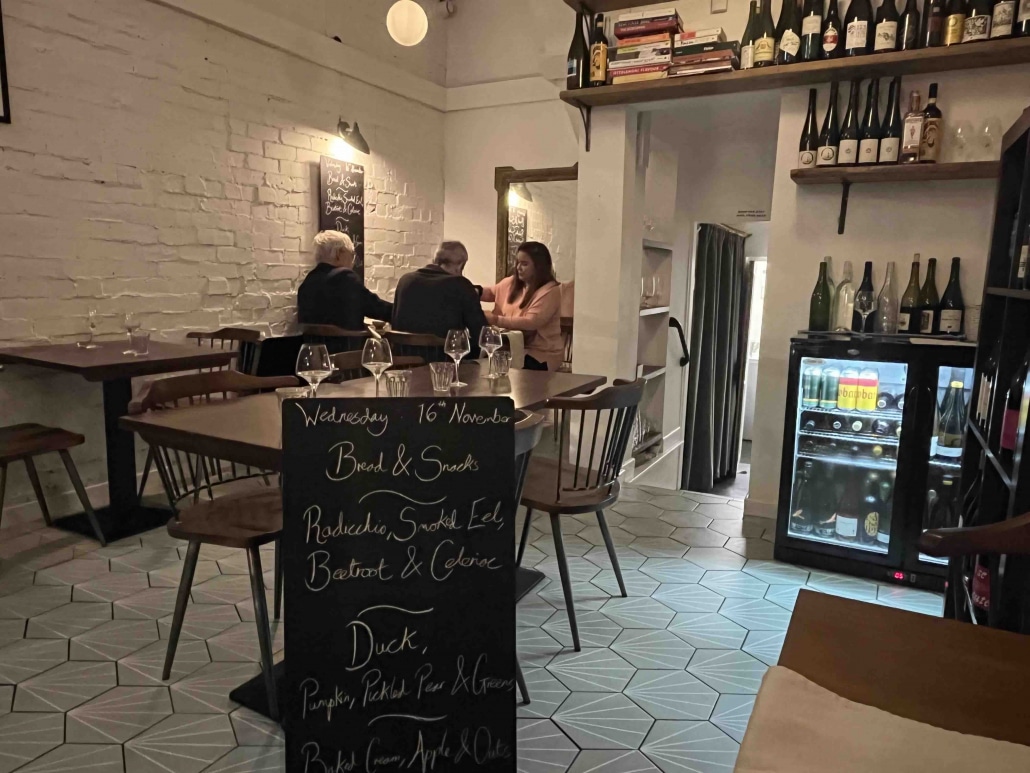
Bread and snacks such as gossamer light panisse and delicate cod’s roe (oddly with crisps) are followed by a sublime assembly of smoked eel, beetroot, celeriac and some bracingly bitter radicchio. 

I resist the £10 cheese supplement but do cough up the same sum for an extra fish special, which arrives next and is my favourite dish of a solo evening when I am spared the tyranny of jousting with a ‘lovely review companion’ over who eats what. 

The wild sea bass is all mine and I’m wild about it in its whey sauce, laced with bottarga, stems of bitter puntarelle peeping out. Once again it’s a case of that’s amaro and I’m not complaining.

Then onto pleasingly pink duck breast in a pumpkin puree, the bite here from chunks of pickled pear and further uncompromising greens. With it I can’t resist a glass of tonight’s red special, an under the radar Grolleau from the Loire, where my modest bottle for the evening also originated – a La Pente de Chavigny Sauvignon Blanc from the talented Mikael Bouges. 

Baked cream with apple and oats completed the evening’s entertainment with a sense of little wasted, with everything to gain. Rab in the kitchen with one young assistant and Ben,  knowledgeable front of house, who has served his time in London. Less is definitely more at Hern.

Hern, Stainbeck Corner, 5, Leeds LS7 3PG. 0113 262 5809. Open Wednesday to Saturday from 6.30pm. Also open Saturday lunchtime with a small a la carte menu to road test new dishes.

Seven years separate your latest book, Healthy Vegan Street Food, from Vegan Street Food (and amazingly it’s over a decade since your statement breakthrough on MasterChef). How has the profile of plant-based cuisine changed in that time?

The landscape has changed so much I hardly recognise it any more!  Plant-based food has become incredibly politicised through the growth in veganism. Which has been both a good and bad thing. On the one hand, there exists quite a hard and sometimes judgemental line about a strict vegan lifestyle but also the increase in the number of people, all people but especially omnivores, eating plant-based food. With the wide availability of products, it’s such a big shift in how people eat. I think people (esp. the younger generations) have embraced this more flexitarian approach to eating and it’s definitely a good thing for them and the planet. Like anything in life there also appears to be a polar opposite response too, that’s quite hardline from dedicated carnivores. As a former sociologist I find all that quite interesting.

How important to the growth of veganism is the kind of South Asian food you promote?

I think we should all be incredibly grateful to the cuisines across Asia because there’s so much more function, health and respect in their cooking overall. South Asian food is more evolved from accessibility and seasonality, rather than relying on Dutch hot houses or globally shipped foods. And, of course, it has many ancient cultural and religious practices that have informed and shaped how people eat. We have so much to learn from Asian cultures in terms of plant-based food. Vegan mock meat was essentially invented in China by the Han dynasty over 500 years ago. 

The new book is no rehash. Hardly a duplicate recipe in there. Even the travel element is updated. The emphasis is on that word healthy, all aspects of which you explore. Is that growing awareness the main difference?

I think the book reflects both my own journey and also what’s going on around us – that people are more interested in wellness and health now. Although I grew up in a family that was always quite healthy, I think we just know so much more now. Having the opportunity to travel has taught me a lot from other countries approaches to health and wellness. Functional medicine is huge in the US. Sadly it’s quite hard to access that kind of healthcare here in UK. And even those who do have access pay a high price for that.

But I’ve always been interested in wellbeing and health. I worked for the NHS as a researcher in evidence-based practice for 18 years before MasterChef. After I became unwell due to an autoimmune disease I began studying nutrition and developing my expertise in creating healthier food (that’s still amazing to eat).

What are your major healthy eating tips?

Mostly plant-based whole food most of the time. The whole food part is important. If you’re eating vegan ready made crap from the supermarket then you’re going to feel like crap. 

My main tips are firstly making some time for prep. Having real food prepped makes it a lot easier to eat healthier while leading busy lives. Number one for me is batch cooking. You can also prepare one meal while prepping some things for other meals. So I always make at least one sauce (such as a simmered tomato sauce) that I can use in two or three dishes. I usually make this while making another meal such as batch cooking a stew, soup or dal. Something that’s protein-packed, with mushrooms or tofu/tempeh plus lots of fresh veggies. I always have cooked rice in the fridge, as cooled, cooked rice has a much lower glucose curve – and is the easiest thing to stir-fry with fresh veggies. Make it black or red rice and you’ve seriously raised the antioxidant and fibre game! Black rice is also higher in protein and rich in anthocyanin – the same thing that makes blueberries so blue (and good for us).

I always take prepped food when I’m on the go as well because we tend to eat more rubbish when we’re caught out hungry out of the house. I don’t eat gluten, so instead of grabbing a sandwich I’ll have homemade energy bars in my bag – there’s a fab recipe or two in Healthy Vegan Street Food. Or I often post recipes on my Instagram for healthy snacks and treats.

I also try to eat seasonally and locally where possible – apart from my spice emporium at home. Now I’m living in Italy it’s easier to eat like this as it’s simply how their markets and produce are run. Imported goods are super expensive.

How big a part has your own auto-immune problem played in this?

It’s played a big part really. I was always pretty healthy until my 40s. Being a former researcher I became laser focused on finding answers. But what I’ve learned, like any good researcher, is I have a lot more questions. Social media would have us believe we can cure ourselves of all kinds of diseases but I think this is unfair at best and dangerous at its worst.  It can make you feel like you’ve failed if you don’t get better. But the truth is, you can only make the best of your own situation. There are no cure all easy answers sadly. We can keep ourselves in the best shape possible, so we are in the best place to handle whatever comes at us, physically or mentally. That’s all we can do.

What are your feeling about the rash of vegan ready meals?

It worries me a lot. On the one hand, as I mentioned before, it’s drawn more people into eating plant-based. And to be fair, if they’re choosing a ready made vegan lasagne over a readymade meat lasagne, then at least it’s a small change. But we have to compare like with like, and ready made food is not great for us and should not be the main part of our diet. We need to eat whole foods, mostly plants, fresh and raw foods, fermented foods, healthy proteins and fats, this is true whatever our dietary choices and even more so as we age.

This is what I wanted Healthy Vegan Street Food to be about – healthy real food that’s more balanced and considered when it comes to nutrition. It’s a focus on making sure someone whose diet is primarily plant-based, would be getting most of the nutrients they need. If someone is solely vegan then you will always need to supplement a little. But to eat well for most of the time, the food has to be delicious and that’s what I wanted to create. So it’s possible to have treats and snacks as well as gourmet banquets, that are flavour-packed but also satisfying. 

How important is a plant-based cuisine in the fight against global warming?

We know that the commercial production of food impacts climate change in quite drastic ways. Obviously capitalism is, well capitalising, on the whole plant-based market. As it is too with the wellness industry. But we shouldn’t throw the baby out with the bath water. We need to take better care of the planet and ourselves. And while it’s just a small thing, I feel that creating exciting, healthy and delicious things to eat made of plants is a pretty good place to start. 

Tell us about your current location in Italy – a far remove both from Chorlton, where you lived, and your Far East adventures.

We moved to Italy just before Brexit. Then the pandemic hit, which slowed our project plans down immensely – as it did for everyone. We moved here to Liguria to create a business that was more aligned to a healthier way of life. We have been building a retreat in the coastal mountains. Nothing complicated or any nutri-nonsense. Just simple principles of Move Well, Breath Well and Eat Well. Looking at the evidence base, these simple principles can give us the longer, healthier and happier life we all hope for. So yoga and hiking, cold water swimming and biodynamic breathwork (think Wim Hof) and together with delicious food and plant forward cookery lessons.

Your ‘Winter Reset’ programme is about to launch. Tell me about the aims of your Wellness Italy project.

This is our first opening for the retreat, so it’s a bit of a soft launch before next year. Our aim is to test the programme before we open the glamping site in the spring. This Winter Reset retreat is focused on yoga and breathwork, with accommodation in the village rather than camping on this occasion. 

We have some incredible teachers coming to support our guests. I actually met one person at a retreat in Thailand and have done some work with her since. I knew I wanted her to be part of the programme as a teacher. We hope next year that we can offer affordable retreat places for people who really need the opportunity. 

I’m well aware that it can be an elitist type of holiday. But we’re aiming to make it something more accessible. Everyone deserves to feel healthier and happier, not just those who can afford it. So we hope to start a Pay It Forward scheme eventually to create a place for someone in need to come for free. I’m also very excited about finally getting to cook for people again. And with small intimate groups too, more like a healthy supper club. And if I get the chance, sneak into the yoga class at the back before I have to get back in the kitchen!

Healthy Vegan Street Food: Sustainable & healthy plant-based recipes from India to Indonesia by Jackie Kearney (Ryland Peters & Small, £20) Photography by Clare Winfield © Ryland Peters & Small. She has published four previous books with them and the BLOG on her ‘Hungry Gecko’ website is an essential background read. 

Don’t miss Jackie’s showstopping recipe for Nasi Campur featured on my website.

‘Winter Reset’ runs from December 8-12 at Jackie’s Italian base of Pieve di Teco, high in the Ligurian mountains.  To find out more email mywellnessitaly@gmail.com .

Back in the day most folk’s first encounter with Indonesian food was probably via a Rijstaffel in Amsterdam or any Dutch city, an all-you-can eat buffet, at heart a colonial legacy. At its centre would be mounds of cooked rice – the Nasi of Nasi Goreng fame, that now ubiquitous fried rice dish, often featuring chicken or prawns.

Indonesia is the world’s third largest producer of rice and farmer must make offerings of the sacred grain at harvest time to Dewi Sri, the goddess of rice and fertility. This can involve eve trekking to the top of a volcano, of which there are many.

In her fascinating new book, Healthy Vegan Street Food (Ryland Peters & Small, £20) Jackie Kearney makes rice the centrepiece of her own Indonesian/Malaysian-influenced showstopper, but it consists of just three or four plant-based elements and the rice is the more nutritious black variety. 

Healthy eating is at the core of the Masterchef legend’s fresh batch of recipes – without sacrificing flavour. As proof let me introduce you, in this exclusive extract, to her recipe for Simple Nasi Campur: Tempeh brittle, purple potato curry and coconut kale stir-fry.

“Indonesia’s answer to India’s thali. This selection plate means ‘mixed rice’, simply a plate of rice with three or four different dishes. It’s a generic term used across Indonesia and Malaysia. Nasi padang is a type of nasi campur, originating from the city of Padang in West Sumatra, where the mixed rice plate was served as a huge banquet alongside multiple curries made with meat, fish and vegetables, plus spicy sambals, peanuts and eggs.

“The Dutch colonialists adored this Minangkabau banqueting, which they called ‘rijstaffel’ or ‘rice-table’. Rijstaffel restaurants are incredibly popular throughout the Netherlands, and a closer foodie experience for most Europeans. Go hungry and be prepared for 15–20 dishes to be laid around the table.

“This recipe is a simplified little taste of nasi campur to make at home. The moreish tempeh brittle recipe uses a significant amount of (unrefined) sugars, so the portion should be a very small part of the whole platter, or give this a miss if you are trying to reduce your sugar intake and simply fry some soy-marinated tempeh instead. The kale stir-fry and simple curry are super-quick to prepare. You could also add other Indonesian elements like loaded cassava fries, manadu ‘woku’ curry or Indonesian corn ‘ribs’, if you want to create a larger rijstaffel.”

TEMPEH BRITTLE

250g tempeh; 1 tbsp plus 1 tsp culinary coconut oil, or use good-quality vegetable oil; 1-cm/½ -in thumb of fresh ginger, peeled and finely chopped (about 2 teaspoons), or use 1 tsp ginger paste;  2 tbsp coconut sugar; 1 tbsp date syrup, or use pure maple syrup or unrefined coconut sugar; 3 tbsp soy sauce; large pinch of salt. Baking sheet, lined with parchment. Serves 6.

Preheat the oven to 190°C (375°F) Gas 5. Cut the tempeh into 6 mm/¼ in thick slices, then slice into 1 cm/½ in wide small pieces (the length will be the width of your tempeh block).

Place a wide frying pan over high heat with 1 tbsp of the oil. When the oil is very hot, add the tempeh pieces. Fry for 8–10 minutes until crispy and brown on all sides. Remove and place on paper towels to drain.

In the same pan, add another teaspoon of oil and add the ginger. Turn down heat to low and cook gently for 2 minutes, then add the remaining ingredients (except the tempeh). Bring the mixture to a low simmer until a thick syrup starts to form, then add the tempeh pieces. Mix well to coat all the pieces and fry gently until the liquid is reduced and sticky.

Lay the pieces onto the lined baking sheet and bake in the preheated oven for 10 minutes until crispy and nicely browned. Remove and set aside to cool. The pieces will then become more brittle and crunchy.

COCONUT KALE STIR-FRY

1 tbsp extra-virgin coconut oil, or use culinary coconut oil or good-quality vegetable oil; 7–8 curry leaves; 1 large brown onion, thinly sliced; 3 fat garlic cloves, thinly sliced; ½ tsp ground turmeric; 7.5-10-cm/3-4-in cinnamon stick; 250–300g bunch or 200g bag of kale, thick stems removed and thinly sliced; 75g desiccated unsweetened shredded coconut, soaked in boiling water for 15 minutes; 2 green chillies, chopped; ½-1 tsp salt, to taste; freshly squeezed juice of 1 lime (about ½ tbsp). Serves 6.

Place a wok or large frying pan over high heat. Add the oil and then add the curry leaves, frying for 20–30 seconds. Now add the onion, garlic, turmeric and cinnamon. Turn down the heat to medium–low, and gently stir-fry for 3-4 minutes until the onions are softened and the garlic is golden brown.

Add the kale and turn up the heat to medium–high. Stir-fry for 8-10 minutes until the kale starts to soften, depending on how crunchy you prefer your kale. Drain the desiccated unsweetened shredded coconut and squeeze out any excess water. Add the coconut and chillies to the pan, mix well and cook for 1 minute more.

Season with salt and remove from the heat. Add the lime juice and mix well. Serve immediately.

PURPLE POTATO CURRY

½ tbsp culinary coconut oil, or use good-quality vegetable oil; 1 large brown onion, finely chopped; 2 fat garlic cloves, finely chopped, or use 2 tsp garlic paste; 4-8 small red chillies, to taste; ¼ tsp chilli powder; 1 tsp ground cumin; 1 tbsp ground coriander; 400g can plum tomatoes; 250 g purple potatoes, peeled and cubed, or use new potatoes; 

250g firm tofu, cubed (and lightly baked if you prefer); ½-1 tsp salt, to taste. Serves 6.

Place a large frying pan or wok over medium-high heat and add the oil. Add the onion and sauté for 4-5 minutes until translucent. Add the garlic, cook for 1 minute, then add the chillies and ground spices. Add the tomatoes (and juices) plus 3½ tbsp water, then squash the tomatoes to a pulp. Simmer for a few minutes, then remove from the heat.

Using a stick blender, blitz until smooth. Return the pan to high heat and add the potatoes. Place a lid on the pan, turn the heat down to low and simmer the potatoes for 20-25 minutes until soft but not falling apart. Add the tofu pieces. Season with salt and add a little more water if needed. This curry can be reheated when needed.

TO SERVE

Cooked black rice; 3–4 tbsp sambal balado; 3-4 tbsp red-skinned peanuts, lightly toasted, or use cashew nuts; freshly chopped coriander; rice crackers.

To serve the nasi campur individually, place some cooked black rice in the centre of a plate (or on a banana leaf if you like). Add a large spoonful of each of the dishes around the outside, plus a spoonful of sambal balado (or hot chilli sambal) and a spoonful of toasted red skinned peanuts. Sprinkle the potato curry with a little fresh coriander and add a few rice crackers, if you like. Indonesian rice crackers are fried, so I prefer to serve with baked Vietnamese-style crackers for a healthier option.

SAMBAL BALADO:  This Indonesian chilli and tomato condiment is a cornerstone of Indonesian food. Buy in or follow this recipe, which will make 250ml. 10-12 large dried red chillies, to taste, soaked in boiling water for 15-20 minutes; 2-6 Thai chillies (optional); 1 small red onion, roughly chopped; 3 fat garlic cloves; 1 large tomato, halved and deseeded; ¼ tbsp culinary/unflavoured coconut oil; 2-3 fresh or dried kaffir lime leaves (optional); ½ tsp date syrup (or maple syrup/unrefined coconut sugar); ½-1 tsp salt,, to taste; freshly squeezed juice of one lime;. 

Drain the soaked chillies and add to a blender or food processor along with fresh chillies (if using), onion, garlic and tomato. Blitz to a rough pulp, then add to a small pan with the coconut oil. Place over medium heat and bring to a simmer. Add the lime leaves, date syrup and salt, and simmer gently for 10-12 minutes until the liquid reduces. Add the lime juice, mix well and taste. Adjust the seasoning, adding more date syrup or salt, if needed. Store in a sterilised jar and keep in the fridge for up to two weeks.

Healthy Vegan Street Food: Sustainable & healthy plant-based recipes from India to Indonesia by Jackie Kearney (Ryland Peters & Small, £20) Photography by Clare Winfield © Ryland Peters & Small. She has published four previous books with them and the BLOG on her ‘Hungry Gecko’ website is an essential background read. 

Check out my recent interview with Jackie.

Grandes Pagos de Espana is a prestige association of single estate Spanish wineries. A broad church indeed as I discovered at a recent public tasting at Manchester’s hub of all things Iberian, the Instituto Cervantes. The seven bottles we sampled ranged from a new wave richer-style Txakoli white from the Basque Country to a minimal intervention Mencia-led old vines field blend from Leon. I particularly liked the 100 per cent Garnacha Secastilla from the Somontano region.

Unsurprisingly though it was a trio of reds from a different but very familar grape that finished proceedings, culminating in the Pago Negralada from Abadia Retuerta. 

Wines from this estate are regularly supplied to winemaking schools as benchmark examples of Tempranillo, Spain’s most widely planted premium varietal. That information came from Miguel Gavita, who had guided through the Pagos tasting. No false modesty here – Miguel works for Abadia – but he can be forgiven. I know first hand, in situ, how good their wines can be. Perhaps the wonderful setting influenced my judgement when I stayed there one glorious late spring. It’s all coming back.

My planned visit to this luxury hotel with its own winery two hours north of Madrid had been nipped in the bud when a journalists’ press trip was cancelled. Then I ran into the Abadia head honcho at a Relais & Chateaux bash in Cheshire and he said: go on, we’ll host you solo. Le Domaine lodging project was still a work in progress when I arrived

Heavenly Retreat Among Spain’s Great Vineyards

Storks and cranes, the skyline of an abbey fortress surrounded by vineyard. The storks are nesting busily in the 12th century belltower; the cranes, the giant mechanical sort, are at rest. This is a Spanish bank holiday and work will resume tomorrow on turning former monks’ dwellings and stables into eight new guest rooms and the Sanctuario spa/pool complex. To complete the transformation into one of Spain’s finest hotels. 

Welcome to Abadia Retuerta, westernmost of the wineries producing some of Spain’s greatest reds along the River Duero’s Golden Mile. Le Domaine, is the place to stay around here with just 22 rooms and a cuisine curated by one of the country’s Michelin-starred greats.

I’ve only just arrived and barely settled in my room, pausing open to fling open the shuttered windows for an eyeful of vines before I am out among them for a pre-prandial stroll. The view back is equally enchanting – pale, honeyed stone cunningly renovated, harmonising Romanesque and Baroque.

Such evenings of mellow sun and blue skies have been rare this spring. At 800m above sea-level here they expect nights to be cold, but it has been uncommonly wet, too, bad for the grapes planted across 700 hectares upon which Abadia’s fortunes are built.

In 2005 their flagship wine, the Seleccion Especial conquered all at the International Wine Challenge, capping a remarkable fast track rise for an operation only begun in 1995 on land previously part of the legendary Vega Sicilia estate. 

The winning  wine was from the 2001 vintage. I never expected to be served a bottle from that year with my dinner in the Refectorio, but there it was, still vigorous yet elegant, the quintessence of Tempranillo (with the support of some Cabernet Sauvignon).

The Refectorio was where the monks ate (and occasionally kept their livestock). Now these soaring white stone vaults are home to Le Domaine’s fine dining restaurant. For the holy men’s simple gruel, root veg and pond fish substitute sauteed cuttlefish with a reduction of its own juice, cod cheeks whitened with gelatine with a honey emulsion, market fish with seasonal ragout and its toasted bone juice, then crispy baby lamb with quinoa.

(Abadia owners Swiss pharmaceutical giant Novartis originally enlisted Andoni Luis Aduriz of Michelin-starred Mugaritz to launch the kitchen operation. It retains a star to this day plus one of those sustainability-savvy green stars. Similarly, the winery was designed by Bordeaux legend Pascal Delbeck, the man who revived Chateau Ausone.)

The estate is actually just outside the borders of the official Ribera del Duero wine denominacion, meaning the wines bear the name of the nearest town, Sardon del Duero.

This actually gives the winery more flexibility in the vines it plants and a portal for innovation. Alongside, Abadia Retuerta really feels like the cradle of winemaking in the region.

The Santa Maria de Retuerta abbey was originally founded in 1145, by Doña Mayor, wealthy daughter of Count Ansúrez, Lord of Valladolid – one of many fortified religious houses built during the Christian “Re- conquest” of Castile from the Moors. The Ansurez family left “terras et vineas” (land and vines) to the French-based order of St Norbert, which was the beginning of the estate’s long history of producing wine. 

The abbey, though, after splendid additional building work during the Baroque era, fell into a steep decline until the current sensitive renovation that marries light-filled chic interiors (lots of marble, linen and luxury fittings) in the bedrooms in the Baroque half with the miraculously preserved original church and sacristy. 

Off the utterly calm cloisters you’ll find an even calmer yoga room, hi-tech meeting rooms and the Vinoteca casual dining space new and old stone all seamlessly joined… while high above the resident stork family keep a beady eye on guests.

Most of these come with wine in mind, sampling first at the Abadia Retuerta’s own tasting room in the winery and then visiting rival establishments along the route to “wine capital” Penafiel. Le Domaine offers a unique personal butler service that can sort out all arrangements for you. Hot air balloon trip, helicopter tour or, closer to the soil a horseback ride? Just ask.

My butler Juan ferried me east to Penafiel to see the remarkable, elongated white castle on the hill and the Richard Rogers-designed Protos winery. It’s a workaday place, as wine towns often are, but with lots of attractive tapas haunts and an astonishing enclosed medieval square called the Plaza del Coso. Folk hire the balconies of its private houses when bullfights are held there. On our visit the shutters were closed, a couple of cats snoozed and it shimmered in the sun like the epitome of Old Castile.

Delightful, too, my last walk before departure at Le Domaine – along a raised path between the Duero Canal and the river proper. The birdlife is abundant and the spring flowers are glorious. The estate pays the same meticulous attention to stewarding the environment as it does to producing proper wine and pampering luxury guests. 

Mummy stork suddenly takes wing and flaps across the vineyards under a cloudless sky. A final glass of Seleccion Especial awaits me in my cool room. I think I’ve gone to heaven.

Abadia Retuerta, Carretera Nacional, 47340 Sardon de Duero, Spain. 

My modest home town of Todmorden boasts four butchers. Which is remarkable these days. Three in the Market Hall (voted Britain’s best small market in 2018) and another around the corner. There’s one I go to especially for good value game birds; another is the place for rose veal, Dexter beef and free range chickens, while Bracewell’s regularly buys in whole Pitlochry venison carcasses and salt marsh lamb from Cumbria. And stocks trip, too, if that’s your bag.

An extra bonus on Saturdays is the outside stall run by Long Causeway Trading. Run by Alison Eason and Sharon Akerboom, once of Levenhulme’s legendary That Cafe, it offers a home-made cornucopia from imaginative savoury and sweet tarts to addictive Seville orange and Jura whisky marmalade. But the real draw for me is the lucky dip line-up of cool boxes containing all manner of meats, frozen and fresh, from their farm. 

A recent Saturday serendipity was offal driven. I lifted up one lid to discover lamb hearts. I had to buy. Just an hour before over my breakfast coffee I’d had a ‘nose to tail’ flashback (I know it sounds painful) as I read Giles Coren’s Times review of the unlikely, belated arrival, in Marylebone of all places, of a third St John restaurant. Hearts, kidneys, trotters, roast bone marrow. As with so many folk, they all formed part of our Fergus Henderson epiphany at the original restaurant near Smithfield market. Alas, rolled pig’s spleen, say, was a step too far.

With his revelatory elevation of cheap cuts Fergus is arguably the most influential chef/restaurateur of the past three decades. When in New York I couldn’t resist the allure of April Bloomfield’s The Spotted Pig in the West Village. This uncompromising gastropub, which closed in 2020, used to hold an annual Fergus-Stock event with its culinary hero in attendance – “known for his kooky demeanour and round, large eyeglasses” wrote one starstruck critic. 

All of which is a roundabout way to those 60p a shot lamb hearts… and what did I do with them? I followed Fergus, of course. Not the recipe in 1999’s Nose To Tail Eating, which entailed (sic) elaborate stuffing, stock and red wine. Instead I went for the fresher treatment given in The Book of St John (2019) – Grilled Lamb’s Hearts, Peas and Mint. It was quite a treat for me and the dogs enjoyed the fatty carapace I cut off the grilled hearts.

Here’s the recipe (to serve 6, or 3 as a main course, 1 good-sized lamb’s heart will suffice as a starter, 2 each as a main course)… I had  to substitute frozen peas.

Ingredients 6 lamb’s hearts, marinated overnight in balsamic vinegar, extra virgin olive oil, thyme, parsley stalks, sliced garlic; 8 spring onions, trimmed and cleaned; 3 heads of little gem lettuce, washed and separated; 2 large handfuls of freshly podded peas; a handful of pea shoots per person; large handful of extra fine capers,

thoroughly drained. 

For the mint dressing: 1 large bunch of mint, picked and stalks retained; 80g demerara sugar; 200ml malt or red wine vinegar; 100ml extra virgin olive oil; sea salt and black pepper.

Method First make the mint dressing. Bash the mint stalks with the back of a knife and place in a small pan with the demerara sugar and vinegar. Bring to a simmer for just long enough to melt the sugar, then set aside to cool thoroughly and infuse. Once ready, finely chop the mint and strain the cold vinegar over the leaves. Whisk in the olive oil, seasoning to taste.

To cook the lamb’s hearts you will need a cast-iron griddle or barbecue. Your hearts should be room temperature, not fridge cold, and the grill should be ferociously hot. Season boldly and place the hearts on the grill, cook for a minute and a half each side, then set aside to rest. A rare heart is a challenge, so aim instead for a blushing medium within. Now season and grill the spring onions in much the same way, charring with intent.

To serve, slice the hearts into slivers about half the width of your little finger, being careful to retain the delicious juices that are exuded in the resting. Place the little gems, peas, pea shoots and capers in a large bowl, then introduce the heart, resting juices, spring onions and mint dressing. Serve with chilled red wine.

Extracted from The Book of St John by Fergus Henderson and Trevor Gulliver (Ebury Press, £28)