Some cookbooks have a longer shelf life than others. Well-thumbed, splattered indelibly with ingredient stains, they’ve stayed the course. Many courses, if you forgive the culinary jeu de mot. One such tome is The Carved Angel Cookbook by Joyce Molyneux, a bastion of my recipe collection since it was published in 1990. It sold 50,000 copies despite the chef’s lack of TV exposure or reluctance to self-publicise. Unlike a certain Mr Floyd, who ran a gastropub upriver from Joyce’s Dartmouth, Devon base. Until bankruptcy.

Her  book celebrates the very special restaurant on the riverfront, where she made her name. I mention it now because this groundbreaking female chef turns 90 this month after being retired for well over two decades. 

Happy Birthday, Joyce (and fellow legend Shaun Hill, 75 this week and still at the stove in his Michelin-starred Walnut Tree, near Abergavenny). 

An appropriate dish to cook in Joyce’s honour might well be the famous Salmon in Puff Pastry with Stem Ginger and Currants, invented by her mentor George Perry-Smith when she worked for him at The Hole in The Wall, Bath in the Sixties. It accompanied her to Dartmouth when in the early Seventies he set up her and his stepson, Tom Jaine, to run the Carved Angel.

One hitch, though. It’s not in the The Carved Angel Cookbook. I’d got it in my head that  it was. An easy enough mistake to make. You’ll certainly find it in two Jane Grigson books, her Fish Book (1993) and The Observer Guide to British Food (1984),where this great food scholar/cook writes: “I’d gathered that the source of the idea was a medieval recipe, but then I found something almost identical in the Cook and Confectioner’s Dictionary by John Nott (1726, reprinted in 1980). In that more fanciful time, the pastry was scored to look like a fish; inside were mace, butter and ginger in slices, along with the salmon.”

For the salmon Perry-Smith insisted on best Wye, then Tamar when he moved his own restaurant to Cornwall; for Joyce definitely Dart?

There was an obvious affinity between Joyce and Jane (who died of cancer in 1990). Tom recalled Jane and her irascible poet/critic husband Geoffrey coming for dinner to the Angel once. Joyce was apprehensive because at least one recipe had come straight from one of Jane’s books. Fortunately all went swimmingly.

Years later, Joyce would hang a grand Jane Bown portrait of Jane at the threshold of her kitchen and, one further link, Jane’s daughter Sophie was co-author of The Carved Angel Cookbook.

All of which I find fascinating but it still leaves me adrift of a birthday dish. Easy really. Let’s keep the puff pastry. Joyce provides a recipe: you could buy it in but insist on butter. It provides the light casing for a very springlike dish – A Pastry of Quail’s Eggs and Asparagus with a Herb and Cream Sauce. Wild cepes would be a luxury addition but are not essential. Check out the recipe at the end of this article. As for that definitive salmon and ginger en croute dish Google and ye will find. Versions are all over the Public Domain.

So what makes Joyce Molyneux and the Carved Angel so special 30 years on?

I happened to be in Bath this year for International Women/s Day. By odd coincidence that city has been Jan’s home since she retired in 1999, having taken ownership of the Angel years before. I called her groundbreaking before. That she certainly was, as was evident during the infrequent dinners we booked there. Joyce was always there in the properly open kitchen – an innovation in those times – with a larger quotient of female sous chefs than you’d normally encounter. And a sense of calm.

It’s seen as cool these days for kitchen staff, not just servers, to bring out  plate to table. That was the norm there. Local sourcing? Farm to fork? In the book there’s a shot of the chef patron harvesting from her own lofty allotment above the winding River Dart. She made exemplary use of the seafood on her doorstep and first introduced me to samphire plucked from the foreshore.

The menu, invariably just a few dishes, no plate overcrowded, avoided the Froglification of ‘fine dining’ at that time. Still I couldn’t resist substituting feuilleté for puff. The true French influences are obvious, yet they are filtered through the acutely Gallic sensibilities of Perry-Smith, Grigson and, inevitably, Elizabeth David. I can’t recall how many covers there were. Not many. Everyone appeared to be enjoying themselves. We certainly did.

The story of how Joyce achieved such eminence, even for a while keeping a Michelin star,  is striking. Read Rachel Cooke’s tribute as The Observer Food Monthly gave her a Lifetime Achievement Award in 2017.

It traces her journey from domestic science classes designed to equip a gal for marriage (Joyce never wed) via a revelation what gastronomy could be during an eight stint in a Stratford restaurant to the Hole in The Wall epiphany.

How The Carved Angel soared and then, post Joyce, began its descent

When the Good Food Guide named The Carved Angel the Best Real Food Restaurant of 1984 it was a remarkable reward for Joyce Molyneux’s persistence in following her culinary vision. She took over completely when Tom left the following year. In his memoir of that time he quotes a poem about the Carved Angel written by adopted Devonian and regular customer Poet Laureate Ted Hughes: 

‘The Angel carved in wood

Resisted all temptation.

She fasted and withstood

Libidinous immolation

And anointings of breasts

Of birds and thighs of beasts.

She did not bat an eye

When those two loose-mouthed harlots

Claret and Burgundy

Turned glass and drinker scarlet.

She barely coloured – say

Chassagne Montrachet.

She only cracked when Tom

Plucked Sally from the shrine as

A cork out of the Dom.

This bomb among the diners

Shattered the Angel – left

Her not so carved as cleft.’

Joyce continued to run The Carved Angel until 1999. Since her retirement it’s had highs and lows under several ownerships. As The New Angel under turbulent celebrity chef John Burton Race it briefly regained its Michelin star. Nowadays, rebranded The Angel, the kitchen is in the hands of 2018 Masterchef: The Professionals finalist Elly Wentworth. Along the quay the big chef name in town now is Mitch Tonks at The Seahorse. His culinary hero? Joyce Molyneux.

A Feuilleté of Quail’s Eggs and Asparagus with a Herb and Cream Sauce (serves 4)

Ingredients

100g puff pastry; 8 quail’s eggs; 225g green asparagus tips; 1 egg, beaten; sesame or poppy seeds; Messine herb sauce; chervil or watercress, to garnish.

Method

Roll out the pastry on a lightly floured surface to form a 20cm square, 4mm thick. Trim edges and divide into four 10cm squares. Place on a baking sheet; rest in fridge for at last 30 minutes. Boil  pan of water. Add egg for one and half minutes drain, rinse with cold water and place in a bowl of cold water to rest. Tie the asparagus in a bundle, cook in boiling, salted water until tender (5 mins). Drain and keep warm.

Brush pastry with beaten egg and sprinkle with seeds. Bake in a pre-heated oven, gas mark 9 for 5-7 minutes until golden brown and risen. Out of he oven cut each so there’s a lid. Store the lids in a warm place for use later.

Re-heat the eggs in hot water for a minute and heat the sauce thoroughly. Drain eggs and place two in each pastry case with asparagus and coat with sauce. Cover with pastry lids and garnish.

For those of you who pigeonhole Jack Monroe as just a consumer Joan of Arc, championing society’s downtrodden and deprived I have two words: magnolia petals.

This week she Tweeted about ‘A Few of my Favourite Things’ and nature’s free bounty featured. Of course, it did.

She wrote: “Did you know that magnolia petals are edible? They’re like chicory; a crunchy and pleasantly bitter morsel with a peppery aftertaste similar to rocket/arugula. Beautiful and delicious in salads, or as a snack with a sliver of apple or pear and soft blue or other strong cheese.”

Immediately came my Damascene ‘you wait ages for a bus to come along… and then’ moment. Lunching at Another Hand up on Deansgate Mews, Manchester – there on the counter of the open kitchen sat a large tray of freshly foraged stuff including magnolia flowers.

There was also wild garlic, three cornered leek (milder, sweet, more onion flavoured) and sweetly scented black currant blossom. Chef/co-owner Julian Pizer had sourced them all around his home patch of Birchwood, Warrington.

So how does it work in the kitchen for much-travelled Kiwi chef Julian? “The magnolia has been pickled down, infused into syrups and dried to use in several applications through the summer like our magnolia set cream dessert with rhubarb and bbq grapes.”

Julian and his team collected 4kg of magnolia and are going back for a second forage. Foraging suggests wild but magnolia is mostly domesticated in the UK. You’ll find it in private gardens, parks and semi-wild. Its global history is mind-blowing, though. The Magnoliaceae family is recorded to be at least 20 million years old with plants in the same family being up to 95 million years old.

Here’s a pickled magnolia petals recipe (it’s not Julian’s) which, alas, turns the pickles brown, losing the vivid pink colour, but creates a flavour similar to pickled ginger, so it’s a  fine sushi accompaniment. It comes rom the website Eatweeds.

Ingredients

75 g magnolia petals; 100g rice vinegar, 35 g granulated sugar, pinch of salt.

Method

Pick petals that are ready to drop from the tree. Pack into a jar. In a small saucepan, heat the vinegar, sugar and salt. Stir to help the sugar dissolve and heat till steaming and the first tiny bubbles appear. Pour over the petals and let it cool before covering. Leave to steep for a week before using.

Add on a great soundtrack while you’re pickling: Jason Molina’s Hold On, Magnolia.

For our lunch (available until 3pm) at Another Hand we shared smoked fish, rosti with creme fraiche and a soft egg, plus avocado and tomato on rye and a generous grilled sandwich of smoked beef, fennel, celeriac and kraut. Much of th daytime menu centres around the outstanding naturally leavened organic bread from Holy Grain two doors away. Baker Danny Foggo teamed up with Julian and fellow chef Max Yorke (the duo worked at Cottonopolis and Edinburgh Castle) to host Three Hands deli on the bakery site as the precursor to their more ambitious joint project, Another Hand.

That daytime brunchy offering is very deli-led, but Julian’s food ratchets up to a different level with his evening small plates menu. Check out my upcoming Manchester Confidential review. Whether magnolia petals will feature let’s wait and see.

Another Hand, Unit F 253 Deansgate, Mews Level, Manchester, M3 4EN.

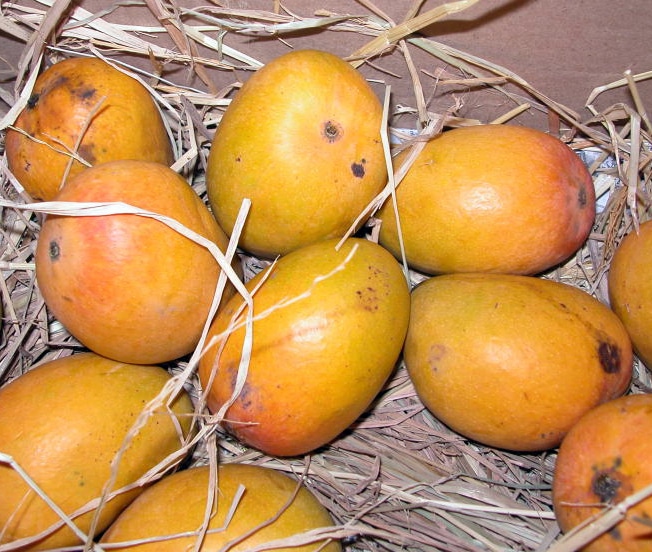
Alphonso mangoes are not lookers. Even the most mottled quince would win a beauty contest with them and the furry bloom of an in-season peach is infinitely more Instagrammable. But all is forgiven once you squeeze the exotic, saffron-coloured pulp out of the yellow skin, the ripe smell almost coconutty, a reminder of the South of India, whence they sprung. Think flavours of honey, melon, nectarine and apricot gone up a notch.

They are named after 15th century general Alfonso de Albuquerque, aka ‘Alfonso the Terrible’, conqueror of Goa. The Portuguese invaders brought to India from the New World red chillies, potatoes, maize, and tomatoes. In return the Sub-continent offered up its native mangoes. Apparently Alfonso (below) was very hands-on in creating a firmer, juicer variant of the fruit for export to Europe. Hard grafting, but what a result. 

Today there are several different varieties of Alphonso mangoes, primarily grown along the western coastal strip of Konkan. The acknowledged superstars are hand-harvested in the tiny Natwarlal plantation of Ratnagiri in Maharashtra. 

OK, every corner of India offers rivals – Badami, Himsagar, Kesar, Chaunsa, Dasheri – but the spring season mango rush is dominated by the Alphonso. Mumbai and other big cities even hold mango festivals. I hold my own. Alas, the season is as short as their shelf life once they arrive, so once again I sliced open a coulpe and guzzled, the juice dripping into my beard, before organising the rest to make a vat of sorbet (De-stone and extract the flesh from six to eight ripe mangoes, combine with the juice of two limes,100g icing sugar and 100ml double cream. Churn the puree in an ice cream maker for half an hour).

I get my annual fix from London-based Red Rickshaw, who specialise in sourcing hard-to find ingredients, primarily from India but also from across the globe. It’s hard to resist exploring their site, which always yields new fruit. Literally. So that’s how I stumbled upon Buddha’s Fingers (or Buddha’s Hand, main picture). This odd ancestor of our mainstream citrus fruits resembles a large lemon with finger-like segments growing from it. True to its name, it is considered a religious offering in Buddhist temples, typically given as a  New Year’s gift, symbolising good fortune.

It is still hanging in the balance whether I’m prepared to stump up £24.99 for a single specimen of a citrus fruit that seldom contains any tangible fruit, flesh or juice. Will it be worth it just to employ its formidable citrus fragrance for cocktails, candy making or salad dressings?

While I’m ‘hanging on by my finger tips’ to make a decision it’s time to prepare a Mango, Lime and Rum Syllabub, the recipe borrowed from Sunshine On A Plate (Penguin, £30), the gorgeous cookbook from Shelina Permalloo, 2012 Masterchef winner, who runs the Lakaz Maman Mauritian Street Kitchen in Southampton.

Ingredients

4 ginger biscuits, crushed; 300ml double cream; ½ vanilla pod, seeds scraped; 3tbsp unrefined icing sugar; 75ml rum, plus 4tsp; zest and juice of 4 limes; 150ml Alphonso mango puree; 2 Alphonso mangoes, peeled and cut into 2.5cm cubes; desiccated coconut and reservd lime zest plus optional mint leaves to decorate.  

Method

Put the ginger biscuits into a large plastic bag and bash vigorously with a rolling pin until you have a bag of crumbs. Using an electric whisk, lightly whip the double cream. Add the vanilla seeds, icing sugar, the 75ml of rum, lime juice and zest, reserving a little for decoration. Keep whisking until it forms light peaks. Add about one third of the mango purée and half the cubed mango and fold through for a marbled effect. T

o assemble the syllabubs, divide the crumbs between four glasses. Sprinkle a teaspoon of rum over each and top with the rest of the mango purée. Spoon the cream over the top. Just before serving, sprinkle with coconut and lime zest. Decorate with the mint leaves, if using.

The unlikely spectres of Cliff Richard and Paul Kitching haunt my imagination as I dine (magnificently) in a new Manchester hotel that restores my faith in exposed brickwork and small plates. Both the 81-year-old former poster boy of British pop and the one-time enfant terrible of Michelin tasting menus are still going strong. So this is no elegy.

My whimsical connection is The Alan’s former incarnation as the Arora hotel, in which Sir Cliff was a stakeholder, and the cv of current chef Iain Thomas (below), who learnt his trade under Kitching, once of Juniper in Altrincham, a restaurant that married wackiness with true one star quality. A bit like Cliff?

All this was back in the early part of this century and Manchester has moved on. Well, not always. Many incoming hospitality operators feel the need for bee motifs, Hacienda colour schemes and gratuitous homages to Emmeline Pankhurst, Alan Turing or Tony Wilson. 

That could have happened to the old Arora, later the Princess Street Hotel, which had long shed its star appeal. I can’t ascertain when the five Cliff-themed rooms were consigned to history – there ought to be a plaque.

Briefly in the basement the Arora was home to a ‘destination restaurant’, Obsidian. How dated neon-raked images of that doomed project look now. What a contrast to the sustainable core of the refit from the new owners, which strikes you as soon as you enter off Princess Street. The outside sign is so discreet that the ambition of the opened-out lobby/bar takes you aback. Welcome to a relaxed, Shoreditch vibe that continues across the 137 bedrooms of this six storey Grade II listed edifice, all vibrant brickwork and distressed paint.

Congratulations (and jubilations) to the raft of designers name-checked on the website. I was particularly smitten with the lobby floor made from a collage of fragmented and discarded marble pieces, and a bar front “inspired by the M62 that runs round our city” (do they really mean the M60?) consisting of cigarette butts, weeds, flowers all set in a resin.

It is all a playfully welcoming surprise. Yet my object in visiting is to check our Chef Iain’s all-day seasonal menu, with more ambitious small and larger plates in the evening. I first met him when he hosted a game dinner at reinvented old boozer The Edinburgh Castle in Manchester’s Ancoats neighbourhood. As with his predecessor in the kitchen there, Julian Pfizer (now of Another Hand) he was given his head and then the owners seemed to get cold feet about culinary ambition.

The Alan strikes just the right balance. From the off it seems just the kind of relaxed setting and offering if you are a hotel guest but there’s plenty of well-sourced interest on the menu to make it a destination in its own right. Ah, the sourcing. Iain name-checks the city centre Butcher’s Quarter for his meat, while mushrooms are from Polyspore, and  microgreens from Aztec Farms, the vertical farming start-up based at Manchester Science Park. On the drinks list there’s beer from the city’s own Pomona Island and Cloudwater with caffeine input from Ancoats Coffee. The wine list, understandably from further afield, is uninspiring, alas.

Then, provenance one-upmanship. As spring gathers pace expect a very special vegetable input from the chef’s own allotment in Tameside’s Hattersley Projects. I trust him to make the most of it all on the evidence of his impressive track record – in kitchens since 16 with stints at Establishment in Manchester (where Rosso now is), at the “amazing” Paul Kitching’s Michelin-starred 21212 in Edinburgh and s sidekick to Davey Aspin, one of the iconic chef names in Scotland.

At The Alan we asked to try all eight small plates on the menu, all priced around £5 to  £6.50. Attractive looking snacks and meat could await another visit. The plan was to sit at the chef’s table with a perfect eye-line onto the open kitchen, but old bones dictated we retrenched to a booth. 

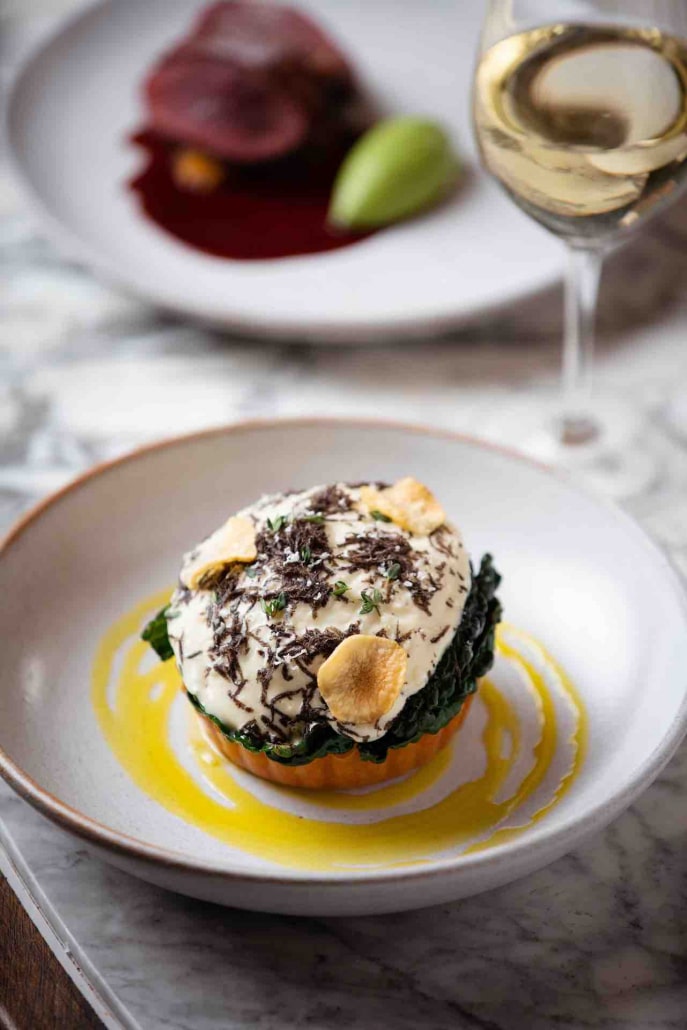
The dishes came in pairs and were a well-judged mixture of plant-based and flesh. No  duff note with either direction but we were most impressed with the vegan salt-baked celeriac with truffle and sherry vinegar and the cauliflower tikka with cumin, coriander and pomegranate, both managing to be earthy and yet delicate at the same time. Punchier was what threatens to become a Thomas signature dish – lamb fat hispi cabbage. Here lamb trimmings are rendered down and the fat is used to sous vide the cabbage, which is then warmed up in a lamb fat cream emulsion with braised shoulder.

There’s an equal richness to a potato and ox cheek terrine, an elaborate confection where 10 butter-brushed layers of finely sliced potato, a layer of ox cheek and a further 10 spud layers are sandwiched together, and served with blobs of French’s mustard and dill pickle gel.

Undoubtedly there’s an Ottolenghi influence going on. The likes of Confit thighs of Goosnargh chicken are glazed with pomegranate molasses, soy sauce aand mushroom ketchup and, also garnished with nasturtium leaves, that simple Turkish aubergine and tomato dishImam  Bayildi, that translates as “the Imam fainted”.

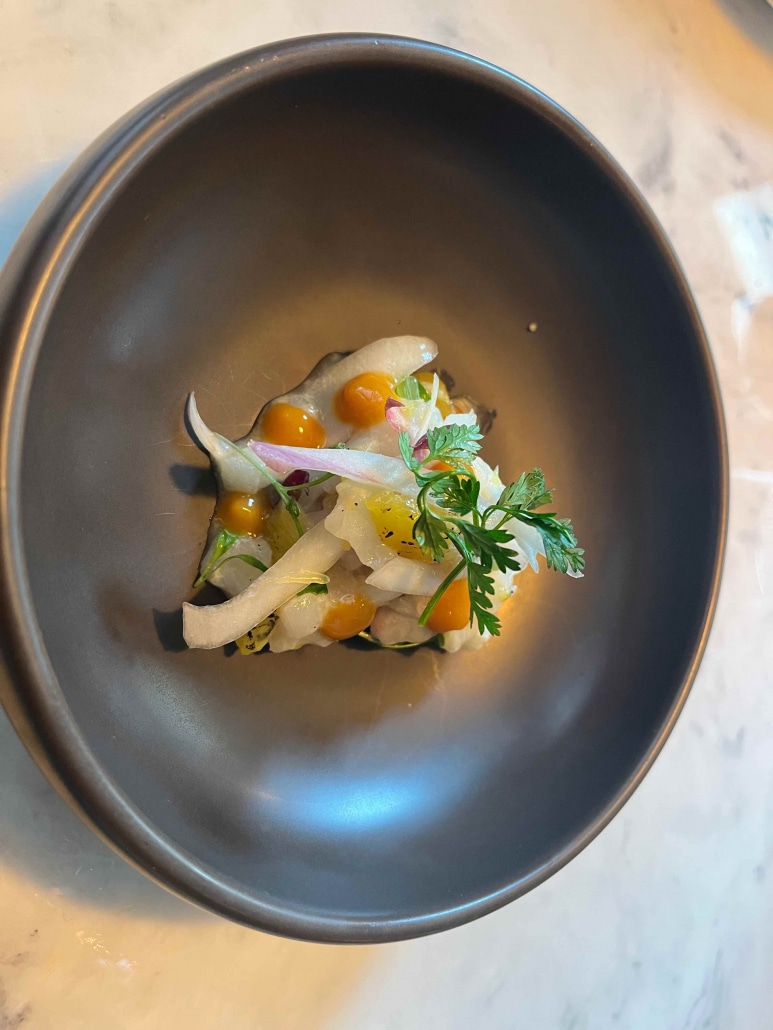
The Levantine spice palette of cumin, coriander, along with pomegranate arils also permeate Iain’s otherwise classical Cheshire beef tartare, but it’s all lightly handled. Ditto a ceviche of Scottish halibut, where chicory and but orange partner the fish rather than overwhelm. Is any hotel dining menu in Manchester (the obvious exception of Adam Reid at The French apart) better than this?

The Alan, 18 Princess Street, M1 4LG. 0161 236 8999. All rooms feature Emperor sized beds dressed in 200 thread count Egyptian cotton, 50” Samsung Smart TVs with Google Chromecast and pay-per-view movies, superfast Wi-Fi and Audio Pro Bluetooth speakers. The tech-forward hotel is also one of only four in the UK to offer Google Nest smart concierge in all its rooms. There are a variety of rooms on offer, the affordability of which gained The Alan a place in the ’40 UK Hotels For Under £100’ list in the latest Sunday Times.

It’s far from up there with P&O’s unceremonious mass cull of their crews but one of the more unsavoury moments in a troubled 2021 for the hospitality trade was Bruntwood’s decision to dispense with vin-yard, a bijou independent wine bar/shop at its Hatch ‘retail and leisure destination’ on Manchester’s Oxford Road. The landlord’s apparent reason was a need to recoup revenue lost during the pandemic by taking over booze sales from its tenants. The quality wine offering from vin-yard’s Anna Tutton has never been adequately replaced.

Anna Tutton at her vin-yard wine venue at Hatch. She has high hopes for her new venture

For several years it has been a ploy for developers, enlightened and otherwise, to add a dash of millennial cool to their sites by hosting street food wannabes on fixed term deals as a launchpad for eventually establishing their own permanent bases. Now with the economy in freefall that’s easier said than done. When I ran into Anna at a recent wine tasting she told me over lunch about her own life-after-Hatch plan for The Beeswing and it sounded a perfect next step, albeit again pitched as the icing on a property cake – at the Kampus ‘garden neighbourhood’ across the canal from the Village.

The Beeswing is a co-production with business partner Joe Maddock, who ran West Didsbury’s much-loved Pinchjo’s back in the day. For the new venture he’ll provide a small plate menu to match Anna’s eclectic wine offering (mainstream plus some natural). I was particularly taken with the black sesame crusted feta triangles, my main picture, from a menu that will reflect the melting pot of food styles around Manchester – including dals, plant-based and Ottolenghi-influenced Middle-Eastern. All food images by Rebecca Lupton.

Design – sneak preview courtesy of these 3D renders from Andy Gough – is in the hands of the talented and lovely Soo Wilkinson, co-founder of Chorlton’s The Creameries. Set upstairs above Nell’s Pizza place, it too looks a treat with its softened industrial look.

But now comes the rub. There is a budget deficit and Anna and Joe urgently need your crowdfunding help…

The pair’s initial costing was £80,000 and when the figure leapt up to over £100,000 they made up that deficit, but they £25,000 remain adrift of the new final total, so they have launched a crowdfunding campaign, deadline mid-April. It’s a great indie cause – contribute here.

Your potential rewards? You can pre-order a meal for two with wine for £50, or if you can’t wait for the restaurant to open, you can order a meal for six and two bottles of wine to be delivered to your home for £150. You can even help shape the menu by throwing £25 into the pot to be invited to a private dining event of menu cook-offs with chef Joe, and tell him what you think works – or doesn’t. I’ve invested in that one.

Kampus’ developers Capital & Centric and HBD have been pretty canny recruiting some established indie food and drink names to populate Instgrammably picturesque Little David Street. The presence of Pollen Bakery, Cloudwater, Madre, Great North Pie Co, Yum Cha and The Beeswing will attract a clientele way beyond the on-site apartment dwellers.

Cloudwater/Levanter collab at Kampus

This is still very much a work in progress, but to whet the appetite Manchester’s highest profile craft brewery, Cloudwater and Ramsbottom’s award-winning Spanish restaurant Levanter (sibling of Baratxuri) have unveiled a 10 week residency. This will consist of a series of globe-trotting weekend block parties around the ‘tropical garden’ with DJs saluting the likes of California beach sounds and raucous Mexican festivities for Cinco de Mayo, Irish folk parties and smooth NYC jazz.

My focus will obviously be on Levanter’s Joe Botham serving up his legendary giant paellas from 3pm at the canalside Bungalow. The residency kicks off on Easter weekend.

Such an old chestnut that one about ‘policemen are getting younger’. Stats say different and anyway the phrase is a reflection of our own mortality creeping up on us. Chefs, now that’s another matter. Especially when they’ve been fast-tracked by a shrewd mentor. Step forward Tom Kerridge and Connor Black. The first is a ubiquitous figure across the English food and drink scene, his latest telegenic showcase judging on the revamped Great British Menu; the second, a 25-year-old who first entered the Kerridge orbit aged just 15, has just made the leap forward to Head Chef at The Bull & Bear, in Manchester’s Stock Exchange Hotel.

What immediately appeals on dipping into Connor’ debut menu is the sense that he is very much his own man. From the start, in the summer of 2019, the northern outpost of the Kerridge has borne the big man’s stamp. Less the standard of food (at a price) that brought him two Michelin stars at The Hand and Flowers in Marlow; more the accomplished pub food you’ll find at his second operation in that town, The Coach.

Connor worked his way up to be sous-chef at The Hand before becoming Head Chef of The Shed, that posh pub’s intimate 10-cover private dining room. His meteoric rise stated much earlier. At 13 he was working part-time in kitchens on the Isle of Wight; at 15 he arrived at the Hand and Flowers for work experience and stayed; two years later he was named Hospitality Guild Apprentice of the Year. All the while contributing to menu development. A spell away working on the continent contributed to his development.

So what does all this bring to the plate in Manchester? A smaller menu, like so many places post-pandemic, yes, but the dishes are noticeably less hearty, though following the Kerridge “refined pub grub” template.

Definitely a good thing in these eyes as I accept starter advice and sample  Roasted Hand Dived Orkney Scallop with Pickled Crown Prince Pumpkin and Smoked Butter Sauce (£24.50) It’s exquisite. Only 60 of these very superior scallops are delivered each week and the storms have stymied even that until, luckily the day of my lunch. A ‘table snack’ of Cheddar Cheese Scones with Marmite Butter is less successful. Dry scones and I’d forgotten how Marmite Marmite is.

 A pre-opening journo jolly to Marlow showed me how seriously the Kerridge team sources. Witness this again with my main Dry Aged Udale Duck Breast off the rotisserie with Caramelised Endive, Rhubarb and Garlic Sausage ‘Cassoulet’ (£34). Up to 40 days in Udale’s Himalayan Salt Ageing Chamber intensifies the flavour of an already benchmark Creedy Carver duck. But the dish is enhanced by the subtle bittersweet/sharp flavours Connor brings to the accompaniments.

Belly of Blythburgh Pork with Marmite Glazed Hasselback Artichoke, Smoked Hazelnuts and Pear Ketchup (£34) and Roast Cornish Cod with Sweet Garlic Puree, Lemon Braised Leeks, Shiitake and Mushroom Consommé (£33.50) also take the eye.

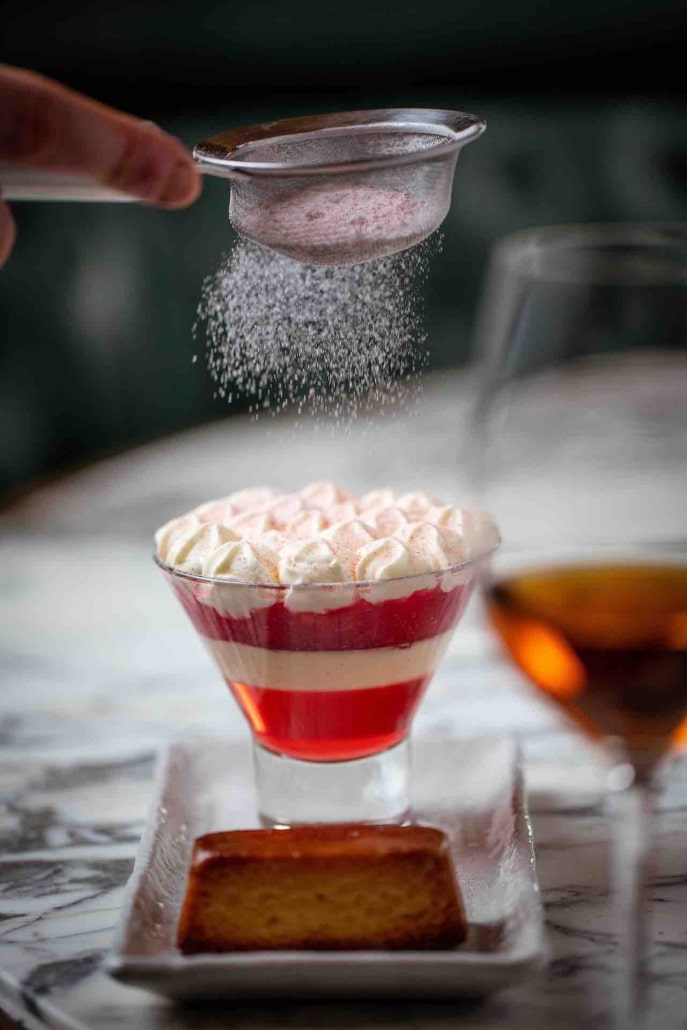
Rhubarb, bang in season, reappears in my retro trifle. All the puddings are £11.50, ranging from Warm Baked Eccles Cake with Lancashire Black Bomb Cheese to a Peanut Butter Crème Brûlée with Raspberry Jelly and Banana Yoghurt Sorbet.

The trading floor of the Grade II listed former Stock Exchange, is as imposing as ever, the large  open kitchen built to cater for a substantial number of covers. Meshed into the revamped B&B regime is a new Head of Food and Beverage, Matthew Griffin, who has previously worked under Jason Atherton. And Group Exec Chef the vastly experienced Warren Geraghty is regularly up from London. As a potential safety net? Will any of this phase young Connor? I doubt it.

The Bull & Bear, Stock Exchange Hotel, 4 Norfolk St, Manchester M2 1DW. 0161 470 902.

It is still hard to credit how much city development has escaped my attention while locked down in my Pennine fastness. Returning gradually to Manchester, I can suddenly feel adrift – and not always in a pleasurable way. Take Circle Square, a brooding behemoth of an apartment complex on the old BBC site off Oxford Road. 

OK, I first crossed its portals on a sullen, drizzly day but didn’t get the vibe promised by Vita Living: “Contemporary apartments and unreal amenities, all neighboured by leafy-green space in the form of the brand-new Symphony Park. Artisan shops, independent bars and restaurants surround Circle Square and make it a true urban oasis for everyone to enjoy.”

On the same day’s trail the ‘tropical garden’ at rival development Kampus looked ominously, bedraggled but the site opposite Canal Street offers a quirky mixed bag of living spaces, while formidable food and drink offerings (Pollen, Cloudwater, Beeswing) are on their way. Similarly, the giant towers of Deansgate Square are being serviced by quality delis (to spare the upmarket residents the trek to the Hulme Asda).

Circle Square’s own newly opened food hall is its most striking feature. Hello Oriental, an architecturally swirling three-floor, subterranean complex. boasts an Asian inspired bakery and café, a Vietnamese restaurant, a whole gallimaufry of East Asian street food options and a supermarket stocking an Instagrammable selection of packaged foodstuffs and colourful snacks hitherto available online. I suspect the small plate dining opportunities will prove more of a draw than the basement shop.

Strangely sterile the physical shop. Hardly anything on the shelves that counts as fresh. For that I’ll still be making my way down to ramshackle old Chinatown. We all have our favourite stores there. Mine is the Hang Won Hong on the corner of George Street and Booth Street. Chinese ingredients apart, it offers enough Thai and Korean staples to fuel my store cupboard. 

For my Chinese recipe needs I usually turn to Fuchsia Dunlop, for Korean Jordan Bourke and Rejina Pyo, for Japanese home cooking and ramen Ivan Orkin. Online for pan-Asian I’ve recently discovered mycookinghut.com/, an acclaimed blog by Leemei Tan-Boisgillot.

Here are a couple of her recipes, which feature in her latest cookbook, due out in June.

Korean Spicy Seafood Noodle Soup

Ingredients

1 tbsp sesame seeds; 15g dried wakame; 500g mussels, scrubbed and debearded; 1 tbsp sunflower oil; 1 onion, sliced; 3 garlic cloves, finely chopped; 1cm piece of root ginger, peeled and finely chopped; 4 dried shiitake mushrooms, soaked, drained and cut into thin strips; 1 tbsp Korean red pepper powder or cayenne pepper; chicken stock ¼ Chinese cabbage, core removed and cut into bite-sized pieces; 1 tbsp light soy sauce; 1 tbsp chilli oil; 300g raw, peeled large king prawns, tails left on, deveined; 400g squid, scored with a crisscross pattern and cut into bite-sized pieces; 500g cooked fresh fine egg noodles or 350g dried fine egg noodles; 2 spring onions, finely chopped.

Method

Heat a frying pan over a medium-high heat, then add the sesame seeds and dry-fry for a few minutes until the seeds begin to pop.Tip onto a plate and leave to one side.

Soak the dried wakame in a small bowl in warm water for about 10 minutes until it rehydrates. Drain, rinse and leave to one side.

Tap any mussels that are only partly opened and discard any that don’t shut. Put the mussels in a saucepan over a high heat and steam for 3–4 minutes, or until the shells open. Discard any that don’t open fully. There is no need to add any additional liquid to the pan, as the mussels will release their own liquid to steam in. Remove the mussels from their shells and leave to one side.

Heat the sunflower oil in a large saucepan over a medium-high heat. Add the onion and cook for 2–3 minutes until soft and translucent, then add the garlic and ginger and cook for 2 minutes, or until fragrant. Add the shiitake mushrooms and Korean red pepper powder and cook, stirring continuously, for 1 minute. Remove from the heat and add the chicken stock.

Return the pan to the heat and bring the stock to the boil. Add the Chinese cabbage and cook for 3–4 minutes until tender. Add the soy sauce and chilli oil and then add the prawns and squid. Bring to the boil for a few seconds, then reduce the heat to low, cover and simmer for 5–6 minutes, or until the prawns turn pink and are cooked through and the squid is tender. Three minutes before the end of cooking, add the mussels to heat through.

Divide the hot, cooked noodles into deep soup bowls, then spoon the prawns, squid, cabbage and mussels into the bowls.

Bring the chicken stock to a vigorous boil. Add the spring onions and prepared wakame to the bowls, then ladle in the piping hot stock. Sprinkle over the toasted sesame seeds and serve immediately.

Sichuan Mapo Tofu

This is a famous Sichuan dish that comes with a story. It is said that during the Qing dynasty, a restaurant on the outskirts of Chengdu was well known for a delicious, very spicy tofu dish, which was made by the restaurateur’s wife. She had pockmarks on her face, and as a result was called Mapo – ma means ‘pockmark’ and po means ‘elderly woman’, and her signature dish was called Mapo Dou Fu.

Ingredients

300g soft silken tofu, cut into bite-sized cubes; 1 tbsp sunflower oil; 1 cm piece of root ginger, peeled and finely chopped; 3 garlic cloves, finely chopped; 200g beef or pork mince; 2 tbsp chilli bean paste; 1 tbsp light soy sauce; 1 tsp granulated sugar; 1 tsp ground toasted Sichuan pepper; 1 tsp cornflour; 2 spring onions, roughly chopped. Serve with 400g cooked egg noodles

Method

Bring a large saucepan of water to the boil, then remove from the heat. Carefully tip the tofu into the water and leave to one side.

Heat the oil in a wok or frying pan over a medium-high heat. Add the ginger and garlic and stir-fry for 1–2 minutes until fragrant but not coloured. Add the mince, break up the lumps and cook, stirring occasionally, for 5 minutes, or until starting to brown. Add the chilli bean paste, soy sauce, sugar, ground Sichuan pepper and 200ml water, stir to combine and slowly bring to the boil.

Carefully drain the tofu and add it to the wok. Gently push the ingredients around the wok until the tofu pieces are coated with the sauce. Do not stir as it may break up the delicate tofu. Let it simmer for 3–5 minutes until heated through.

Meanwhile, combine the cornflour with 1 tablespoon water in a small bowl. Slowly pour the cornflour mixture into the wok or pan and gently fold through. Sprinkle over the spring onions and serve immediately with noodles.

• Both recipes are fromThe Asian Home Kitchen by Leemei Tan-Boisgillot, to be published by Nourish in hardback, price £20, on June 14, 2022. Leemai is a recipe writer, food stylist

Regionality is a foodie buzz word. Yet increasingly dishes in vogue transcend their locality. Take the dosa, fermented lentil and rice crepe of South India. Such is its popularity you’ll now find it across the whole of the Sub-continent and in many a street food spot in the UK (though I notice it is absent from the revamped Bundobust menu). Well, I always, felt I wasn’t getting the full masala dosa experience there with their mini-version. I like mine to be huge crispy, stuffed scrolls.

Which brings us, by a roundabout route, to the previous insularity of Spanish regional cuisines. Tapas and Pintxos may be Iberian cousins but  Andalucian and Basque culture and food stem from separate bedrocks. I recall an Eighties Spanish road trip when in some Castilian cantina I ordered a Manzanilla. Expecting a chilled glass of saline dry sherry from Sanlucar de Barrameida in the south, I was rewarded with a glass of chamomile (‘little apple’) tea. That confusion wouldn’t happen nowadays. Ditto on a Seville wine list you might easily find a Galician Albarino alongside sherries and local drops.

All corners of Spain retain distinctive cuisines of their own alongside the tourist staples of paella and sangria, but some very specific dishes named for their place of origin are also now ubiquitous in markets and on bar counters.

The Plaza Major is the glorious architectural centrepiece of Almagro

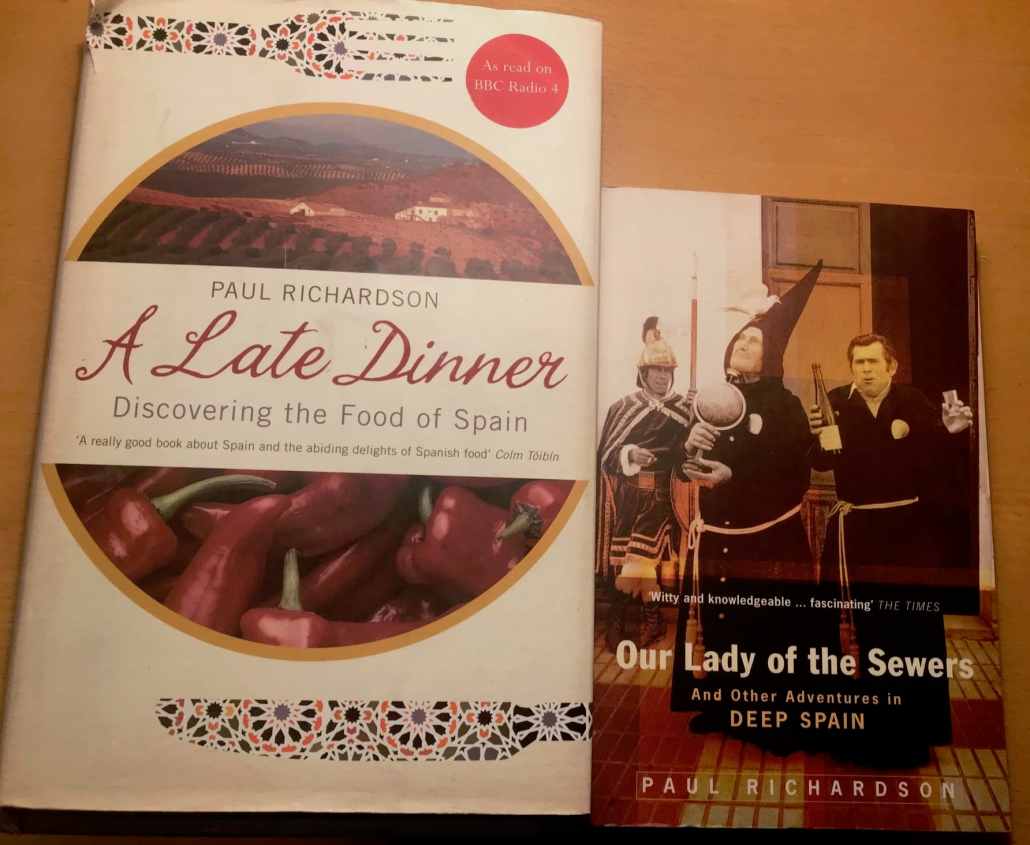
Take Berenjenas Almagro, pickled aubergine speciality from the sleepy La Mancha town of Almagro. Think a less complicated cousin of the Sicilian Caponata. Tastier maybe. I’d like to say I first came across the dish, which is eaten cold, in situ or even in Bilbao or Seville but it was in Paul Richardson’s revelatory 2007 culinary travelogue, A Late Dinner: Discovering The Food of Spain. More recently I found a workable recipe on Page 202 of Rick Stein’s Spain, spin-off from one of his more informed BBC series. Home prepared, though, it never tastes as good as in Spain.

Perched in the south of the vast meseta that is the Castilian heartland, Don Quixote country, Almagro (pronounced alˈmayɾo) is made for telly. Notably its Plaza Mayor and 16th century theatre, both products of the wealth generated by mercury mining, though it is the lacemaking introduced by Flemish families in that period that is the major legacy today. Oh and for hundreds of years before and after a particular aubergine recipe has been a constant.

Of Indian origin, the aubergine arrived in Spain via the Berbers. You see the name adapt to its new territories – the Persian badingan to the Arab badinjan to the Spanish berenjena, eventually to the French aubergine. Along the way it conquered a bad press, which had it responsible for piles, cancer, leprosy, poisoning and insanity. Indeed, the Italian name, melanzane, comes from the Latin mala insana or ‘mad apple’.

Aubergines or eggplants come in varied sizes and colours

Still it became a fundamental part of Middle Eastern and Mediterranean cuisine. Not always as the ample purple specimen that dominates our shelves. Often it was white or green striped and the size of an egg, hence its American name, the eggplant. 

It’s this variant that the folk of Almagro took to their hearts and their pickling vats. If you attempt to recreate it at home seek out Thai aubergines or at a pinch the mini dark varieties in Asian stores. It’s hard to find any canned Berenjenas Almagro in the UK.

Rick Stein’s Pickled Aubergine Almagro Style

1.25kg small aubergines

3 large roasted red peppers

500ml red wine vinegar

120ml olive oil

3tbsp caster sugar

½tsp crushed dried red chilli flakes

2tsp pimentón dulce

25g garlic cloves crushed

2tsp freshly ground cumin seeds

½tsp dried oregano

Salt and freshly ground black pepper

Method:

Bring a pan of well salted water to the boil. Make a small slit lengthwise in each aubergine down to within 1cm of the stalk. Drop them into the water for five minutes or until just tender, yet crunchy. Drain, leave to cool. 

Meanwhile split open the red peppers, discard the stalks and seeds and cut the flesh into 5mm wide strips. Push a couple of strips into each aubergine slit and then pack them tightly into two sterilised one-litre Kilner jars.

In a pan mix the remaining ingredients with 300ml water, 1tbsp salt and ½tsp pepper. Bring to the boil, pour over the aubergines, so they are completely covered, put on the lid and refrigerate. They are ready to eat within 24 hours and will keep for up to three weeks. 

From Rick Stein’s Spain (BBC Books, hb £25)

PAUL RICHARDSON, GREAT SPANISH EXPLORER

If there’s one book in English that captures the sheer ‘Duende’ of Spanish regional food it is A Late Dinner, companion piece to the earlier Our Lady of the Sewers, Richardson’s quest for the old, dark Spain. Both are highly recommended. The author has lived in Spain  since 1990, latterly, self-sufficiently with his husband on a remote Extremaduran farm. How he came there is the central theme of a recent When In Spain Podcast.

He has shared many discoveries about his adopted country. A pickled aubergine is not too humble to acknowledge. For A Late Dinner after encountering Maria del Carmen Sanchez Serrano, a berenjerena or ‘one who occupies herself with aubergine’ since she was eight year old, he visits the family pickling works, born out of extreme hardship following the Civil War. The key elements are the aubergines the size of a small fist grown in the richer soils of nearby Aldea del Rey and getting the boiling time exactly right before curing.

“I said goodbye before she stomped off to load up the van; tomorrow she had a delivery. We shook hands. Her arms were stained orange with pimentón – the permanent tan of the aubergine maker. ‘Berenjerenos, berenjerenos, that’s what we are. And it’s too late to be anything else,’ she said with a smile of resignation, tiredness and satisfaction.”

For tourism information on Amalgro and the Ciudad Real region visit this link.

Opera has alway been entwined with food, especially Italian. We’re not talking tour riders of the stars with Pavarotti apparently demanding a 24 hour kitchen be set up next to his room with fridges packed with pasta, tomatoes and roast chickens, enough to feed 20. It was a phobia from an impoverished childhood – the big man ate comparatively moderately.

No it’s the way great names have become attached to certain dishes – Tournedos Rossini, Spaghetti Caruso, Peach Melba, Salsa Verdi. OK, I employed artistic licence on that last one. And then there is a truly terrific dish called after an actual opera. It is also one of the simplest to prepare, provided you’ve sourced the exact ingredients.

Pasta alla Norma has become the unofficial signature dish of Sicily. Invented in Catania on the east coast about the time Vincenzo Bellini’s romantic opera Norma premiered, it is said that the pasta was created as a homage. Legend has it that Nino Martoglio, an Italian writer and poet, was so delighted when presented with this dish that he compared its splendour with that of the opera.

Alternatively, according to Ben Tish in his evocative cookbook, Sicilia (Bloomsbury, £26) – one of my Cookbooks of 2021 – “another story tells of a talented home cook who served her creation to a group of gourmands and was duly christened at the table via the classic Sicilian compliment of Chista e na vera Norma (‘this is a real Norma’). Whatever the truth, the dish became an instant classic and its fame spread around the world.”

At my last London review meal before the lockdowns I ate this iconic dish of rigatoni, aubergine, tomato, basil and ricotta salata, appropriately enough, at Norma, the restaurant Ben created in Fitzrovia for the Stafford Group, showcasing the dishes in his book, many with Moorish influences. He has recently moved on. I finally published my account of that memorable meal in June 2021.

Since when I’ve looked out for Pasta alla Norma on menus in my native north. Among the indies specifically offering the island’s cuisine you won’t find it at Sicilian NQ in Manchester or A Tavola Gastronomia Siciliana in New Mills, though Trinacria in York do serve it. Less surprisingly the more generic Rosso in Manchester or the PIccolino chain do not list it. Rivals San Carlo do, but substitute pecorino for the ricotta salata. A cardinal sin in Catania, even though these crumbly, grateable sharp cheeses have much in common.

Indeed, my home quest to replicate the perfect Norma has been hampered by the absence of ricotta salata in my life. Until recently.

So what makes the salata version separate from that mild soft whey cheese found in tubs across the land. For a start, it packs a pungent, salty punch. Hence the name. It is  is only made over winter and spring when pastures are lush and herb-filled and the cooler air is perfect for ageing. 

I located an authentic version from Bermondsey-based Italian Artisan food importers Ham and Cheese after being alerted by the folk behind new Hebden Bridge bar, Coin, who serve a range of their charcuterie.

The ricotta salata I bought online is made by the Agostino family, who sell it normally from their butchers shop in Mirto, on Sicily’s north coast, west of Messina. We must have driven past on a road trip from Etna to Cefalu (main picture) the other year.

Their version is made from full-fat, raw cow’s milk, sometimes with the addition of goat’s or sheep’s milk, and is curdled with lamb or kid rennet before being put in to moulds. After a couple of days it spends 48 hours in a brine bath and is then aged for three months. It was a wonderful component of the Tish recipe for Pasta alla Norma. My one deviation from the norm (sic)? I added salted capers. Because they go so well in that other Sicilian aubergine, classic, caponata. Below, it tasted as good as it looked…

Ingredients: 2 firm aubergines, trimmed and cut into 2cm dice; 150ml extra virgin olive oil; ½ onion, finely chopped; 2 garlic cloves, finely chopped; a good handful of basil leaves

800g quality canned chopped tomatoes or passata; 400g dried rigatoni; 200g ricotta salata cheese, grated; sea salt

Method: Put the diced aubergines in a colander in the sink and sprinkle with salt. Leave to drain for 30 minutes. Preheat the oven to its highest temperature, around 250°C/230°C fan/Gas Mark 10.

Rinse the aubergine in cold water and pat dry with a kitchen towel, then toss in a bowl with half the oil. Spread out on a baking tray, place in the oven and cook for 15-20 minutes or until caramelised, turning occasionally to make sure the pieces don’t dry out.

Meanwhile, heat the remaining oil in a medium saucepan over a medium heat and add the onion and garlic. Sauté for a couple of minutes, then add half the basil and the tomatoes. Bring to a simmer. Turn down the heat and cook gently for 23–30 minutes or until thickened (the exact time will depend on your canned tomato brand).

When the sauce is almost ready, cook the pasta in plenty of boiling salted water according to the packet instructions to al dente. Add the aubergine to the sauce. Drain the pasta (reserving a little of the cooking water) and toss in the sauce. If the sauce seems too thick, add some cooking water to loosen.

Divide among the plates and sprinkle with the ricotta and remaining basil leaves, roughly torn over the top. It’s best to allow this to cool slightly before eating.

Serves four

This website isn’t given to spoiler alerts. So let’s call it an informed guess that on Caroline Martins’ trio of canapés, pictured above, may feature tonight (Tuesday, February 8) in Great British Menu 2022 as the weeklong North West Heat kicks off. They’ve refreshed (ie purged) the old judges in favour of telegenic Tom Kerridge and Nisha Katona, both of whom I know and respect, so no gripes there. There’s also one Ed Gamble whose food podcast has passed me by. Whether the three of them can inject life into a hackneyed formula we shall see by the time the victorious competing chefs stumble over the finishing line in late March, having earned the right to cook at the Banquet.

The ‘North West’ chefs are a geographically confusing quartet. In the past we’ve had Mancunians Mary-Ellen McTague and Adam ‘Golden Empire Dessert’ Reid representing the region where their restaurants were (Aumbry and The French) and this year, the second running, Dave Critchley is the flag carrier for his native Liverpool, albeit as head chef at Chinese Lu Ban. In contrast 2002 also features two local lads, Stevie and Sam, plying their trade respectively in Darlington and Devon, and more exotically Caroline Martins, who hails from Barretos in deepest Brazil. I wonder if Postman Pat or Z Cars ever made it to her native country. The GBM theme this year is ‘100 Years of British Broadcasting’. 

I caught up with Caroline in deepest Ancoats at her residency at the Blossom Street Social, where those exquisitely beautiful canapés were the prelude to a parade of playful, adventurous small dishes that define her self-styled Sao Paulo Project. So colourful they almost make David Attenborough’s Green Planet look drab. Ingredient-wise cassava, papaya and açaí rub shoulders with our own native salmon, scallops and Cumbrian pork. It’s a new world away from the formulaic likes of carnivore-centric Fazenda and Bem Brasil. Skewered objects of desire don’t hold a candle to the Martin menu. Literally. For her major concession to meat somehow links to her pre-chef incarnation as a scientist. 

For a fascinating account of her globe-trotting life as a plasma physicist, who endured Brazilian Masterchef before success at the Cordon Bleu School and in Michelin kitchens, finally settling in Britain read my Manchester Confidential colleague Kelly Bishop’s in depth PROFILE.

At Blossom Street the bread course that followed those canapés wasn’t about the Calabresa sausage flavoured brioche rolls with a spread of caramelised onion butter (£7.30). No it was the innovative technique used to create a flaming, edible, rosemary- scented candle out of beef rump cap dripping. Another herb, lovage, colours the moat of melted fat to dip your rolls into.

It’s quite a statement after the delicacy of a waffle cone encasing chicken liver and açaí (palm) parfait with a gel of catuaba (apparently it’s an aphrodisiac herb infusion); a tartlet of locally smoked salmon brazil nuts and Brazilian style cream cheese, topped with `Platt Field edible petals and Exmoor caviar; and finally, demonstrating seriously high end technique, a vivid green ‘flower’ composed of Crofton cheer, heart of palm and parsley mousse, atop a pure of pickled walnut and passion fruit purée a crouton of Holy Grain bread. Gloriously different and a gift at £6.70.

All this is coming out of minuscule kitchen never purposed for full restaurant service. It will be Caroline’s home for the rest of 2022. Such has been her impact Ben Stephenson’s wine-led operation has extended what was initially meant to be a two month residency.

The chef herself, a bundle of creative energy, is impressed by her local suppliers. Not just Holy Grain. Meat from the Butchers Quarter and WH Frost and, naturally, their Chorlton neighbours, Out of The Blue, who supplied the hand-dived scallops for our next course – pure Brazilian umami on a cassava mousseline with a scattering of peppery dehydrated papaya seed (£6.50).

Next up we shared the obvious main, a deconstructed version of the only Brazilian dish I’d been fully aware of. Here a thinner than expected  Feijoada black bean stew was for dunking with buttered sourdough crumpets that accompany slices of pink pork fillet, substantial spirals of crackling dusted with collard green powder. As a counterpoint to all this porkiness there are salad leaves from Cinderwood, the Cheshire market garden, co-run by Higher Ground chef Joseph Otway. The leave are brought to vivid life by one of the best dressings I’ve ever tasted, made from lime and Manchester honey.

There is a seriously tempting cheese option of a baked Tunworth cheese to feed four; instead we shared a £12 British selection of Baron Bigod, Wigmore, Cumberland farmhouse and smoked Lancashire, given its ‘twist’ (what is the Portuguese for tracklement?) by partnering with mango and passion fruit chutney, spiced banana compote and a polyspore mushroom relish, the fungi sourced from a specialist grower in Altrincham. The biscuits are made from cassava starch. “Cassava is for Brazilians what potatoes are for the British,” Caroline told us.

If this is all a bit fusion, then her take on a classic Brazilian dessert, Romeu & Julieta feels as authentic as it is spectacular in its own visual homage to the Fly Agaric mushroom. The key ingredients are guava jam and Minas cheese made by a Brazilian couple, th only producers in the UK. The base is a parmesan genoise sponge, then a guava parfait and the cheese is coated in a guava jelly, then sprinkled with a crumble created from lime and  chocolate specially commissioned from the city’ bet chocolatier, Isobel at Dormouse. More edible flowers to complete the idyll on a plate. I doubted it all would work it did triumphantly. 

With the supply chain of local ingredients you’v seen employed throughout the menu and 26 regions from the fifth largest country in the world, all with their own culinary contributions there look no way the Sao Paolo Project is likely to run out of steam. It should remain among the most vital restaurant arrivals of 2022.

How did Caroline get on n the Great British Menu? Now that would be telling.

Caroline Martins’ Sao Paolo Project is at Blossom Street Social, 51 Blossom St, Ancoats, Manchester M4 6AJ.