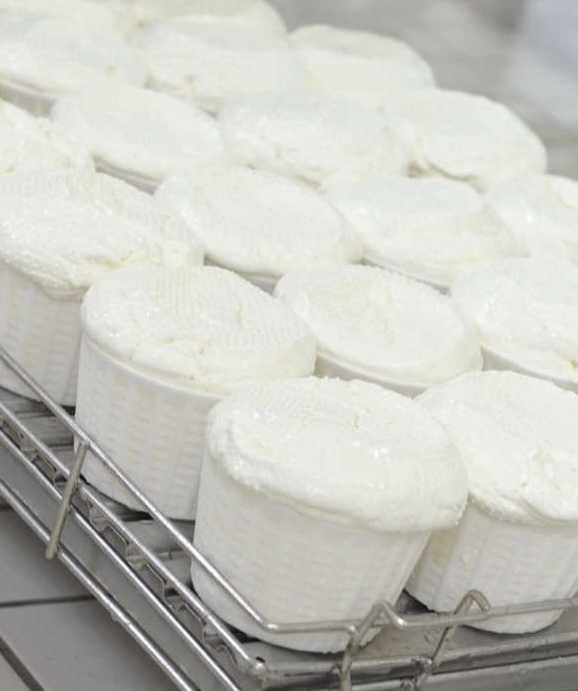
One of the delights of our recent trip to Bolognawas emerging from our apartment one Sunday morning in search of coffee to find a buzzing organic market on our doorstep. Just 12 hours earlier the Piazza Aldrovandihad been swarming with carousing students; now it was celebrating the equally vibrant food culture of the Emilia Romagna region.
On a dairy stall we encountered a tub of Squacquerone. Surely this was the tangy soft cheese layered with prosciutto di parma and arugula (rocket) on the piadina flatbread we had snacked on in the Quadrilatero gastronomic quarter? A purchase and post-coffee tasting confirmed it
Squacquerone di Romagna is a wobblier more spreadable version of the Lombard soft cheese stracchino, matured for a maximum four days, often less.
It has PDO status, exclusively produced in a well defined area between the Ravenna, Cesena, Rimini, Bologna and Ferrara provinces, and between 64 Porrettana trunk road and Po river. Four cattle breeds, including Frisona Italiana (Friesian) provide the rich milk, the native lactic enzymes joined by natural whey starter, veal rennet and salt. Result: the final product, shaped by the molds, it is poured into, is slightly sourish from brining, but also delicately herbaceous.
Under my radar till Bologna and I’m now trying to source it in the UK. Perhaps like the Lambrusco wine that accompanies it so well, it doesn’t travel well.
https://i0.wp.com/www.neilsowerby.co.uk/wp-content/uploads/2026/07/Squacquerone_Romagnolo_1.jpg?fit=1707%2C1280&ssl=112801707Neil Sowerbyhttps://www.neilsowerby.co.uk/wp-content/uploads/2022/11/NS-typemark-v1c.pngNeil Sowerby2026-07-21 11:03:362026-09-23 07:54:33You say macaroni, I say Squacquerone. Ciao to one of Italy’s best kept secrets
En route to Impala through London’s Chinatown you run the gauntlet of lacquered roast ducks garnishing restaurant windows. From the humblest establishments to the Four Seasons, which trumpets its version as the world’s best. Switch from Wardour Street to Dean Street and you enter a different dining realm. It’s hard to resist dropping in on Jeremy Lee’s cosseting Quo Vadis, but make the effort and before you emerge onto Oxford Street duck (sic) into the aforementioned Impala, living up to the recent hype, not least because of its own signature duck dish.
Meedu Saad
Just six weeks after opening, this refurbished garage leapt into the National Restaurant Awards Top 50 at no.15 and at the ceremony its creator Meedu Saad was named Chef to Watch. Not that he’s emerged out of the blue in Soho. He has long headed the kitchen at Northern Thai-inspired Kiln, which is part of the Super 8 group, encompassing nearby Mountain, both East London manifestations of Brat and Kiln’s live-fire precursor, Smoking Goat in Shoreditch.
I’ve eaten at all of them, yet none had prepared me for Impala, which referencesEgyptian-born Meedu’s own Cairo meets Tottenham upbringing. The name doesn’t spring from the antelope but from the cherry-red 1964 Chevrolet Impala his family drove during his summer holidays in his homeland.
When Super 8 founder and business partner Ben Chapman asked him what new project might be nearest to his heart he didn’t hesitate in saying North African.
Impala is all that but it’s far more, offering a creative fire to match the wood-burning ovens out of which emerges Aish Baladi, signature wholegrain and bran bread – puffed up pucks of loveliness.
Ash baladiThose creamy beans
We used it to scoop up smoothly pounded (and we don’t mean liquidised) white beans infused with wild herbs and topped with briny bottarga – an appetiser that road-maps the whole Med. More uncompromising were our kibbehs of white crab and sun-dried wheat parcelled in a shiso leaf cone. The chilli hit had me gulping my glass of Aligoté. Not just any Aligoté; Sylvain Pataille’s. Impala’s is a seriously good wine list and the cocktails tempted, too, from a smart bar that’s worth a visit in its own right.
Warily we sidestepped sweetbreads with pickled green chillies or beef tartare laced with baklouti chilli, even though that Tunisian speciality pepper is not high on the Scoville scale, while spiced ox tongue with bird’s tongue pasta lost some allure when we discovered that’s the Egyptian name for orzo.
Crab kibbeRoast duck is a speciality
So the half duck to share, it was. Surprisingly substantial bird and worth 68 quid. Sourced from Cornish butcher Philip Warren, it is dry-aged, brined, stuffed with a black lime spice paste and molasses and hung over embers, its dripping juices incorporated into the final fig sauce.A final crisping in that ferocious oven imbues it with its mahogany hue. All the fanned slices required for accompaniment was a simple salad of tomatoes cumin and aromatic herbs.
In a launch interview Saad played up the five years of on the ground research that went into Impala, travelling to Istanbul, Athens, Tokyo, Marseille, Italy and the south of France, but mining his memory bank is equally important.
He recalled a summer in his mid-teens, staying near Ismailia with his cousin and helping out on a mango farm. At lunchtime, there would be these lavish meals ofroast pigeon, roast ducks, rice and fruit. “I knew I needed a dish that one, was delicious, and two, really came from a place in my mind that had a lot of memory.”
Check out Impala website for a list of suppliers stretching from a Tunisian family harissa producer to the great David Lowrie in Fife for fish.
Braised jute leafThe raw material
Such wide-ranging sourcing came together intriguingly in one dish – molokhia (braised jute leaf) and cull yaw. The latter, I knew, tender mutton from ewes that are too old for breeding. From Matt Chatfield, a Cornish colleague of Warren’s, you’ll find it across some of London’s finest restaurants. But molokhia? One of many spellings of what turns out to be a nutrient-packed green vegetable found across the Middle East, North Africa and beyond. Egyptians were cultivating it back in the times of the Pharaohs. Typically, it makes a gelatinous soup; here encasing the slow cooked yaw (ewe). Not a pretty dish, it was vividly earthy and herby. The whole menu, I suspect, would yield similar surprises. Impala so lives up to the hype.
PS: Thanks, Impala, for the birthday candle on the sole pudding, a gorgeous date and pistachio tart.
https://i0.wp.com/www.neilsowerby.co.uk/wp-content/uploads/2026/07/Best-duck.jpg?fit=2016%2C1512&ssl=115122016Neil Sowerbyhttps://www.neilsowerby.co.uk/wp-content/uploads/2022/11/NS-typemark-v1c.pngNeil Sowerby2026-07-16 10:13:572026-09-23 08:17:41Red-hot Impala lives up to the hype with a dream duck and molokhia’s ancient magic