Thunder stolen by a turnip; whatever next? My portal into reviewing Pen Vogler’s enthralling new social history of food, Stuffed (Atlantic, £22), was to be via the humble root vegetable. But trips to Florence and Paris delayed my words and, meanwhile, The Observer’s Rachel Cooke went down that same route (sic), name checking naturally the departed agriculture minister Thérèse Coffey, who responded to salad dearth in our supermarkets by advocating we all ‘cherish’ the turnip. Did she mean the cute purple and white version the French call ‘navets’, or our own more rustic swede or rutabaga, often confined to being over-wintering livestock fodder? Even though her advice might count as a plea for seasonality, as so often, ‘Nellie The Effluent’ muddied the waters. The UK’s biggest turnip grower happened to be in her Norfolk constituency and he was giving up on it because those same supermarkets wouldn’t give him an affordable return.

Appropriately, Stuffed, subtitled ‘A History of Good Food and Hard Times in Britain’, is a surprisingly political survey of feast and famine with a particular emphasis on the damage wrought on subsistence by 300 years of Enclosures forcing 6.8 million acres of communal land into private ownership. The book title is not just about a full stomach, it’s also about being shafted.

Its predecessor Scoff, with its examination of class within English eating and drinking was her ‘Nancy Mitford’ book; this is her ‘Jessica Mitford’, constantly drawing parallels with times of scarcity in the past with, say, today’s children going hungry. In the introduction she puts herself firmly in the camp of medic Chris van Tulleken in bemoaning the baleful effects of UPF (ultra-processed foods), toxic equivalents of the adulterated horrors of the Victorian era, detailed in chapters such as ‘Bread and Butter’ or ‘Mustard and Pickles’ in lurid detail.

It took an outsider to chronicle the industrialised food short-cuts that could wreck or even kill a consumer. In 1820 London-based German chemist Frederick Accum published A Treatise on the Adulteration of Food and Culinary Poisons, its cover warning “There is death in the pot”. But it was not until half a century later that the Sale of Food and Drugs Act finally legislated against universal excesses such as the addition of alum or aluminium salt to make a baker’s loaf heavier and bleached whiter. Pen writes: “It was not lethal but it could cause swollen gums and inflate the gum, leading to dyspepsia, diarrhoea and gastritis, all of which impeded the absorption of nutrients.” Alum grinders inhaling its dust became seriously ill; it is still around today.

If all this sounds a mite dour, don’t fret. Born out of impeccable historical research, Stuffed shares the same lightness of touch that made Scoff a best-seller. Particularly wry is her take on the link between that Dickensian twist, gruel, and a ‘healthy brunch mate’ of 2023. While porridge had 5oz of oatmeal per pint, gruel managed just 2oz. A similar ratio to our oat milk, which thankfully avoids the workhouse pollution of rat and mice droppings!

As with Scoff, the book is divided into chapters devoted to a particular foodstuff, 26 in all, ranging from carp to strawberries, from goose to pumpkins with a recipe tagged on the end of each, each account riffing across the centuries, driven by the weight of her research.

Which brings us back to where we came in. The turnip gets a chapter to itself, introduced as a surprising flagship for Renaissance wellness theory based upon ‘the humouds’… revered too for its aphrodisiac qualities. So not just the neglected foodstuff it has become across our shores. According to Stuffed, improved farming techniques on a grander scale slowly transformed the turnip into primarily animal feed for winter.

Let us salute Baldrick’s proud and upright turnip

Witness for the turnip’s defence, unearthed by the diligent Pen, is much-travelled Tudor cleric Andrew Boorde, A Compendyous Regyment or a Dyetary of Healthe (1423) puts the turnip on a pedestal for its medicinal properties, particularly in a sexual context. She writes: “His prescriptions closely follow a slightly earlier book by Sir Thomas Elyot, as they both agree that turnips boiled and eaten  with flesh ‘augmentyth the seed of man’ and a small amount of raw turnip was good for the appetite.”

Hence the aptness of those running turnip jokes across the first two series of BBC’s Blackadder. In the launch episode the new King Richard gives a speech: “This day has been as ’twere a mighty stew in which the beef of victory was mix’d with the vile turnip of sweet Richard slain and the grisly dumpling of his killer fled. But we must eat the yellow wobbly parts two serves. In life, each man gets what he deserves!”

The apogee of the dick-shaped turnip gag comes in series two when the Edmund Blackadder’s servant prepares his ‘Turnip Surprise’. Edmund: “And the surprise is…?” Baldrick: “There’s nothing else in it except the turnip.” Edmund: So, in other words, the Turnip Surprise would be…a turnip.”

To much merriment the Turnip Surprise turns out to look like a “thingy”. Baldrick: “A great big thingy! It was terrific.” Edmund: “Size is no guarantee of quality, Baldrick. Most horses are very well endowed, but that does not necessarily make them sensitive lovers. I trust you have removed this hilarious item?” Baldrick: “I found it particularly ironic, my lord, because I’ve got a thingy that’s shaped like a turnip!” Miriam Margolyes as Edmund’s Puritan aunt (whose inheritance he seeks) demands she must have her turnip not mashed but as “God intended”. It arrives and further priapic hilarity ensues.

I have turnips. What do I cook with them?

The batch of un-suggestively shaped turnips I brought back from the market demands I prepare something that does them humble justice. Maybe use the beef stew with turnips recipe from 17th century diarist and gardener John Evelyn that’s appended to Pen’s turnip chapter. My gut instinct is to go for the great Richard Corrigan’s take on the French classic Navarin that pairs lamb shoulder with anchovies, but it requires tiny purple spring turnips. Mine are larger but still intense, so I stew them in butter and thyme with chopped chestnuts and black garlic, add rich beef stock, simmer for an hour, liquidise and serve as a rich veloute. A proper winter warmer.

Off grid, zero food miles, farm to fork. Buzz words all for a genuinely sustainable restaurant almost worth it for the view alone – across Designated Biological Heritage wildflower meadows to mighty Pendle Hill. Welcome, finally, to Eight at Gazegill, dream project of organic farm groundbreakers Ian O’Reilly and Emma Robinson. It will fully open in the spring.

The culmination of several years planning came with yesterday’s announcement of Doug Crampton as Chef Patron of Eight at Gazegill by Doug Crampton. It’s quite a coup. Doug has spent the last decade helming James Martin’s eponymous Manchester restaurant inside the 235 Casino. 

When I last reviewed it for Taste of Manchester in 2019 I wrote: “Which brings us to Doug, nearly six years heading up the kitchen yet still overshadowed by the branding. His talent deserves to be celebrated because his serious contemporary cooking is the equal of most rival offerings in the city. Smoking, pickling, fermenting, sourcing, seasonality, foraged materials – a lot of boxes are ticked. The end product is food combinations that make sense on the plate with a surprise wow or two.”

Those skills, first honed at the hugely ambitious 3AA Rosette Anthony’s Restaurant in Leeds, will now have access to some remarkable raw materials. Gazegill’s own organic meat and dairy plus access to a web of like-minded suppliers across the Ribble Valley and nearby Yorkshire Dales. I expect some inspirational results.

Husband and wife Ian and Emma are custodians of 250 acres of unspoiled farmland, with hay meadows and more than 50 species of wild flower and herbs, that has been in her family for 500 years. Of course, there has been an upgrade in the roads in that time – tarmac replacing rutted mud. Yet there’s still a good chance you’ll have to hit the car wash if you travel there on a primeval weather day via the single track lane by Howgill Beck.

So getting to the new farm restaurant will all be part of the adventure. I’ve been doing the run sporadically for years to buy naturally reared meat, usually stock bones and offal, from their Gazegill Organics butchery and farm shop. 

I’m not alone in my patronage. The’ve recently won the Countryside Alliance Rural Oscar for Best ‘Local’ Food & Drink Retailer in the UK. Couple this with the most stringent animal welfare provision (100 per cent antibiotic-free for a decade) and high ranking in Natural England’s environmental stewardship scheme and you realise what a special place this is.

Their herd of rare breed shorthorns are given at least 250 days outdoors a year. The rest of their time, when the weather is foul, is spent in straw barns where the animals feed on the cut from summer, meaning they get their 100 per cent grass-fed diet all year around.

Visit their website to read in depth about the farm’s organic ethos and approach to traditional breed husbandry, including their ‘closed herd’, which ensures traceability of their cattle.

Gazegill also offer a hugely successful mail order meat box service and a waiting list for their raw milk deliveries, but I can’t resist motoring over the tops from Barrowford to stocking up, then continuing via Gisburn to another of the North’s unparalleled food destinations, Courtyard Dairy at Austwick 20 minutes further on.

So what to expect at Eight?

The restaurant’s octagonal shape was somewhat inspired by the fact that there are eight festivals to a pagan year, which “is all about looking after nature.” Teaching the next generation about the importance of organic production has always been important for Gazegill. In addition to the restaurant Ian and Emma are also planning to build a children’s play area.

With the launch of Eight my future visits won’t be so fleeting. There are two major selling points for the new 100-cover restaurant that has been several years in gestation. First those eco-friendly off the grid credentials. It’s called Eight because it’s octagonal, a 100-cover oak structure with large Pendle-ready picture windows, the whole space powered using stored solar energy generated on-site by a wind turbine and solar voltaics. Wood-fired and tandoor ovens will be central to the open kitchen cooking. Private dining pods will even have their own grills.  On sunny days the outside terrace can host a further 60 folk.

Doug’s own plans are to make it a ‘destination restaurant’, he tells me, using both the panoramic dining room and the outside terrace, equipped with green eggs. So much will be prepared on site. More casual brunches will feature sausage, using Gazegill’s nitrate-free pork. The farm, with three on-site butchers, may resume making charcuterie. The menu will take advantage of the huge range of organic meat, but “We won’t be too fixated on organic fruit and veg. With fewer suppliers the emphasis will be on fresh is best.”

There are further bi plans for the future at Gazegill. Doug explains: ““The whole ethos of organic and indeed Gazegill is to put more in than we take out. This most important ethos is central to how Eight will operate and source produce. By mid 2024 a 250kw solar array will provide the entire needs of the farm, the farm shop and restaurant in terms of electricity. Add to this the offsetting of the use of oak in the construction of Eight by a commitment of the farm to plant 250 trees a year for 10 years and you will begin to get an insight into the bigger picture. Eight is a very exciting opportunity to highlight home-grown produce on a plate and on the farm, this is just the beginning…”

Prior to Eight’s opening in spring 2024 they will be holding some special one-off taster events at weekends throughout December. More details to be announced shortly…

Herculean tasks? Breaking down a whole carcass of an ex-breeding Red Poll cow might count. It requires much grappling and knife skills. This particular beast in front of me is destined for Shaun Moffat, chef and carnivore extraordinaire at the Edinburgh Castle pub in Ancoats. He’s the reason I’m here at Littlewoods Butchers in Heaton Chapel, suppliers to at least half of the chefs nominated for Chef of the Year in the 2023 Manchester Food and Drink Awards (Shaun among them).

A week previously I enjoyed one of the great meat dishes of my life upstairs at the EC – a wild boar Barnsley chop. Proper beef dripping chips and mixed kale on the side and a big puddle of Shaun’s sauce, concocted from a stock from duck carcass and pig trotters, mirepoix and herbs, then reduced and infused with pepper dulse, lemon thyme and a snifter of Julian Temperley’s Somerset Cider brandy (we enjoyed a shot later with our post-prandial madeleines).

Agreed such a treatment would enhance any meat main, but the quality of the boar double loin was exceptional; as the gobbets settled they tasted even more entrancing. Littlewoods had made the boar sausages I had for my starter; not quite on a level with their acclaimed merguez but it was all part of the boar trail that eventually has led me to their cramped basement meat store. Here, among some prize carcasses, owner Marcus Wilson explains the Forest of Dean connection that put that fabled boar on our table.

The classicists among you will recall the Fourth Labour of the aforesaid Hercules was his quest to capture the fearsome Erymanthian boar alive, which he eventually did through a mixture of guile and strength. It was easier meat for Marcus’s Instagram buddy Chris, charged with culling stags in the historic Gloucestershire forest and chancing upon a herd of wild boar, which his licence allowed him to shoot. 

“They were quite young, each only 25kg in weight,” recalled Marcus. “I was sent a couple. Unlike pigs, it really is hard to skin them with all that bristle sunk into the fat layers. When I posted a picture of one of them Shaun got in touch and said he must have a whole one. I told him these were cut up and spoken for but he insisted, so I persuaded Chris to send me up a third one, which helped provide your dinner.”

Shaun, once of East London cool spots Manteca and Berber & Q, has an engaging commitment to proper sourcing and using the entire animal (check out our chat). Witness his constantly changing menu name-checking his suppliers, so a perfect Littlewoods trade customer. That 11-year-old Red Poll suckler upstairs in the School Lane shop is destined for him, prepared by Marcus’s team of six specialist butchers. Its source is tagged – ‘The Langleys at Bunbury, Cheshire’.

The Cheshire hinterland is a great source of animals for Marcus, who made the decision several years ago to go down the grass-fed, sustainable butchering route. For the public and now increasingly those cutting edge restaurants. My readers will be aware of my devotion to the exemplary Jane’s Farm at Poole Hall near Nantwich, profiled here – Farmer Jane’s Herd Instincts are spot on. It is umbilically linked to Higher Ground, Manchester’s top restaurant of the moment, whose Cinderwood market garden is on the same site. Perfect examples of regenerative agriculture and its wonderful to see livestock of this quality, reared permanently on grass, given no antibiotics, featuring on restaurant menus.

Jane and Marcus make use of the same private abattoir on the Wirral, Edge and Sons Butchers, run by Callum Edge, who shares their ethical commitment. This is how networks are built.

The destinations of the produce hanging in Littlewoods’ basemen read like a litany of Manchester and Stockport’s finest eating places. The small but perfectly formed Dexter steer is promised to Climat on the eighth floor of city centre Blackfriars House, the red deer stag from Lyme Estate for Higher Ground and the 20-strong squadron of two-week aged, salted ducks is booked in for Where The Light Gets In down the road in Stockport. The link-up with its chef/patron Sam Buckley when it opened seven years ago was the Littlewoods launch pad. Marcus, then 39, had worked in the butchers from the age of 11, so knows everything about the trade, but this was a new challenge. These days he even makes his own salami. Just a home project, he quickly qualifies; there’s a strong influence from his French wife’s family down in the Dordogne.

What is key to his influence, I believe, is the way he imparts meat-handling skills to the talented chefs he works or has worked with –  Joseph Otway (Higher Ground), Luke Richardson (Climat), Sam Buckley (WTLGI), Julian Pizer (Another Hand), Patrick Withington (Erst), Iain Thomas (Our Place), oh, and that persistent Mr Moffat.

Invasion of Aussie beef and lamb – the sticking point

As I was penning this piece I received an email inviting me to a tasting of imported meat that has proved somewhat controversial. It read: “The world-renowned Aussie Beef & Lamb brand has now launched in the UK following the UK-Australia Free Trade Agreement, meaning it can offer a point of difference for UK consumers looking for high-quality, consistent and sustainable red meat that complements but does NOT compete with British product.”

I immediately texted Marcus, who as it happens was away on holiday, lunching off horse meat tagine in Marrakech. He was, as expected, scathing about the deal with Down Under: 

“I’m not if the opinion that importing cattle/livestock which rely greatly on water for grass/feed from one of the driest continents in the world, or promoting stall reared grain fed cattle, is a good idea. The UK has the perfect environment to rear cattle/sheep without a cost to the environment and, if reared in a regenerative manner, will increase carbon capture and diversity. The recent deal, was one of the worst trade negotiation outcomes I think I’ve seen in the agricultural sector. The callous disregard the Conservative government show to our farmers is shocking.”

Tusks, bristles and tempers – the wonderful world of wild boar

Among the most sustainable of animal meats, boar has traditionally been imported from Eastern Europe, where it has been a fixture in the forests and latterly in farms, though much is not generally the true tusked terror but a cross with feral pigs. In Japan, where it is a surprisingly popular meat, they call it such a cross-breed Inoshishi; in Germany Wildschwein, though here he discovery of excessive radiation in the breed has caused health scares.

The French call mature boars sanglier, younger, tenderer specimens marcassin. In my Boar-Googling I found a Lidl online recipe for Ragoût de marcassin aux chicons et sauce aux canneberges (stew with Belgian endive and cranberry sauce). I’ve yet to encounter wild boar on any supermarket shelf, even though they do roam wild in selected woodlands. Approach with caution, especially if you have a dog with you.

The Forest of Dean does appear to be Wild Boar Central. It’s positively bristling with them (sic). Here’s a precis of the Forest’s information on them: “Wild boar are stocky, powerful animals covered in bristly hair that can vary from dark brown almost black in colour to gingery brown. Mature males have tusks that protrude from the mouth. Females also have tusks, but these do not protrude. Piglets are a lighter ginger-brown, with stripes on their coat for camouflage and are affectionally known as ‘humbugs’. Wild boar can stand up to 80cm at the shoulder and they normally weigh between 60–100kg. Though short-sighted they can move surprisingly fast for their size. They will also readily move to defend their young when they feel threatened, so should always be treated with caution and respect. Sows can give birth at any time of the year, although there is a peak of births in the spring and early summer.  Average litter sizes in the Forest of Dean are between six and 10 piglets, which is nearly twice that of their continental cousins.” 

The last time I ate wild boar regularly was 30 years ago. The farmed variety sourced from a smallholding above Oxenhope (think Worth Valley and Railway Children), whose owners bizarrely doubled up as wedding limousine providers. Their meat wasn’t a patch on our fateful Barnsley chop.

• The main image is of a boar hunt by 17th century Flemish painter Frans Snyders. It doesn’t represent how the animals are culled these days.

Name your dog after fermented soybeans and you are guaranteed a review here. But please don’t quote me. It was delightful to shake paws in the yard with resident pooch Miso the Shibu Ina pup, but that wasn’t the clincher at the outstanding new Restaurant Örme, I was just in need of immediate canine therapy after an epic trek from my Pennine fastness. Floods had taken out the rail line and I endured nearly an hour on the bus from Manchester centre to Urmston, home to the three young folk who opened Örme here in May. To instant acclaim.

Last month the 30-cover restaurant on Church Road was one of 15 new inclusions in the Michelin UK guide alongside higher profile Manc newcomer Higher Ground. It also garnered two nominations in the 2023 Manchester Food and Drink Awards – for Newcomer of the Year and Best Neighbourhood Venue.

 Quite a step up for a suburban site that had previously hosted the likes of The Hideaway, Best Afternoon Tea and an Indian called Theru Kadai.

The name of the latest incumbent, in case you are wondering, derives from the area’s 12th century landowner, one Orme Fitz Seward. Not sure where the umlaut came from. There’s something about four letter leave-you-wondering names for new wave restaurants – Mana, Erst, Kala. Or a chunk of ancient heritage as with Elnecot, which was what Ancoats was called in those misty times before natural wine and designer pooches joined beards as de rigueur.

In truth it hadn’t been my intention to formally review Örme; I just wanted to check what the fuss was all about. The £45 tasting menu isn’t available Saturday lunchtimes; instead it was a pared down £35 four courser, though I couldn’t resist a supplementary dish of cured monkfish for £9 that levelled it all up anyway. That was actually the star turn in a lunch that was consistently impressive from superior snacks through to an indulgent sticky pear, peanut butter custard and ginger ice cream finale.

The monkfish had been sliced so thinly it was diaphanous, dressed with a silky dill emulsion, buttermilk spheres adding freshness and cubes of pickled celeriac a certain punch. Very Nordic. It would have been interesting to see what Örme sommelier Rachel Roberts might have paired it with. I did spot an unusual to find Basque white Txakoli being poured at another table. Rachel (pictured cuddling Miso) offers matching wines at £25 and unusually a British line-up for £35  – for those curious to know what a Welsh red from the Regent grape tastes like. With further Saturday commitments ahead I declined.

Navy blue walls, large front windows, fine cutlery and an indie soundtrack were all factors, but what took my eye was the presence of influential, cutting edge cookbooks on a shelf in the dining space. There was a similar bookish statement of ambition in a young chef at Metamorphica in Haslingden. The Örme collection (think the Noma Book of Fermentation and Josh Niland’s The Whole Fish Cookbook) belongs to Rachel’s partner, Jack Fields; he and his co-chef Tom Wilson have worked in some impressive kitchens before striking out with their own project.

There’s a lovely precision to their work. A tranche of venison haunch came with a faggot sidekick. A splendid use of the off-cuts. There’s a smoker out back and its use had ‘elevated’ a humble carrot, blobs of blueberry puree adding their own autumnal oomph.

Örme has a quiet assurance about it for such early days. It needs everyone who feels the need to support genuine indie culinary heroes to find a day when the trains are running and walk the 10 minutes from the station. There’s lots of interest en route, too. a good cheese shop, a wine merchants and more. Did I mention that Urmston is also shortlisted for an MFDF gong for Foodie Neighbourhood of the Year?

Slipping into ‘The Mouth of the Wolf’ has been an intermittent indulgence over these past 15 years of its existence. Grabbing a stool at the marble counter, a Negroni Sbagliato soon to hand, perhaps with almonds and olives, and a wolfish perusal of the ever-shifting menu. How time has flown. And how remiss of me to omit Bocca di Lupo from my recent dewy-eyed retro crawl around Soho.

Founder Jacob Kenedy’s rustic Italian formula has stood the test of time while never standing still. Across Archer Street from the restaurant’s carved sandstone facade sprang Gelateria Gelupo, modelled on the kind of ice cream parlour straight out of Amarcord or Cinema Paradiso with the added bonus in truffle season that it will supply you with a modicum of the musky tuber to be shaved over an appropriate dish in the mothership.

Maybe even over a luganega sausage dish. After all, in some parts of Northern Italy truffles and parmesan add an extra, luxurious touch to one version of this aromatic coiled banger. 

Not that I expect to find those inclusions in the luganega I’ve ordered to celebrate Bocca’s 15th birthday. Mine haven’t winged their way from the heart of Soho but from an industrial estate on the edge of Skipton – home to the redoubtable Swaledale Butchers. Experts in whole carcass butchery with access to Yorkshire’s best naturally reared livestock, they supply many fine restaurants and have done collabs with Jacob Kenedy since 2018, the latest his traditional North Italian delicacy, prepared to his formula. Swaledale proudly quote their chef fan: “From fat pheasants and plump partridges to little Dexter sirloins and blackface hoggets, the quality of their meat is outstanding. Their pork, in particular, finds its way onto our menu near constantly – as dry-aged, marbled chops, marinated with honey, rosemary and garlic, as shoulder cooked gently with milk, lemon zest and sage, and as sausages, chubby and inviting.”

With the luganega Jacob provides a recipe that pairs it with farro, a spelt-like grain, roasted fresh porcini and tarragon. I like it with polenta and my favourite Abruzzo lentils, some bitter radicchio leaves on the side. Or skinned and crumbled with peppers in a tomato-based sauce for pasta.

So what is luganega sausage?

Usually pork shoulder and belly minced, spiced with nutmeg, cinnamon and a smidgeon of clove, and flavoured with dried porcini. Squeezed into a thin natural casing, it will be twisted into a tight coil. Consequently it can be grilled or sauteed in a matter of minutes.

The attraction for me is the provenance of the pork used – in Swaledale’s case free range native breed Tamworths or Middle White, dry-aged on the bone for three weeks in their Himalayan salt chamber.

You can’t pin down this sausage to any one region of Italy. The name references Lucanaia, the ancient name of today’s Basilicata in the deep south – both Cicero and cookery writer Apicius mention it in Roman times. Since when the style has migrated north and is hugely popular in the Veneto even with Milan staking its claim to make the definitive version, moistened with wine. In Lombardy it’s the staple of the regional risotto.

The coarsely minced pork is traditionally stuffed into a metre long piece of gut, giving it its nickname ‘salsiccia a metro’, to be sold by the length. Not unlike our own Cumberland sausage but much more satisfying.

I am lunching in the only 2 Michelin star Chinese restaurant outside China – A. Wong, just down from London’s Victoria Station.  My 15-course dim sum-centric tasting menu, Touch Of The Heart, costs £175 and the sophisticated package includes five splendid matching wines. Curated by chef patron and Oxford-educated chemist and later social anthropologist Andrew Wong, this is no ordinary dumpling experience. 

The menu, based on Andrew’s extensive explorations, has this mission statement: “The world of Chinese cuisine is limitless and exciting, a journey of tasteful cultures and flavoursome histories, from Buddhist temple cuisines of the Tang Dynasty Silk Road and the lantern-lit teahouses of bustling Ming Dynasty Suzhou to the cocktail hour of Hong Kong and Shanghai’s jazz age. We are honoured to have you join us on this culinary journey, with a menu that celebrates Chinese food heritage, historical recipes, and kitchen crafts that evolved over 4000 years.”

I hope Fuchsia Dunlop approves. She too is a standard bearer. Her new book, Invitation To The Banquet: The Story of Chinese Food (Particular Books, £25) explores through 30 widely disparate dishes/food styles the extraordinary culinary universe of that vast nation. Not the dumbed down version of Cantonese cuisine that has been long peddled in the West. Now thankfully changing at the top end, if not in takeaways.

Invitation seems the logical progression from a series of cookbooks that have earned her an authoritative reputation, not least in China, commencing with the groundbreaking Sichuan Cookery (2001). Even Shark’s Fin and Sichuan Pepper, her 2008 memoir of how she trained as a chef in its capital, Chengdu, came with a recipe at the end of each chapter. Her latest doesn’t. Both evocative and encyclopaedic, part travelogue, part social history, it’s not a stoveside tome. Instead you are by proxy by the side of local food producers, chefs, gourmets and home cooks spread across a homeland of over 1.4 billion people. Ultimately you are worshipping at the shrine of Fuchsia’s foodie hero, one A Dai, proprietor of Dragon Well Manor in the city of Hangzhou, whose ‘cooking rooted in the local terroir’ mirrors that of forward-thinking chefs in the West.

Before reading it I knew something about Dongpo pork, named after an 11th century Song Dynasty poet and governor of that same Hanghzou, and about Pockmarked Mrs Chen’s mapo tofu from Fuchsia’s wellspring, Sichuan, but pomelo with shrimp eggs or the trophy dish of the mega-rich maverick even today – bear’s paw? Emperors had that rarity served with the tiny tongues of crucian carp fish. Like serving pangolin or shark’s fin, all very arcane subject matter, but the book’s mission is less about the exotic, more about dispelling the scariness of many regional specialities and explaining how more recognisable delicacies came about.

Take the procession of dim sum I’m enjoying from Andrew Wong’s buzzing kitchen. In Invitation Fuchsia devotes a couple of chapters to dim sum, dumplings, noodles and baos and they are among the most enchanting, firmly pinning down their Turkic Silk Road origins. ‘Transforming Dough  knife-scraped noodles/dao xoao mian’ and  ‘Kindling The Spirits: steamed soup dumplings/xialong bao’ trumpet the skills that put many non-Chinese chefs to shame. Well, that culinary triumphalism is a constant trope from stalwart Sinophile Fuchsia. Still I do get her point as midway through my steady Wongathon I’m actually purring.

Dim sum at 2 star Michelin level? Pull up a lunchtime stool

I’m perched at the end of a shiny green-tiled counter, marvelling at the sheer elan of the operation and the warmth of welcome not always apparent in either Michelin places or old school Chinatown. What was once a standard Cantonese, run by Andrew’s parents in one of Pimlico’s less fashionable streets, has been transformed over the last decade thanks to his ambitions.

While evening service centres around The Collections of China, a wide-ranging three hour banquet, this Touch Of The Heart tasting menu of smaller dishes is available only at lunch alongside an à la carte dim sum offering. The title springs from a translation of these between meals snacks – ‘dian xin’ in Mandarin – which first came into use during the Tang Dynasty.

Fuchsia writes: “In its literal meaning dim sum is ambiguous; the two characters which compose it can mean ‘dot’ or ‘press’ and ‘heart’ or ‘mind’, which is why some people translate it into English’ as ‘touch the heart’…

“Food scholar Wang Zihu suggests that the emergence of this new term for a kind of ‘edible pick-me-up’ reflected a whole new era in Chinese gastronomy, in which eating was increasingly seen not just in terms of sustenance, with pleasure a a secondary goal, but as something that could be done mainly for fun, as was the case with dainty snacks that were designed to appeal to the senses as much as fill the belly.”

Cut to me at 70 Wilton Road, SW1V 1DE on a Thursday lunchtime. So which components appealed to my senses most?

Chilled ‘smacked’ cucumber with trout roe, chilli and garlic vinegar was an appetiser before  a glorious trio of dumplings, dim sum and wontons served together. Pick of the bunch was an incredibly delicate Shanghai steamed pork dumpling with a sharp ginger infused broth, the quintessence of xiao long bao. Equally classic was an almost transparent shrimp dumpling, sweet chilli sauce, topped with a cloud of rice vinegar foam. Sturdier, with a more compact dough, was a pork and prawn dumpling crowned with pork crackling.

Perhaps the ‘rabbit and carrot glutinous puff’ proved less delicious than it sounded but its fellow puff, the ‘999 layered scallop puff’ with powerful XO oil was a convincing bite, ahead of a dish (main image) that was a genius level artful deconstruction. ‘Memories of Peking duck’ arrived in a swirling nest of feathers and straw, the classic thin pancake encasing duck and foie gras. It’s a two bite experience. Go left and the topping is caviar, right and it’s a shaving of truffle. 

Further stand-outs were a cheung fun, that Cantonese rice noodle sandwich, here matching an Isle of Mull seared scallop with honey-glazed Iberico pork, then ultra delicate  ‘bamboo pole’ noodles with king crab and spring onion oil (my server first showing me a video at table of the deft noodle-making process) and the main pudding, a fluffy steamed duck yolk custard bun that benefited from not being over-sweet.

Before that, though, a skillet arrived bearing the component parts of our Xian lamb burger – a dish at odds with the rest of the culinary parade, its inspiration the pork-free Muslim-centric north west vastness that is Xianjing province. The author mentions in passing “the plight of its Ugyhur people” that ”has been well documented in the international media” and that’s it. Food takes precedence over geopolitics.

Here at A.Wong the mix and match presence of sesame, coriander, chilli and pomegranate alongside the lamb pattie transported me along the Silk Road – the route west. What better way to conclude a remarkable pilgrimage through the world’s most diverse cuisine?Thank you, via your different routes, Andrew and Fuchsia.

Chewy, bouncy, slippery, crunchy? I settle for century-old eggs

The menu was a sublime procession of flavours, but none of it was challenging – the kind of macho Chinatown ‘take me off piste’ stuff that ‘old China hand’ critics such as Jay Rayner and Giles Coren occasionally indulge in… and Fuchsia Dunlop has grown to relish after her first tentative coming to terms with a nation of eaters that value food for mouthfeel as much as flavour. “They want chewy, bouncy, slippery and even crunchy ingredients which ‘feel beautiful’.”

Tripe I do, even slippery pig brains, but I gag on chicken feet or tendons. Still, broadening my horizons, I’m now a convert to century old eggs. My recent dish of the month for Manchester Confidential came from Noodle Alley in the city’s Chinatown. They were done Sichuanese style. Here’s what I wrote: “Smoked beers? I’d sampled a few at Smokefest, niche celebration at Torrside Brewing in New Mills, so what perils could a surfeit of Sichuan pepper hold for kippered me? Hence it was a ballast of ‘Burning Noodles’ all round at Ken and Wendy Chen’s Chinatown basement homage to her native province. This version of the classic dish featuring minced pork is not the tonsil-cauterising challenge you might encounter in the back alleys of Chengdu, but it is the most authentic manifestation ever to pop up in Faulkner Street. Numbing enough to need the quenching (unsmoked) neutrality of a Tsingtao lager or two.

“My foodie focus, though, was more left field. I am currently working my way through Invitation To A Banquet, Fuchsia Dunlop’s newly published introduction to Chinese cuisine, so I felt I had to order £6.80 small plates of Sichuan starch jelly with house chilli sauce and charred green chilli with century old eggs. The former was testimony to the Chinese love of texture, the latter proof that an ammoniac whiff doesn’t have to be off-putting. 

“The wedges of egg fanned around the plate, resembled on first glance, streaked dark green tomatoes. The Chinese see a pine pattern, so another name beyond the usual pidan issonghua dan, or pine-patterned egg. That look is the result of several weeks’ fermentation. Traditionally this consisted of pickling duck eggs in brine and then burying them in a mixture of coals, chalk, mud and alkaline clay. Result – they can last unrefrigerated for months but not long years. Bite through the gelatinous coating and the taste is uncompromisingly ripe. Think blue cheese on steroids. The impact at Noodle Alley certainly skittled any lingering ashtray beer tastes.”

We each have our own private Soho. For the long of tooth it may well be Paul Raymond’s Revue Bar and the nudge nudge of sleaze or Jeffrey Bernard regaling his reprobate chums slouched across lunchtimes that never ended. Perhaps Gaston Berlemont’s French House and Muriel Belcher’s Colony Club, L’Escargot with Elena Salvoni at the helm or Victor Sassie’s goose-fattened politico haunt, The Gay Hussar. So many ghosts. Even a near contemporary of mine, Alastair Little, whose eponymous restaurant brought a blast of fresh culinary air to Frith Street in the Eighties, is no more (my tribute).

Northern-based, I’ve only had the tiniest of bit parts in the pulsating Square Mile of Sin, much sanitised these days, of course. Maybe, on a flying visit, a café au lait and croissant at Maison Bertaux before stocking up on Italian essentials at I Camisa & Son (recently granted a two year stay of execution; its rival around the corner, Lina Stores, has now swollen to a glossy five-strong chain). For cocktails it still has to be tiny Bar Termini on Old Compton Street. And if we ate in in Soho it would inevitably be at Andrew Edmunds in Lexington Street, an 18th century townhouse that for four decades has combined being dog-friendly with offering a remarkably affordable fine wine list, well matched with the game it regularly serves. Alas, Andrew, too, died last year at 80, another key figure in ‘Old Soho’ departed.

There were occasionally more flamboyant experiences. A random invitation, by his biographer, to the funeral of Sebastian Horsley, the Last Dandy of Soho, where to a Marc Bolan soundtrack the horse-drawn hearse delivered his heroin-ravaged body to St James’s Piccadilly, Stephen Fry delivering the eulogy.

Another time I lingered into the early hours in the Groucho Club in the company of Lembit Öpik, Liberal Democrat MP, I’m A Celebrity contestant and Cheeky Girls squeeze, and one Ron Brand, dad of Russell (whatever happened to him?).

Quo Vadis – no wriggling out of Jeremy’s eel sandwich

The Groucho Club is a homage to the wittiest of the Marx Brothers, but it was the former home of a more seismic Marx  – Karl – that hosted us on a recent return to Soho. Once also a brothel, Quo Vadis in Dean Street is definitely ‘Old Soho’, launched as a restaurant in 1926, one year before L’Escargot (Camisa arrived two years later). It has enjoyed a resurgence over the last decade under the stewardship of the Hart Brothers, whose neighbouring Barrafina is definitely a standard bearer for the ‘New Soho’.

The Quo Vadis kitchen is in the hands of national treasure Jeremy Lee, whose Cooking Simply and Well, for One or Many (Fourth Estate, £30) has just won Best General Cookbook in the 2023 Guild of Food Writers Awards. I wrote about his championing of salsify here a year ago. That root vegetable wasn’t on the menu on the Monday evening we dined there, but his signature starter was – the smoked eel sandwich. I’ve tried to replicate at home several times, quite recently with in-house prepared eel from Upton Smokery in the Cotswolds, but the restaurant version was miffingly superior. At £14.50 a tranche it had to be.

Amazingly, it was pipped by the other starter we shared in the cosy, quirky dining room –the best terrine I’ve had in years. A quid cheaper, it was a master class in the charcutier’s art. Tender tiles of compressed chicken, grouted with a moist blend of ceps, savoy cabbage and bacon, accompanied by fresh figs. 

The scene was set. The extended, enhanced ground floor restaurant looked a treat, as did arguably London’s most beautiful paper menu. Alas, the mains didn’t match all  this level of excitement. A case of NOFOM? (never order fish on Mondays)? I’d like to think that wouldn’t apply to a place, whose rigorous standards are apparent from Jeremy’s gloriously written book, but my wife’s hake with clams dish (£32.50) was dull and over-beaned, while my skate with tartare sauce (£34.50) smelt too much of the pan and felt tired. And yes, I am allowing for skate being a fish actively benefiting from a few days’ ageing. Neither dish was done any flavours by a timid Rousette de Savoie Cru Frangy Domaine Lupin, which cost £50. Our jolly neighbours were knocking back their white, a Puligny Montrachet at thrice that price, and we were so jealous.

Ain’t no Mountain high enough?

So a certain disappointment at Dean Street’s old stager, made up for thrillingly by new arrival Mountain in Beak Street. I vaguely remember the corner site being occupied by a Byron Burgers, but there’s also a louche Soho legacy, naturally. From 1913 it was home to  Murray’s Cabaret Club; in the Fifties Ruth Ellis danced in the club before murdering her husband, in the Sixties hostess Christine Keeler met Stephen Ward here before embarking on the Profumo Affair. 

These days it would be a scandal not to make the pilgrimage to taste the latest manifestation of Tomos Parry’s genius. His Michelin-starred Brat in Shoreditch (former strip club premises, a theme developing) set the bar high for the ‘Welsh Wizard Who Cooks With Fire’. The restaurant name? His inspiration has always been the ‘mar y montaña’ cooking (sea and mountain inspired) along Basque and Catalan coasts. Tast Catala in Manchester nods to that same culinary philosophy through its Costa Blanca-based exec chef, Paco Pérez.

Big investment has gone into the two floors occupied by Mountain, each boasting a state of the art Gozeney wood-burning oven, losing some of the hipster vibe along the way, but the food offering has suffered no identity crisis on the evidence of our early evening walk-in. Tables are currently booked out for weeks after the metropolitan critics swooped with their ‘already a candidate for restaurant of the year’ snap judgements. 

They might well prove right. We just loved everything about the place as we perched at the counter and wanted to order all of the menu. With a train to catch we settled for half a dozen treats, small plates except for a spectacular loin of fallow deer on the bone (£40) – dark char giving way to perfect saignant flesh. Like some Game of Thrones hero emerging from battle. Alongside, a squad of Parry’s signature smoked potatoes, even better than their equivalent at Yorkshire’s legendary Moorcock at Norland.

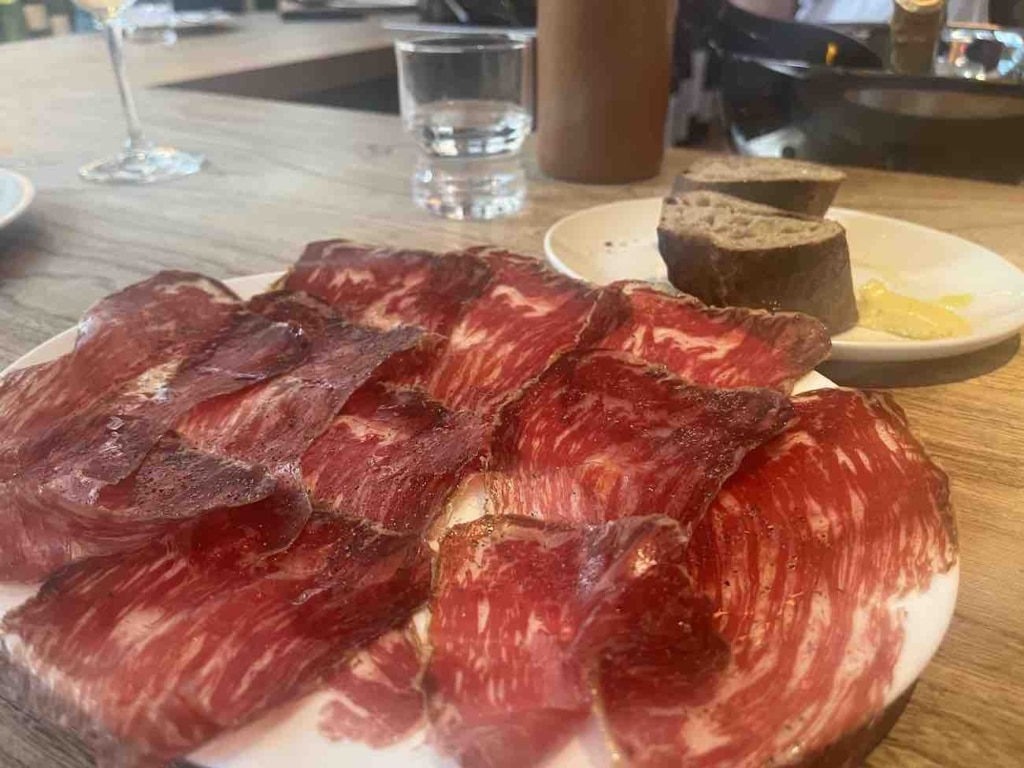
The supporting cast was equally impressive. A plate of home-cured ex-dairy beef (£12.50, fanned out wafer thin (the meat slicer is as much in evidence here as at Brat’s Shoreditch rival Manteca), then substantial chunks of raw sobrasada (£6.50), doused in honey. on their own wood-fired bread, topped with squiggles of guindilla pepper. Apparently this spicy, spreadable sausage is sourced from an organic Mallorcan farmer called Luis Cirera. 

Such attention to detail is everywhere. Wines show a Noble Rot influence. Where else might you encounter that delicate North Italian white, Nosiola? At £8 a sizeable glass, it had been our welcome drink, to be followed by a 500ml carafe of a Portuguese bulk tinto that was remarkable, fruity value for £20. It handled the spice of the chorizo we ordered in envy of our neighbours on the counter because of the balloon-light flatbread they also got.

Returning another time then to dig deep into a no-compromise menu offering beef sweetbreads, tripe, turbot head and, for three or more to share (£90-£120), a whole lobster caldereta (one pot stew) that may prove to be the peak signature dish for Mountain. Aiming to scale it one day.

Finally, a satisfying foray into Fitzrovia

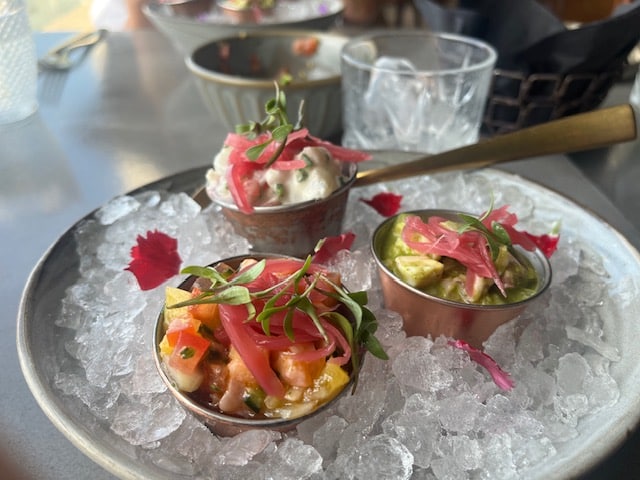
We were staying in the Treehouse Hotel in Langham Place, , which has a Mexican restaurant Madera on its 15th floor, where we sampled assorted seafood ceviches and organic, grass-fed carne asada served over hot lava stones. Alas, Madera won’t be accompanying Treehouse when it opens in Manchester next year; consolation, head chef at the main restaurant there will be the remarkable Mary-Ellen McTague (ex- Aumbry, Creameries and The Fat Duck). 

The London hotel is opposite the BBC and John Nash’s All Saints Church on the edge of Marylebone and Fitzrovia, both exceptional districts to dine out in these days. The latter is home to the Sicilian food of Norma on Charlotte Street, which I have previously reviewed.

This time 64 Goodge Street was our destination. In its few weeks of existence it has been garnering plaudits akin to Mountain for its retro French bistro looks and menu. A new venture by the Woodhead Restaurant Group, creators of The Quality Chop House, Portland and Clipstone, it’s a handsome fallback destination for those who can’t squeeze out an advance booking for equally francophile Bouchon Racine in Farringdon (read my review) I dined in the shadow of a dark oak armoire in the intimately lit bottle green interior. I half expected Inspector to Maigret to sidle in out of the Fitzrovia dusk.

The ‘Famous Belgian’ would certainly have relished my amuse bouche, a truffled Comté gougère and my hors d’oeuvre, a duo of snail, bacon and garlic bon bons – a cute, deep-fried take on classic escargots à l’ail.

Starters were a litany of Gallicness. What to choose from soupe au pistou; Morteau sausage, walnut and Morbier tourte (a homage to my beloved Jura); scallops, lentils and beurre blanc and a rabbit Niçoise. The latter won the day and there were enough olives, capers, tomatoes and basil to justify the substitution of blander bunny for the regulation tuna.

That dish cost £16. My main was £36. Like virtually everywhere of quality in London and other cities, even with modest wine, bills are now regularly topping £100 a head for three courses. No matter, if they get the details right From another well-judged wine list, a carafe of Austrian Blaufränkisch did the trick, its black fruits and whack of acidity a perfect match for the myrtille compote that underpinned squab pigeon two ways, breast seared, leg stuffed with Lyonnaise sausage. Perhaps a substantial addition of beetroot and chanterelles tipped the dish towards excess, but chef Stuart Andrew’s menu is built on richness. Comforting in discomforting times. Let me confess then. I wish, for therapy’s sake, I’d splashed out an extra £4 and gone for the lobster vol-au-vent with a cream/brandy infused sauce Américaine.

For 2023’s critical kitchen darlings the world appears to be their lobster.

The shortlisted nominees for the 2023 Manchester Food and Drink Festival Awards have been announced. The Awards are the most prestigious in the North West and celebrate the region’s outstanding hospitality talent, with winners to be revealed at the MFDF Gala Dinner on Monday, January 29, 2024. 

There are 114 exceptional venues, traders, places and people nominated across 18 categories celebrating a resurgent year for Greater Manchester’s hospitality industry. This year’s roll call takes in the whole breadth of talent flourishing in our region – from talented takeaways and superb street food vendors to Michelin-star dining and some of the newest and most exciting additions to the scene. 

The shortlisted nominations have been compiled by the MFDF Judging Panel, taking into account award submissions from the hospitality industry. The panel is made up of the region’s leading food and drink critics, writers, and experts. The awards are now open to public vote on the MFDF website. 

A ‘mystery shopping period’ will now commence alongside the public vote. During this period judges will visit nominated venues for an incognito dining visit, and will score venues based on their experiences. Then on Monday, November 20, 2023 the polls will be counted and combined with the judges’ scores, and the winner of each category will be chosen. 

The MFDF 23 Award Winners will be announced at the MFDF Gala Dinner & Awards at the New Century Hall (above) on Monday January 29, 2024, tickets for which can be purchased by emailing isabella@foodanddrinkfestival.com. Your hosts for the evening will once again be Matty White of Manchester’s Finest and Channel 4’s Steph’s Packed Lunch and BBC Radio Manchester’s Anna Jameson.

To vote please visit this LINK. The nominees are…

PLANT-BASED OFFERING OF THE YEAR

Bundobust

St James Building, 61-69 Oxford Street, Manchester, M1 6EQ

Lily’s Indian Vegetarian Cuisine

85 Oldham Road, Ashton-under-Lyne OL6 7DF

Bahn Ví

New Century Kitchen, 34 Hanover Street, Manchester M4 4AH

The Walled Gardens

Alness Road, Whalley Range, Manchester M16 8HW

Maray

14 Brazennose Street, Manchester M2 6LW

Speak in Code

7 Jackson’s Row, Manchester M2 5ND

Flawd Wine

9 Keepers Quay, Manchester M4 6GL

The Mekong Cat

47 Lower Hillgate, Stockport SK1 1JQ

TAKEAWAY OF THE YEAR

Fat Pat’s

88 Portland Street, Manchester M1 4GX

Ad Maoira

34 Copperas Street, Manchester M4 1BJ

Unagi Street Food & Sushi

10 Park Place, Cheetham Hill, Manchester M4 4EY

Ciaooo Garlic Bread

93-95 Shudehill, Manchester M4 4AN

Wright’s Fish and Chips

86 Cross Street, Manchester M2 4LA

Maida Grill House

38 Liverpool Street, Salford M5 4LT

Al Madina

76 Wilmslow Road, Manchester M14 5AL

Burgerism

18 West Ashton Street, Salford, M50 2XS

INDEPENDENT DRNKS PRODUCERS OF THE YEAR

Sureshot Brewing

4 Sheffield Street, Manchester M1 2ND

Stockport Gin

19B St Petersgate, Stockport SK1 1EB

Cloudwater Brew Co

7-8 Piccadilly Trading Estate, Manchester M1 2NP

Tarsier Spirit

Unit A5, Bankfield Trading Estate, Coronation Street, Stockport, England, SK5 7SE

Pod Pea Vodka

Irlam, Manchester

Manchester Union Brewery

96D North Western Street, Manchester M12 6JL

Squawk Brewing Co

Tonge Street, Manchester M12 6LY

Track

Unit 18, Piccadilly Trading Estate, Manchester M1 2NP

INDEPENDENT FOOD PRODUCER OF THE YEAR

Pollen

Cotton Field Wharf, 8 New Union Street, Manchester M4 6FQ

Great North Pie Co

Kampus, Aytoun Street, Manchester M1 3GL

La Chouquette

812A Wilmslow Road, Manchester M20 6UH

Gooey

Ducie Street Warehouse, Manchester, M1 2TP 

Yellowhammer

15 Lower Hillgate, Stockport SK1 1JQ

The Manchester Smoke House

123 Waterloo Road, Cheetham, Manchester M8 8BT

The Flat Baker

Unit 2, 23 Radium Street, Ancoats, Manchester M4 6AY

Companio Bakery

Unit 6, Flint Glass Wharf, 35 Radium Street, Ancoats, Manchester M4 6AD

FOODIE NEIGHBOURHOOD OF THE YEAR

Levenshulme

Stockport

Altrincham

Urmston

Prestwich

Monton

Sale

Stretford

COFFEE SHOP OF THE YEAR

Grapefruit Coffee 

2 School Road, Sale M33 7XY

Cafe Sanjuan

27 St Petersgate, Stockport SK1 1EB

Another Heart to Feed

10 Hilton Street, Manchester M1 1JF

Idle Hands Coffee

35 Dale Street, Manchester M1 2HF

Bold Street Coffee

53 Cross Street, Manchester M2 4JN

Smoak

105 Manchester Road, Chorlton-cum-Hardy, Manchester M21 9GA

Ancoats Coffee Co

9 Royal Mills, 17 Redhill Street, Manchester M4 5BA

Siop Shop

53 Tib Street, Manchester M4 1LS

FOOD TRADER OF THE YEAR

Baratxuri

Exhibition, St George’s House, 56 Peter Street, Manchester M2 3NQ

Chaat Cart

Society, 100 Barbirolli Square, Manchester M2 3BD

Triple B

24 Bury New Road, Prestwich, Manchester M25 0LD

Tawny Stores

Yellowhammer, 15 Lower Hillgate, Stockport SK1 1JQ

Little Sri Lanken

Reddish, Stockport

Pico’s Taco’s

Mackie Mayor, 1 Eagle Street, Manchester M4 5BU

Oh Mei Dumplings

Fat Pat’s

88 Portland Street, Manchester M1 4GX

AFFORDABLE EATS VENUE OF THE YEAR

Nila’s Burmese Kitchen

386 Third Avenue, Trafford Park, Stretford, Manchester M17 1JE

Great North Pie Co

Kampus, Aytoun Street, Manchester M1 3GL

Cafe Sanjuan

27 St Petersgate, Stockport SK1 1EB

Noodle Alley

Basement Level, 56A Faulkner Street, Manchester M1 4FH

Tokyo Ramen

55 Church Street, Manchester M4 1PD

Lily’s Deli

Unit 2C, Henry Street, Ancoats, Manchester M4 5BA

House of Habesha

Central Bay, Unit 32, Quayside, Media City, Salford Quays, M50 3AG

Ornella’s Kitchen

10 Manchester Road, Denton, Manchester M34 3LE

FOOD AND DRINK RETAILER OF THE YEAR

Ad Hoc Wines

28 Edge Street, Manchester M4 1HN

Out of the Blue Fishmongers

484 Wilbraham Road, Chorlton-cum-Hardy, Manchester M21 9AS

Littlewoods Butcher

5 School Lane, Heaton Chapel, Stockport SK4 5DE

Wandering Palate

191 Monton Road, Eccles, Manchester M30 9PN

New Market Dairy

1 Central Way, Altrincham WA14 1SB

Petit Paris Deli

10 King Street, Manchester M2 6AG

Cork of the North

104 Heaton Moor Road, Stockport, SK4 4NZ

La Chouquette

812A Wilmslow Road, Manchester M20 6UH

POP UP OR PROJECT OF THE YEAR 

Our Place

Platt Fields Market Garden

Platt Fields Park, Platt Fields Market Garden, Fallowfield, Manchester M14 6LT

Tawny Stores

Yellowhammer, 15 Lower Hillgate, Stockport SK1 1JQ

SAMPA

Blossom Street Social, 51 Blossom Street, Manchester M4 6AJ

Little Sri Lankan

Reddish, Stockport

Suppher

Fare Share

Units E1-8, New Smithfield Market, Whitworth Street East, Openshaw, Manchester, M11 2WJ

Micky’s

Ply, 26 Lever Street, Manchester M1 1DW

PUB OR BEER BAR OF THE YEAR

The Marble Arch

73 Rochdale Road, Manchester M4 4HY

Track Brewery Taproom

Unit 18, Piccadilly Trading Estate, Manchester M1 2NP

The City Arms

46-48 Kennedy Street, Manchester M2 4BQ

Runaway Brewery Taproom

9-11 Astley Street, Stockport, SK4 1AW

Fox & Pine

18 Greaves Street, Oldham OL1 1AD

Reddish Ale

14 Broadstone Road, Reddish, Stockport SK5 7AE

Station Hop

815 Stockport Road, Levenshulme, Manchester M19 3BS

Heaton Hops

7 School Lane, Stockport SK4 5DE

BAR OF THE YEAR

The Jane Eyre

One Cutting Room Square, 14 Hood Street, Manchester M4 6WX

Blinker

64-72 Spring Gardens, Manchester M2 2BQ

Red Light

4-2 Little David Street, Manchester M1 3GL

Sterling Bar

4 Norfolk Street, Manchester M2 1DW

Hawksmoor

184 – 186 Deansgate, Manchester M3 3WD

Schofield’s Bar

3 Little Quay Street Sunlight House, Manchester M3 3JZ

10 Tib Lane

10 Tib Lane, Manchester M2 4JB

Flawd Wine

9 Keepers Quay, Manchester M4 6GL

NEIGHBOURHOOD VENUE OF THE YEAR

Restaurant Örme

218 Church Road, Urmston, Manchester M41 9DX

Stretford Canteen

118 Chester Road, Stretford, Manchester M32 9BH

OSMA

132 Bury New Road, Prestwich, M25 0AA

Ornella’s Kitchen

10 Manchester Road, Denton, Manchester M34 3LE

The Oystercatcher

123 Manchester Road, Chorlton-cum-Hardy, Manchester M21 9PG

Yellowhammer

15 Lower Hillgate, Stockport SK1 1JQ

Fold Bistro & Bottle Shop

7 Town Street, Marple Bridge, Stockport SK6 5AA

The Jane Eyre

60 Beech Road, Chorlton-cum-Hardy, Manchester M21 9EG

GREAT SERVICE AWARD

Hawksmoor

184-186 Deansgate, Manchester M3 3WD

Higher Ground

Faulkner House, New York Street, Manchester M1 4DY

Schofield’s Bar

Sunlight House, 3 Little Quay Street, Manchester M3 3JZ

Where The Light Gets In

7 Rostron Brow, Stockport SK1 1JY

Climat

8th Floor, Blackfriars House, Manchester M3 2JA

Wood Manchester

Jack Rosenthal Street, First Street, Manchester M15 4RA

Sterling Bar

4 Norfolk Street, Manchester M2 1DW

Tast Catala

20-22 King street, Manchester M2 6AG

NEWCOMER OF THE YEAR

Climat

8th Floor, Blackfriars House, Manchester M3 2JA

Higher Ground

Faulkner House, New York Street, Manchester M1 4DY

Restaurant Örme

218 Church Road, Urmston, Manchester M41 9DX

Fold Bistro & Bottle Shop

7 Town Street, Marple Bridge, Stockport SK6 5AA

The Jane Eyre

60 Beech Road, Chorlton-cum-Hardy, Manchester M21 9EG

Madre

Minshull House, 47 Chorlton Street, Manchester M1 3FY

New Century Kitchen

34 Hanover Street, Manchester M4 4AH

Stretford Canteen

118 Chester Road, Stretford, Manchester M32 9BH

CHEF OF THE YEAR

Joseph Otway (Higher Ground)

Danielle Heron (OSMA)

Luke Richardson (Climat)

Julian Pizer (Another Hand)

Shaun Moffat (The Edinburgh Castle)

Patrick Withington (Erst)

Seri Nam (Flawd Wine)

Mike Shaw (MUSU)

RESTAURANT OF THE YEAR

Higher Ground

Faulkner House, New York Street, Manchester M1 4DY

Climat

8th Floor, Blackfriars House, Manchester M3 2JA

Another Hand

Unit F, 253 Deansgate, Manchester M3 4EN

10 Tib Lane

10 Tib Lane, Manchester M2 4JB

OSMA

132 Bury New Road, Pretwich, M25 0AA

Erst

9 Murray Street, Ancoats, Manchester M4 6HS

The Spärrows

16 Red Bank, Cheetham Hill, Manchester M4 4HF

mana

42 Blossom Street, Ancoats, Manchester M4 6BF

THE HOWARD AND RUTH AWARD FOR OUTSTANDING ACHIEVEMENT

Recognising people who have contributed something outstanding to the hospitality industry in Greater Manchester.

I was blackberrying the other day in the fields above our house. The gleamingly ripe berries were destined for a crumble, but I was reminded of alternative uses. Maybe to make the perfect seasonal sauce to accompany grouse. Alas, that’s now a great gustatory treat forsworn. This particular game bird is off my menu. For ethical reasons.

According to Chris Packham, since 2018 in the UK there have been 101 illegally killed hen harriers, plus tens of thousands of eagles, kites, buzzards, hundreds of thousands of foxes, stoats, corvids all killed, and vast swathes of upland have been ecologically damaged by burning. And all the while, I understand, grouse moor owners have been granted tax concessions.

I’ve been equally wobbly about that other traditional emblem of the hunting, shooting and fishing lobby – salmon. Except wild with its remarkable story is very much the exception these days. It is the industrial scale horror of fish faming that fuels my concerns.

The conservation charity Wildfish claims (and I have no reason to doubt them) that a reported 900,000 Scottish farmed salmon died between June 1 and 30 2023, bringing the total for the year so far to an estimated 5.6 million. That’s 1.6 million more fish compared with the same period last year.

It’s a wake-up call about the environmental, sustainability, and welfare issues connected with open-net farmed salmon. And since Wildfish launched its Off the table campaign encouraging restaurants to take such produce off its menus there has been a strong support from the likes of Fergus Henderson’s St John Restaurant in London and Michelin-starred Old Stamp House in Ambleside, The Palmerston and Fhior in Edinburgh and  Silo in Hackney. More than 100 destinations are now listed on an international directory of ‘refuseniks’.

Tim Maddams, former Head Chef of River Cottage says of the farmed salmon industry: “It’s inefficient, misleading in its advertising, it’s polluting, and it endangers the already massively threatened wild salmon. There are plenty of better, tastier, and far more sustainable options.”

In brief Wildfish’s damning claims about the Scottish farmed salmon industry

Mass production: intensive salmon farming creates a breeding ground for diseases and parasites. According to a WildFish report, in 2022, a single Scottish salmon farm can be infested with as many as 5 million parasitic sea lice at any one time – juvenile lice spread out from the farms, risking potentially fatal infestations in wild salmon and sea trout.

Impact on wild fish: it’s estimated that 440 wild fish are required as feed to produce one farmed salmon OR around 2.5kg (wild-caught fish as feed) per 1kg (farmed salmon). The industry relies on wild fish such as wild herring, anchovies, and mackerel for this feed; 90 per cent of which could be directly eaten by people.

 • Contamination: despite farmed salmon often being labelled as “responsibly produced”, the Scottish salmon farming industry is the only UK livestock industry to report increasing antibiotic usage trends), according to the UK Veterinary Antibiotic Resistance and Sales Surveillance Report published in 2022. The industry also continues to use chemical pesticides, toxic to marine life, that can spread as far as 39km away from the farms. According to an analysis by Inside Scottish Salmon Feedlots, Scottish salmon farm waste is equivalent to the volume of sewage produced by half of Scotland – approximately 35,000 tonnes per year.

Making a decision on what salmon you’ll buy. Go Faroe!

I accept the fact that most supermarkets and even traditional fishmongers don’t have access (or don’t seek access) to ethically reared fish, while punters may not care to splash out the big bucks for the wild stuff when it’s available, but, as with free range chicken, it is worth going the extra mile in your quest for salmon.

You can find wild salmon on occasions on the slab at one of the UK’s finest fishmongers, Out of the Blue in Chorlton, Manchester. They also regularly stock what many would claim is the king of sustainably farmed salmon from the pure waters off the spectacular Faroe Islands (above, out in the North Atlantic between Norway and Greenland,).

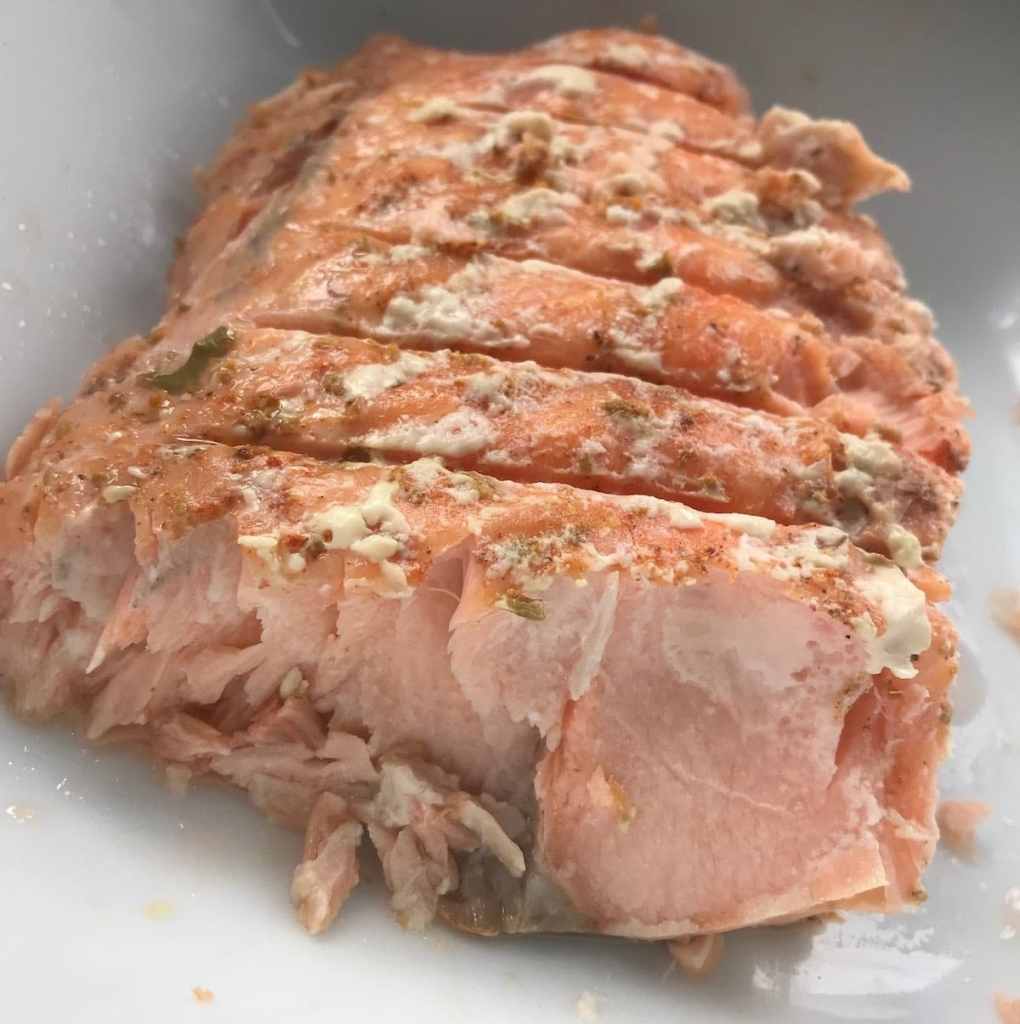
Faroes’ surroundings are the natural feeding ground of wild Atlantic salmon, which travel out from the rivers of Europe before heading back to spawn. Perfect environment also for fish farming with a conscience. No antibiotics to treat disease have been used for 20 years. Resulting product, off the back of a couple of OTB purchases, offers a rich buttery taste with a firm texture, the roseate colour the result of naturally occurring carotenoids, not dye. These come primarily from the healthy pigment astaxanthin, derived from a diet of microalgae and shrimp. And it has a high omega-3 content. Herring and eel are also part of the diet, helping build up that healthy fat content and his protein levels.

One obvious benchmark – it is sushi-graded, so can be safely consumed raw. Whatever you do with such quality salmon don’t over cook it. My personal preference is to smoke it gently with beech or cherry wood chips in my Cameron’s stovetop smoker.

Or maybe head down the Iceland route (and I don’t mean the supermarket)

We had to pass through the Cotswold town of Burford en route for Oxford recently, which meant visiting its glorious church to pay our respects to the three Levellers leaders executed there on Cromwell’s orders in May, 1649. His troops had first penned them inside St John The Baptist along with 340 other rebels who shared their ‘socialist’ beliefs. There’s a plaque to the trio in the churchyard.

Two miles away was the other object of our pilgrimage – The Upton Smokery, which has featured in the Financial Times top 50 places to shop in the world. We dropped in to purchase smoked eel. As with the great Jeremy ‘Quo Vadis’ Lee, who created his signature sandwich to showcase its delights, it is a passion of mine. And Upton smoke it on site.

They also stock arguably the world’s most sustainable land-reared fish sourced from Icelandic aquaculturists Silverscale.

Upton founder Chris Mills says: “I have been caught in a trap of supporting an industry (salmon farming) which I simply don’t believe in. Open cage salmon farming at sea is an environmental tragedy with such a low level of husbandry that, if people really knew what happened below water, they would never eat salmon again.

“Silverscale is changing that so I am thrilled to be part of this new initiative. Only good husbandry, pure water and zero chemicals can produce an end product to match its wild cousin. Wild Atlantic salmon is an incredible species in terrible trouble. Open caged salmon farming at sea is having a dire effect on their very existence and the only responsible and sustainable form of salmon farming has to be done in a controlled environment on land. Iceland is the obvious place to achieve this.”

Still in development, Silverscale expect to harvest  500-1000 tons this year increasing to 30,000 tons plus from salmon brood stock entirely raised in Iceland from egg.

You can buy smoked Icelandic salmon and char online from Upton.

Anthony Bourdain called AJ Liebling’s Between Meals (1962) “the benchmark for great food writing”, so there’s palpable excitement among gastronomes that 60 years on it’s about to be republished. This Francophile expat contributor to the New Yorker is an obvious inspiration for Wes Anderson’s The French Dispatch, quirkiest of odes to La Vie Parisienne mid-20th century (though that movie is set in the fictional provincial town of Ennui-sur-Blasé).

Liebling was more gourmand than gourmet and his unreconstructed attitude to women matched his gross appetites at table, which in turn led to obesity, gout and death at just 59 in 1963. Yet the guy could undoubtedly write. Like his almost exact contemporary also renowned for evocative prose rather than recipes, Mary Frances Kennedy Fisher. She  survived him by a further 30 years, dying as a feted grande dame in California’s Napa/Sonoma wine country.

As with Alice Waters or our own Elizabeth David, hers is a formidable foodie name to drop. Meryl Streep was never destined to play her. Snooty MFK in an apron for telly demos à la Julia Child? Quelle horreur! All we have is the writing and a certain cult following, of which I’m happy to be a fully paid-up member. If Liebling got Bourdain’s vote, I’m happy to endorse WH Auden’s verdict on her: “I do not know of anyone in the States who writes better prose”.

The great poet died in 1973 (a year after I had dinner with him in Oxford – we disagreed over the merits of the avocado), so that view of his may have dated. Indeed there is a certain antipathy in some quarters towards her legacy and the genre of food-centric life memoirs she initiated. Nadir? Eat, Pray, Love by Elizabeth Gilbert. 

Yet MFK doesn’t really deserve this diatribe from one Josh Ozersky in Medium magazine, culminating in “Her legacy suffocates us, immobilises us, covers us as tightly as puff pastry in a beef wellington. Food writing today is one great echo chamber, and the voice it echoes must be silenced. M.F.K. Fisher must die.”

Harsh. Contrast it with the unlikeliest of MFK homages in Birmingham last weekend, which sparked this, my own reminder of her greatness as a writer. No, I didn’t attend the supper club ‘Lunch with MFK Fisher’ hosted by Matt O’Callaghan, whose Italophile blog isthe rather excellent MangiaMangia, but I’d like to have shared that menu of tea, bread and honey, sherry, tomato, chicken and wine broth, cheese tarts (with white wine), roast pigeon with herbs and bread (with red), iced fruit, gaufrettes and Tokay, coffee and Armagnac.

This ‘fusion of food and art’ apparently replicated a meal she served for friends and family in her rural Swiss home, Le Pâquis above Vevey, just before the outbreak of World War Two. This was just one stop-off in a peripatetic life that also took in Italy, various parts of France and later, her native America (she was born in Michigan). 

Food was integral but she always aimed to chart her life in its entirety, summed up beautifully in the opening to her most popular book, The Gastronomical Me, “Our three basic needs, for food and security and love, are so mixed and mingled and entwined that we cannot straightly think of one without the others.” 

She was a great beauty. Photographer Man Ray worshipped her bone structure. Her determinedly independent life had its fair share of glamour, but also trauma, especially when her terminally ill second husband, Dilwyn Parrish shot himself. Life after the war as a single mother can’t have been easy but those years yielded two of my favourite books of hers on Marseille and Aix-en-Provence. I visited both cities last year and her ghost was there, particularly in Aix along the Rue Cardinale, her base in the Mazarin Quarter.

The area on which she is most evocative is Burgundy. In 1929 she moved there with her first husband, A,l to Dijon, where both studied at the university. Heady days as the newlyweds celebrated its rich food pickings: “We ate terrines of pâté ten years old under their tight crusts of mildewed fat. We tied napkins under our chins and splashed in great odorous bowls of ecrevisses a la nage. We addled our palates with snipes hung so long they fell from their hooks, to be roasted then on cushions of toast softened with the paste of their rotted innards and fine brandy.”

A touch florid, even Lieblingesque, maybe but, especially as her marriage faltered, she grew into her razor-sharp narrations. My favourite of these, set in the Burgundian Avallon region, is I Was Really Very Hungry

It was first published in the Atlantic Monthly in 1937; I discovered it in a delicious ‘greatest hits’ compilation, As They Were (1982). The centrepiece is a kind of a joust between a serving girl besotted with the cuisine her chef is producing backstage and the solo diner (MFK is always brilliant on the ‘woman who dines alone’).

It starts: “Once I met a young servant in northern Burgundy who was almost frighteningly fanatical about food, like a medieval woman possessed by a devil. Her obsession engulfed even my appreciation of the dishes she served, until I grew uncomfortable.

“It was the off season at the old mill which a Parisian chef had bought and turned into one of France’s most famous restaurants, and my mad waitress was the only servant. In spite of that she was neatly uniformed, and showed no surprise at my unannounced arrival and my hot dusty walking clothes…”

3,000 words later, after being pressed with glasses of marc and settling the large bill, the relentlessly sensuous ‘tasting menu’ is over, our heroine ready to leave…

“Suddenly the girl began to laugh, in a soft shy breathless way, and came close to me.

‘Permit me!’ she said, and I thought she was going to kiss me. But instead she pinned a tiny bunch of snowdrops and dark bruised cyclamens against my stiff jacket, very quickly and deftly, and then ran from the room with her head down.

“I waited for a minute. No sounds came from anywhere in the old mill, but the endless rushing of the full stream seemed to strengthen, like the timed blare of an orchestra under a falling curtain. She’s a funny one, I thought. I touched the cool blossoms on my coat and went out, like a ghost from ruins, across the courtyard toward the dim road to Avallon.”

You’re hooked? You must be. Follow this link to read the full 3,500 words.

The best introduction to Fisher at her peak is The Art of Eating, a compendium of four books, her debut, Serve It Forth, Consider The Oyster, The Gastronomical Me and An Alphabet for Gourmets. Her most recipe-led volume, How To Eat A Wolf, was published at the height of Second World War food shortages and its wryness still resonates. One chapter is called How to Be Cheerful Through Starving, another How To Boil Water, and she helpfully tips us off on creating a life-saving ‘sludge’ for 50 cents, yet the message, echoing the rest of her 25-strong oeuvre, is ‘food is pleasure’. When we “nourish ourselves with all possible skill, delicacy and ever-increasing enjoyment it is a way to “assert and then reassert our dignity in the face of poverty and war’s fears and pains”.

That message was there at the start of her writing career in Serve It Forth: “If you have to eat to live, you may as well enjoy it.”

Main image is courtesy of the Audubon Canyon Ranch, a sustainable nature charity based at Stimson’s Beach, who are custodians of MFK Fisher’s Californian legacy.