Destination restaurants in Manchester hotels are almost extinct. The days when Michael Caines had his name over the door at Abode and David Gale ruled Podium at the Hilton further down Piccadilly are long gone. Both now offer standard hotel brasserie fare. As do relative newcomers such as Dakota (though their Grill, well sourced, is surprisingly good), QBIC and Hotel Brooklyn.

Adam Reid, following his mentor Simon Rogan at The French inside the Midland Hotel, continues to fly the flag for Great British Menu style fine dining, but even that failed to make the cut in this year’s Estrella Damm Top 100 UK Restaurants list.

Arguably the city’s most high profile hotel, The Lowry, has dumbed down from the early Noughties days when German chef Eyck Zimmer created some of the finest dishes ever seen in Manchester. Recent restaurant space makeovers there and at the Radisson Edwardian do not equate to a radical upgrade of the food offering. The Peter Street Kitchen at the latter, partnering Mexican and Japanese menus, is a wild card, though. Let’s leave it at that.

Which bring us to Sunday lunches, a perennial draw in hotel dining rooms. Scrap them at your peril. The worst case scenario being carveries, which discreetly we’ll shove on the back burner.

Possibly the best roast in town is inside the Stock Exchange Hotel, at the Bull and Bear. You’d expect that from Tom Kerridge, whose whole ethos trumpets comfort food done with accomplishment. But, though the stunning setting sings ‘destination’, we’re not talking food on a level of his two Michelin star pub in Marlow, The Hand and Flowers.

The Ducie Street Warehouse has relaunched its own Sunday Lunch offering with the added bonus of the UK’s first dedicated Cauliflower Cheese Menu, courtesy of head chef Andrew Green, who has previous in this department. At Mamucium dairy took centre stage one ‘Cheesemas’ with a menu that included a 3kg cheese wheel to share. 

I must admit my arteries wobbled at the though of tackling classic vintage cheddar cauliflower cheese and twists featuring truffle, bacon fizzles, blue cheese (our choice), garlic and herb crusted, macaroni, a totally vegan cauliflower cheese and, the ultimate, a four cheese version with parmesan, gruyere, philadelphia and cheddar. 

Relief came at table when I realised they were all sides at £4.50 a pop. Alternatives included old stagers such as Cumbrian pigs-in-blankets and honey roasted heirloom carrots.

Head chef Andrew Green is a meat and cheese specialist putting his stamp on Ducie Street Warehouse

Glossop-born Andrew has been one of the Manchester chef stalwarts in recent years. Though he started in an Italian restaurant, the rest of his his professional career has been in hotel kitchens, a couple at the Airport before he headed up The Lowry’s and then Mamucium’s. His forte has been meat cooking, notably a classic Beef Wellington, and he has always sourced from top notch butchers such as Mettrick’s, WH Frost and currently The Butcher’s Quarter.

So why am I slightly disappointed in the dry-aged shorthorn beef sirloin and roast supreme of corn fed chicken we share as mains? Small plate starters had signalled a user-friendly, standard, global hotel menu, but our mains didn’t take it up a gear. A pond of all-purpose gravy, chewy roasties and chunky Yorkies didn’t do the meats any favours – the chicken tasty enough but on the dry side, beef sliced in thin wafers needed the lift of the horseradish we requested.

Alternative Sunday mains were rosemary roasted leg of lamb, free-range gammon and a weekly changing vegan roast. You can even order a pick and mix of all four meats on the plate. Nothing to scare the punters but lacking the pizzazz of the setting, the vast stylish ground floor below the Native Hotel.

Slightly more exciting sounding is access to two-to-share offerings that sit in the normal a la carte – harissa spiced whole chicken, miso glazed fish of the day, 800g tomahawk of Cheshire beef or a whole roasted ‘ras el hanout’ cauliflower. 

Bistrotheque was the initial food and beverage offering when Native created 166 apartments in the Grade 11 listed Victorian warehouse back in. It was soon apparent its quirky comfort food at posh prices formula didn’t transfer well from the East London original, so after six months it was ditched and the 80 cover dining room became Restaurant at CULTUREPLEX (the co-working, arty raison d’etre for the rest of the ground floor). Highlight of this manifestation was a pop-up by the cutting edge restaurant team of Higher Ground (now operating Flawd at New Islington Marina). Its front of house expert, Richard Cossins, famously opened Fera at Claridge’s for Simon Rogan. But that was London and this is Manchester,  where the real culinary frissons are rarely to be found inside hotels. Now pass the horseradish.

Sunday with Sides’ is available every Sunday, with special cocktail offers and live music, from 12.30pm to 8.30pm at The Ducie Street Warehouse, 51 Ducie Street, Manchester, M1 2TP.

Such has been the impact of District, hyper-stylised Oldham Street take on “progressive barbecue cookery and liquid intelligence inspired by a future Bangkok”, that it soared into the Best Newcomer shortlist of the 2021 Manchester Food and Drink Awards just weeks after opening. 

10 Tib Lane, an altogether quieter affair (no synthwave soundtrack), didn’t. It launched a crucial couple of months later and missed the cut.

What do they have in common? Both are sophomore projects of Northern Quarter ramen rivals; in District’s case Danny Collins, in 10 Tib Lane’s Ben Gretton and Tom De Santis. Their new ventures diverge fascinatingly. 

At Tokyo Ramen, pet project of Japanophile duo Collins and Stephanie Chiu, I adored the broth and noodles, but the stark experience erred towards being in a holding cell for Yakuza mobsters. Albeit only for a swift lunch break before parole. 

Two minutes’ walk away Cocktail Beer Ramen + Bun was more fun, is more fun, playful of concept, the cocktails good. They are far better at 10 Tib Lane, where new business partner Joe White of Chorlton Bar Henry C can be found manning the bar. French-influenced small plates have upped their game too and the wine and beer offering is cannily chosen.

So what of District? Collins trumpeted pre-launch, in a way of justifying a pricey platform of tasting menus: “We don’t want dining to be a quick in-out job. Restaurants can be a place to spend a whole evening, at a pace that really allows you to relax.”

Visiting early evening, the sole customer for 40 minutes. I couldn’t gauge how mellow an extended stay with a full house might turn out. I didn’t mind the bombardment from the sound system because I had no one to talk to, apart from my excellent server Katie, who offered to write a full brief on each dish and its manifold constituents.

For her sake I was glad I had chosen the simplest menu, the £40 ‘My First Crush’ (“A new life awaits you in the Off-world colonies. A chance to begin again in  golden land of opportunity and adventure!” So not really Oldham Street).

As it turned out, with a substantial open kitchen team devoted to my needs, the seven course meal lasted under an hour and a half, which well suited me (with a Modern British Cider tasting head of me in the Green Quarter).

‘The Full Experience’  (“Do questionable things. See things you wouldn’t believe. All moments will be lost in time like tears in the rain.”) would have cost me £85 for 11 courses. No director’s cut discounts for recognising the Blade Runner quotes, but would the dishes set in my (immediate) future be outlandishly out of this world? The voyage started well.  A ceviche of Cornish wild sea bass tasted as exquisite as it looked, the pearly raw flesh dotted with Thai basil mayo and spiked with gaunt purple yam crisps. Punchy is the word for the pool of nam jim sauce the bass sits on. It’s a sour, salty, sweet amalgam of garlic, fish sauce, coriander root and not too assertive bird’s eye chilli.

Next up, ‘Not Tacos’ is two savoury discs that riff on the T word, one a purple corn tostada topped with nam tok (waterfall  beef) made with seared rib-eye, the other a soft omelette pancake bearing short rib cooked with turmeric and dried spices, southern curry style. It’s a one swallow each. A bit like shots, the hit is in the aftertaste. Just slightly unsatisfying.

Dishes three and four come in tandem, their contrast this time making perfect sense. I shall refer to Katie’s extensive note on this one, which definitely spares my short term memory.

Fire is at the centre of what District is about. That and dystopian lighting in disturbing purple, especially in the downstairs bar. The coals at the end of the kitchen counter offer a more welcoming glow. On them pork coppa shoulder was seared, slivers of it smeared with a tamarind jeaw or dipping sauce that in this instance offers a real umami smack. In beautiful contrast is the accompanying bowl of that under-rated brassica kohlrabi, cooked sous vide, carved into curls. It is dressed with, and I quote, palm sugar, lime juice, fish sauce, shrimp paste, bird’s eye chillies, then mixed with tomatoes candied in fish sauce caramel, crushed peanuts, ‘shrimp floss’ and long beans. It managed to be refreshing and complex.

All was building up to the chicken dish that seemed to constitute a main because it came with a portion or rice cooked in rich chicken stock, topped with crisped chicken skin.

There was an intense broth of coconut and galangal, laced with spring onion oil, that featured shimeji mushrooms and charred sweetcorn which demanded to be mopped up by every grain of rice. And the corn-fed chicken? An elaborate pan-Asian conceit that involved confiting chicken thighs in chicken fat, then removing the bones and pressing the flesh on skewers over coals.

All this was an absolute delight but then the meal tapered off. Massaman curry I always find a mite muddy and it didn’t do any favours for Herdwick hogget rump, slow-cooked then finished on the barbecue. A large minty oba leaf felt extraneous too.

Finally, the dessert called “It was only a dream” was hardly a nightmare but the mango, coconut fudginess was disappointingly bland. An esteemed colleague acutely compared the puffed rice topping to Coco Pops.

These are only tiny quibbles. But with their prices set to rise (up to £50 and £100 respectively) from the start of November and belt-tightening on the winter agenda District may need to refresh the launch menus to maintain its impetus. It’s not quite the Manchester game changer that drew the initial encomiums. There are definite echoes of Pan-Asian places head chef Ben Humphreys (second from right in the line-up) previously worked at – Australasia, the undervalued Tattu and, most closely, Rabbit In The Moon, definitely in decibel/dark decor levels.

The Thai barbecue approach has also led to comparisons with Kiln in Soho, but that has a more authentic jungle feel of raucous sizzle and the ingredients aren’t as polite (see above). Perhaps turn up the heat, District. To quote Roy Batty in Blade Runner: “Fiery the angels fell. Deep thunder rolled around their shoulders… burning with the fires of Orc.”

District, 60 Oldham St, Manchester M4 1LE.

No, I didn’t succumb in that first lockdown to making my own sourdough. Life’s too fleeting. In the past I’d had more starters than University Challenge… and more flaccid failures. So the pillars of my home loaf baking remained a classic white tin loaf and an Irish sourdough (Richard Corrigan’s tried and tested Gentleman’s Journal recipe with extra treacle).

Sticking with the Irish, I knew a chef in deepest County Cork who rose at 3am every morning to start the daily croissant making process. Five hours later the cute little viennoiseries were sitting in your breakfast table basket, crisp, flakey and buttery. 

Yet which of his guests would have given a thought to the Herculean effort involved in juggling the temperatures of the ‘beurre de tourrage’ (butter block) and the ‘détrempe’ (yeast-leavened dough) as folding and folding created the requisite multiple layers demanded by La Tradition Française?

On occasions I succumb to the convenience of supermarket croissants but there really is no substitute for the real thing. Manchester patisserie chain Bisous Bisous manage the trick, as do Pollen Bakery at the city’s New Islington Marina. The added incentive in the trek there is, after a cappuccino and croissant in the cafe, to carry home the absolute star of the Pollen range – the 28 hour sour, which is made with a blend of white flour, wholemeal flour and rye, each added for nutritional value and flavour. All flours organic and 100 per cent stoneground

The length of the proving process is to allow all the water to fully hydrate the grain which allows it to lock all the nutrients and make it more digestible. The glossy exterior is the evidence of that work having been done, apparently. The only sourdough that has bettered it in my experience is one we discovered at the Wild Flour Bakery at Freestone along California’s Bohemian Highway (I kid you not).

Co-founders Hannah Calvert (she has a croissant tattooed on her arm) and Chris Kelly started up the bakery in late 2016 in a Sheffield Street railway arch near Piccadilly Station before moving to the Marina premises, which allowed them to open their hugely popular café. Now there’ s a fresh Pollen in the offing.

Kampus has hosted cutting edge restaurants Tine and Higher Ground in its ‘Bungalow’, foreground

Let’s ‘Pollinate’ KAMPUS

KAMPUS, Manchester’s self-styled garden neighbourhood of variegated apartment blocks, cultivated by CAPITAL&CENTRIC and HBD, seems to be competing with the rival developers down at Deansgate Square to plant quality food and drink offerings on the doorstep of their new tenants.

After the success of high profile pop-ups Higher Ground and Tine the indie likes of General Stores and Nell’s Pizzeria have signed up for permanent units, but Pollen relocating their pastry team to a Kampus ground floor site is the real coup. Looking out over the ‘tropical’ garden, the Pollen café will offer indoor and outdoor seating and room for workshops and supper clubs. Plus an expanded brunch menu. Opening is planned for early 2022.

It’s too easy to pin ‘Magnificent’ to Obsession but it’s a perfect fit for Northcote’s gourmet festival. For over two decades, with ever-starrier line-ups of guest chefs, it has lit up the depths of January. Last year, alas, the lights went out as the shadow of Covid cancelled all hospitality.

Now it’s storming back, ambition undimmed, from January 21 to February 6 2022 at the Michelin-starred Ribble Valley stalwart. Caution remains with an absence of global big hitters but this is more than made up for by 16 chefs, with 15 stars under their belt, from the UK and Ireland.

In announcing the cast of Obsession 22 Northcote exec chef Lisa Allen was quick to point out the big plus of this approach and I’m inclined to agree. After a torrid 18 months and more for the industry, and with staffing and supply headaches that won’t go away let’s celebrate ‘our own’. Their world class quality but also their energy and durability in the circumstances.

Not that there’s anything remotely parochial about the schedule below, tickets for which go on sale on Tuesday, September 28. It ranges from the high profile Michelin likes (above) of Matt Abe (Restaurant Gordon Ramsay), Simon Rogan (L’Enclume) to Obsession newcomers Roberta Hall McCarron from Edinburgh and Jordan Bailey from Co KIldare (below) alongside familiar telly faces Tom Kerridge and James Martin. Bailey, who runs two Michelin-starred Aimsir with his wife Majken, particularly intrigues me. Once a key part of the Restaurant Sat Bains team, he was later head chef at 3-star Michelin Maaemo in Oslo before they moved to Ireland in 2018.

As is traditional, Lisa Allen kicks off the 14 days of dinners on January 21 and she returns for a formidable female Grande Finale on February, when she teams up with Monica Galette and Nieves Barragan Mohacho.

The lineup: 

  • Fri Jan 21: Lisa Goodwin Allen, Northcote, Ribble Valley (1 star) 
  • Sat Jan 22: Matt Abe, Restaurant Gordon Ramsay, London (3 stars) 
  • Sun Jan 23: Mickael Viljanen, Chapter One (previously The Greenhouse), Dublin  
  • Mon Jan 24: Jordan Bailey, Aimsir, County Kildare (2 stars) 
  • Tue Jan 25: Simon Rogan & Tom Barnes, L’Enclume, Cumbria (2 stars) 
  • Wed Jan 26: Roberta Hall McCarron, The Little Chartroom, Edinburgh 
  • Thu Jan 27: Alex Bond, Alchemilla, Nottingham (1 star) 
  • Fri Jan 28: Galton Blackiston, Morston Hall, Norfolk (1 star) 
  • Sat Jan 29: Hrishikesh Desai, Gilpin Hotel & Lakehouse, Cumbria (1 star) 
  • Sun Jan 30: Kenny Atkinson, House of Tides, Newcastle (1 star)  
  • Wed Feb 2: James Martin, celebrity chef and TV presenter 
  • Thu Feb 3: Tom Kerridge, The Hand & Flowers, Marlow (2 stars) 
  • Fri Feb 4: Atul Kochhar, Atul Kochhar Restaurants, London  
  • Sun Feb 6, Grande Finale feat Monica Galetti, Mere, London; Nieves Barragan Mohacho, Sabor, London (1 star); Lisa Goodwin Allen, Northcote, Ribble Valley (1 star) 

Lisa said; “Obsession 22 is particularly special. After having to cancel this year’s festival due to the pandemic and with the hospitality industry taking such a hit, we’re all ready to put on a show of culinary brilliance. This year it was only right to bring all corners of Britain and Ireland together, focusing on the incredible talent that we have on our shores, but still with an injection of different styles of cooking, different regional ingredients and different flavours. We have some great emerging chefs like Alex Bond, and much-loved household names, as well as some of the UK’s best female chefs, joining us.”  

Tickets for Obsession 22 go on sale on September 28 and are priced at £160 per person, including a Louis Roederer Champagne and canapé reception, five course menu, coffee and petit fours. A specially paired wine flight can be added, starting from around £65 per person. For more information visit this link.  VIP hospitality packages are available to book for six or more people in the Louis Roederer Room or at the Chef’s Table, from £2,350 + VAT. A few lucky (and swift) guests might be able to book one of Northcote’s 25 boutique bedrooms. Northcote, Northcote Road, Langho, Blackburn BB6 8BE. 01254 240555. Here’s my review of Northcote’s five-course tasting menu.

In the week that Noma belatedly gained a third Michelin star after years of accolades for transforming the way we look at the food on our plate and how we source the raw materials it seems entirely of the moment to be talking low intervention wines with one of its alumni.

No, not on the Refshaleøen waterfront in Copenhagen, where chef Rene Radzepi works his culinary magic; our view is of New Islington Marina, extension of Manchester’s own hip enclave, Ancoats. Dan Craig Martin is the curator of the wine offering at Flawd, latest arrival on Marina Promenade. Originally from Oregon, Dan spent three years working at Noma. 

New Islington Marina looks idyllic in the autumn sunshine… time for natural wine and charcuterie

Crucially he was previously at Blue Hill at Stone Barns restaurant in upstate New York – the farm to table crucible where the Joseph Otway/Richard Cossins project, Higher Ground, was forged. Richard was general manager at Stone Barns when fellow Brit Joe arrived as fish chef.

In 2020 Higher Ground sprang up in Manchester as a residency in the Kampus development. Here’s my Manchester Confidential review, which also unravels the partners’ CVs that include America, London, Copenhagen and Stockport.

After further peripatetic pop-ups their eyes are on a permanent restaurant site in the NOMA (the acronym is catching) district near Victoria Station, probably next year. Higher Ground has benefited from keeping their terrific team intact too – the likes of Meg and Chris.

The gang are all together at self-styled neighbourhood wine bar Flawd. Awkward name for a destination that decidedly isn’t. OK, the lack of an extractor fan means there’s no cooking on the premises. So expect assemblies of produce grown at Cinderwood, a Cheshire market garden they are partners in or platters of British cheeses and charcuterie with bread from neighbours Pollen Bakery, naturally.

Not just any charcuterie, mind. It’s sourced from Curing Rebels in Brighton, up there with the UK’s best producers of cured, fermented and smoked treats. The £12 plate on the menu for my visit featured salami, smoked sausage and coppa. So perfect to share a bottle of wine over with a view of barges and wildfowl (oh and the odd steepling apartment block in the distance).

I warmed immediately both to the wines and ciders on Flawd’s shelves, to drink in or take away, and to new partner Dan’s approach to specialising in ‘low intervention’. It’s no secret that natural wine apostles can turn into zealots, given consumer resistance. Here the choice, with affordable wines by the glass too, is much more welcoming. 

Natural wines will always be a broad church. Some wines will be a challenge to traditional, maybe hidebound palates, but there’s so much to convert you with proper advice from Dan. We share a love of less alcoholic Loire reds from Cabernet Franc and Gamay grapes. Among the most vibrant vignerons in the region is biodynamic champion Thierry Germain, marrying a modern approach to tradition (he uses both shire horses horses and specially light quad bikes in the vineyards). His Roches Neuves Saumur Champigny is £37 to drink in and at £28 to carry out. I couldn’t resist the latter.

To accompany a trio of dishes I was recommended a red from Northern Spain that combined old favourite grape Mencia with a dash of Palomino, white grape best known for sherry. Fascinating and very drinkable. 

Each of the dishes showed the value of Cinderwood. This one acre biologically intensive market garden in Poole, Cheshire, is based on the regenerative, organic principles championed by Dan Barber at Blue Hill at Stone Barns in a quest for the best possible flavours 

Under grower Michael Fitzsimmons, Cinderwood is supplying an increasing number of Manchester’s best places to eat, including 10 Tib Lane, Elnecot and The Creameries, which all share a similar ethos. Flawd, though, benefits from a daily supply chain, on which they base a swiftly changing menu.

What also cheers me is the presence of ‘signature’ ingredients that featured in that first Kampus tasting menu – the likes of smoked cod roe, Tropea onions, sea buckthorn.

Rings of Tropea, that intense red onion originally from Calabria, join an ox heart crumble in a sweet/savoury jumble on the freshest ice queen lettuce, another Italian ‘expatriate’ variety

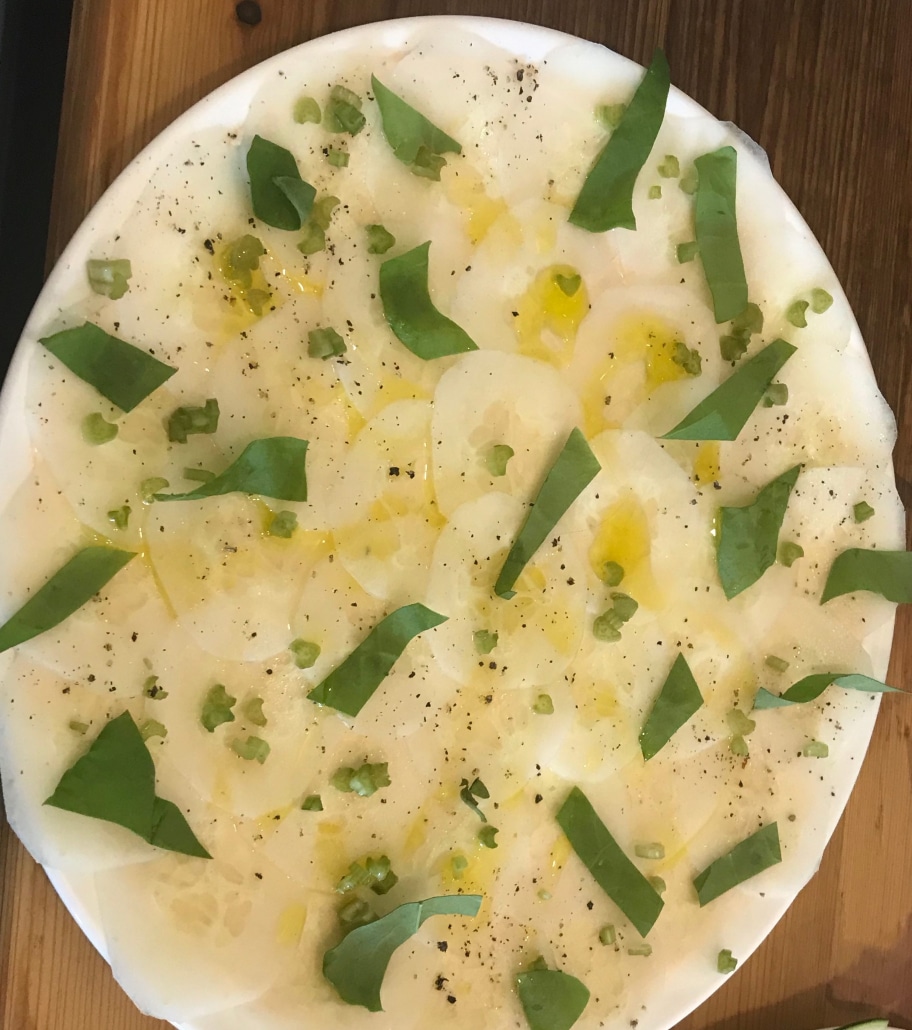
Wafer-thin slices of courgette come dotted with Morecambe Bay shrimp in an elderflower dressing; even prettier and mouth-tingling is a dish where almost transparent discs of cucumber are coated in (the acceptable face of taramsalata) an emulsion of smoke cod roe and garnished with strips of lemony sorrel.

Most of the small dishes range in price from a fiver to £8. Seated next to the pass with Joe hard at work, the most popular dishes on the night appeared to be smoked salmon with Manchester sea buckthorn hot sauce and Lancaster Smokehouse mackerel on toast.

Of the new ventue Joe has said: “We really just want to open a neighbourhood wine bar for the growing New Islington community, to create a space for people to drink great wine, relax and have fun. Treat it as an ideal destination for an after-work drink, an aperitivo before dinner, or a few drinks before a night out in surrounding Ancoats or the Northern Quarter.”

I think it’s going to be hugely popular and I’m looking forward to a proper investigation of its bottleshop shelves. Still, it feels a product of canny expediency, a stepping stone towards a full restaurant experience Higher Ground. Now that would lift the spirits for 2022. Joseph Otway cooking on gas again!

Flawd, Unit 3, Mansion House, Marina Promenade, New Islington, M4 6JL. Wine bar hours: Wed/Thu/Sun: 5pm-11pm; Fri/Sat: 5pm-11:30pm. Bottle shop hours: Wed/ Thu/Sun: 12pm-11pm; Fri/Sat: 12pm-11:30pm. Main image left to right: Richard, Meg, Joe, Dan and Chris.

Blue Hill at Stone Barns 

This is the (literally) groundbreaking project of farm to table guru/chef Dan Barber. With a messianic zeal, his book The Third Plate: Field Notes for the Future of Food (Abacus) champions organic flavour-driven produce as a meal focus. Shift to fewer slabs of protein, elevate the finest quality veg and grains to centre stage, respect the earth is the message. To see what can be achieved on the plate, check out series one, episode two of Netflix’s Chef’s Table.

Natural Wine primers

I’d suggest two books by Alice Fiering – Natural Wine for the People (Ten Speed Press) and The Dirty Guide To Wine (Countryman Press), the latter in conjunction with Pascaline Lepetiere. Less terroir hardcore and covering organic and biodynamic producers is Wine Revolution (Jacqui Small) by Jane Anson.

As I pen this al fresco appreciation of conjoined Ramsbottom restaurants Levanter and Baratxuri, both are preparing to re-open inside for the first time in many months. More choices again. Inside or out? It was difficult enough pre-Pandemic to pick which of the Botham family’s Iberian destinations to drop in on. 

Latterly (it’s only relative) it was Baratxuri’s bar with its flurry of Basque pintxos that won out, but the pedestrian conversion of Square Street meant a joint reservation system and shared menu outside. So was a sunny Saturday lunchtime under the awnings the best of both worlds? Definitely.

The glory of Baratxuri, writ even larger at its Manchester Escape To Freight Island site, is Joe Botham’s way with fire. Yes, more wood-fired grills (check out my Heady Basque Mix of Woodsmoke and Wild Turbot). How then could we resist, from the asador, the Galician Xuleton, giant rib steaks from 10-year-old Capricion de Oro oxen dry aged for a minimum of 45 days? 

There was a raft of on the day prices, dependent on weight from £51 to £80. We asked for the £60 for three of us. We were just charged the £51 for a serving that was easily enough – after a succession of support act pintxos. The txuleton (bone-in cut from former dairy cattle) came simply with padron peppers and dressed tomatoes.

The menu description uses the word ‘malty’. Not a word I’ve used about steak, but now I’m a convert. The dish was stupendous. Well rested, the charred flesh had a slight chew to it but was intense in flavour, the salt enhancing this rather than distracting.

What else did we have? Also from the wood-fired oven a tranche of that favoured Spanish fish, hake done a la gallega, ie Galician style, which involves spuds, garlic, chorizo and, in this instance, pea emulsion (£12).

Chorizo featured again inside the Baratxuri bar favourite, txistorra sausage rolls (£4.50), but this time took second place behind another snack at the same price, the sobrasada pintxo. Here Mallorcan soft cheese and PIco blue cheese are melted on tostadas with honey and walnuts.

We had started with an £8 plate of jamon serrano plus bread, oil and balsamic and salmorjo for dipping. I’m glad I saved some bread to mop up the goo of ember-roasted scallop, salt cod whipped potato and Iberico lardo – a clever little dish, again £8. Coliflor bravas (£5.50) hit the spot too.

The three of us shared a bottle of supple, complex Madai Mencia (£35), the great Northern Spanish red that isn’t Rioja and finally with the txuleton, which we knew we had to wait 40 minutes for, some actual Rioja. A belter of a Rioja at £8.40 the glass. The Carpess crianza was a spicy, cherryish dude, cloaked in the smoothest of oak overcoats. Bravo.

Levanter, 10, Square St, Ramsbottom BL0 9AT.

Chewing the fat, not literally, on a dinner date with a fellow food critic (her review bosses were paying) we inevitably strayed into the territory of ‘What’s been your most memorable meal?’, knowing on both sides of the table there had been plenty of contenders over the  years.

Memorable can mean many things, of course, not all of them positive, but we’ll pass on the shockers. And when we are just seeking superlatives, there is so much to factor in – setting, service, food and wine obviously, company, though if you are reviewing professionally that shouldn’t be taken into account. 

So when I say ‘boning’ clinched it for me I am not being naughty about my all-time favourite. I was swept off my feet by the whole ceremony of separating a turbot from its skeleton. Not just any turbot but the legendary wood-grilled rodaballo (wild turbot) of Getaria on the Basque coast. Elkano was the shrine we sought, arguably Spain’s finest fish restaurant. Unique for a Michelin starred establishment with its cast iron grills glowing intensely outside the front door.

There are several wood grill rivals in this working fishing village but all will doff their berets to this prow-like restaurant way back from the harbour where the legend was born 50 years ago. Founder Pedro Arregui’s magic formula – the fish sprayed with his own oil and vinegar elixir and then grilled for a precise 12 minutes.

Of late the rodaballo dish has travelled far. It’s the calling card of Brat in London, where chef Tomos Parry readily acknowledges its Basque origins; up north it’s a speciality of Joe Botham’s Baratxuri in Ramsbottom and Manchester’s Escape To Freight Island, while a steady stream of 4kg turbot are shipped up from Cornwall to the mighty Pennine grill of the Moorcock at Norland

All quite rewarding but in situ? Accept no substitutes. We had managed to get an Elkano lunch booking on a Monday. It was for 2.30pm, giving us plenty of time for a limbering up hike along the wild sea front to Zarautz and back through vine-clad hills producing the seafood-friendly, tart local white, Tzakoli.

Settling into the comfort of Elkano, we asked Pedro’s son and keeper of the flame Aitor to pick a Tzakoli for us from a dozen on the list, all at very affordable prices. He  recommended one particular example, whispering “it’s the only one not from the Getaria area. You’ll love it.” We did and it was a perfect match.

We did. It went well with an unforgettable ‘warm-up’ parade of seafood – notably txangurro (spider crab meat, sautéed with leeks and garlic, spiked with brandy, put back in the shell and browned) and the classic Basque treat, kokotxas (hake throats in a salsa verde). “Just tip them down your throat – it’s all about texture,” said our mentor. 

Yet, of course, this was just the supporting cast for our Wild Turbot to share. It had arrived on the quay at 8am with the rest of the catch. If it had been landed a few hours earlier it wouldn’t have made the cut. Elkano only sticks the freshest fish on its embers. 

Did our rodaballo rock? You bet. We were introduced to the fish by our server before it was salted, sprayed and grilled

Encountering the result on the plate was magical. Aitor, who now runs today’s more stylish restaurant, gave us a masterclass in the various constituents of the fish as he carved them – from the delicate fillets and dark fatty back sections, ribs from which he leached the gelatin with his knife and the succulence of the cheeks. The simple accompaniment just the sweetest of roasted red peppers. 

At dusk we walked off the long lunch around the San Anton headland, known as Getaria’s Mouse because of its shape. It protects the working harbour, once a famous whaling port,  from the Biscay swell. 

Our lodging was the Pension Katrapona. We had arrived the previous evening via a 50-mile shuttle from Bilbao Airport. Equidistant is San Sebastian. The Getaria grills greeted us. At nightcap time the wood smoke from two floors below forced us to retreat indoors from our balcony with its great view of the harbour. We found supper refuge at Jatatxea Iriba in the old town where we devoured a supper of house-cured anchovies, then langoustines and monkfish – from the outside grill naturally.

How did Elkano get its name? From one of Getaria’s two great sons. Balenciaga and Juan Sebastian Elcano make an unlikely pairing. One, the gay son of a sailor and a seamstress who rose to be Paris’s 20th century king of couture, the other an iron man mariner, who after Magellan’s death completed the first circumnavigation of the Earth with a skeleton crew. 

Born 400 years apart, both men are honoured in the town. Balenciaga with a vast modern museum housing 3,000 of his creations, attached incongruously to a palace once home to his aristocratic mentors. Elcano with two statues, the more impressive crowning an old bastion overlooking the port, and his name on the restaurant shrine to the blessed rodaballo.

He’s buried in a less secular place of worship, Getaria’s fortress-like seafront church, San Salvador, which dates from the 14th century and slopes oddly as if it’s about to launch like some fantastic Gothic galleon. How appropriate.

Factfile

Neil flew from Manchester to Bilbao with easyJet. Below, nearer home, a ‘wildharbour’ turbot at the Moorcock and expert carving at Baratxuri.

I ought to be reassured by Richard Corrigan writing “there’s no such thing as a recipe for colcannon really,” but all he’s doing in The Clatter of Forks and Spoons is dismissing the need for exact measurements or debating whether you can substitute kale for Savoy cabbage. The great chef is not jettisoning the spuds, bedrock of this rustic Irish classic.

Both colcannon and its country cousin champ can be made using fresh or leftover potatoes, but they have to be the floury sort, boiled in their skins. The texture is all wrong with waxy varieties. Parsnips can be added but mustn’t be a puree.

My ‘Colcannon Royale’ with celeriac and pancetta gilding the cabbage lily

The champ mash variant is proof, though that dishes mutate with the times. Originally it was made with stinging nettles – peasant stuff indeed – but over the years spring onions, green and white parts, became the norm. The word colcannon is from the Gaelic term cal ceannann, which means white-headed cabbage while cainnenin can mean garlic, onion, or leek.

But does all this looseness give me carte blanche to make colcannon with mashed celeriac, albeit kept deliberately lumpy? After all, the Scots equivalent of an avenue for leftover mashed potatoes, rumbledethumps, can easily incorporate swede or turnip, while England’s own bubble and squeak has licence to use up a whole gallimaufry of fridge remnants.

In this company, celeriac is a class apart, especially when the mash (never a puree) is augmented with cream and butter, then stirred into lacy Savoy and young leek, braised but retaining a certain bite. Oh and I couldn’t resist adding crisp pancetta to the mix. I call it my Colcannon Royale.

My combination of traditional coq au vin and colcannon was wickedly delicious

It would have made a fine bowlful on its own, but I partnered it with an old school coq au vin, which made for a testingly rich lunch. Before I had a much-needed lie-down I continued some cursory research into the role of colcannon in Irish life and its curious association with Halloween.

Indeed the first written mention was a 1735 diary entry of one William Bulkely, a traveller from Wales who had the dish on October 31 in Dublin: “Dined at Cos. Wm. Parry, and also supped there upon a shoulder of mutton roasted and what they call there Coel Callen, which is cabbage boiled, potatoes and parsnips, all this mixed together. They eat well enough, and is a dish always had in this kingdom on this night.”

Bulkely didn’t know the half of it. For Halloween the Celts developed their own souped up fortune telling equivalent of coins in Christmas pud. It all kicked off with a blindfolded spinster plucking from the garden the head of cabbage or kale that is to be cooked in the colcannon.  

Charms were mixed into the dish itself. Which charm you found was seen as a portent for the future. A button meant you would remain a bachelor and a thimble meant you would remain a spinster for the coming year. A ring meant you would get married and a coin meant you would come into wealth.

To seal the deal unmarried women would stick the first and last spoonfuls of Halloween colcannon into a stocking and hang it on their doors. Guaranteeing the first man who walked through the door would become their husband.

There’s even a 19th century folk song, ‘The Skillet Pot’ that celebrates the dish:

“Did you ever eat colcannon when ’twas made with yellow cream,
And the kale and praties blended like the picture in a dream?
Did you ever take a forkful, and dip it in the lake
Of the heather-flavoured butter that your mother used to make?”

Time to consult Alan Davidson’s Oxford Companion To Food, one of the greatest books in the English language. An immediate surprise in the colcannon entry is its adoption by the English upper classes in the late 18th century. According to one account: “A more elaborate mash was prepared of potatoes and Brussels sprouts, highly flavoured with ginger and moistened with generous amounts of milk and butter.” Now that is a ‘Royale rival’.

Caldo Verde is a distant Portuguese relative of colcannon and all the other cabbage/potato combos

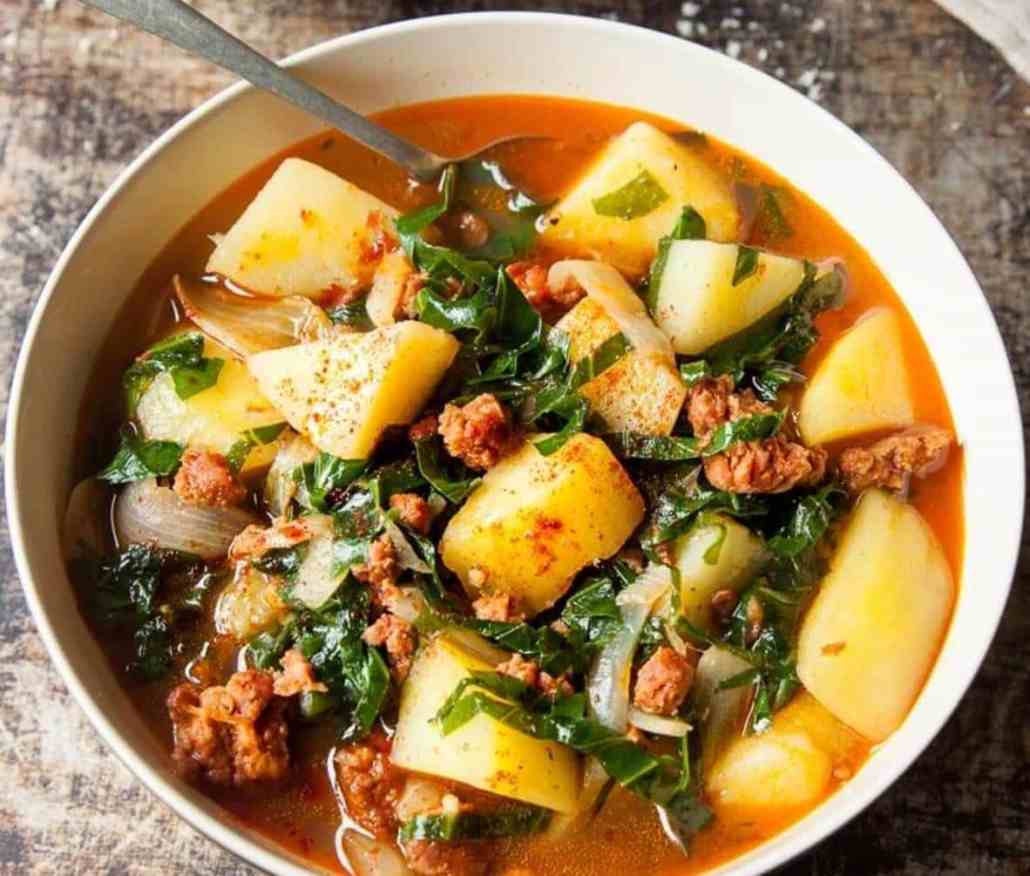
Still for those lower down the social ranks it is so often a leftover dish. And I’ve still got three quarters of a Savoy cabbage and half a bag of Rooster potatoes. Onions, garlic and chorizo are yanked from the larder, chicken stock from the freezer and soon, small world, a big pot of Portuguese Caldo Verde is simmering on the hob. Shall we call it Sopa de Colcannon’?

Time was there used to be a new brewery opening every month in Manchester with cosy taprooms hard on their heels. That torrent of craft has slowed to a trickle with the emphasis now on established operations upsizing to bigger premises. Track are shifting up to Piccadilly Trading Estate opposite Cloudwater while both Beatnikz Republic and Blackjack have expanded into neighbouring arches.

Bucking the trend (though it has, appropriately, had the gestation period of an Indian elephant), is the Bundobust Brewery, which is opening from 4pm on Thursday, September 16, offering the group’s full repertoire of Gujarati street snacks and craft beer, much of it their own, created on the premises. So the kind of major, major opening we’ve been starved of. And it’s dog-friendly. Our chihuahua Captain Smidge (below left) approved even though spicy veggie is not quite his thing.

It’s located in the Grade II-listed St James Building on Oxford Street, a swift stagger from Oxford Road Station or the St Peter’s Square Metrolink stop.

The last time I was on site was February 12, 2020 and we all know what inhibiting factor for hospitality happened shortly after. Kitted out in a hard hat, I quickly recognised why Bundobust co-founders Marko Husak and Mayur Patel had fallen for the former car park with its wealth of period features – vintage alarm bells, glazed bricks and ‘Drive Slowly’ signage – plus a show-stopping giant glass atrium mirroring the Piccadilly Bundobust’s glass apex. 

This is all on a much bigger scale, influenced by US brewpubs and with a focus on sustainable furniture. Each chair is made from 40 recycled plastic water bottles, while school desks have been repurposed into beer hall-style tables, complete with “I Woz ‘Ere” etchings across a 150-seat taproom and restaurant. All  within a fully-functioning brewery that gleams with all the allure of a new toy. A toy that’s in the hands of a very experienced head brewer.

Dan Hocking, former main man at Holland’s world-renowned Uiltje Brewery, has spent the past year perfecting recipes behind closed doors in the state-of-the-art facility.

Bundobust’s brand new Vienna-style Lager, Cartway Lager, will be available exclusively at the brewery upon opening, taking its name from the historic ‘Cartway’ space within the St James Building that the brewery occupies. Hocking says: “Vienna Lager has a fantastic balance of sweetness and bitterness, and it’s the best all-rounder beer style to pair with food”.

On the opening day the first 200 pints are being given away, with the purchase of food and we expect lager demand will make it Goodnight Vienna.

Marko tells me: “We were due to open in May 2020. The past 18 months have slowed us down, but the delay has meant that we’ve been able to develop our beer recipes. Expect the familiar Bundobust vibe and menu, with the bonus of being in a working brewery”.

That 10-hectolitre custom-build is capable of producing 20,000 pints per month. The beer range will only be available, on rotation, at the Brewery and at the other Bundobust venues in Manchester, Liverpool and Leeds. They are designed to partner the award-winning food.

CHAITRO. 5% Nitro Chai Porter. Smooth and creamy Porter with roast malts, a whack of our Bundobust chai masala, and fresh ginger.

PEELA. 4% Pale Ale. Easy drinking hazy Pale, brewed with Azacca and Ekuanot hops. Loads of tropical fruit flavour.

DHANIA PILSNER. 4.8% Coriander Lager. Clean and crisp Czech-style Pilsner with a hit of citrusy toasted coriander seeds.

KIPSY BHAI. 4.8% Kellerbier. Traditional Kellerbier-style lager with German malts and hops. Clean, balanced and crisp.

EAST IS EAST. 6.5% New England IPA. New England-style IPA showcasing ever-changing combinations of the freshest hops.

WEST IS WEST. 6.5% West Coast IPA. Dank and bitter IPA. Piney and resinous, brewed with a rotating selection of the choicest hops. An absolute stand-out.

Bundobust Brewery will also be collaborating with the cream of UK brewery talent. Recent collaborations include Andhera Hoppy Black Lager with Deya Brewing Company, New Delhi Dazzler India Pale Wit with Northern Monk, and Salted Lemon Sour with North Brewing Co.

On a personal note, I have a small role in the Bundobust Odyssey. I was an early reviewer, for Shortlist magazine, of Marko’s pioneering Sparrow Bier Cafe in Bradford, ensuring it made the Top 10 UK craft beer bars, and as a customer wolfed my share of dosas, choles and chaats at Prasad, the Patel family’s acclaimed restaurant, now in Drighlington. In 2014 the two friends combined beer and veggie small plates to create the first Bundobust in Leeds (yes, Zelig-like I was there). The Brewery is just the latest chapter in a delicious indie story.

The Manchester Food and Drink Festival kicks off on Thursday, September 16 with the full raucous backing at the Cathedral Gardens Hub of Mr Wilson’s Secondliners (above). As usual the Festival is packed with events and should profit from a huge public appetite for some kind of tasty ‘new normal’. Here is my choice of five very special MFDF opportunities to enjoy yourself and support a resurgent hospitality industry…

Bull & Bear Festival Hub Takeover, Cathedral Gardens, 7pm, Mon, Sep 20. £55. 

Tom Kerridge’s posh operation in the Stock Exchange Hotel will will be bringing the pub to the hub on Monday 20 September for a three-course feast with music, too. Expect potted Loch Duart salmon with apple jelly and cucumber chutney to start and a braised beef and cheese pie with English mustard for your main and a pud of banana custard with dates, pistachio and honeycomb. The Festival Beer Bar is there to add to the pub experience.

MFDF x Eat Well Dinner, Mana, Blossom Street. Tue Sep 21. £200.

This is the big one – a collab between some of the city’s finest chefs at its only Michelin-starred establishment, all to raise money for Eat Well, a social enterprise tackling food poverty in Manchester. Participating are Mana’s own Simon Martin, Mary-Ellen McTague (The Creameries), Ben Humphries (District), Eddie Shepherd (Walled Garden) and Anna Søgaard (Erst), each preparing one course. Tickets go on sale Friday, September 10. 25 spots only are available. Book here.

Elnecot x It’s Alive Supper Club, Blossom Street. 6pm onwards. Tue Sep 21. £65.

Much-loved Ancoats pioneer Elnecot are joined by their wine suppliers It’s Alive for a menu inspired by the British Isles. Natural wines will be paired with the likes of a Yorkshire hogget broth, a surf and turf and a rendang doughnut.

Tast Meets The Macallan, Tast, King Street. 6.30pm Thu Sep 23. £125. 

Exec chef Paco Perez and head chef Julià Castelló have designed a five-course gastronomic tasting menu that includes octopus, oysters, autumn rice with mushrooms, cheese and figs plus poussin, beetroot and truffle. There’ll also be one limited-edition Macallan whisky that pairs with this feast. Choose Barcelona but also choose Scotland via Manchester. Choose a ticket that costs £125.

Sustainable Wine Evening, Open Kitchen Cafe & Bar. 7pm, Thu Sep 23. £28.

Launching a run of seasonal events, Open Kitchen, inside the People’s History Museum, showcase a selection of wines from the Bolney Estate in Kent, a winery known for its sustainable land management since 1972. Taste six wines across the evening (I particularly recommend the Lychgate red) with table snacks and a wider small plates menu available to purchase.

Check out our preview of MFDF – Manchester’s Biggest Chippy Tea Is In The Bag and Your Vote Counts for Everything for a full list of MFDF Awards nominees. For the latest updates on the programme (Sept 16-27) and to vote for your favourites off the shortlists visit the MFDF website.