The philosopher Julian Baggini, considering rules in the kitchen, proposes a category of dishes called SIVs (Simple but Infinitely Variable) for various cuisines. The English exemplar is the Roast Dinner. Meat joint, root veg, roasties, Yorkies, gravy, condiments. There are only so many ways you can assemble this Sunday centrepiece and yet… nothing beats everybody’s Mum’s. Or if you’re into culinary dereliction, the congealing hotplate offering in your pub carvery.

I’ve written recently about the Sunday roast route for restaurants and its perils as a paradigm of Englishness. Imagine my surprise then when out of leftfield came a decision by Canto in Ancoats decision to push, alongside its Mediterranean tapas menu, a classic Sabbath selection of half roast chicken, beef sirloin or pork belly. 

You won’t find roasts at Simon Shaw’s sister restaurants, El Gato Negro (Spanish) and Habas (Middle Eastern), but then Canto has alway felt slight hybrid since the initial concept as a homage to  Portuguese food was ditched. Shame on the Manchester public for not buying into this distinctive Iberian cuisine.

The coup for Canto was installing Carlos Gomes as head chef. Porto-born, as it happens, he’s a former head chef at the original Barrafina in Soho, which gained a Michelin star for its Spanish small plates. His Canto menu is basically that too, the only remaining nod to Portugal a few wines, an octopus dish and the irresistible pastel de nata custard tarts.

An image I was sent of the Sunday pork belly almost convinced me to drop my prejudice against trad roasts, but the rest of the gallery had me salivating towards the Carlos’s new autumn/winter menu, launched at the same time. I didn’t regret it. Sampled early evening as a deluge sent the Cutting Room Square crowd scuttling for cover, it was the best array of dishes we’ve eaten at Canto and a couple were a real knock-out. If comfort food can count as a knock-out?

In showbiz you save the star turn till last; so it was with the braised ox cheek, crispy pancetta, celeriac and horseradish puree with kale (£11), a slow-cooked master work to blow any simple roast out of the oven. 

A similar intensity of flavour was present in one of the ‘warm-up’ acts. Jamon croquetas are my gooey crumbed balls of choice, but a swirl of black garlic mayo elevated a mushroom-filled version to umami heights (£6).

Not far behind were griddled cod with a black olive crust and confit potatoes (£9) and caramelised cauliflower in tomato and harissa spiced bean stew (£5.50), both soothing and seasonal in feel.

Octopus is a staple of North West Spain (pulpo) and Northern Portugal (polvo). Here for  £10, a substantial tentacle was served Portuguese lagareiro style, baked with spuds. Not subtle but cephalopod dishes rarely are.

Canto is dog-friendly and trying tiny chunks of octopus was a first for our chihuahua, Captain Smidge. He loved it almost as much as the Italian meatballs in an almondy tomato sauce with parmesan shavings (£8) we ordered with him in mind, but he snubbed the roasted beetroot with ajo blanco sauce (£5.50). Watching his waistline, we were frugal with our contributions of carrot cake and pastel de nata.

We ordered my favourite red on the wine list, from Dao in Portugal (where else?). The Quinta do Correio Tinto 2018 offers a riot of dark berry fruit, herbs and a beguiling smokiness. It’s a bargain at £37 a bottle (also available by the glass). Come to think of it, it would be a perfect partner for a Sunday roast.

Canto, Cutting Room Square, Blossom Street, Manchester M4 5DH.

Now open Wednesday and Thursday 5pm-11pm, Friday and Saturday 12pm-12am and Sunday 12pm-11pm.  The Sunday Roast menu offers two courses for £23 and three for £27, while on Saturdays ‘Tipsy Tapas’, provides great value, with three select dishes and unlimited Cava, Bellinis or house wine for 90 minutes at £35pp. It’s available from 12pm to 3pm until November 8, when the restaurant’s festive offer will officially launch. To make a reservation contact reservations@cantorestaurant.com or call 0161 870 5904.

Old chestnuts are less an ingredient more a verbal crutch but I can forgive Fergus Henderson for dredging up his riposte to the smugness of plant-based proselytisers: “How do you tell someone is a vegan? Answer: They tell you.”

Nigella Lawson shares the great man’s charm and forthrightness. She has just ruffled a few feathers – if feathers are allowed in the equation – by admitting to a newspaper she “doesn’t see the point” in being vegan after she essayed the lifestyle choice for two weeks.

While loving vegetables and respecting the views of those who eat a plant-based diet, she won’t be giving up meat again any time soon.

In her opinion humans should eat meat as the “have the teeth for meat”, while conceding we all should cut down excessive intake. It was the eggs she missed the most during her trial run. With me it would be the cheese. Have you ever sampled vegan cheese? As unpleasant as many of the meat and fish substitutes flooding the market.

The 61-year old telly icon, whose latest book Cook Eat Repeat is her best since her debut How To Eat, said she is unsure how such a diet can be better for you due to “intensive factory-making”, preferring to eat ‘proper food’.

Proper food? If I were to pay a belated individual visit to Escape to Freight Island, self-styled “axis of incredible food, drink, music and immersive entertainment, hidden in plain sight at Manchester’s Depot Mayfield” the dining option I’d arrow in on would be Baratxuri’s wood-fired oven for a Galician Xuleton steak, grilled by the maestro Joe Botham.

No one’s going to ask him to provide the scran to celebrate World Vegan Day at Freight Island on Tuesday, November 2. That honour goes to their Depot neighbours, Mi & Pho, who will be collaborating with Pomona Island, easily the best beer choice across the venue. This fully vegan food and beer pairing will take place at the Urban Market on Tuesday, November 2 (6.30pm-10pm) and feature six fresh and healthy Vietnamese dishes paired carefully with six beers.

Expect Spring Rolls, Hot & Sour Soup, Steam Bao Bun, Pad Thai Tofu, Vietnamese Curry Tofu, and a surprise dessert to be announced on the day. Drink pairings from Pomona Island include Factotum, a pale ale; Discotheque a Go-Go, a double dry-hopped pale ale with Zappa, Mosaic, Simcoe, Vic Secret; Pomona lager; Stacks of Green Paper, a strawberry and raspberry sour with grains of paradise; and Boogie Chillen’, a double dry-hopped IPA with Citra, Idaho 7, Sorachi Ace and Galaxy. Book here.

Forget Seitan, Quorn and industrial ready meals, this is the kind of food (and beer) that rocks my plant-based boat. Mi & Pho, both here and at their original South Manchester restaurant, offer fish and meat dishes but vegan is an essential component of Vietnamese cuisine… and across the rest of South East Asia. 

It’s no surprise that the latest food and drink residency at the evolving residential ‘neighbourhood’ KAMPUS, just a 10 minute walk from Freight Island, has gone to Altrincham Market favourite, Bánh Vì. Until the end of November, Thursday to Sunday, co-founders Harry Yarwood and Jess King will be serving a vegan version of Vietnam’s benchmark sandwich, the bánh mì, along with other non-meat treats from that country.

Harry? Jess? Am I hearing cries of ‘cultural appropriation’? Rubbish. The baguette that’s the basis of a bánh mì springs from French colonial heritage – further proof that food is a cultural melting pot.

Remember recently when the hateful Mail and Express drummed up a storm in a rice bowl over Manchester-born Pippa Middlehurst, winner of Britain’s Best Home Cook’, daring to write about dumplings and noodles? More sneaky woke bashing on their part. Check out my appreciation of her essential new book.

Which brings us to arguably Britain’s most influential cookery book writer, Jackie Kearney, aka the Hungry Gecko (as Pippa is Pippy Eats). The Masterchef star’s seminal first book, Vegan Street Food (Ryland Peters, £16.99), is one of the most thumbed through on my shelves. Its recipes stem from culinary adventures with her young family across Thailand, Laos, Vietnam, Malaysia, Indonesia, Sri Lanka and India. The initial plan wasn’t for a vegan-centric account. It just evolved that way thanks sheer weight of approachable meat/fish/dairy free recipes.

Only last weekend, buoyed by the presence of two South East Asian grocery stores in Hebden Bridge down the road, I recreated her Hungry Gecko Jackfruit Jungle Curry – a riot of lemongrass, galangal, turmeric root, tamarind, kaffir lime leaves and much more, served with a coconut milk-infused yellow rice. After a spring roll starter

A less complicated dish is Jackie’s Laos-style Roasted Pumpkin, Coconut and Chilli Soup,  a picture of which she has just posted on Facebook. Once of  Chorlton, she is now based in Liguria. I told you the world is a melting pot. If you are fancying a switch to a plant-based diet, or even becoming more flexitarian, start with this. Vegan doesn’t have to mean bland.

Jackie Kearney’s Laos-style Roasted Pumpkin, Coconut & Chilli Soup 

2tbsp vegetable oil; one small pumpkin nor squash, deseeded and cubed; 2-4 large red chillies, trimmed; 1 litre veg stock; 800ml coconut milk; 2tsp salt; 2-3 almond or any vegan cream.

Preheat the oven to 220C (Gas 7). Drizzle the oil onto a baking sheet. Put the pumpkin on the sheet and toss to coat in the oil. Roast for 20-30 minutes until it begins to brown and soften. Put the chillies on the baking sheet for the last 8-10 minutes and roast until they begin to blacken.

Put the stock in a large pan and add one litre of water and the roasted vegetables. Bring to the boil, then reduce to a simmer and add the coconut milk. Return to the boil, then simmer gently for 10 minutes. Using a food processor or stick blender, blend the soup until smooth and creamy. Season with salt to taste. Divide the soup into serving bowls and finish each with a swirl of almond cream.

Wish me luck. I’m about to embark on recreating the Roasted Chicken Wing Garum that is a party piece at Noma in Copenhagen. I’m scaling down the portions required by the Fermentation Lab of the global game-changing three-star restaurant and adapting my own less hi-tech equipment for the experiment.

They’ve allowed me to share the recipe from their Noma Guide to Fermentation (Artisan, £30), seeing how keen I was to explore a culinary technique handed down since Roman times and given a new lease of life by Noma founder Rene Redzepi and David Zilber, his head of fermentation for five years.

Read my ‘Anchovy is of the Essence – Garum, Coltura d’Alici and Nam Pla’ for a primer in my nascent discipleship and desire to enhance the flavours of my cooking with the funkiest of fermented sauces but without the traditional fish. https://www.neilsowerby.co.uk/2021/07/02/anchovy-is-of-the-essence-garum-colatura-dalici-and-nam-pla/ Now comes the hard, stinky part. I’ve purchased my chicken bones and wings and have adapted a rice cooker to stand in for a fermentation chamber, modifying the amount of raw materials to fit.

I’ve cheated by buying in organic pearl barley koji (from Amazon UK); next time I’ll start from scratch, but first I’ll have to acquire a koji tray. Another boy’s gastro toy, my wife sighs.

For the uninitiated, Koji is cooked rice that has been inoculated with Aspergillus oryzae, a mold that’s widespread in Japan. The mold releases enzymes that ferment the rice by decomposing its carbohydrates and proteins. In this case the process is applied to barley (barley miso is made this way). 

• Wish me luck over the coming weeks. I’ve followed the authors’ instructions to carefully peruse more detailed instructions in the ‘Beef Garum’ section but, with my success rate in creating basic kimchi not of the highest, I’m going to be on tenterhooks. All of a ferment, you might say. 

Roasted Chicken Wing Garum

Makes about 1.5 litres

2kg chicken bones; 3kg chicken wings; 450g Pearl Barley Koji; 480 grams non-iodised salt.

Roasting brings a lot of rich, fully developed flavour to this garum, meaning it needs only about a month of fermentation to coax out more umami. If we were to ferment this chicken garum as long as we do beef or squid garum, it would lose its subtlety and complexity.

Method:

Place the bones in a large pot and fill with water just to cover—about three litres. Bring the water to a boil, skimming away any impurities that float to the surface as it comes to temperature. Once it reaches a boil, reduce the heat to a simmer and cook the stock for three hours.

In the meantime, heat the oven to 180°C/355°F. Line a baking sheet with parchment paper. Place the chicken wings on the lined sheet and roast them for 40 to 50 minutes, tossing several times while cooking to ensure that they get an even, dark browning. Remove the wings from the oven and let them cool down. Weigh out 2 kilograms of the roasted wings and use a cleaver to chop them into small pieces. Strain the chicken stock through a fine-mesh sieve and allow it to cool.

Pulse the koji in a food processor to break it up into small pieces. Put the chopped chicken wings, koji, salt, and 1.6 kilograms of the chicken stock in a 3-litre fermentation vessel of your choice and stir to combine thoroughly. Scrape down the inner sides of the container with gloved hands or a rubber spatula and lay a sheet of plastic wrap directly on the surface of the liquid. Cover the container with a lid; screw it on slightly less than completely tight if it’s a screw cap or leave it slightly ajar in one corner if it’s a snap lid. Ferment the garum in a fermentation chamber at 60°C/140°F or in an electric rice cooker on “keep warm” for four weeks.

Every day for the first week, use a clean spoon or ladle to skim off as much fat as you can, then stir the garum and cover again. After the first week, skim and stir once a week.

To harvest: 

Pass the garum through a fine-mesh sieve, and then again through a sieve lined with cheesecloth. Allow the liquid to settle and skim off any fat that floats to the surface.

Pour the garum into bottles or another covered container. The garum is very stable and will keep well in the fridge for months. You can also freeze it for longer storage without any negative effects, but note that because of the high salt content, it probably won’t freeze completely solid.

Suggested Uses:

Ramen Broth

When first tasting roasted chicken wing garum, almost every Noma chef mutters the same word: “Ramen.” It’s true, this garum possesses some of the same deep, meaty tones of a great bowl of ramen. A splash poured into a basic kombu and katsuobushi dashi makes for a convincing cheat. And if you’ve made a more proper ramen broth, a touch of garum will help kick the flavor up to eleven.

Roasted Cashews

Coat cashews (or any nut of your choice) with melted butter and spread onto a baking sheet or oven- safe pan. Roast in a 160°C/320°F oven until they become golden brown and fragrant. Remove them from the oven and mix in a couple of tablespoons of chicken wing garum. Don’t add so much garum that the liquid pools on the pan. All the garum should be absorbed by the nuts and evaporated by the heat. You don’t want the cashews to become soggy. Once they cool, they should still be crunchy, with a savoury, salty crust.

Excerpted from Foundations of Flavor: The Noma Guide to Fermentation by Rene Redzepi and David Zilber (Artisan Books). Photographs by Evan Sung.

One bane of a food writer’s life is reviewing a restaurant only to discover post haste that the menu’s about to change. Big time. Fortunately when I wrote up a September visit to Kala in Manchester my focus was on the glories of their featherblade steak, a signature dish across all the Elite Bistros group. 

This perennial stalwart remains on the new Autumn Menu, along with the obligatory truffle and parmesan chips, but there’s a whole raft of new dishes. I was alerted to their arrival by a chance meeting at a wine tasting of an old sommelier friend, who works out of Hispi, Kala’s sister restaurant in Didsbury. He was raving about a dish just created by Elite exec chef Richard Sharples  – a spiced field mushroom doughnut with sesame creamed spinach and caramelised celeriac gravy.

Solid reason to swiftly revisit Kala. It felt like fate when an invitation to sample the new menu suddenly dropped in my inbox. The doughnut turned out to be terrific, but the surprise package – and what a package – was the whole stuffed guinea fowl to share. OK, we were gannets to order both this and the surprisingly substantial doughnut as mains, ‘Mais nous ne regrettons rien’ as they say in Montparnasse or Montpellier.

Indeed there was something quintessential French bistro about this bird (let’s call it Le Pintade), while the fennel and apricot stuffing summoned up all our Christmases coming early. Better early than never with the current prophecies of festive dearth this year.

Our bird, encrusted with fennel and caraway seed, the moist stuffing lubricating the legs, came boned and ready to slice, a pool of pickled pear puree a neat enhancement for its  succulent interior. I couldn’t resist ordering the chips, but the bowl of the most delicate sauerkraut would have sufficed as a side.

We’d preceded the guinea fowl with that doughnut, its stretchy carapace harbouring  a teeming interior of braised fungi. Did it count as vegan? Jury’s out on the earthy creamed spinach, but the celeriac gravy was an inspired plant-based conceit.

Since the return to comparative dining room normality Elite Bistros boss Gary Usher has given his six venues leeway to branch out from the standard group menu, particularly with changing fish of the day picks. At Kala that Wednesday it was a choice of grilled whole plaice or pan-fried stone bass. 

My starter came from the fish specials because I’m a sucker for octopus and I was curious about how Kala’s daring combo would work, pitting the flamed cephalod against equally charred smoked corn and pickled currants. Maybe a red currant hot sauce gilded the piquant lily too much, but it’s typical of a hugely to be trusted menu that is still not afraid to push bistro boundaries.

An unqualified success was my partner’s starter, even if her initial qualm was: doughnut and dumpling in the same lunch? Fear unfounded. The dumpling was a light, gnudi-like pillow of great delicacy, as beautiful to look at as it was to eat, topped with grated Killeen cheese, all nutty and floral, a cauliflower puree base dotted with blobs of lemon and chive oils plus pickled shallot.

We finished off with Chocolate ‘Oblivion’ and poached pear with Sauternes jelly, the former with mint choc chip ice cream, the latter with walnut praline ice. Comforting autumnal bistro staples both. Wines by the glass had been appropriate for each dish and special mention for the Delicioso ‘En Rama’ Manzanilla that got us off to the perfect start, partnering Gordal olives and Don Bocarte anchovies. Isn’t autumn really rather wonderful?

Kala, 55 King Street, Manchester, M2 4LQ. 0161 839 3030. Reservations 0800 160 1811. The three course menu costs £40 for three courses, £35 for two. There’s a £16 supplement for that guinea fowl. There’s a limited choice bistro set meal available lunch and early evening.

Food heroes – there are many claimants. Few are a patch on a monocled Major credited with saving traditional British cheese. From the Fifties onwards war hero Patrick Lowry Cole Holwell Rance promoted the real thing through his polemical writing and regular stock of 150 cheeses at his village shop in Streatley, Berkshire.

Current champions of raw milk farmhouse cheeses the Courtyard Dairy near Settle are quick to acknowledge their debt to the great man, who died two decades ago.

Yet Rance’s partisan spirit was never insular. The majority of the unpasteurised wheels and rounds stacked to the rafters at Wells Stores were French and arguably his greatest contribution to cheese chronicling was The French Cheese Book (1989). I have this treasured 550 page magnum opus in front of me now as I seek out his thoughts on the adjacent Mont d’Or, one of the great French autumnal treats, much more readily available here than in his day.

Like the first cuckoo of spring, I await the first oozing Mont d’Or image of the autumn from out little town’s resident cheesemonger. Jay mailed me a selection this year as the cheeses, all the Brexit bureaucratic boxes ticked, trickled in from the Jura after the mid-September start of the six month season.

It’s early days yet and the billowing crust is yet to attain the peach-pink hue of perfection, but stick a spoon in and the interior ooze offers a buttery, almost clotted cream flavour, with a beguiling sappiness no other cheese quite matches.

This year’s first hand experience comes second best to that of September 2019 when we just happened to be in the Jura mountains – also home to Comté – when the first Mont d’Ors hit the restaurants in the shadow of the ‘Golden Mountain’ that gives its name to the cheese. 

At an unpretentious village auberge, as tradition demands, a whole Mont d’Or was baked in its spruce bark ‘belt’ and served with potatoes, gherkins and a bottle of the tart local white, Savagnin. A posher establishment might have partnered the cheese with an aristocratic Vin de Jaune. Check out Fiona Beckett’s Matching Food and Wine blog last month for further tips.

Back to the bark wrapping. Major Rance’s take in his chapter on Franche-Comté is magisterially atmospheric: “In my mind I have often put myself in the place of a snowbound comtois farmer, collecting logs from the neat stack under the snow-heavy eaves. I have pictured his being suddenly struck by the warm beauty of the cut spruce and its resinous bark, which can glow like mahogany and smell like heaven. 

“A cheese could look like this, he might well have felt. So, on a base cut above the log, with a ring of épicéa bark around it to contain its enthusiasm, a new soft cheese was born. Bathing in brine helps seal bark and cheese together, and the resinous flavour and aroma spread into the cheese as it ripens.” 

Quite. That’s the full experience I’m getting now, not neglecting the sensory delights of gnawing the bark too. I scoop the unctuous cheese out onto a sourdough slice, the first of several. My preference, I’ve chosen not to bake this mini Mont d’Or. 

Vacherin is its more familiar name. The nefarious Swiss across the border nabbed the legal right to use the Vacherin-Mont d’Or moniker for their inferior, semi-pasteurised version, leaving the French with ‘Mont d’Or’ or ‘Vacherin du Haut-Doubs’ (the local département).

It’s no truism when you say you can taste the mountains in the cheese: as autumn nears the cow herds come back to the stables after summering on the high sub-Alpine pastures. The key to its allure is the richness of the milk, exclusively from Montbéliarde cattle. It is made when the yield from the cows is less and more intense, so more suitable for production of soft cheese, rather than the harder Comté cheese. After 21 days’ ageing Mont d’Or is packed in spruce boxes ranging from 480g to 3.2kg.

Closer to home Montbéliardes are also the milk source for Baron Bigod, Suffolk’s feisty answer to Brie.

Our own encounter with these brown and white beasts came during that Jura foodie road trip. The evening of our fondue-style Mont d’Or meal we had arrived at our folksy gite, La Ferme de Fleurette, in the village of Les-Hopitaux-Vieux. After a long drive we were keen to freshen up, No chance. We were immediately off in the hire car to a milking parlour high up among the forests. Our farmer host Mickaël steered us through the mud to introduce his beloved herd, raw milk from which is used to make Comté. 

Raw, yes. Pasteurisation would destroy much of the character. Rich from unsprayed grazing teeming with wild flowers and herbs, Mickaël’s milk will go to a ‘fruitier’ to be turned into traditional cheese. There are roughly 150 of these small village dairies, supplied by 2,700 farms across this beautiful, unspoilt region in the east of France. Below are the Fromagerie du Mont D’Or at Metabief and the Fruitiere des Lakes at at Labergement-Sainte-Marie in the Haut Jura.

Comté is built for ageing, for up to 24 months before it is released; Mont d’Or is for early consumption. Keep it  wrapped in greaseproof paper inside a polythene bag, and store in the fridge – it should keep for around a week. Don’t wrap in clingfilm, as it will make it sweat.

It has never lasted that long at our house. The final word goes to Major Rance: “If you are not in stuffy company: lick the bark after each mouthful of cheese, and do not waste what is left; put it on the fire to die in a scent of glory…”

Calder Cheesehouse, 56 Patmos, Burnley Road, Todmorden OL14 5EY. For Mont d’Or and all your cheese and deli needs.

Those Facebook memories to share that pop up are a relentless reminder of time passing. Was it really 11 years ago I laid out an unplucked pheasant alongside a seasonal red cabbage on our garden table to pictorially celebrate my personal ‘Game for a Laugh’? (that cultural reference dates me instantly) during Manchester Food and Drink Festival.

En route to co-host a ‘Wine Tour of Spain’ event at Manchester’s People’s History Museum with Jane Dowler of Evuna, I bumped into legendary chef Robert Owen Brown, with whom I later collaborated on the cookbook, Crispy Squirrel and Vimto Trifle (Manchester Books, £15.99).

He tempted me into Mulligans off Bridge Street for a couple of palate-refreshing stouts. Drink taken, Rob offered me the pick of a swag bag full of feathered game. I still have the Barbour jacket, twice re-waxed, I was wearing that day, but never since have I stuffed a brace of partridges into the big inside pockets.

Later at the PHM, as I introduced a dense, dark Monastrell from La Mancha as the perfect accompaniment to game, notably Spain’s native red-legged partridge, I drew out my feathered props gunslinger-like to the consternation and then amusement of the front row. 

Our chihuahua, Captain Smidge, is partial to partridge. And since The Edinburgh Castle in Ancoats is dog-friendly he accompanied me to its monthly ‘Trust The Chef’ blind tastingdinner, the first since it was crowned Pub of the Year at the 2021 Manchester Food and Drink Awards. The theme was game, so there was every chance of the Smidge (and my) fave. As it turned out we enjoyed a trio of gamey treats – venison, woodcock and partridge (oops, I never asked what colour its legs had been).

‘Trust The Chef’ had already turned all autumnal for its September five-courser, taking advantage of head chef Iain Thomas’ personal veg harvest from his plot at The Hattersley Projects in Tameside.

Iain’s impressive track record includes stints at Establishment in Manchester (where Rosso now is), at Paul Kitching’s Michelin-starred 21212 in Edinburgh and alongside Davey Aspin, one of the iconic chef names in Scotland. 

So a red deer starter from Pitscandly Farm outside Forfar promised to be an object lesson in sourcing and so it proved. Prepared as as a tartare, it was simply glorious with beetroot done three ways – roasted, puréed and in a sorbet. To follow, a rich game ‘tea’ hosted a mallard breast. The tea, product of some serious reduction, was a savoury treat to the last spoonful; the mallard had a fine gamey flavour but was sinewy, as wild duck can be, and Smidge had to help out. Alongside, a rillette of mallard joined duck liver pate in a smart take on a club sandwich. Dunked in the tea, the brioche butty disintegrated delightfully.

Our gourmet hound was decidedly keen on the partridge, highlight of the five courses. A touch tricksy with its bread sauce espuma and two red onion skin cradles for a borlotti bean leg meat ‘cassoulet’, but the star of the composition was tender 

à point partridge breast. There were wine matches available for each course but we ordered (inevitably) a big Spanish red recommended by our server. The Ritme Priorat from Southern Catalonia, a well structured blend of Garnacha and Carignan, coped admirably with each game dish and the cheese course, moist and nutty Pitchfork Cheddar, accompanied by a chutney made with Iain’s own Hattersley tomatoes. Smidge confined himself to nibbling crumbs of oatcake, which summed up a copacetic, dog-friendly evening at The Castle.

The pudding course homage to Snickers, a 60 per cent chocolate parfait with candied peanuts, was deemed too rich for the little fellow. I suspect it features more regularly given chef Iain’s commitment to sustainable chocolate, supporting local bean providers in Colombia.

The regular menu gives a bid nod to Scottish produce. Good also to see a game terrine there, featuring venison, foie gras and, splendidly, grouse. The departure of my compadre Owen Brown seven years ago left a grouse-shaped hole in Manchester (the classic Rob picture below is by Joby Catto). The city scene moves on, but in Iain Thomas the Edinburgh Castle may have found its own talented ‘game changer’.

The Edinburgh Castle, 17-19 Blossom Street, Ancoats, Manchester. M4 5AW. The five course Trust the Chef menu costs £60pp for five courses. Wine flight extra. The next instalment is on Wednesday, November 3. To book in advance email bookings@ec-ancoats.com.

Serendipity brings on a random snail trail. Flicking through the index of Brown and Mason’s magnum opus, The Taste of Britain, to clarify my thoughts on Kentish cobnuts – for the first of my ‘Autumn Is The Season’ vignettes – I encountered the Mendip Wallfish and was immediately intrigued.

Since when my mind has been roaming those Somerset hills from the days when the Romans mined for lead there and introduced edible snails to our land… to the 1960s, when a maverick rocket engineer put those Mendip molluscs on the menu of his pioneering microbrewery pub… to the current small scale renaissance in snail farming. Well, high in protein, low in fat, it is the ultimate Slow Food.

The picture above is of the last platter of snails I downed, in those peripatetic, pre-pandemic times. Escargots au beurre d’ail are a fixture on the menu of Le P’tit Castel in the hilltop Jura fastness of Chateau-Chalon, one of Les Plus Beaux Villages de France.

The escargots were beauts too, six chewy little buggers in garlic-flecked froth, equal to the ones I was served (with Pernod in the garlic butter naturellement) at Soho’s venerable L’Escargot, below, which also has a feuilleté of snails and morels on the menu. The Jura view was magnificent too. Burgundy, heartland of the dish, was a distant blue blur across Bresse’s vine-clad plain.

Location, location. I’m not sure The Miners Arms, Priddy, in the Sixties before they really became The Sixties, could offer the same je ne sais quoi at a crossroads in uplands scarred by past lead extraction. New owner Paul Leyton’s own homage to the miners was his variation on the Cornish pasty, the Priddy Oggie, containing pork, bacon and cheese. More challenging was his reintroduction of the mysterious Mendip Wallfish, a native snail dish that substituted cider and mixed herbs for garlic butter.

Why wallfish? It probably relates to snails’ ability to cling to walls, but the ‘fish’ part might be a way of transgressing the Catholic church’s prohibition of meat eating on Fridays.

That edict would definitely rule out dormice but the Romans’ relish for farmed, corn-fed rodents doesn’t appear to have transferred to Britain when they conquered it. Snails certainly did make the leap (sic) – notably the large Roman snail (helix pomatia), still popular in France and Italy. Below, is my colleague Joby Catto’s image of snails and citrus in Catania Market, Sicily. Giant African land snails are a whole different kettle of wallfish, of which more later.

C.Ann Wilson’s wonderfully scholarly Food and Drink in Britain (1973) charts Roman snail farming: “Snails had to be kept on land surrounded entirely by water, to prevent them wandering way and disappearing. They were fed on milk or wine-must and spelt, and were put into jars containing air holes for the final plumping up. When they were so much fattened that they could no longer get back into their shells, they were fried in oil and served with oenogarum (liquamen mixed with wine).

By medieval times snails had long been an essential foodstuff and remained so for the Somerset miners well into the 19th century. The resurgence of Mendip Wallfish 100 years on was all down to the restless mind of Leeds-born Leyton, who had forsaken an engineering career, as chief developer for Britain’s first rocket programme in the Fifties and  then a director of Black and Decker. With no catering background, he took a major gamble with the Miners Arms. One that paid off, receiving acclaim from Egon Ronay and The Good Food Guide. 

By 1973 when the pub had incorporated England’s smallest brewery, it was regularly attracting what we now call celebs. Did we then? The roll call included Delia Smith, Terry Wogan, Kate Adie, Malcolm MacDowell, Anthony Hopkins. How many ordered the wallfish, I wonder? Maybe Delia pronging into the shells with a cry of ‘let’s be havin’ you, molluscs’?

Leyton’s obituary in 2011 recounts that his “engineering background still shone through in the world of catering: first, with the design of an electric fence to keep up to 100,000 snails at a time in a disused swimming pool; and then, with the introduction of the freezing of prepared snails and other complete dishes. This led to considerable debate in gastronomic circles at a time when freezing was only considered suitable for basic ingredients.”

A tiny clip on British Movietone shows the ingenious Leyton stuffing snails with a device of his own invention. Plus there’s a period Pathe News report, with a wonderful Cholmondley-Warner style commentary, on his snail project, available via YouTube

The Miner’s Arms is no more. After selling 4,000 snails a year at its apogee the restaurant closed down in 2006. This recipe for the common brown garden snail, from Bob Reynolds who cooked at the Miners Arms, contains the key caveat: ensure you purify them thoroughly before cooking. Buy them ready prepared if you are squeamish.

Snails Priddy style

Collect snails, put into a container in which they can be kept moist and can breathe. Feed them on bran or lettuce or cabbage leaves for seven to 10 days. This cleanses them. Put in a sieve and dunk them in boiling water for a few seconds to kill them. Take the snails from the shells with a small fork, wash them off and then cook. To cook about a 100 you need a pint of water, ¾ pint of cider, a large carrot and an onion cut into pieces. Make sure the snails are covered in liquid. Bring to the boil and simmer until tender for about an hour – it may take a little longer. Rinse in hot water to clean off the bits of vegetables.

Meanwhile put the empty shells in a saucepan with salt and water and bring to the boil. After a few minutes rinse in cold water. Repeat to make sure the shells are clean. Dry the shells in the oven.

After which you will need a pound of butter for 100 snails. Then grind together herbs, fresh or dry – ½tsp of each of chervil, dill, fennel seed, basil and sage; 1tsp chives, 3tsp parsley and a pinch of cayenne pepper – and mix well into the butter.

Take a snail shell, put a little bit of the herb butter into it, then a snail and seal off the shell with more herb butter. Then put the snails on a tray and put into a hot oven. When the butter bubbles they are ready to eat. Serve with cubes of bread to mop up the herb butter. Enjoy.

Lyn Paxman of Somerset Escargots brings a new entrepreneurial spirit to snail farming

So where can you buy the best snails in the land?

An hour’s drive away from Priddy a serious renaissance in Somerset snail farming is under way at Somerset Escargot, founded in 2019. On a farm complete with electric fences, salt traps and herding pens Lyn ‘Queen of Snails’ Paxman and her partner specialise in petit gris, picked and prepare to order. The fresh escargot is then supplied cleansed and hibernated, which means they are the freshest possible when they are cooked. They cost £25 per 500g bag plus £4.90 delivery.  

Other UK snail operators include Dorset Snails, who supply Gordon Ramsay restaurants and L’Escargots Anglais at Credenhill in Herefordsshire, whose Helix pomatia are the base for Heston Blumenthal’s modern classic, Snail Porridge (see below). H & RH Escargots of Canterbury have long been the UK’s premier supplier of live snails. Ready-to-cook, they are delivered to you in cardboard boxes, with a plastic mesh so they can’t eat their way out!

You’ve got your snails. What else can you do with them in the kitchen?

Snail Broth

Marwood Yeatman is an eccentric national treasure. From his base in an old Hampshire pub in 2007 this private chef produced his magnum opus, The Last Food of England (Ebury Press), which is at its best when unashamedly nostalgic. He recounts how he was lent an old book of recipes by Roald Dahl’s wife Liccy that belonged to her mother’s family, the Throckmortons, Warwickshire confederates of Guy Fawkes. How to pot an otter and viper soup feature, but there’s also a recipe for Snail Broth, which sounds on the medicinal side.

Having slit and cleaned the slime off 50 or so… “Have ready a chicken cut in pieces with a little bugloss, agrimony and the leaves of endives, and so boil them in the broth. When the chicken is half boyld, put in the snails being clean wiped, so let them boil until all the strength is boiled out. When the broth is ready to take off put in either a little mace or rosemary, which her pleaseth the taste. Drink this a fortnight.”

Snail Porridge

If the above is too demanding of your foraging skills or spice cupboard, then you might fancy recreating this Heston Blumenthal special, which I’ve eaten a couple of times at The Fat Duck when I could (just about) afford it. The great man gives the recipe in an article he wrote for The Guardian nearly 20 year ago. The information on snail’s sex lives is eye-opening; so too is the amount of sweat and toil needed to prepare the dish, which is more like a vivid green oaten risotto. Good luck with it!

Dorset Snail with Bone Marrow and Toast

Dorset Snails continue a tradition of snail eggs or caviar that was on trend in the 1990s as gourmets sought an alternative to Beluga. They even featured in the title of a book, Snail Eggs & Samphire – by the best food journalist of the time, Derek Cooper. In it he recalls attending an outdoor ‘cargolade’ in Perpignan where 1,000 Helix pomatia (the wrinkled Roman Snail) are grilled in pork fat over intense heat. There’s  a separate chapter on the lucrative rarity value of the eggs, described by Cooper as like “pinky-beige, opalescent pearls”. Blumenthal compares the look to tapioca. Neither are fans. I’m a fan, though of the bone marrow treatment for snails, in Dorset’s recipe section. I have a stash of bone marrow; now I just need the molluscs.

Paella a la Valenciana

If your idea of paella is the seafood-led dish found all around the Spanish Costas, think again. In the Valencia region, spiritual home of the saffron-infused rice dish, traditional ingredients, especially inland, include rabbit and snails, the whole dish best cooked outdoors in one of those vast, flat-bottomed specialist pans. Claudia Roden, in her magisterial over-view, The Food of Spain (Michael Joseph, £25), quotes a Spanish expert on how the snails bring a taste of the rosemary they feed on. Every recipe in the book is tempting, the research exemplary.  The book is an essential Hispanophile purchase, even if you’re not pursuing edible snails.

 Pomegranate glazed African land snails

The most exotic snail dish I’ve come across is on our doorstep; well, Brixton Village’s. The acclaimed blogger Miss South included it in her celebration of the global diversity of food and folk in this South London market hall. I’ve visited; it’s a vibrant place, inevitable gentrification slowly creating a different vibe. The various traders and cafe owners contribute their favourite specialities to Recipes from Brixton Village (Kitchen Press, £15.99) with appropriate stockists. In this case the recipe is inspired by Viva Afro-Caribbean Food Store on 3rd Avenue, who provide the land snails (especially revered in Nigeria), with the pomegranate molasses for the glaze coming from Nour Cash and Carry on neighbouring Market Row. The author notes the shell alone of this particular snail can grow up to 20cm long, so it can be a challenge to open them. Next you scrub them clean with alum provided by the store. Hardcore food prep even before you start cooking in chicken stock with various spices. Not for the sluggish.

Damn it. I’ve never been in Kent on St Philibert’s Day to join in the green nutting and maybe never will. August 20, traditional start of the cobnut picking season, has come and gone again. ‘’Garden of England’ or ‘One Big Lorry Park’, whatever, in late summer the county produces one of my favourite foodstuffs, the creamiest of fresh nuts, And hops, to which I am also no stranger, but the ale enhancers are another vivid green seasonal story.

Actually, seventh century serial abbey founder Saint Philibert of Jumièges is a bit of a red herring here. It just so happens his feast day coincides with the optimum cobnut ripening moment. He’s not quite in the same league as St Swithins, the patron saint of 40 day weather apps. Still Philibert’s name lives on in the word filbert, like cob nut a confusing variant of hazelnut.

Manchester food historian Dr Neil Buttery makes a good fist of explaining the similarities and differences of the trio in his British Food History blog. He also provides a delicious recipe for Kentish Cobnut Cake, featuring preserved stem ginger and honey.

Neil is always scrupulous about source material and this time references an entry in the magisterial The Taste of Britain by Catherine Brown and Laura Mason (the Leeds-based writer and researcher, who sadly died this year). I couldn’t resist dipping in again. Region by region, this details 400 foodstuffs that might be defined as ‘longstanding’ (in commercial exploitation for more than three generations), linked to ‘terroir’ and distinctive. The Kentish Cobnut sits proudly between the Grenadier Apple and the Leveller Gooseberry. With the totally distinctive Medlar fruit just over the page.

The green cobnut is a thing of beauty as it approaches the St Philibert’s Day of reckoning

I learn that the hazelnut (Coryllus avellana), dating back to Neolithic times, is indigenous to the whole of the UK and has been cultivated since at least the 16th century. Cobnuts grew wild. Kids picked them to use as an earlier form of conkers.

Diarist John Evelyn, in his tree treatise Sylva, declared “They crop more plentifully if the ground be somewhat moist, dankish and mossie, as in the fresher bottoms, and the sides of hills, hoults, and in the hedgerows.“

The word cob originates from the Middle English cobbe, referring to a ’round object’, and filbert derives from the German Vollbart which refers to a ‘full beard’ that the husk of a hazelnut resembles. It covers the entire nut, while the cobnut is more exposed.

In Kent they were always grown in mixed husbandry with hops, apples and cherries in orchards called plats. The nut known as the Kentish Filbert was white skinned. In the19th century it was supplanted by an improved variety called Lambert’s Filbert, soon to be renamed the Kentish Cobnut. I told you it was confusing. By early 1900s there were 7,000 acres, mostly in Kent, given over to hazelnuts – before dwindling to the current handful. New orchards are now being planted, testimony to the nutritional value of nuts in our quest for wellbeing. Cobnuts are rich in Vitamin E and calcium.

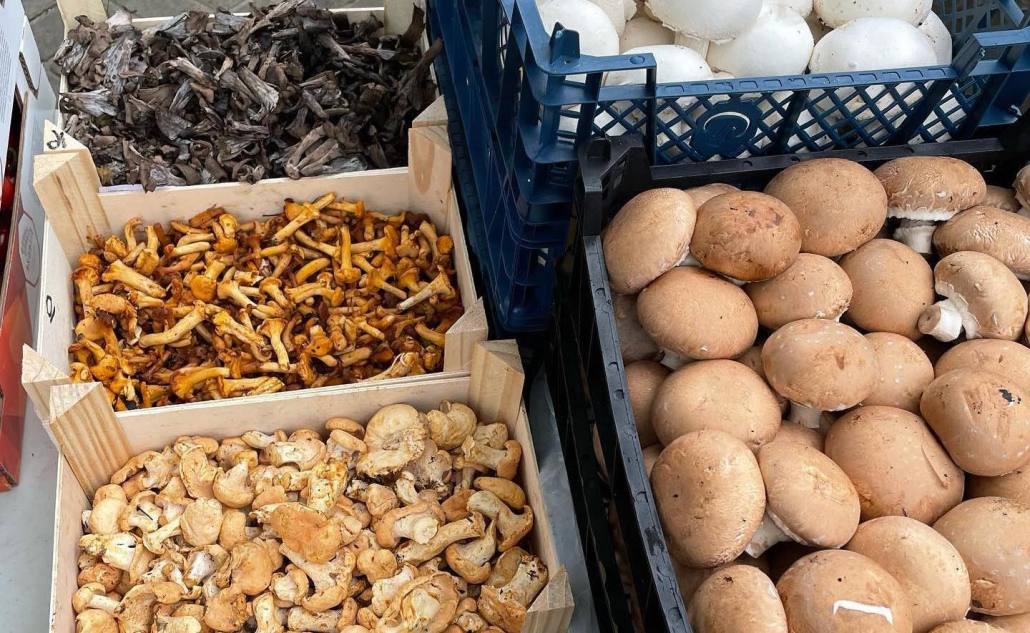
Valley Veg is a lifeline to the seasons – mushrooms are just as much an autumnal staple as the Kentish cobnuts

All this back story is the perfect preparation for the bowl of Kentish Cobnuts I’m unsheathing and shelling in the garden (it can get messy, especially when you soak the nuts in water to ease the process). I just feel lucky to have them. Thanks to Valley Veg (above), which pops up in Mytholmroyd along the valley every Saturday morning with more, much more, than the usual fruit and veg suspects.

You can, of course, order online from producers, addresses of which can be found on the Kentish Cobnuts Association website. The season is short (ending mid-October). Cobnuts are marketed fresh, not dried like most other nuts such as walnuts and almonds. At the beginning of the season the husks are green and the kernels moist and milky. Nuts harvested later on have brown shells and husks plus a fuller flavour and you might be able to keep them in the fridge until that nuttiest of times, Christmas.

I’m nibbling my lightly roasted  ‘nouveau’ nuts, freshly salted, with a glass of my favourite Palo Cortado sherry.

Besides baking the cake I plan to sprinkle crushed nuts onto a dish of baked salsify and Ogleshield cheese and onto an old favourite soup from The Ethicurean cookbook (Ebury Press, £25) that uses up our remaining courgettes. The restaurant operates from an original glasshouse built in 1901 as part of an estate in the Mendip Hills. The walled kitchen garden supplies the restaurant with grapes, greengages, apricots, beans, cabbages, herbs and much more.

ROASTED COURGETTE AND COBNUT SOUP WITH LABNEH AND GINGER TURMERIC AND MINT DRESSING

1kg small firm courgettes, sliced into 2cm pieces; rapeseed oil; 500g onions finely sliced; 250g carrots finely sliced; 250g celery finely sliced; 1tsp salt plus more for final seasoning; 40g fresh cobnuts, chopped, then lightly toasted.

For the labneh: 500g Greek yoghurt; ½tsp salt; 1tbsp chopped marjoram; 1tbsp chopped oregano.

For the dressing: 85ml rapeseed oil; 50ml cider vinegar; 1tsp English mustard; ½tsp ground ginger; ¼tsp ground turmeric; 1tsp chopped mint.

Method

Make the labneh a day in advance. Line a sieve with muslin and put the yoghurt in it, stirring in salt. Wrap into a bundle over a deep bowl to drain overnight. Next day discard the liquid. To make the dressing blend all the ingredients together.

Heat the oven to 200C/Gas Mark 6. Toss the courgettes with a little rapeseed oil, then spread on a roasting tin. Roast in oven for 20 minutes. Meanwhile, heat a film of rapeseed oil in a large saucepan and add onions carrots and celery; sweat for 10-15 minutes until tender. Stir so the veg doesn’t colour. Add roasted courgettes and sweat for 5 minutes longer. Add water to barely cover and bring to a simmer. Add salt and after five minutes blitz in a blender (in batches if necessary). If too thick for you, pas through a fine sieve to create a more velvety mouthfeel. Now season to taste, reheat gently and serve in bowls topped with a tablespoon of labneh, a scattering of chopped cobnuts and a drizzle of mustard dressing.

It’s always great when some of your favourite food and drink acts get the major plaudits. The weekend buzz was all about Erst in Ancoats being praised to the skies by Observer critic Jay Rayner. Deservedly so. I last reviewed it pre-pandemic and still remember a remarkable experience.

Equally immense has been the contribution of Pollen Bakery, not far away at New Islington Marina. Check out my recent celebration of their 28 hour sourdough. The public obviously share my opinion. They voted them Artisan Food Producer of the Year in the Manchester Food and Drink Awards on Monday, held in the really rather remarkable Escape To Freight Island Ticket Hall. Fittingly Escape themselves won Pop Up/Project of the Year. 

Chef of the Year Rachel Stockley gets a well-deserved hug from Baratxuri co-owner Fiona Botham

But the big winner on the night was Baratxuri, the Ramsbottom pintxos bar that also has a wood-fired outlet at Freight Island. It won Restaurant of the Year and its chef Rachel Stockley (above) Chef of the Year.

Receiving her award, she gave an impassioned speech about the role of women in the hospitality industry. To see what all the fuss is about re Baratxuri and its big sister Levanter read my glowing review from earlier this month.

In total 16 award winners were announced from food and drink establishments across Greater Manchester in this fitting climax to a resurgent Manchester Food and Drink Festival, which saw a record 80,000 visitors coming to the Festival Hub at Cathedral Gardens. 

This year it was an Awards with a difference. The shortlists were compiled by the MFDF judging panel, made up of the region’s leading food and drink critics, writers and experts (including yours truly). Amid challenging circumstances, the ‘mystery shopping’ element of the judging process was paused this year. Instead, the winners were decided entirely by the public – with food and drink fans voting in their thousands via the website. And the winners were…

Restaurant of the Year – Baratxuri, Ramsbottom

Shortlisted: Adam Reid at The French; Erst, Ancoats; Hawksmoor; Mana, Ancoats; Sparrows; Street Urchin; Where The Light Gets In; Baratxuri, Ramsbottom.

Recognising the ‘best of the best’ dining establishments in Greater Manchester in 2021, this category refers to venues visited primarily for a full dining experience featuring table service, alcohol license etc.

Chef of the Year – Rachel Stockley

Shortlisted: Adam Reid (The French); Eddie Shepherd (The Walled Gardens), Mary-Ellen McTague (The Creameries, Chorlton); Patrick Withington (Erst, Ancoats); Sam Buckley (WTLGI, Stockport); Simon Martin (Mana, Ancoats); Terry Huang (Umezushi); Rachel Stockley (Baratxuri, Ramsbottom).

Aiming to recognise the most talented and outstanding work of chefs cooking in Greater Manchester kitchens – their skill, menu, commitment and contribution to the dining scene.

Newcomer of the Year – Ramona, Swan Street
Shortlisted: District, NQ; Open Kitchen MCR; Osma, Prestwich; Pho Cue; Schofield’s Bar; Society; The Moor, Heaton Moor; Ramona.

Recognising the best new food and drink operations to open in Greater Manchester since the last awards decision period (August 2020). Date eligibility: Establishments opened between August 2020 and June 2021. Sponsored by the Manchester Evening News.

Bar of the Year – Albert’s Schloss, Peter Street

Shortlisted: Henry C Chorlton; Kiosk West Didsbury; Schofield’s Bar; Speak in Code; 

The Blues Kitchen; The Jane Eyre, Ancoats, Three Little Words, Albert’s Schloss.

Recognising the best drinking venues in the region that specialise in a “wet-led” offer and aren’t considered ‘pubs’. 

Pub or Craft Ale Bar of the Year – Edinburgh Castle,  Ancoats

Shortlisted: Beatnikz Republic; Cob and Coal, Oldham; Heaton Hops, Heaton Chapel; Society, Manchester; Nordie, Levenshulme; Reasons To Be Cheerful, Burnage; Stalybridge Buffet Bar; Edinburgh Castle.

Recognising the finest pub and beer bars in the region, focusing on quality and range of ales, beers and atmosphere. 

Artisan Food Producer of the Year – Pollen Bakery, Cotton Field Wharf,

Shortlisted: Bread Flower;  Companio Bakery, Ancoats; Gooey, Ducie Street Warehouse; Holy Grain Sourdough, Great Northern Mews; Just Natas, Manchester Arndale; Lily’s Deli, Chorlton; Manchester Smokehouse; Pollen Bakery.

Celebrating the fabulous array of food producers popping up around the region, including bakeries, picklers, pie makers and everything in between.

Pop Up/ Project of the Year – Escape to Freight Island, Baring Street

Shortlisted: Eat Well MCR; GRUB, Red Bank; Homeground, Medlock St; Kampus Summer Guest Events, Aytoun Street; Platt Fields Market, Platt Fields Market Garden; One Central, Charis House, Altrincham; MIF Festival, Festival Square; Escape to Freight Island.

Recognising exciting projects and events and showcasing innovation and creativity within the food and beverage sector.

Neighbourhood Venue of the Year – Lily’s, Ashton-under-Lyne

Shortlisted: Bar San Juan, Chorlton; Levanter, 10 Square St, Ramsbottom; Erst, Ancoats;

The Fisherman’s Table, Marple; Porta, Salford; Oystercatcher, Chorlton; Stretford Foodhall; Lily’s.

This award is set to recognise the superb establishments that are based in the suburbs of Greater Manchester. Sponsored by Roomzzz Aparthotels.

Food Trader of the Year – Wholesome Junkies, Manchester Arndale

Shortlisted – Abeja Tapas Bar, Hatch; Archchi’s; Gooey, Ducie Street Warehouse; Honest Crust; Maison Breizh; Pico’s Tacos; Tender Cow; Wholesome Junkies.
Awarding the Greater Manchester-based food heroes that are gracing our food halls, markets and events with an ever increasing range of gastro goods

Affordable Eats of the Year – Rudy’s, Ancoats and Peter Street

Shortlisted: Abeja Tapas Bar; Chapati Café, Chorlton; Ca Phe Viet, Ancoats; Little Yeti, Chorlton; Lily’s, Ashton-under-Lyne; Mi & Pho, Northenden; Platt Fields Market Garden; Rudy’s Pizza.

Recognising the best venues that are visited for a high value, quick and simple dining experience. Sponsored by Just Eat.

Coffee Shop of the Year: Federal, Nicholas Croft, NQ

Sortlisted: Another Heart to Feed, NQ; Ancoat’s Coffee, Royal Mill; Ezra & Gil, NQ; Grindsmith; Grapefruit, Sale; Just Between Friends, NQ; Pollen Bakery, Ancoats; Federal.

Recognising the best coffee shops and bars in Greater Manchester.

Veggie/Vegan Offering of the Year – Bundobust, Piccadilly

Shortlist: Eddie Shepherd (Walled Gardens, Whalley Range); Four Side Pizza, NQ); Herbivorous, Hatch; Lily’s, Ashton-under-Lyne; Sanskruti, Mauldeth Rd; Wholesome Junkies, Manchester Arndale; Vertigo, several venues; Bundobust (also now on Oxford Street).

This award recognises venues that provide innovative and exciting dining options for vegetarian and vegan diners.

Independent Drinks Producer of the Year – Manchester Gin, Watson Street
Shortlisted: Bundobust; Cloudwater Brewery; Diablesse Rum; Hip Pop (Formerly Booch & Brew), Dunham Massey; Northern Monkey, Bolton); Pomona Island Beer Brew Co, Salford; Steep Soda Co,; Manchester Gin.

Celebrating the many exciting and innovative producers of artisan drinks in Greater Manchester.

Food and Drink Retailer of the Year – Ancoats General Store 

Shortlisted: The Butcher’s Quarter, NQ; Bernie’s Grocery Store, Heaton Moor; Grape to Grain, Prestwich and Ramsbottom; Isca, Levenshulme; Out of the Blue, Chorlton; Unicorn Grocery, Chorlton; Wandering Palate, Eccles; Ancoats General Store.

The Best Food and Drink Retailer celebrates the best food and drink shopping experiences in the region.

Foodie Neighbourhood of the Year – Altrincham

Shortlisted: Heaton Moor, Prestwich, Ramsbottom, Sale, Stockport, Stretford, Urmston, Altrincham.

New for 2021, this award has been set up to celebrate those thriving communities and neighbourhoods in Greater Manchester that continue to build a name for themselves as a foodie destination outside the city centre.

Outstanding Achievement Award – Mital Morar (Store Group)

Recognising someone who has contributed something outstanding to the hospitality industry in Greater Manchester.

Destination restaurants in Manchester hotels are almost extinct. The days when Michael Caines had his name over the door at Abode and David Gale ruled Podium at the Hilton further down Piccadilly are long gone. Both now offer standard hotel brasserie fare. As do relative newcomers such as Dakota (though their Grill, well sourced, is surprisingly good), QBIC and Hotel Brooklyn.

Adam Reid, following his mentor Simon Rogan at The French inside the Midland Hotel, continues to fly the flag for Great British Menu style fine dining, but even that failed to make the cut in this year’s Estrella Damm Top 100 UK Restaurants list.

Arguably the city’s most high profile hotel, The Lowry, has dumbed down from the early Noughties days when German chef Eyck Zimmer created some of the finest dishes ever seen in Manchester. Recent restaurant space makeovers there and at the Radisson Edwardian do not equate to a radical upgrade of the food offering. The Peter Street Kitchen at the latter, partnering Mexican and Japanese menus, is a wild card, though. Let’s leave it at that.

Which bring us to Sunday lunches, a perennial draw in hotel dining rooms. Scrap them at your peril. The worst case scenario being carveries, which discreetly we’ll shove on the back burner.

Possibly the best roast in town is inside the Stock Exchange Hotel, at the Bull and Bear. You’d expect that from Tom Kerridge, whose whole ethos trumpets comfort food done with accomplishment. But, though the stunning setting sings ‘destination’, we’re not talking food on a level of his two Michelin star pub in Marlow, The Hand and Flowers.

The Ducie Street Warehouse has relaunched its own Sunday Lunch offering with the added bonus of the UK’s first dedicated Cauliflower Cheese Menu, courtesy of head chef Andrew Green, who has previous in this department. At Mamucium dairy took centre stage one ‘Cheesemas’ with a menu that included a 3kg cheese wheel to share. 

I must admit my arteries wobbled at the though of tackling classic vintage cheddar cauliflower cheese and twists featuring truffle, bacon fizzles, blue cheese (our choice), garlic and herb crusted, macaroni, a totally vegan cauliflower cheese and, the ultimate, a four cheese version with parmesan, gruyere, philadelphia and cheddar. 

Relief came at table when I realised they were all sides at £4.50 a pop. Alternatives included old stagers such as Cumbrian pigs-in-blankets and honey roasted heirloom carrots.

Head chef Andrew Green is a meat and cheese specialist putting his stamp on Ducie Street Warehouse

Glossop-born Andrew has been one of the Manchester chef stalwarts in recent years. Though he started in an Italian restaurant, the rest of his his professional career has been in hotel kitchens, a couple at the Airport before he headed up The Lowry’s and then Mamucium’s. His forte has been meat cooking, notably a classic Beef Wellington, and he has always sourced from top notch butchers such as Mettrick’s, WH Frost and currently The Butcher’s Quarter.

So why am I slightly disappointed in the dry-aged shorthorn beef sirloin and roast supreme of corn fed chicken we share as mains? Small plate starters had signalled a user-friendly, standard, global hotel menu, but our mains didn’t take it up a gear. A pond of all-purpose gravy, chewy roasties and chunky Yorkies didn’t do the meats any favours – the chicken tasty enough but on the dry side, beef sliced in thin wafers needed the lift of the horseradish we requested.

Alternative Sunday mains were rosemary roasted leg of lamb, free-range gammon and a weekly changing vegan roast. You can even order a pick and mix of all four meats on the plate. Nothing to scare the punters but lacking the pizzazz of the setting, the vast stylish ground floor below the Native Hotel.

Slightly more exciting sounding is access to two-to-share offerings that sit in the normal a la carte – harissa spiced whole chicken, miso glazed fish of the day, 800g tomahawk of Cheshire beef or a whole roasted ‘ras el hanout’ cauliflower. 

Bistrotheque was the initial food and beverage offering when Native created 166 apartments in the Grade 11 listed Victorian warehouse back in. It was soon apparent its quirky comfort food at posh prices formula didn’t transfer well from the East London original, so after six months it was ditched and the 80 cover dining room became Restaurant at CULTUREPLEX (the co-working, arty raison d’etre for the rest of the ground floor). Highlight of this manifestation was a pop-up by the cutting edge restaurant team of Higher Ground (now operating Flawd at New Islington Marina). Its front of house expert, Richard Cossins, famously opened Fera at Claridge’s for Simon Rogan. But that was London and this is Manchester,  where the real culinary frissons are rarely to be found inside hotels. Now pass the horseradish.

Sunday with Sides’ is available every Sunday, with special cocktail offers and live music, from 12.30pm to 8.30pm at The Ducie Street Warehouse, 51 Ducie Street, Manchester, M1 2TP.