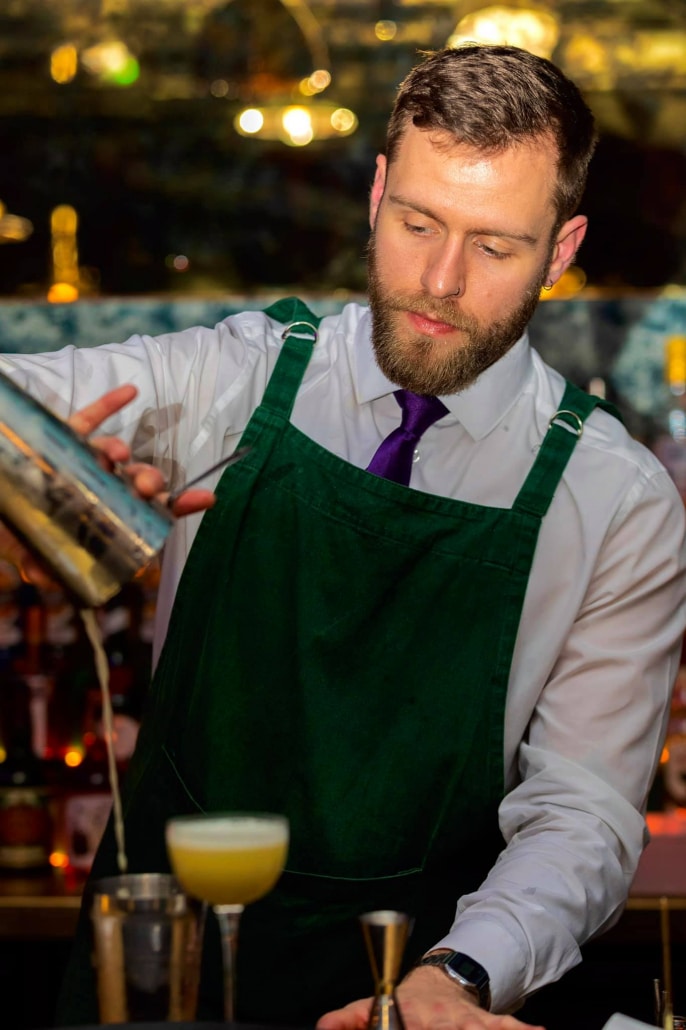
Not a Punk IPA in sight (thankfully) but the unveiling of Sureshot Brewing’s debut quartet of beers offered a bizarre echo of a seminal Sex Pistols gig, also in Manchester,  a lifetime ago. The seeds of this fanciful link were sown by my brother – like myself, old enough to have been in the Lesser Free Trade Hall in the Summer of ’76, but neither of us claims to have attended. Unlike hundreds of of others. The actual audience for a band barely known outside London barely topped 40.

In contrast Keith and I, on the evening of February 25, 2022, were definitely at a Port Street Brewhouse rammed to the gills for a home-coming beer hero. The loose connection? Virtually all who witnessed The Pistols were inspired to form their own band. The Buzzcocks-to-be organised the gig and the futures of The Smiths, Joy Division, New Order, The Fall, Simply Red were all forged that night. 

Maybe everybody supping at Port Street (distinctly un-punk with the plethora of facial hair on show) will be inspired to launch their own breweries. The theory breaks down here since a good raft of attendees were already brewers – the elite of Manchester come to welcome back into the fold one James Campbell, already a legend in his own mash time.

Raised in the Black Country, James became head brewer at Manchester’s Marble in 2000 and for the next 13 years pioneered the pick of New World styles and hops without losing sight of native traditions. Manchester Bitter, Lagonda, Dobber, Pint, Ginger Marble and Earl Grey IPA – most of these are his creation.

It can be argued that his mentoring of the team there is equally influential (shades of that gig). These days you’ll find Dominic Driscoll at Thornbridge Brewing and Colin Stronge at Salt Beer Factory while not forgetting Rob Hamilton, who founded Blackjack, and others.

Later as co-founder and head brewer he launched Cloudwater in Manchester, gaining global recognition. Since leaving there, but not his adopted city, he has set up new brewery plant for a roster of equally cutting edge operations such as Verdant (Falmouth), Deya (Cheltenham) and in Manchester the new Bundobust Brewery.

Still, using my final music analogy, this was like an original talent recording an album of cover versions. Still plans for Sureshot – yes, it is named after that Beastie Boys track – fermented away during lockdowns. Finally on the former Track site alongside Piccadilly Station, using initially their old equipment, it all took shape. Bannered by a beautifully random lion meets sun logo. No cask yet, but the kegs and colourful 440ml cans are launched. Buy the latter via the website. You won’t regret it. Yes, the initial batch will please the hopheads among you, but there’s a beautiful balance to them all. Hard to choose a favourite. Here’s the line-up:

How Much Does Water Weigh? (£4)

A 4.2 per cent pale ale hopped with Centennial, Galaxy and Citra. Crisp sipping with dry finish and fruit throughout. Built on an extra pale malt base. 

I’ve Had My Fun & That’s All That Matters (£4.50)

A generously hopped 5.6 per cent pale ale with Mosaic, Centennial, Galaxy and Idaho contribute  tropical juiciness with a silky smooth, almost oaty texture.

I Lost My Bag In Newport Pagnell, New England IPA (£5)

A 6 per cent NEIPA. Dry hopped with Nelson Sauvin, Citra & Idaho 7, all citrus, grape and pine.

Bring Me The Head Of John The Accountant (£6.50)

An 8 per cent double IPA juiced up on Strata, Mosaic, Citra & Centennial. Substantial tropical blast, mashing melon and passionfruit.

‘Never go back down those country roads’ might be the advice of some plaintive troubadour or a stressed-out Sat Nav, but when it’s Northern California how could I resist? My previous trip to the Napa Valley and Sonoma had been a wine-soaked idyll from sumptuous bases in Relais & Chateaux properties, but the simpler pleasures on the side seduced me too.

Hence a planned two week road trip between San Francisco and Seattle had to include some blissed-out backwoodsmanship and watching ocean sunsets with chilled IPAs. 

Here are 10 places along the route where we ditched the hire car and went native…

Ram’s Gate Winery

OK, so a vineyard had to be our gateway. Ram’s Gate is possibly the closest winery to San Francisco, so perfect for a wine tasting lunch. It’s set on a hill off State Route 121 heading for Sonoma among its own 28 acres of vines, but since its inception in 2011 its terroir-driven selling point has been its handling of small-lot Pinot Noir and Chardonnay grapes from across Sonoma and Carneros. 

The very definition of a Californian boutique winery, it is architecturally stunning. Inside it’s vintage chic, almost clublike; from the outside it lives up to its claim to be a modern interpretation of the weathered farmsteads of old Carneros, while below the vine-clad hill the wildlife habitat, Tolay Creek, signals the sustainable ethos.

Ram’s Gate is open Thursday-Monday , 11am-4pm, for tasting appointments. We went the whole hog and had the $160 a head Five Course Wine and Food Pairings, featuring  the likes of saffron poached lobster and pasta, smoked bavette, raspberry shortcake with brown sugar chantilly. Out on the terrace, naturally with some lovely wines.

Jordan Vineyard & Winery

Another winery, can’t resist, but the vineyard tour here is something special. You can spot the French influence on this chateau-stykled family winery, which opened back in 1971 and is single-minded about producing just two wines – a Cabernet Sauvignon Bordeaux blend and a Chardonnay. Tasting both in a luxury hilltop gazebo overlooking the  entire 1,200 estate with some seriously gourmet small plates was the culmination of a tour that took in a look at their own organic veg garden and apiary, natural habitat, a tasting of their own estate olive oil and real insights into vineyard practice. You can understand why it has won a clutch of awards. The three hour tour costs $150 plus tax; available May-October only, weather permitting. More affordable is theWinery Tour & Library Tasting, which features wine tasting with food pairings for $75 plus tax. 

Healdsburg

My, how this town has gentrified, gussied itself up big time, especially around the central lawned Plaza. When I first visited a quarter of a century ago there was hardly a bespoke tasting room in town. Hell, this was Sonoma, not Napa; you had to go out into the country and find the winemakers. Now a raft of grape-driven opportunities rub shoulders with designer shops and small batch coffee haunts. Still it’s undeniably attractive and some favourite spots remain – the Hotel Les Mars, where we stayed last time, and the homely Oakville deli/cafe on the Plaza, but the raucous Bear Republic brewpub just off the main drag has bitten the dust. Fear not they are still brewing elsewhere that quintessential West Coast IPA, Racer 5. After a couple we started noticing more the hardware stores and simpler liquor stores of an older Healdsburg; the apple orchards and ranches that dot the Sonoma hinterland – a world away from the polished wine palaces and their millionaire owners in Napa.

The Bohemian Highway

Definitely a world away from Napa. This was the country road we needed to get back on and it didn’t disappoint. Our destination was a log cabin lodging with ocean views at Jenner at the mouth of the kayak-thronged Russian River. Direct way from Healdsburg is the 116 up the valley, but we mooched further south towards Sebastopol to join the Bohemian Highway

Rarely has a road so lived up to its name. Orchards, redwood groves, vineyards and grazing land are the heavenly backdrop to laid-back small settlements. Occidental and Monte Rio are folksy cute, but Freestone, official population 50, is my favourite. Mainly because it’s home to the Wildflour Bakery and Freestone Artisan Cheese store, an essential stop on the California Cheese Trail.

Wildflour boasts a wood-fired brick oven, lit each afternoon with a wheelbarrow of eucalyptus kindling. Scones and all kinds of delights are produced, but it is the Organic Sourdough that rules supreme. Thick of crust and yet airy-light inside (even the rye variety), this is the best bread you’ll find anywhere.

At the cheese store affineur Omar Muller sells locally pressed olive oil, almonds and walnuts and a range of dairy-related artefacts, but the glory is the cheese. Try the local Bleeting Heart sheep’s or more widely available cheeses from the Cowgirl Creamery. A bottle of Pinot Noir from the nearby Joseph Phelps completes the picnic.

River’s End Restaurant & In, Jenner 

A tea-time sea fret shrouded the extended estuary of the Russian River. It grew thicker as we checked into the River’s End Inn and settled into our cabin. What chance a glimpse of their legendary sunset from our wooden porch? There were going to be few other distractions. With no cellphone or internet accessibility, no telly, we could have been back in the days when it was built as a wayside inn for loggers and fishermen.

Maybe they would have tucked into a large helping of elk, as I did; the difference surely the finesse with which mine was treated by chef Martin Recoder and it wouldn’t have been imported from New Zealand! Food miles concerns apart – and no problems with the King Salmon starter – this was an extraordinarily fine meal, the best of our whole road trip, even the sophistication of the service belying the rusticity of the Inn. And the wine? It had to be a Littorai Pinot Noir – perfection from legendary winemaker Ted Lemon. We’d visited his biodynamic vineyard above Sebastopol, where the cooling clouds roll in off the Pacific (main image). As if to cue, the clouds here suddenly cleared like ‘curtains up’ to reveal a glorious sunset finale.

Gualala and Point Arena

It’s a switchback car ride north on Highway 1, the Pacific on port side smashing into coves hundreds of feet below. There a few choice stop-offs to catch your breath and get closer to the ocean, notably Salt Point State Park, which has a winding, wooded path down to a sheltered cove. Twenty-five minutes further on and worth a longer visit is Gualala Point, at the mouth of the river of that name. We wandered through the dunes onto a driftwood-littered sand spit and then clambered up the headland, which promised whale watching but didn’t deliver on the day. A further 25 minutes north you hit Point Arena, centred on the lighthouse of that name but pulling in 1,600 acres of National Monument Land, a vast coastal preservation reserve. Fascinating to explore, we’re told, but we had to settle for a sea view, craft beer and San Francisco-style chowder (in a hollowed out sourdough bap) at the Pier Chowder House and Tap Room down by the pier in the historic district.

Albion River Inn

Star brew we tasted at the Pier was a G&T Sour Beer from Anderson Valley Brewery, a craft pioneer 30 years ago and still going strong. On our last visit to Anderson Valley we explored its cool climate vineyards, but this time were happy to go down the hop route – check out Visit Mendocino’s 9 Hop Stops at ABV’s beautifully-situated taproom, enjoying another approachable sour, the Briney Melon variety. We had to resist completism; we were en route for our next lodging, the Albion River Inn – like River’s End on a bluff at the river mouth. The clifftop views were equally spectacular but the style of lodging quite different. More romantic than rustic, with spa baths and panoramic decking.

Similarly high standards in the kitchen serving superb seafood to an 80 cover restaurant, set apart from the 22 room/suite complex and built out of wood salvaged from a 1919 shipwreck.

Mendocino

The Albion River Inn was our base to visit Mendocino, a 10 minute drive north up Highway 1, along which you can sense the locations of one of California’s most gripping and gritty literary fictions, Gabriel Tallent’s My Absolute Darling (4th Estate, £12.99). It wonderfully evokes the stunning coastal landscape (though might deter you from going camping!). Mendocino itself was as laid-back as ever. Old hippies and floral New Agers meet clapboard and cliffs. The Cannabis Medical Resource Center is along the road from Virgil’s Vittles – DIY Dog Biscuits. With a year-round population of not much more than a 1,000 there’s little in the way of bar culture but the Cafe Beaujolais offers fine West Coast bistro food. To get an appetite, go for a walk on the town’s great glory, the wave-lashed headland with its maze of easy trails. A pity the vertiginous path down to the beach has been cordoned off. Hardcore hikers can tackle the 130 mile Mendocino County Coastal Trail, which takes in beautiful State Parks.

Avenue of The Giants

I for one can’t get enough of giant redwood trees. Not content with detouring off the Anderson Valley Road to wander in wonder around Hendy Woods State Park (the greatest coastal redwood concentration is in the 80 acre Big Hendy grove) we fixed our GPS on the unique Avenue of the Giants 130 miles to the north up off the inland Route 101. This is a self-guided auto tour through great sleeping forests, 32 miles in length, but you can just access a section if time is short; I’d recommend the Boiling Grove stretch as best to appreciate examples of the Sequoia sempervivens, average age 400-600 years old, the largest living things on earth. Awesome, dudes, as they say in those parts.

Safari West

I’ve left the most luminous spot till last. Its recent backstory demands pride of place. We stayed, safari glamping style in a tree at this wildlife preserve/conservation centre, nicknamed the ‘Sonoma Serengeti’, a month before the Tubbs Fire, deadliest of the Wine Country conflagrations, ravaged the area. In its path Safari West and its 400 acres, home to giraffes, rhinos, zebras, cheetahs and countless other exotic creatures in the hills above Santa Rosa. On our personal sunset safari, drinking local craft beer on a hilltop surrounded by antelope we’d asked our guide Alex if they had evacuation plans in the event of fire, which he confirmed. Just small talk then after a memorable, eye-opening jeep tour.

Safari West survived the fire thanks to the bravery of owner Peter Lang, who founded the reserve 40 years ago. He and his team saw their own homes go up in flames in the distance, but stayed to fight off the main blaze with fire hoses and a vintage fire engine. All the animals were saved and the park reopened. It is a fascinating place to visit. Check glamping availability and rates here and safari tour rates here.

• To plan your trip of a lifetime go to Visit USA and Visit California. For full tourist information about Sonoma go to Sonoma County and for Mendocino Visit Mendocino County.

In the recent Observer Food Monthly 50 (Everything We Love About Food Right Now) at number three was wine editor David Williams’ celebration of adventurous winemakers snubbing ‘noble’ grapes to make good wine from under the radar varietals such as Chilean Pais, Argentinian Criolla and Spanish Airen plus ‘reinvented’ workhorses such as Cinsault and Carignan.

To the former list now add Rubin from Bulgaria. No, me neither. The only Rubin in my consciousness was Rick, the full-bearded record producer who gave hip hop-music its voice and superintended the late flourishing of Johnny Cash with his American Recordings.

Ah, Bulgarian wine. For me it conjures up loon pants and tank tops, for it was the affordable elixir of my hippyish studenthood back in the Seventies. Sturdy reds, pretending to be claret, as they accompanied trial and error Boeuf Bourguignons and Coq au Vins at our at fledgling ‘dinner parties’. 

Cabernet Sauvignon and Merlot predominated among the reds, to the detriment of Bulgaria’s indigenous grapes. It worked, as the hardcore Communist country amazingly became the world’s fourth largest producer by this pandering to the mainstream. The Soviet Union was much the largest consumer of these industrial scale tipples until the collapse of the Iron Curtain took this particular wine trade with it. A winemaking culture dating back 3,000 years was on its uppers. Affordable rivals from the New World certainly rushed to fill the gap in the UK.

Meanwhile, in the Thrace Valley (spectacularly pictured above) little pockets of Rubin grapes – a hybrid of Syrah and Nebbiolo – were biding their time. Maybe that time has come as Bulgarian wine is enjoying a modest resurgence. It has never left the bargain basement section of supermarket shelves, but we are now talking the quality market, that explored by Central and Eastern European specialists Vida Wines.

They sent me a Rossidi Rubin that’s worth every penny of its £21.29 price tag. It does seems to combine elements of of the Barolo grape Nebbiolo (paleness and fragrance) and the more intense Syrah. Fragrant and herby, it is a more elegant rival to another Bulgarian stalwart, Mavrud.

Rossidi is a combination of the names of the founders – Rosie and Eddie Kourian, whose vineyard is near the village of Nikolaevo in the Eastern Thracian Valley.

On the evidence of this bottle they couple (not the duo pictured!) do live up to their claim to be “the new face of Bulgarian wine”, but there are plenty of rivals in this viticultural revival.

A good primer to what’s happening in this corner of Europe is The wines of Bulgaria, Romania and Moldova by Caroline Gilby MW (Infinite Ideas, £30). She praises the new wave wines for being artisan, affordable and authentic.

“The change has been a complete revolution from communist, mass-market, wine-based alcoholic beverage, to today’s industries where an exciting raft of small producers has added interest and individuality and pushed quality forward.”

That’s true in other Eastern European countries. Another Vida wine I admire is Slovenia’s Kristančič Pavo Cristatus Classic Cuvee 2014 (£23.39), a methode traditionelle sparkler which displays a wealth of peachiness and brioche using Pinot Blanc and indigenous Rubela as its base grapes.

Two reds I’ve hugely enjoyed recently are Belliani Valley Winery 97 Unfiltered Saperavi 2019 from Georgia, deep in colour and reeking of blackberry and plum. Imported by Boutinot, expect to pay around £20 retail, worth the couple of quid mark-up on the simpler filtered version. And Maurer Oszkár Crazy Lud Red from Serbia’s border with Hungary. Fourth-generation winemaker Oszkár cultivates 15 ha of land by hand and horses, growing native grapes from vines up to 100 years old. There is grippy Cabernet Sauvignon in this bottling, which offers a decided earthiness alongside substantial acidity without swamping some lovely fruit. Flawd at Manchester’s New Islington Marina also stocks, at £25, a Lud majoring on the local Kadarka grape. Who’d have thought the world offers so many under the radar grape varieties yielding such riches?

My wife is aiming for a new Kindle for Christmas. Helping to save trees. While I’m dreaming of a couple of fat tomes to occupy my stocking. Maybe not on the topics this website centres on. I’m not averse to fiction or books on German history. Hint.

Lockdowns saw me researching into some recherché culinary roads less travelled, hence of late I’ve purchased fewer new publications. So don’t expect any definitive overview from the 2021 suggestions below. Still much delight. In compiling my list I realised I had bookended it with two authors who have been with me most of my post-Beano reading life. Let’s salute two octogenarians who are the greatest living exemplars in their field – food scholar Claudia Roden, 85, and travel writer Colin Thubron, 82, both of whose books this year transcended all those feeble potboilers piled high around them. 

Med: A Cookbook by Claudia Roden (Ebury, £28)

On the cover of Roden’s first new book in a decade there’s praise from Yotam Ottolenghi: “To read Claudia is to sit at her table, with everything, simply, as it should be. Pull up a table for the food; stay at the table for the stories.” The author herself begins what is much more than a recipe book with the epigraph “Cooking is the landscape in a saucepan”. All of which neatly sums up the fault line, dotted with hummus, tabbouleh, baba ganoush and a 1001 other treats, that lead from her groundbreaking A Book of Middle Eastern Food (1969) to the post-Millennium dinner parties inspired by her disciple Ottolenghi’s own oeuvre.

The Med reflects the fact that she has never rested on her scholarly laurels. Egyptian-born with Sephardic Jewish roots, Roden tapped into Spain with her last book, arguably my favourite of hers, and her latest offers a distillation of all her magpie-like culinary excavations radiating from the Mediterranean shores. Travel to Gaziantep, a Turkish city on the border with Syria via a green olive, walnut and pomegranate salad or investigate her pumpkin soup with orzo and amaretti, finding a new use for the traditional pasta filling of Mantua in Northern Italy. All this accompanied by evocative, anecdotal detail ranging from early family life in Aleppo via exile to Britain to the contemporary culinary mores of Barcelona.

Ripe Figs: Recipes From The Eastern Mediterranean by Yasmin Khan (Bloomsbury, £26) 

Claudia Roden us a hard act to follow but many cookery writers have mined that rich Mediterranean/Middle Eastern seam. I’ve been a huge fan of Yasmin Khan since her debut, The Saffron Tales (2016), which is as much about charting the lives of contemporary Iranians as their exquisite cuisine. Its successor, Zaytoun, inpected Palestinian food through an acutely political lens as she journeyed through kitchens in Israel, the West Bank and the Gaza Strip. Raised in Birmingham, the child of a Pakistani father and Iranian mother, she initially worked as a human rights activist. This is fully evident again if you look behind the handsomely illustrated pages of her third cookbook. It covers the food of Greece, Turkey and Cyprus with a set mission – to explore how migration has shaped cultures for the better… with food a vital litmus test.

Hence Ripe Figs is filled with the stories and recipes from families that have lived in the region for generations but alongside, in the midst of the global refugee crisis, she finds positive contributions from the displaced in the Moria refugee camp on Lesvos and elsewhere. In Istanbul kitchens she cooks with Kurds and in Northern Cyprus explores the thorny British colonial legacy. Fascinating reportage but the book is also a  trove of sun-filled recipes that celebrate how the joy of food can bring us all together.

Sicilia: A Love Letter to Sicily by Ben Tish (Bloomsbury, £26) 

Food and joy to me are synonymous with Sicily. Well maybe not gagging on spleen sandwiches from the street stalls of Palermo. I’m thinking proper tomatoes, lemons, capers, olive oil, ricotta salata, scaccia bread, cannoli and, of course, seafood. The image fronting this article is of the remarkable gambero rosso red prawns from the island’s South West Coast. These particular specimens were served to me with an orange dressing and thyme, in one of my final meals out before the first lockdown, at Norma in London’s Fitzrovia. This homage to Sicilian cuisine, with an inevitable Arabic influence, was created for the Stafford Collection by Ben Tish. In his matching ‘love letter’ he puts his own light stamp on a culinary melting pot of so many influences. It’s worth buying the book just for the pudding recipes.

An A-Z of Pasta by Rachel Roddy (Fig Tree, £25) 

Subtitled ‘Stories, Shapes, Sauces, Recipes’, this is an alphabetical exploration of the quintessential Italian food from the Rome-based home cook, whose evocative despatches appear in The Guardian every Saturday. Does it supersede my super-stylish long-standing pasta primer, The Geometry of Pasta by Caz Hildebrand and Jacob Kenedy (of Bocca di Lupo fame)? Neither can do full justice to the full range of Italian pasta shapes, estimated at over 500. She tackles 50, subdivided into six main categories, with 100 accompanying recipes to justify her claim that “pasta shapes are edible hubs of information”. if that sounds daunting just check out the recipes, most of which are eminently accessible. Tagliolini with datterini tomatoes and chanterelles? Or fresh capelli d’angelo with prawns and lemon. Pass the parmigiano, per favore.

To complete my Italian ‘course’ I’d like to recommend the pasta-driven Taste: My Life Through Food by Stanley Tucci (Fig Tree, £20), but this eagerly anticipated prezzie is still being loaded up at Santa’s Lapland HQ, I’m hoping. There’ll be hell to pay if I’m not tucking into the Big Night star’s comestible memoir amid the messy aftermath of a roast goose dinner.

A Cook’s Book by Nigel Slater (4th Estate, £30)

What’s not to like about chapters entitled ‘Sometimes You Just Want Pie’ or ‘The Stillness of Cheesecake’? Slater’s Observer column readers, he tells us, didn’t want prunes in a chicken and leek pie, so he has left them out for this book of 200 tried and tested recipes, which plays to his strength – a close kinship with his readers. As the title implies, he is a cook, not a chef. As home-based as his near namesake Nigella, he does not share her ease on telly. Still he writes like a cosy angel, drawing you into the foodie diary of his life. Think Alan Bennett with a well-stocked pantry. The Stillness of Cheesecake may read like a riff on Milan Kundera (The Unbearable Lightness of Soufflés, anyone?) but it offers the homeliest of advice, too, alongside a slavering appreciation of food kept simple. And I quote: “A slice of cheesecake arrives on a small white plate. Cool, calm, silent. A sour whiff of buttermilk, the caramel sweetness of vanilla, Your fork slides through with barely a sigh.

“The sweet, fudgy filling can cloy after a mouthful. This pale and graceful pastry needs a pot of jam or fruit to waken it, and us, from its vanilla-scented slumber. A tart fruit compote will work – gooseberry, plum or apricot – or a little mound of baked rhubarb at its side.”

No space to digress into his discovery in San Sebastian of Basque cheesecake. Never been a huge fan of this over-praised pud, but Slater’s advocacy makes me want to attempt it again.

The Beer Bible by Jeff Alworth, 2nd Edition (Workman, £30, also available in pb)

Beer really is more my thing than cheesecake and the ideal Christmas present for the ale lover in your life has to be this revised version of Alworth’s award-winning magnum opus, first published in 2015. Six years is a long time in the rapidly evolving world of craft beer and the Portland Oregon-based Beervana blogger has been perfectly placed to chart it. Take Manchester’s iconic Cloudwater Brewing – they were just starting out in 2015, fuelled by co-founder Paul Jones’ learning expedition to the American West Coast where Alworth mentored him in the hop-driven scene.

Now Cloudwater merits four pages in this massive, comprehensive work of reference that still has that personal touch in its appreciation of the world’s vast array of beer cultures. Even sake gets a look in this time round. What I particularly like about the book is its even-handedness, giving space to understand how mass market lagers might appeal. Manchester, too, is not just about Cloudwater and Marble (young head brewer Joe Ince makes the index) but traditional family brewers Hydes, Robinsons and JW Lees are also hailed.

Modern British Beer by Matthew Curtis (CAMRA Books, £15.99pb)

Another acclaimed beer writer liked Manchester so much he moved here permanently. Just after publication this autumn I met the LIncoln-raised writer/photographer at the Sadler’s Cat bar in the city centreto discuss its genesis – in a blog born out of a Damascene conversion to beer in Colorado a decade ago. In my interview/review I wrote: “New wave UK beer writers have codified the global beer styles that have been clarified/reinvented across America and then taken up over here. Matthew Curtis goes a step further and charts the creative melting pot of our own mash tuns and barrel ageing projects. Modern British Beer proves we are not just brewing lackeys; our own cask ale traditions remain the envy of the world, our own innovations the equal of anywhere.” 

The Curtis format certainly does the contemporary UK beer scene justice. The book is divided into seven regions with up to 15 breweries from each profiled via a defining beer style. It has already sparked a number of thirst-quenching pilgrimages. Check out this one to Sheffield’s St Mars of the Desert.

Modern British Cider by Gabe Cook (CAMRA Books, £15.99pb

On the surface a companion volume to MMB and, by chance I also spent a fascinating day  in the company of its author. the self-styled ‘Ciderologist’. Not in a bar this time but in the orchards of Dunham Press Cider, a northern outpost of a drink more associated with Somerset and Herefordshire. Later that day, at a tasting at GRUB in Manchester I even encountered a Scottish cider among a remarkable variety of styles.

In my subsequent report I wrote: “Rather than an artisan polemic, Modern British Cider is a careful summation that makes you want to sample all the delights he flags up in ‘The Most influential British Cider Makers Today’ chapter. In particular, to consider the contrasts between West Counties and East Counties, ie. made from tannic bittersweet cider apple varieties on the one hand and from fresher, fruitier dessert and culinary specimens on the other.”

So is all lovely in the orchard? The book is a fine gazetteer of where to find the good stuff but doesn’t fight shy of confronting the challenges for a tipple saddled with tarnished perceptions from the past. And, of course innovative ‘new wave cider’ has its own responsibility to its traditions. My Christmas suggestion – order this book and maybe treat yourself to a fine Pomona or Oliver cider to accompany your turkey or (apple-stuffed) goose.

A Cheesemonger’s Compendium of British and Irish Cheese by Ned Palmer (Profile, £14.99)

Cider, like beer, is a great accompaniment to cheese. And we’re not talking the token Christmas Stilton here. In 2014 Ned Palmer, schooled at Neal’s Yard Dairy, set up the Cheese Tasting Company to proselytise about the golden age of British cheese (it’s now). Two years ago his A Cheesemonger’s History of the British Isles beguilingly explored the artisan wonders at hand and the doughty makers who provide us with an alternative to the slabs of pap that dominate the supermarket shelves. A rollicking read from Ned but this follow-up is the book to slip in your pocket as you seek out a Baron Bigod or a Stinking Bishop or ask to compare a Montgomery Cheddar with a Keen’s Mature. It codifies, via style (mould-ripened, blue, washed rind, hard etc) 158 native cheeses, one to each page with a drawing and a succinct story and tasting note. Highly recommended. Next move is  find a good cheese shop. I’m lucky enough to have the outstanding Calder Cheesehouse just a 10 minute walk away in our little mill town of Todmorden. They do online, too. Visit this link. There’s still time before Christmas.

Wines of the Rhône by Matt Walls (Infinite Ideas, £30)

Early in 2021 I caught up with last year’s Noble Rot: Wine From Another Galaxy. I’d been reluctant to join Dan Keeling and Mark Andrew on their ebullient adventures since I’d already read some of them in their Noble Rot magazine. They’ve been busy boys this year too, opening a second Noble Rot restaurant, in the old Gay Hussar site in Soho and wine retail website, Shrine to the Vine. In prose, they have their finger on the pulse of the contemporary wine scene, opening up new paths.

Less showy is the Infinite Ideas Classic Wine Library, sparsely illustrated, hugely comprehensive survey of countries or key regions, often written by experts with MW after their name. Matt Walls isn’t a Master of Wine but he is Contributing Editor to Decanter magazine, who uprooted his family to a village outside Avignon fo a couple of years In order to really get under the skin of France’s Rhône region, North and South. The result is a revelatory delight, a reference work full of wise judgements. As up to date as it gets and an inspiration for our Christmas dinner wine offering.

The Amur River by Colin Thubron (Chatto & Windus, £20)

It’s a truism that there is nowhere left on the planet to discover, making it increasingly difficult for travel writers to push the boundaries. Well, veteran explorer Colin Thubron, in his 83rd year, is not one to settle for the ‘we’re all tourists now’ get-out clause. Before reading this – in one transfixed sitting – I couldn’t pin the Amur on the map. Yet it is apparently the 10th longest river on earth, flowing 3,000 miles east from a secret source in the Mongolian mountains to the Tatar Strait. Thubron travels he entire length. What gives the book its tense socio-political edge is that much of the journey follows the highly fortified, much fought-over Russian-Chinese border. 

In his quest to chart how the Russian imperial dream died Thubron’s fortitude is astonishing. Early in the trip traversing fathomless bogs at a frantic trot he falls from his squat, primitive nag and twists his ankle badly. Later he brazens out an arrest by the local police. What transcends any sense of mere derring-do is his grasp of the Amur’s tragic history and, of course, his luminous prose. Witness: “To walk here is to wade through a tide of wildflowers: multicoloured asters, gentians, butter-coloured potentilla, peacock-blue columbines. Over farther slopes, swathes of blown edelweiss make a frosty pallor for miles.”

I’ve followed Thubron from his early books on the Middle East through his eye-opening explorations of Russia and China, but this arguably is his elegiac masterpiece. 

I’ve been contemplating ice this week. No, not the hazardous stuff that comes with the wind chill factor and a chance of compound fracture. More the gleaming pure lozenge enveloped by a Negroni.

I’m greeted by one on my arrival at Mecanica, our server Ellie embellishing with “We’ve heard you’re partial to one”. Two or three actually, but I’m at the bar to sample a range of the creative house cocktails, not a stone cold classic. Though like any cocktail bar worth its salt they’ll rustle up whatever you request.

Wine was the selling point of the previous occupant of this site on the busy corner of Oldham Street and Swan Street, but The Quick Brown Fox was never busy and shut all too quickly. I can see Mecanica having a less transitory shelf life – as one of Manchester’s key cocktail destinations. Which bring us to the nice ice touch.

It was such a sparkling snug fit I assumed my Negroni (Martin MIller gin, Campari, Cocchi) was sharing the tumbler with one of those bought-in designer ice cubes. Arch rivals Schofield’s Bar source theirs from Chas Ayres’ cutting edge Black Ice CPD Ltd.

No, like Speak In Code bar, another of the city’s cocktail elite, Mecanica make their own. General manager Phil Aldridge (pictured above) explained: “We use a process known as ‘directional freezing’ where we take a container thats insulated on all sides apart from one, this means the ice freezes from the top down forcing the impurities to the bottom (as the more impurities in the water the lower the freezing point).

“We then remove this from the freezer, dispose of the unclear ice and then break down the clear ice into smaller more manageable pieces by hand. These are then hand chipped down into the perfect size for our rocks glass. Its time consuming and takes a lot of keeping on top of, but it’s cheaper than buying it in and infinitely more rewarding.”

The same attention to detail goes into the in-house preparation of most of the cocktail ingredients (of which more later). It takes a dedicated, trained staff to make this work and all six bartenders get a picture testimonial in the Team section of the website. This add-on always reminds me of those movies where the closing credits incorporate snapshot epilogues of what  will happen to all the characters in the future.

But instead of ‘died in Vietnam’ or ‘became an itinerant preacher man’ it namechecks each’s favourite cocktail. Zombie is Ellie’s, which is appropriately cineaste, since two concoctions she has created for the Mecanica list are film-themed. We also tried tipples from Dom, Jack and Adam (Phil and Rory, promise we’ll sample your contributions next time).

See You in Half an Hour (£9.50) is a fruity mix of Suze Aperitif, St Germain, Chazalettes bianco vermouth, with a red wine float and and almond mist for their aromatic qualities. “Reproducing the visual aesthetic of Wes Anderson’s 2007 short Hotel Chevalier, the drink makes multiple references to the characters’ fleeting romance in the titular backdrop.” Phew.

Well, it has put Hotel Chevalier on my streaming bucket list and I’m glad to confirm Ellie and I are devotees of Anderson’s Grand Hotel Budapest and Ralph Fiennes’ comic tour de force but agree to differ on Isle of Dogs. Not the kind of conversation sparked by 2-4-1 happy hour service in Slug and Lettuce.

The 1981 comedy, Arthur, is Ellie’s inspiration for Between the Moon and New York City (£9.50), definitely my punchy kind of cocktail, incorporating Bulleit rye whiskey,  Bitter Rose Moonshine, all rosehip and elderberry, Cocchi Rosa vermouth and peach bitters. It’s a line from the theme tune to the movie which follows Dudley Moore as a drunken millionaire who spends his days drinking in the hotel room he calls home.

There’s a further comic backdrop to Jack’s A Touch of Class (£11.50), named after the 1975 pilot episode of Fawlty Towers, and so paying homage to Basil Fawlty and the hapless Manuel. Indeed basil herb dominates in a delightful way, adding  surprisingly savoury bacon note to this blend of Sipsmith London Dry Gin, Cocchi Americano vermouth, clementine and champagne.

I loved it. Just the kind of cocktail you’d never get at a hotel of the calibre of Fawlty Towers. ‘Touch of Class’ alludes to Basil’s snobbish aspirations for it. To quote the script… Basil: If we can attract this class of customer then the sky’s the limit. Sybil: Basil, 22 rooms is the limit. Basil: Have you seen the people in room six. They’ve never sat on chairs before.”

The cannier of you may have twigged by now that a connecting theme in all these cocktails is HOTELS. Mecanica declares itself a ‘No-tel’ bar, promising the hotel bar experience without the hotel and yet inspired by the world’s best hotel bars… in sumptuous surroundings. Certainly the sophisticated interior belies the plain frontage but more importantly for me the slightly random hotel pegging doesn’t feel a distracting  imposition.

The theme is up there with Speak In Code current record sleeve inspired drinks menu and the ambitious ‘Japanese Idioms’ list developed by Gethin Jones at Cottonopolis a few years back. I like lists that tell stories.

Fear and Loathing (£10.50) courtesy of Adam, is a rollercoaster a cocktail ride as you’d expect from its inspiration, Hunter S. Thompson’s novel later adapted into the 1998 film featuring Johnny Depp and various oddballs holed up in a hotel sipping Singapore Slings and Mezcal. This bittersweet homage is appropriately in your face, blending Koch Mezcal, D.O.M Benedictine, passion fruit liqueur, a Sipello and grapefruit shot and, a new one for me, citrus squid ink.

You get a subtler but equally powerful buzz from El Convento (£10). It’s based on an actual hotel in a convent building dating back to 1646, neighbour of the oldest cathedral in Puerto Rico. Has creator Dom been there? Or is the Latin holy trinity of olive oil washed Barsol Pisco, Cocchi Americano and pickled chilli just a tot of inspired cultural appropriation?

Finally, a five star hotel I’ve actually stayed in a couple of times – Ashford Castle at Cong in County Galway. It was home to the Guinness family in the 19th century, so the eponymous dark stout features in Dom’s super smooth Ashford Estate (£10) along with nutmeg, orange and Roe & Co Irish Whiskey, whose creamy texture is enhanced by milk washing.

Not a term you’re acquainted with? Olive oil washed too? Let’ close with dip into the behind the scenes teamwork that makes Mecanica quite special.

Over to Phil again, the ringmaster of this project with a CV that impresses (from  Sokyo, a high-end Japanese bar in Sydney to MIchelin-starred Mana in Ancoats):

“For our home made ingredients we use a number of different methods and techniques, the majority of our ‘fresh’ ingredients are made in a water bath that’s heated using an immersion circulator set to around 54 degrees. This is the perfect temperature to both speed up the process of infusing flavour without exposing the ingredients to direct, intense heat. 

“We’re aiming to stay away from the idea of cooking or caramelising, the maillard reaction or anything that will alter the chemical structure of the amino acids and sugar compounds found in our ingredients (unless on purpose of course), changing the fresh flavour we’re trying so hard to preserve. 

“There are processes such as ‘fat washing’, cold infusion and elements of fermentation, shrub and brining included on our menu. We also have access to things like centrifugal juicers and chamber vacuum machines, allowing us to extract flavour from nearly any ingredient we choose to work with, which when you work with the seasons, can be very valuable. 

“We then store everything under vacuum to prevent oxidisation, preserve flavour and cut down on the need for excessive storage space.”

It is not just our restaurants – the likes of Mana, Where The Light Gets In and the Moorcock at Norland – with their foraging, fermenting and passion for ingredients that are the contemporary cutting edge cauldrons. The cocktail scene at Mecanica’s level is equally vibrant.

Mecanica, 1-3 Swan Street, Manchester M4 5JJ. 0161 806 1492. Wednesday and Thursday 3pm-12am; Friday and Saturday 12pm-1am; Sunday 12pm-12am. Bar snacks include handmade flatbreads and cheese and charcuterie from the Butcher’ Quarter. The wine list is better than at mot cocktail bar, too. 

Check out Mecanica’s festive packages HERE. Also every advance booking of four or more this New Year’s Eve will receive a complimentary bottle of Prosecco when purchasing a round of cocktails

The Manchester Rum Festival 2022 is on my birthday. Saturday, June 18. No need to bake a cake then – unless it’s laced with an abundance of Plantation Pineapple or the like.

Last year’s event, the fifth, was a gas. The city was awash with thousands of Pride revellers, all just glad to flash the rainbow after months of crossing their legs in lockdown. Not that the Mercure Manchester Piccadilly was some sedate refuge from party central. The rum flowed. As it will again next June, pandemics permitting – at the same venue.

I was so happy to touch base with producers I’d met before in the Caribbean, Colorado or even up on Manchester’s Red Bank. So much jollier than those commercial suburban gin rallies which end with couples just a tonic short of oblivion.

My preview for this website was on the global  peripatetic side. No need to be blase. In 2022 I’m going to be introduced to world’s biggest-selling rum in Tanduay from the Philippines and local newcomers Tameside Distillers. Debuts for Streamertail from Jamaica and Trinidad and Scratch (from tropical Hertfordshire) are also confirmed by festival organiser Dave Marsland. No idea but I’m willing to give them a sip. Whatever, live dangerously. Buy tickets here.

Salford Rum pop-up

Meanwhile, if you are feeling ‘rum-bunctuous’, there’s a Christmas-themed bar from the Salford Rum Company called Bar Rumbug, launching on Thursday, December 2. It’s located at their forthcoming Dirty Old Town Distillery and rum garden at Arch 33 on Viaduct Street, Salford and will be open throughout December, Wednesdays to Sundays (12pm-12am). 

The atmosphere will be eclectic at the upcoming Red Bank Festive Trail, the only slightly off the beaten track antidote to the fake jollity and craven rapacity of Manchester Christmas Markets. As 2021 draws to its uncertain close it has never been more important to support the city’s independents and I can’t think of any more indie stretch than the arches above the ‘Green Quarter’ (but don’t get me started on that nomenclature).

Contributing to the Festive Trail celebrations (Saturday December 4, 12pm-6pm) are The Spärrows, Blackjack Brewery, Beatnikz Republic, Popup Bikes, Base Bar, Runaway Brewery, Chapeltown Picture House, GFFdamian Dance Studio and admirable street food champions GRUB, who are the very definition of grass roots.

I’ve been along for the rollercoaster ride with founders Jason and Juliana Bailey from the start back in 2014 across a variety of pop-ups and venues, with a constantly shifting roster of vendors they have supported and mentored. It’s great to see them in a permanent home  now at the top of Red Bank – its bar, events space and street food garden a beacon of sustainability. 

In a Manchester scene where corporate developers pay lip service to ‘street food’ and ‘artisans’, hosting them for fixed terms to give cool cachet to their building schemes, GRUB is the real deal.

This Saturday afternoon may offer a promenade of brewery tours, live music, dance performances, street food, cinema screenings, fresh produce stalls and a record fair, but such vitality is not a one-off thanks to an eclectic (that word again) calendar of events and fairs GRUB generates. I recently attended a packed wine and cheese matching at their Red Bank HQ featuring Reserve Wines and Chorlton Cheesemongers.

GRUB have led the way in plant-based promotion, so no surprise to see they are hosting a 100 per cent Vegan New Year’s Party.

GRUB’S EXTRA FOR CONTACT

The Baileys’ events company also reaches out across the region in collaborations. Its latest project epitomises their approach. Following their major reopening earlier this year, Contact performing arts venue on Oxford Road has sought to reenergise its catering. 

GRUB have recruited for them a street food chef to watch – Michael Anderson, owner and creator of Tikka Chance On Me. Describing himself as “a gobby Irish Mancunian with a big belly and an even bigger mouth who loves life and lives to eat”, he quit his day job in 2019 and has since been creating ‘Northern’ dishes inspired by Indian ingredients, until recently from an Ardwick base. To match his culinary creations at Contact beers will be local, cocktails from the GRUB team. Opening hours will be 10am-8pm Monday-Friday, 12pm-8pm Saturday.

GRUB, The Red Bank Project, 50 Red Bank, Manchester, M4 4HF. Wednesday-Friday 4pm-10pm, Saturday 12pm-10pm, Sunday 12pm-6pm.

It has been an epic journey across time and space and I’m understandably nervous when I encounter a scribbled sign at the picket gate into the Brewery of St Mars of the Desert. Private function today? Shut by Covid scare?

Phew. ‘Please don’t let Grimbold the dog out’ with a silhouette of the jet black bundle of fun I get to pat once I step across the ‘Welcome To Mars’ threshold. Fun is a good word, indeed, for everything that greets me inside this colourful cottage of a taproom. My benchmate, who budges up for me, recommends the ‘SMODFEST’ Festbier for its soft maltiness, continental hop character and absence of excess carbonation that can bedevil a lager. 

OK, I’ve made him more eloquent than he was. Yet it is a great introduction to SMOD, who specialise in “hoppy koelship beers, foeder-soured stingos, rustic lagers, deep malty dark beers and Benelux-inspired creations”, according to their website. Koelship? Pronounced cool ship, it’s a long, slender, open top stainless steel vessel akin to those traditional Flemish/Dutch koelschips, originally made of wood, whose high surface-to-mass ratio allows for more efficient cooling of the wort in the brewing process. Won’t go into more detail – this is a nerd-free zone.

It’s the centrepiece of a modest scale brewing operation behind the taproom, where SMOD co-owners Dann Paquette and Martha Simpson-Holley, plus apprentice Scarlet, produce some splendidly niche and nuanced beers in the old industrial district of Attercliffe, surrounded by ranks of contemporary factories/depots.

Not the easiest place to get to, hence my ‘epic journey’ lead-off. On my last adventure in Sheffield my last port of call was meant to be here but my phone charge went dead and no local could guide me, even though I was within a couple of hundred metres. Even this this time, on a trek from a tram halt, I feel rudderless.

Once I arrive, then, I am in no hurry to leave, sampling in turn Clamp Koelship IPA, hazy and hoppy yet like all the beers very clean, Koel It! Jingly Bells, all my Christmases come early with oodles of hops married to a festive fruitiness and, finally, The Battle of Frogs and Mice, Dann and Martha’s ‘tribute to the original craft brewers of Belgium’. Artisan or what?

At 8 per cent, Frogs, a dark special brune, outmuscles the 6.3 per cent Mice, a Flanders golden bitter, but it is also smoother, fruitier and more complex. According to the SMOD beer menu it is “brewed with a recreation of the water profile of West Flanders”. Now that is an attention to detail.

Bizarrely, when the globally influential RateBeer site announced its 10 Best New Breweries in the World 2020, two of the three British breweries named had this Belgian resonance (SMOD and, understandably, Mount Saint Bernard Abbey in Leicestershire) and two had American founders/brewers (SMOD and Suffolk’s Duration, incidentally many of whose ales are farmhouse and saison, too).

Bostonian Dann met North Yorkshire lass Martha across the Pond and the pair ran the acclaimed Pretty Things brewery for eight years before embarking on peripatetic journeys across Asia and Europe. Along the way they fell in love with a smallholding near a village called Saint-Mars-du-Désert in France’s Pays de la Loire region, named after an eighth century hermit. 

Maybe but for the prospect of Brexit they might have set up there; after considering Leeds and Manchester they went for Sheffield and took the monastic moniker with them. After all it was monks who first consolidated the brewing industry.

The pair’s fascinating story is recounted in a Pellicle online magazine piece by Matt Curtis,  ‘Everything in its right place and SMOD is a featured brewery in his recently published Modern British Beer (CAMRA Books, £15.99). Read my review here.

It’s not just about the beer, though. The taproom faithful are a civilised lot, Dann and Martha host it all with real warmth and Grimbold is irrepressible.

St Mars had been on my radar since its inception in 2018. My yearning to visit has since become a catalyst for discovering a Sheffield beyond my Richard Hawley and Jarvis Cocker affiliations. This time around I was smitten by the diversity and raw vitality of The Moor Market and found Cutlery Works the most relaxing street food hall I’ve ever visited.

THE MOOR MARKET

Chicken livers, gizzards and hearts are all the same price – 90p a pound. The adjacent pig’s feet are priceless (in a nose to tail photoshoot way). Across the aisle a specialist Persian food stall offers ingredients I’ve only ever read about in Sabrina Ghayour or Yasmin Khan. On one fish stall I encounter a sturdy carp, not seen on most slabs. There is tripe and various intestinal siblings, feathered, ungutted game birds and a whole, skinned rabbit still defrosting I enquire about, to be told “it’s French, farmed, you’ll have to wait a couple of weeks for the English, wild, fresh.” I loved all this from the moment I walked into find a fine bottle shop, Beer Central, to welcome me.

The building is less than a decade old, cost £18m and includes 200 market stalls and eight shops. Situated off a pedestrian precinct rammed with every high street name you can think of, what a relief to discover this haven of independent traders, offering an affordable, browsable, diverse alternative to control freak supermarkets. 

Its main northern rival, Leeds Market, benefits from its Victorian monumentality and better dining-in opportunities, but Sheffield’s really is hard to beat. Obviously not in comparison with the great markets of Spain, Barcelona’s Boqueria or Valencia’s Modernista-style Mercado Central. They reflect a whole different food culture. It has been interesting, though, to tick off across the Iberian peninsula the rise of markets morphing into food halls – in Bilbao, Madrid, Seville and notably Lisbon’s waterfront Time Out Market.

CUTLERY WORKS

That Lisbon operation is a showcase for the city’s Michelin-starred chefs. Sheffield’s stand-out food hall is an altogether more modest affair despite its claims to be the North’s largest. Set in a converted cutlery factory, in the post-industrial corridor that stretches out from Kelham Island, Cutlery Works offers 13 different vendors across two floors, ranging from China Red’s Szechuan sizzlers to chocolate counter Bullion and coffee roasters Foundry, taking in Thai, pizza, fried chicken, burgers, sushi and Mexican along the way.

Foundry provide bottomless batch coffee for freelancers taking advantage between 9am and 5pm of designated co-working spaces with plug sockets and 10 per cent food discounts. All very cool and relaxing in my mid-afternoon slot, it lacked the buzz of Manchester’s Mackie Mayor, which I still love – despite my general weariness with the whole food hall experience. 

The Guardian restaurant critic Grace Dent summed it up nicely: “I need to ask a very honest question here: are food halls ever a truly satisfying dining experience? I’ve no doubt they seem so on paper and in the marketing meetings, they’re fantastic for filling old, unloved but historically important spaces and they’re good news for downward-spiralling city centres. Yet in reality they’re noisy, unrelaxing and the food is often patchy, with the occasional gem hidden among the colossal choice of menus.”

That was in last month’s review of the GPO in Liverpool, as the name suggests, a post office repurposed into a food hall. She was unimpressed by Nama, a Japanese small fish plates counter, created by Luke French and Stacey Sherwood-French of Sheffield big hitter Jöro (my restaurant review here), who have also transferred their other new venture Konjö.

The original of this Korean-influenced, fire-based “Robatayaki” Kitchen was my choice at Cutlery Works. It’s the first vendor on the left as you reach the first floor – preferable to the ground floor if only because it boasts the proper craft beer bar, Boozehound.

I spent £30 at Konjö, mainly because I over-ordered in my eagerness (and a desire for ballast ahead of my beer destination). Don’t expect a spin-off from Jöro down the road. There’s no comparable finesse. And yet my combo was hugely enjoyable. A duck bao was basically a take on the old Peking/hoisin sauce stalwart while chilli beef was sticky and punchy. Sides of subtle kimchi and refreshing sesame greens provided perfect balance ahead of my journey  to Mars.

Brewery of Saint Mars of the Desert, 90 Stevenson Rd, Sheffield S9 3XG. The taproom is normally open Fridays and Saturdays 2pm-8pm.

Cutlery Work, 73-101 Neepsend Lane, Neepsend, Sheffield S3 8AT. Open Sunday-Thursday, 10am-10pm; Friday-Saturday 10am-11pm.

There was a time when Hay on Wye was not the gentrified Borders outpost of Bloomsbury and Notting Hill it is today after 30 years of Literature Festivals. When we hung around there a lot in the Seventies it had become the burgeoning ‘Book Town’ with up to 40 bookshops following in the footsteps of ‘King’ Richard Booth, who declared ‘home rule’ from Hay Castle in 1977.

Yet on market days it still felt the fiefdom of rough-hewn farmer folk from the Black Hills, their Welsh lilt heard in both stony chapel and smoky pub. The latter served a decent pint of Draught Bass is you were lucky, but some of the Welsh ales were thinner than sheep’s piss.

We were rescued in that same year,’ 77, by word of a new brewery – Penrhos. Its beers could apparently be found in the Llanthony Priory Hotel 12 miles south of Hay. A daunting quest, though, in our Citroën 2CV. The route is over the Gospel Pass, at 1,800ft the highest in Wales and heart-stopping both for its beauty and its narrow bends. 

They were serving the Penhros Bitter by hand pull in the tiny bar of the hotel next to the ruined 12th century monastic remains. We had negotiated an overnight stay in the turret room. En suite it wasn’t – just a water jug for our ablutions and steep spiral staircases to the pissoir. It was to prove a hazardous schlepp with a torch in the wake of copious samples of the nectar. Honeyed and pure, ‘nectar’ was for once appropriate. 

Next pilgrimage would be to the pioneering microbrewery responsible. It would take us a similar distance north of Hay into the heart of Herefordshire cider country to an organic project scattered with the stardust of Monty Python star Terry Jones’s involvement. A very naughty brewer?

You wonder what has brought on this à la Recherche de Penhros Perdu nostalgia? The sheer serendipity of an obit in Opening Times, one of the best CAMRA regional mags. Part of the reason, when the November/December issue dropped, I turned to the appreciation of Tony Allen first was that my nurse daughter had looked after him in his last days. She liked the man as much as I liked the pale and hoppy beers he crafted at his Phoenix Brewery at Heywood near Rochdale.

Penrhos apparently inspired him to become an independent brewer. He was working for Bass in Runcorn in 1980 when he read an article by Richard Boston, who promoted the resurgence of real ale in his Guardian column as well as editing his own eccentric eco mag, Vole, funded by Jones. The pair had now apparently joined with a certain Martin Griffiths to launch their own tiny brewery. Not the regular occurrence it is today.

Tony was hooked by the Penrhos aim to make a small amount of top quality beer. So he persuaded them to let him travel down on his four Bass rest days each month to help with the brewing. Indeed he had a hand in the creation of Penrhos Porter, reviving a dark beer style that had almost died out.

Penrhos Court its last legs in 1971 when Griffiths paid just £5,000 for the near derelict 15th century manor house at Lyonshall near Kington and embarked on a Sisyphean 30 year restoration project.There was still a mountain of work ahead when we visited to sample the beer and eat at the organic restaurant, the first to be Soil Association accredited, created by his wife, nutritional crusader Daphne Lambert. I still have her inspirational 2001 cookbook, Little Red Gooseberries based on what she taught in her cookery school.

We were familiar with the area, drawn by the traditional cider revivalism of the late Ivor Dunkerton along the road in Pembridge. The Cider Barn there is in the safe hands of the next Dunkerton generation; Griffiths and Lambert have been gone from Penrhos a decade and it is now a luxurious holiday home complex with an attractive cafe. 

A far cry, though, from its maverick heyday when it hosted the likes of Led Zeppelin, Queen (they rehearsed a soon-to-be-recorded Bohemian Rhapsody there) and Mike ‘Tubular Bells’ Oldfield, who lived six miles away on Hergest Ridge. Al Gore visited too. All must have been smitten by the glorious banqueting hall with a minstrel’s gallery and crux beams.

Less spectacular was the cattle byre that serial brewery builder Peter Austin converted into the Penrhos brewery. He had been enlisted by Griffiths, Jones and Boston and out of it flowed a trio of impressive cask beers, made with British malt and local hops. I recall Penrhos Bitter (OG 1042) , Jones’s First Brew and Penrhos Porter (both OG 1050) as beers ahead of their time. We even lugged a wooden firkin home for one Christmas, insouciantly forgetting it would be a 300 mile round trip to return the ‘empty’.

Launched in 1977, the brewery formed just one chapter in a remarkable 30 year epoch for Penrhos; it shut in 1983, the year the Pythons released The Meaning of Life with Jones creating the ultimate glutton/food critic, Mr Creosote. Beer continued to play an important part in Terry Jones’ life (which ended sadly in 2020). 

In 2003 he contributed a piece to the 30th edition of CAMRA’s Good Beer Guide. It was titled My Love Affair With Beer and confirmed: “Beer, for me, is more than something I like drinking. It’s a litmus of civilisation. If the society is making good beer, then it’s a healthy society… Real ale is a civilised drink. Keg beer is a dead parrot.”

It’s that time of the year again when Bundobust is dangling its festive baubles, otherwise known as Sprout Bhajis. It’s a world away from all the crass foodie gimmicks of Christmas – pigs in blankets pizza toppings and the like, but then this burgeoning brand yoking Gujarati veggie street snacks to craft beer always does things with style.

So what do you get for your £4.75? Deep-fried bundles of Brussels sprouts, broccoli, onion, fennel and chilli, served with a dollop of cranberry chutney. Chuck in an extra £1.25 and it comes in a soft vegan brioche bun. Proof all their venues are a Scrooge-free zone, a quid from each Sprout Bhaji Butty goes to a local charity.

My Bundo destination of choice to snaffle a bhaji has to be their latest project – the Bundobust Brewery on Oxford Street in Manchester, where head brewer Dan Hocking is knocking out a splendid range of beers tailored towards the spice-driven food menu.

I was disappointed on a recent visit that my favourite of his beers wasn’t on. West is West is a piney and resinous, dank and bitter (in a good way) West Coast IPA. A perfect match for the setting, surrounded by the gleaming vessels of a working brewery, it reminded me of many of the taprooms I’ve visited along the US western seaboard. In San Diego, say.

Which brings me back, by a roundabout route, to Brussel sprouts. The tiny green cannonballs are definitely love or loathe over here with major consumption confined to Christmas. Our Brussels Sprouts Appreciation Society Facebook Group numbers under 700 members after five years in existence.

Vivid green healthy ammunition, but they are culinary anathema to many folk

Contrast this with California, where the foggy, coastal area south of San Francisco grows 95 cent of the American crop, and they are mega cool. A big help is they are not over-cooked to bland mushiness. Food websites in the States are packed with innovative ways to treat your Brussels, which are neck and neck with kale to be top green on menus. Apparently they are a good source of dietary fibre, folic acid, manganese, and vitamins A, C, and K. Sprouts date back to Roman times but were first grown in large quantities in Belgium – hence the Brussels tag – and French settlers brought them to Louisiana in the 18th century.

Flying kites for the much-maligned Brussels sprout in glorious San Diego

Yes, there are roasted sprout gumbos out there, but I’ve never tackled one. I vividly remember  tempura sprouts accompanying  shrimp tacos in one downtown San Diego taproom, their natural hint of bitterness in harmony with the hop. Bizarrely research has shown that genetically two thirds of folk may be wired against the bitter chemical PTC found in sprouts, broccoli, dark chocolate, coffee and even beer. 

Definitely count me out of that pool.

My top Brussels sprout dish is also Indian…from my favourite new generation cookery writer, Meera Sodha. This quick Keralan stir-fry is in Fresh India, her follow-up to debut Made In India (both are £20 from Penguin Fig Tree). Like so many of her recipes, it fuses her Asian culinary sensibility with the raw materials she inherited when her family made their home in rural Lincolnshire.

Shredded Brussels Sprout Thoran (Choti gobhi thoran)

Ingredients

2 tbsp coconut oil; 1 tsp mustard seeds; 12 curry leaves; one large red onion, thinly sliced;  2 cloves garlic, crushed; 1 red chilli, finely sliced; 50g coconut, grated (fresh, creamed, or desiccated); 600g Brussels sprouts, washed and shredded; 1/2 tsp salt; 1/2 lemon, juiced.

Method

Heat the oil in a large pan or wok. Once hot, add the mustard seeds and curry leaves and cook for a minute or two until they start to pop. Add the red onion. Cook until soft and starting to caramelise, about 10-15 minutes. Add the garlic, chilli and coconut and stir fry for a couple more minutes.

Turn the heat up. Add the sprouts, mix thoroughly, and stir fry for a few more minutes. Add the salt and lemon juice, stir, and then adjust the seasoning to taste. The lemon juice counters any bitterness from the greens, so add more if you’ve used quite large sprouts.

Bundobust has three other bar/restaurants besides the Brewery – the original in Leeds, Manchester Piccadilly and Liverpool. They are all taking Christmas bookings now.