Tag Archive for: Food

One of my early lockdown treats, my alternative to baking banana bread and sourdough (or hoarding more loo rolls than my neighbours) was to order a small sample of English truffle from The Wiltshire Truffle Company, shaving the precious tuber into scrambled eggs, its heady aroma permeating the kitchen.

Since when I’ve moved onto more and more arcane foodie explorations – bottarga, colatura d’alici, mostarda di cremona, cottechino. There’s an Italian theme developing here, so if I want to resume my truffle fixation I should really hang on until next autumn when the white truffles of Alba in Piedmont make their seasonal bow. 

Not that seasons are crucial in our global society. The Wiltshire suppliers don’t just confine themselves to Italy, France and the ‘full English’ they’ve done so much to promote. Their latest mail-out trumpets the arrival of Australian winter truffle, akin to Périgord truffles from South West France – “widely considered by leading chefs to be the best black truffles on the planet”. Big claims and you could compare these Aussie beauts with the company’s regular shipments of Italian summer truffles from hunters in the Tuscan and Umbrian hills. If your funds run to it. Truffles are wallet-busters. At auction the most prized varieties could cost you over £5,000 per kilo.

A local truffle trader on the streets of Alba

The most exciting and affordable way to encounter them is to visit Alba at peak Truffle Festival Time. OK, it hosts auctions flogging the most perfect specimens to connoisseurs and entrepreneurs across the world, but even the smallest cafes offer affordable menus showing their pride in the product. I know I’ve been there. And also, cutting out the middle men, I’ve trekked with hunters in the ancient forests as they unearth secret truffle patches with their specially trained dogs. Ditto in Oregon, USA, where I was invited to an altogether more academic Truffle Festival…

• There’s a documentary in cinemas, The Truffle Hunters, which is set around Alba and another UK online truffle merchant called TruffleHunter, which has a fine reputation. They’ll also sell you a professional standard truffle shaver. I’m wary of much that passes as truffle oil; truffle butter can be a better bet for a cheaper option to the real tuber.

But first, what exactly makes the white truffle so special?

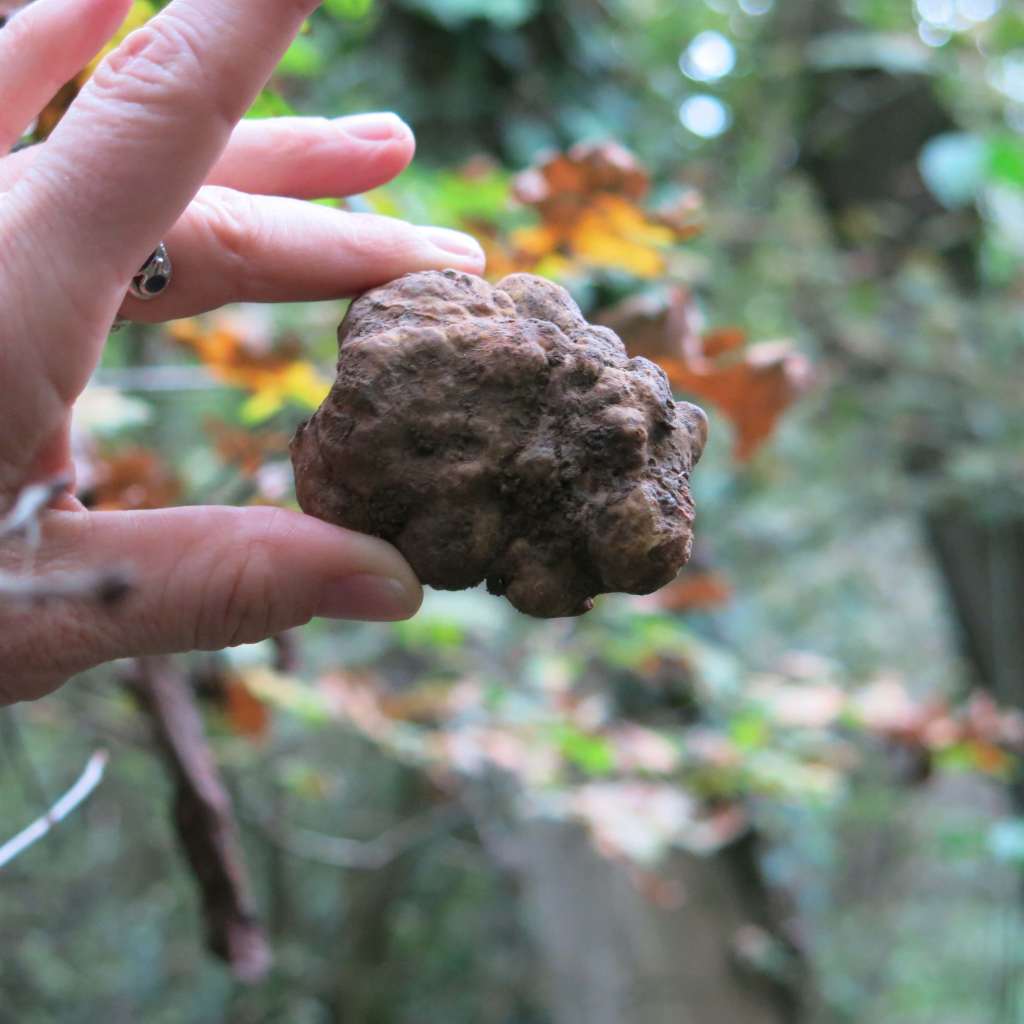
Truffles are the fruiting body of a subterranean fungus usually found in close association with the roots of trees, their spores dispersed through fungivores (animals that eat fungi). Hence it was traditionally pigs that were trained to hunt these coveted delicacies. These days it’s more likely to be dogs. White truffles are more highly prized than the black. Growing symbiotically with oak, hazel, poplar and beech and fruiting in autumn, they can reach 12 cm diameter and 500g, though they are usually much smaller, between 30g and 110g. The flesh is pale cream or brown with white marbling which releases their powerful scents, not appreciated by everyone (let’s call it olefactory Marmite). There are an estimated 200,000 regular truffle gatherers in Italy, with the sector worth around €400 million a year.

Fresh truffles should be consumed more or less immediately although they will last for up to seven days in a domestic fridge.

Once upon a time in Alba 

I’d never associated hedonism with tramping through thick forest undergrowth in the dusk. Peering to see if a lean setter-cross has found the ideal tree root to dig frantically under. I am not alone here in the heart of Alba truffle country in an October unseasonally warm. Around me 15 other paid-up ‘Hedonistic Hikers’, cameras at the ready, also await a tuber epiphany. 

Our guides, trading under the name Hedonistic Hiking, are proud to include an authentic white truffle hunt in season as part of their ‘Jewels of Piedmont’ (Piemonte) walking tour. It’s not everyone’s idea of holiday heaven but it sets serious foodies salivating. Those who know what the fuss is all about when the autumn mists that give their name to the famous local grape variety, Nebbiolo vines coat the valleys of North West Italy’s Langhe region and the autumn wine harvest is nearly over. It’s now Truffle Time, all the way to Christmas.

The following day we’ll indulge in an early evening aperitivo and do the ‘passeggiata’, strolling around the truffle-scented squares and alleys of regional capital Alba, where the annual Truffle Fair is on to celebrate – and auction off – this lucrative delicacy. 

Still for the moment, at the gourmet equivalent of the coalface, there’s work to be done. 

Truffle accessories aren’t strictly necessary

Our truffle hunter, Marco Varaldo, expresses faith in his rookie hound, Laika, so new she doesn’t feature in his publicity material. Marco has a day job, but hunting for the lucrative truffles, with their intoxicating, almost aphrodisiac scent, is his passion. 

The white variety, the ‘tartufo bianco’, rarer and more expensive than the black and found mostly famously in this corner of Italy, is revered the world over by gastronomes (and expensive restaurants). Admiration isn’t universal – their earthy assertiveness nauseates some sensitive palates. I’m not in that camp.

The white truffle can’t be artificially cultivated. This is part of its unique appeal. They are sought for in certain jealously guarded locations, hidden at the base of oak, beech and hazel trees. You train your dog to recognise the pungent aroma and then snuffle them out of the soil and leaf mould. It all seems a mite random as Laika zips and zig-zags around, scattering leaf mould, but then…

The novice truffle hound comes up trumps

I don’t know what the Piemontese for Eureka is, but it is time to yell it. The pooch apprentice has struck gold – ‘white gold’. Marco quickly straddles Laika, snatching a knobbly clay-covered lump from her jaws, pocketing it and rewarding the dog with a far less expensive treat. We clamber to see what the fuss is about. Marco delicately brushes the muck off the white truffle and we all commune with its pervasive perfume.

Over the next couple of hours we collect further specimens and, later, part of the haul, assiduously shaved over the local tajarin pasta, will be the centrepiece of our supper at a little local restaurant called Mange. When truffles are abundant, near the source, they can be a surprisingly democratic treat. Just a few slices elevate a local beef dish, below.

Truffle heaven on a plate. It doesn’t get much better

We were staying in La Morra, which follows the pattern of all the settlements in the Langhe, which recently attained World Heritage Status. They sit on a hilltop above the vines, dominated by a castle, a church, usually both, and offer ample opportunity to taste the wines that have made this corner of Piemonte famous – Dolcetto, Barbera, Barbaresco (in one small enclave) and, above all, Barolo. 

One of of our walks, from our hotel, the Corte Gondina, to Barolo village itself, took in the family-run winery of GD Vajra at Vergne. I’ve been there before in the early summer to taste their excellent wines and, now the harvest complete, was welcomed back like an old family friend. Piemonte’s like this. It doesn’t feel like some calculating tourist honeypot. You meet it on its own terms. Just like the truffle.

The Ponzi vineyards at the heart of Oregon’s wine country

Oregon’s wine country is also home to truffles (and another festival)

The Willamette Valley, just south of Portland, is the epicentre of Oregon wine, notable for Pinot Noir that can arguably rival Burgundy’s silkiest reds. And where there’s great wine there’s usually a thriving food culture. Yet until I was invited to join the The Oregon Truffle Festival I had no idea the rolling hills around McMinnville are also home to both black and white varieties plus four Oregon natives. 2021 pandemic strictures meant it has gone virtual (you can pick up goodies via an online marketplace – truffle stout anyone?).

Truffle hunting Oregon style and there’s a reward here

All this is obviously off a normal tourist’s radar, but rolling Willamette Country’s wineries and fine restaurants aren’t. McMinnville makes a fine base for exploring. Stay in its red brick historic district, perhaps at the oddball Hotel Oregon, which has a rooftop bar and is decorated with relics of the building’s 115-year history and the town’s famous 1950 UFO sighting. You might also run into the ghost of a former resident, nicknamed John.

As in all the towns along the route, I grabbed a craft beer, this time at the convivial Golden Valley Brewery and Tap before sampling a festival special truffle vodka and local wine at the Elizabeth Chambers Cellars, one of many tasting rooms in the town. 

You’ll probably find it more fun to drive out to one of the country wineries to do your sampling. It sounds boringly generic but Willamette Valley Vineyards offers exceptional quality. Wine and truffles – the perfect marriage either side of the pond.

Truffle carpaccio – our festival reward

Yucatán or Oaxaca? Oaxaca or Yucatán? It’s a heavyweight contest. Celebrations of particular cuisines don’t come more comprehensive – and gloriously well illustrated – than two monumental, magisterial love letters to regional Mexico by David Sterling and Diana Kennedy.

Sterling’s Yucatán: Recipes From A Culinary Expedition and Kennedy’s Oaxaca al Gusto: An Infinite Gastronomy together weigh in at over 5kg. Both are published by the University of Texas, from a state that likes to think big. They’re beautiful too and immaculately researched.

Essex-born Diana, based in Mexico since 1957, is the doyenne of writers on Mexican cuisine. Even the Mexican government recognise her championing of their culinary traditions, often sadly debased – they gave her their highest honour for a foreigner, The Order of the Aztec Eagle. Oaxaca, her magnum opus, won Cookbook of the Year in the 2011 James Beard Awards. Similar US top table recognition for Yucatán arrived four years later; within a year its author was dead at the age of 65. 

Originally from Oklahoma, Dvid Sterling had a mega career as a designer before his chef talents saw him found, in the heart of the Yucatán, Mérida’s Los Dos – lauded as one of the world’s top 10 cookery school. That designer’ visual sense permeates a book that, like Kennedy’s, is the result of a lifetime’s intense research. Both could be seen as coffee table books but are so much more. I bought hers first and then found the courage to stump up the £48 for his.

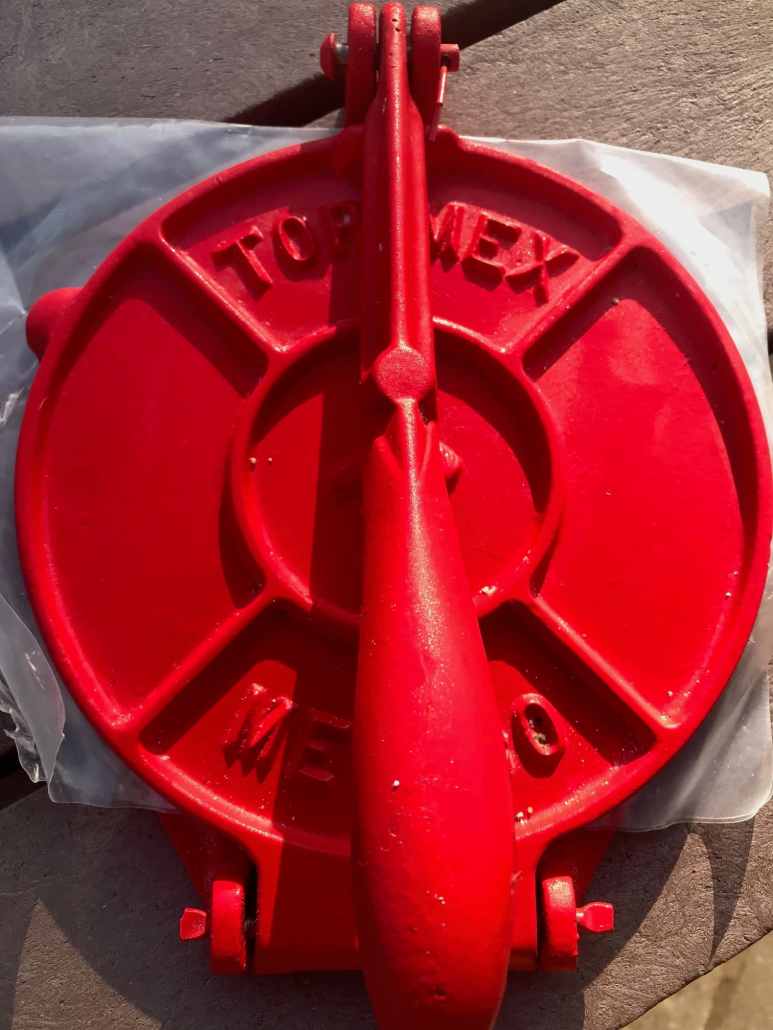
This tortilla press has been a passport to a whole new world of tacos, burritos and enchiladas

The books became my lockdown lifeline. I dream one day of flying into Mérida, gateway to the beaches of Cancun and Turum but also a portal to visit the ruins that evoke the Mayan civilisation that flourished hereabouts. Or will Oaxaca 800 miles to the South West live up to DH Lawrence’s prose in Mornings in Mexico and the musings of Anthony Bourdain in Netflix’s Parts Unknown, where he encountered classic Zapotec (ie pre-Hispanic) cooking?

Pandemic restrictions gave me time and space to foster an interest in the regional cuisines of Mexico, as varied a those of Italy, say. It has resulted in a wooden box hosting 20 different types of dried chillies, a spice cupboard boasting epazote, Mexican oregano and achiote, a giant chaya plant prospering in a garden tub and a bright red tortilla press with bags of blue corn masa at the ready. Yes, I am also a devotee of Netflix’s Tacos Chronicles.

The watershed moment? The documentary Diana Kennedy: Nothing Fancy (available to rent on Amazon Prime for £3.49) tracks the now 98-year-old expat to her lair deep in the Mexican forests. This fiery, formidable cookery writer is the foremost champion of authentic Mexican cuisine and Elizabeth Carroll’s inspiring warts and all profile does her proud.

For over 50 years she has travelled the length and breadth of the country. The resulting books are light on illustration and design; the best the travelogue My Mexico: A Culinary Odyssey with Recipes. All that low key presentation is rectified by Oaxaca al Gusto: An Infinite Gastronomy.

Let’s be honest. Its sheer authenticity makes it hard to replicate dishes. There’s little chance I’ll be rustling up an iguana in a black mole sauce any time soon. For the uninitiated a mole is a rich chilli sauce with chocolate and nuts, not a wee underground critter.

Techniques cited too are equally intimidating. Her recipe for mole negro oaxaqueño calls not only for a specific type of clay pot (“it has to have a round base and a ‘collar’ around the top to hold in the heat”), but also for this pot to be cooked on a charcoal brazier. All this and I’m still trying to source an iguana (ready skinned).

Food preparation is labour-intensive in both Yucatán and Oaxaca

Kennedy’s ringing endorsement is on the dust jacket of Sterling’s Yucatán: “I know of no other book in print today, or in the past for that matter, that explains so meticulously the ingredients and history of the foods of Yucatán.” 

She herself had not given her full attention to this tropical peninsula, isolated from the rest of Mexico. Sterling makes up for it big time, exploring the three states it comprises – Yucatán, Campeche and Quintana Roo. The food is a melting pot of many traditions, Mayan, Spanish, Lebanese, French and more, all fuelled by remarkable abundance of raw produce. All these are catalogued in full colour at the start of Yucatán.

Chapters divide the book by geography — the market, the urban matrix, the fertile shores, the pueblos, as well as sections devoted to “pantry staples” and “kitchen technique.” 

At the heart of Yucatecán cuisine are the spice mixes called recardos, some powdered, some in paste  form, which you’ll find heaped up in every market. There’s no shame in using these essentially home-made bases for every recipe. Alas here you’ll have to make your own. Or travel to Yucatán. It’s on my post-pandemic bucket list.

It just pips Oaxaca because of a contemporary culinary cuckoo. In ultra-hip Tulum, south of suntan city Cancun, is Hartwood, New York exiles Eric Werner and Mia Henry’s restaurant between the jungle and the sea. Each provides the freshest wild ingredients to be transformed by the wood-burning oven that dominates the outdoor kitchen (I expect I’d pack insect repellent before visiting).

The food served at Hartwood is “addictive,” says Noma chef Rene Redzepi, adding, “It’s the reason people line up for hours every single day to eat there, even though their vacation time is precious.”

How do I know about it? I read the cookbook, of course,

Unless I’ve missed it previously, Zhug is making a Manchester debut on the menu of Simon Shaw’s eagerly anticipated third restaurant in the city, Habas, which opened in early June in the former Panama Hatty’s site on Brown Street.

Brought by Jews from the Yemen a century ago, Zhug is the Israeli national chilli paste, mixing parsley, coriander, and assorted spices. I first discovered this fiery condiment on the counter of Soho’s vibrant Palomar restaurant and in the pages of Ottolenghi’s Jerusalem. I slather it over shawarma; at Habas it accompanies homemade garlic and herb flatbread with hummus.

Potato skins filled with sliced lamb

Other dishes feel very Ottolenghi, the Guardian Weekend readers’ passport to Levantine dinner party heaven. So familiar that maybe it lessens the excitement of Habas. Still what’s not to like about small plates such as Middle Eastern raw slaw with pomegranate molasses; batata harra – spicy fried potatoes with dill sour cream; beetroot hummus with Greek yoghurt and dill (main image); feta cheese, wilted spinach and sunblush tomato filo cigars; spiced lamb ‘jackets’ – fried potato skins filled with spiced lamb, served with mint yoghurt. 

But is it a culinary game changer? One Manchester Confidential reviewer, of Persian heritage, accused it of ‘culinary appropriation’. Fair comment? There may be a certain residual bias against a classically trained Yorkshire chef’s temerity in tackling cuisines not ‘his own’. Certainly Habas is a lurch east from his twist on Shaw’s ‘Iberian-influenced’ food at El Gato Negro (Spanish) and Canto (Portuguese).

Simon Shaw feel the MIddle Eastern project is a natural progression

Shaw is very much aware he is surfing a certain ‘Zhug Zeitgeist’, telling me, a friend and supporter from El Gato’ first stirrings in the Pennine village of Ripponden: “It’s phenomenal just how much people’s appetites have evolved over recent years. 

“Back in the late Nineties you’d have struggled to have found Middle Eastern restaurants outside London. Even there, they existed largely to feed the local community, people from those countries living in the city.

“Times have changed and there’s a whole new wave coming through. It’s an amazing style of food, simplistic but with a real depth of flavour. It’s what excited me about it as a chef and I think it will have really broad appeal.”

Habas cuisine is a picture on a plate

Like El Gato Negro and Canto, the menu centres around a generous number of small plates, coupled with larger dishes and feasting platters. 

“Middle Eastern cuisine has many influences and Habas is a fusion of all,” says Shaw. 

“It’s about ingredients. There are lots of connections to Spanish food, the Syrian lentils, lamb meatballs and spiced aubergine dishes enjoyed at El Gato Negro all lean towards the style of cuisine. I suppose part of my mind was already on it.”

Habas means fava (broad) bean) in Spanish and also is the name of a settlement in the Yemen, where zhug is the relish of choice, no doubt.

Batata harra – spicy fried potatoes with dill and cream

Habas, 43a Brown Street, Manchester M2 2JJ. 0161 470 9375. Opening hours Thursday-Sunday 12pm to late (food service until 10pm, after which we’d recommend continuing with suitably-themed cocktails). Expect opening hours to be extended when the industry’s current staffing issues are resolved.

The bar is the place to try Habas’s cocktails, prepared with a Middle Eastern twist