Elena Ferrante’s Neapolitan Quartet novels were set in a gritty, poverty-stricken Fifties Naples still recovering from the War. I came later than most to the best-selling saga of Elena and Lila, then devoured its 550,000 words with all the gusto I had brought to road-testing the pizzas of that chaotic, hypnotic city. 

Seventy years ago, as now, an idyllic escape route was offered by the hour ferry ride across the Gulf to Ischia. It was on a moonlit beach there that Elena lost her virginity in The Story of a New Name. My solo visit to this 17-square mile island out in the Bay of Naples was less life-changing but quite unforgettable.

Ischia teems with other ghosts – cinematic, musical and literary. This volcanic outcrop of hot springs and mud treatments may lack the sheer chocolate box glamour of rival Capri, but what an exotic, sometimes louche, backdrop it has been to the lives of numerous creative mavericks.

Capri boasts homespun Gracie Fields; Ischia WH Auden, William Walton, Luchino Visconti and their luminous guests. OK, much of this celebrity action was back in the Fifties and Sixties, when it was not the developed tourist destination it is today. The same is true of so many Mediterranean boltholes, yet against the odds Ischia retains a special dolce vita allure.

It helps that it has acted as location for at least 30 movies. It also hosts two annual film festivals. I gasped when I first reached Ischia Ponte, the picturesque extension of the island’s capital, Ischia Porte, and gazed upon the iconic citadel, Castello Aragonese, rearing 300ft above the sea across its causeway. Instantly recognisable from film noir The Talented Mr Ripley, where Matt Damon, Jude Law and Gwyneth Paltrow play out their sardonic, sun-kissed endgame.

Off-screen movie melodrama came to Ischia four decades before when Richard Burton and Liz Taylor conducted their very open and controversial public affair on the island during the filming of Cleopatra in 1962. At the Bar Mara Caffe Internazionale in Forio town there’s no recognition they were once visitors alongside a starry cast that included Charlie Chaplin, Sophia Loren, Ava Gardner, Jackie Kennedy and Aristotle Onassis.

The regular presence at Maria’s Cafe of great English poet Auden is marked by a framed photo with then owner Maria Senese, while other visitors have terrace tables named after them. I sipped a wheat beer with my legs under ‘Truman Capote’. Auden lived nearby in the summer with boyfriend Chester Kallman, forming a gay enclave that sometimes scandalised residents of this workaday port.

There is no trace left of the house they rented, so I pursued my quest for Ischia’s bohemian past by walking north along the coast back to my hilltop hotel base, San Montano Resort & Spa via two surviving monuments to artistic giants. It was a stiff climb up to the pine-clad Zaro promontory in the north east of the island that is home both to film director Luchino Visconti’s Moorish-style villa, La Colombaia (The Dovecot), and Oldham-born composer Sir William Walton’s world famous garden, La Mortella (The Myrtles).

La Colombaia, set deep in forested grounds, was rescued from a decade of neglect and relaunched as a museum and international school of film and theatre 20 years ago. In these difficult times the whole complex is closed, possibly for good. The ghosts remain. Here the rampantly bisexual director held open house. If walls could tell tales. When Aristotle Onassis ditched Mara Callas for Jackie Kennedy, here Visconti comforted Callas, who he had directed in La Traviata at La Scala. All three were his friends and frequent house guests.

A couple of miles away is a place with an altogether less turbulent past. The gardens of La Mortella were 50 years in the making. In 1958 Lady Susana Walton started transforming a quarry on the property her husband Sir William had bought, opening it to the public in 1991. Today, run by a private foundation, it is a spectacular sub-tropical and mediterranean garden featuring a working concert amphitheatre, a museum devoted to the composer (best known for Facade and Belshazzar’s Feast) and his pyramid-shaped tomb overlooking the sea. I liked the risque murals in the quasi pagan ‘Temple of the Sun’ and the world’s largest water lily, the gender-bending victoria amazonica, that flowers in the morning as a white petalled female and later in the day reopens as deep crimson petals and male organs. 

If you visit one attraction in Ischia, make it La Mortella, but note it is shut to the public from until April 2 2022. During the winter month the garden can be visited via a guided tour each Thursday. You must book in advance.

I was lucky it was an hour’s walk away from marvellous San Montano,which itself boasts a spectacular outlook in all directions. Down to its private beach 100m below or along the coast towards Ischia Porte. Perfect for sunrises and sunsets. My room with its own balcony shared these sublime vistas.

It is such a haven much of the clientele seemed happy to while away the afternoons around the fabulous pool complex or make full use of the light-filled Ocean Blue Spa with its hand-made Vietri tiles before dining in formal but relaxed style al fresco on the terrace. Dishes featuring plenty of fish, buffalo mozzarella, olive oil, salad and herbs offered a deft take on traditional local cuisine. The local produce is magnificent.

A dinner excursion down to Lacco Amena town was exciting, too. Here at the island’s only Michelin-starred restaurant, the Ristorante Indaco locally-born chef Pasquale Palamaro offers challenging tasting menus. It is situated in the L’Albergo della Regina Isabella, the only hotel on the island with its own beach – and a sense of a glorious celeb past. 

Both hotels have fabulous wine lists showcasing Campania on the mainland and Ischia’s own specific grape heritage. Key local producer is the acclaimed D’Ambra winery, which has championed varieties native to the island such as Biancolella, Forastera, and Rilla white varieties, and Piedirosso and Guarnaccia for reds.

I tasted the range in the company of Andrea d’Ambra, who is assisted in th winemaking these days by his daughters Marina and Sara, then went on a vertiginous car ride up  to the Frassitelli vineyard that is their pride and joy, four hectares clinging to a mountainside 600m up en route for Monte Epomeo, the slumbering volcano that dominates the island. Great walking all around, aided by a colour-coded footpath network.

Frassitelli, the flagship white produced here from Biancolella, also hits the heights. Peachy on the nose, it is piercingly fruity, with a hint of salt, on the palate. Visconti helped design distinctive labels for D’Ambra when they were finding their feet in markets beyond the island.

 Visible from the vineyards on the southern coast is Sant’Angelo, loveliest spot on the island. All whitewashed cubes and pricey boutiques and fish restaurants, it lies on an isthmus in the lee of a volcanic hump (they are everywhere – Lacco Amena has a tufa outcrop called Il Fungo because it resembles a mushroom. 

Here most of all on this lush, less developed side Ischia lives up to its sobriquet of the Emerald Isle. No cars or buses are allowed in Sant’Angelo, so it is a tranquil spot to people watch on the beach or grab a beer and a pizza.

I covered so much of the island on foot there was no time left to take to the hot springs. Those in the know recommend Negombo, which is next door to San Montano’s private beach. This ‘thermal garden’ covers 22 hectares with a variety of mineral baths, jacuzzi and Turkish bath. You buy a day pass. Probably a great place to relax and gather your strength before being ferried back from vibrant, villagey Ponte Ischia (below) to the urban maelstrom that is Naples.

Getting there

I flew into Naples and then travelled to Ischia by Alilauro hydrofoil on the 9th at 2.35pm (alt 3.30). Get there 45 minutes before and tell them you have luggage. Alilauro ticket office is at Molo Beverello (Napoli’s Port).

A version of this article first appeared on Manchester Confidential.

It has been an epic journey across time and space and I’m understandably nervous when I encounter a scribbled sign at the picket gate into the Brewery of St Mars of the Desert. Private function today? Shut by Covid scare?

Phew. ‘Please don’t let Grimbold the dog out’ with a silhouette of the jet black bundle of fun I get to pat once I step across the ‘Welcome To Mars’ threshold. Fun is a good word, indeed, for everything that greets me inside this colourful cottage of a taproom. My benchmate, who budges up for me, recommends the ‘SMODFEST’ Festbier for its soft maltiness, continental hop character and absence of excess carbonation that can bedevil a lager. 

OK, I’ve made him more eloquent than he was. Yet it is a great introduction to SMOD, who specialise in “hoppy koelship beers, foeder-soured stingos, rustic lagers, deep malty dark beers and Benelux-inspired creations”, according to their website. Koelship? Pronounced cool ship, it’s a long, slender, open top stainless steel vessel akin to those traditional Flemish/Dutch koelschips, originally made of wood, whose high surface-to-mass ratio allows for more efficient cooling of the wort in the brewing process. Won’t go into more detail – this is a nerd-free zone.

It’s the centrepiece of a modest scale brewing operation behind the taproom, where SMOD co-owners Dann Paquette and Martha Simpson-Holley, plus apprentice Scarlet, produce some splendidly niche and nuanced beers in the old industrial district of Attercliffe, surrounded by ranks of contemporary factories/depots.

Not the easiest place to get to, hence my ‘epic journey’ lead-off. On my last adventure in Sheffield my last port of call was meant to be here but my phone charge went dead and no local could guide me, even though I was within a couple of hundred metres. Even this this time, on a trek from a tram halt, I feel rudderless.

Once I arrive, then, I am in no hurry to leave, sampling in turn Clamp Koelship IPA, hazy and hoppy yet like all the beers very clean, Koel It! Jingly Bells, all my Christmases come early with oodles of hops married to a festive fruitiness and, finally, The Battle of Frogs and Mice, Dann and Martha’s ‘tribute to the original craft brewers of Belgium’. Artisan or what?

At 8 per cent, Frogs, a dark special brune, outmuscles the 6.3 per cent Mice, a Flanders golden bitter, but it is also smoother, fruitier and more complex. According to the SMOD beer menu it is “brewed with a recreation of the water profile of West Flanders”. Now that is an attention to detail.

Bizarrely, when the globally influential RateBeer site announced its 10 Best New Breweries in the World 2020, two of the three British breweries named had this Belgian resonance (SMOD and, understandably, Mount Saint Bernard Abbey in Leicestershire) and two had American founders/brewers (SMOD and Suffolk’s Duration, incidentally many of whose ales are farmhouse and saison, too).

Bostonian Dann met North Yorkshire lass Martha across the Pond and the pair ran the acclaimed Pretty Things brewery for eight years before embarking on peripatetic journeys across Asia and Europe. Along the way they fell in love with a smallholding near a village called Saint-Mars-du-Désert in France’s Pays de la Loire region, named after an eighth century hermit. 

Maybe but for the prospect of Brexit they might have set up there; after considering Leeds and Manchester they went for Sheffield and took the monastic moniker with them. After all it was monks who first consolidated the brewing industry.

The pair’s fascinating story is recounted in a Pellicle online magazine piece by Matt Curtis,  ‘Everything in its right place and SMOD is a featured brewery in his recently published Modern British Beer (CAMRA Books, £15.99). Read my review here.

It’s not just about the beer, though. The taproom faithful are a civilised lot, Dann and Martha host it all with real warmth and Grimbold is irrepressible.

St Mars had been on my radar since its inception in 2018. My yearning to visit has since become a catalyst for discovering a Sheffield beyond my Richard Hawley and Jarvis Cocker affiliations. This time around I was smitten by the diversity and raw vitality of The Moor Market and found Cutlery Works the most relaxing street food hall I’ve ever visited.

THE MOOR MARKET

Chicken livers, gizzards and hearts are all the same price – 90p a pound. The adjacent pig’s feet are priceless (in a nose to tail photoshoot way). Across the aisle a specialist Persian food stall offers ingredients I’ve only ever read about in Sabrina Ghayour or Yasmin Khan. On one fish stall I encounter a sturdy carp, not seen on most slabs. There is tripe and various intestinal siblings, feathered, ungutted game birds and a whole, skinned rabbit still defrosting I enquire about, to be told “it’s French, farmed, you’ll have to wait a couple of weeks for the English, wild, fresh.” I loved all this from the moment I walked into find a fine bottle shop, Beer Central, to welcome me.

The building is less than a decade old, cost £18m and includes 200 market stalls and eight shops. Situated off a pedestrian precinct rammed with every high street name you can think of, what a relief to discover this haven of independent traders, offering an affordable, browsable, diverse alternative to control freak supermarkets. 

Its main northern rival, Leeds Market, benefits from its Victorian monumentality and better dining-in opportunities, but Sheffield’s really is hard to beat. Obviously not in comparison with the great markets of Spain, Barcelona’s Boqueria or Valencia’s Modernista-style Mercado Central. They reflect a whole different food culture. It has been interesting, though, to tick off across the Iberian peninsula the rise of markets morphing into food halls – in Bilbao, Madrid, Seville and notably Lisbon’s waterfront Time Out Market.

CUTLERY WORKS

That Lisbon operation is a showcase for the city’s Michelin-starred chefs. Sheffield’s stand-out food hall is an altogether more modest affair despite its claims to be the North’s largest. Set in a converted cutlery factory, in the post-industrial corridor that stretches out from Kelham Island, Cutlery Works offers 13 different vendors across two floors, ranging from China Red’s Szechuan sizzlers to chocolate counter Bullion and coffee roasters Foundry, taking in Thai, pizza, fried chicken, burgers, sushi and Mexican along the way.

Foundry provide bottomless batch coffee for freelancers taking advantage between 9am and 5pm of designated co-working spaces with plug sockets and 10 per cent food discounts. All very cool and relaxing in my mid-afternoon slot, it lacked the buzz of Manchester’s Mackie Mayor, which I still love – despite my general weariness with the whole food hall experience. 

The Guardian restaurant critic Grace Dent summed it up nicely: “I need to ask a very honest question here: are food halls ever a truly satisfying dining experience? I’ve no doubt they seem so on paper and in the marketing meetings, they’re fantastic for filling old, unloved but historically important spaces and they’re good news for downward-spiralling city centres. Yet in reality they’re noisy, unrelaxing and the food is often patchy, with the occasional gem hidden among the colossal choice of menus.”

That was in last month’s review of the GPO in Liverpool, as the name suggests, a post office repurposed into a food hall. She was unimpressed by Nama, a Japanese small fish plates counter, created by Luke French and Stacey Sherwood-French of Sheffield big hitter Jöro (my restaurant review here), who have also transferred their other new venture Konjö.

The original of this Korean-influenced, fire-based “Robatayaki” Kitchen was my choice at Cutlery Works. It’s the first vendor on the left as you reach the first floor – preferable to the ground floor if only because it boasts the proper craft beer bar, Boozehound.

I spent £30 at Konjö, mainly because I over-ordered in my eagerness (and a desire for ballast ahead of my beer destination). Don’t expect a spin-off from Jöro down the road. There’s no comparable finesse. And yet my combo was hugely enjoyable. A duck bao was basically a take on the old Peking/hoisin sauce stalwart while chilli beef was sticky and punchy. Sides of subtle kimchi and refreshing sesame greens provided perfect balance ahead of my journey  to Mars.

Brewery of Saint Mars of the Desert, 90 Stevenson Rd, Sheffield S9 3XG. The taproom is normally open Fridays and Saturdays 2pm-8pm.

Cutlery Work, 73-101 Neepsend Lane, Neepsend, Sheffield S3 8AT. Open Sunday-Thursday, 10am-10pm; Friday-Saturday 10am-11pm.

Fashion and diamonds, waffles and ales – Antwerp’s a heady mix even before its surreal side creeps up on you. And it will. Just let it. Rubens and Bruegel, the gabled Grote Markt and the soaring Flemish Gothic cathedral offer you art and architecture with a Capital A, but don’t neglect the hard-nosed quirkiness that also stalks this town, so perfect for an offbeat weekend break.

Step into the Chocolate Line workshop of self-styled “Shok-o-llatier” Dominique Persoone and ask for one of his chocolate shooters, which catapult finely ground dust of of exotically flavoured cocoa up your nose. No sniggers when you learn they were first commissioned by the wives of Ronnie Wood and Charlie Watts for a surprise birthday party for their Rolling Stone husbands.

“Instead of putting chocolate on the dish, because they were the rock ‘n’ roll grandpas, we thought they should sniff the chocolate and to get a good result we designed a machine for that,” says maverick Dominique. “We just made one for that party, but then everybody talked about it in the newspapers, so then we had to make it commercial because everybody was asking for it.”

My companion took the full whoosh of a ginger flavoured shooter, while I suffered the lingering torment of sucking on a wasabi suffused truffle. Heston Blumenthal is a fan. I can see why.

The Paris-trained chef with a “chocolate is rock and roll” tattoo on his right bicep, set up hisfirst shop in his native Bruges; the Antwerp offshoot, utilising the finest South American source materials, is inside the splendid 18th century mansion called the Palais op de Meir (Meir is the main shopping drag between the imposing, gilt-encrusted Centraal Station and the Old Town).

The Palais once belonged to Napoleon, so our Flemish Willy Wonka created a chocolate in homage in the shape of a bicorne hat, filled with marzipan, cherry liquor and bitter banana cream. Look out for poodles and frogs crafted out of the finest cacao.

A sweet alternative is the waffle and doyen of these in a city that likes to snack is Désiré De Lille on Schrijnwerkerstraat (easier to pronounce than spell, it means Blacksmith Street). Desire’s HQ has a decided 1930s feel about it. Pass through to the glass pergola at the back where carp-teeming pools give it a lightly oriental garden feel. Decidedly not light are the alternatives to waffles and doughnuts – smoutebollen, or deep-fried lard balls. Good ballast, as they say.

Just the thing before running the considerable gamut of celebrated Belgian beer styles – immensely drinkable, deceptively strong Duval, various Trappiste ales such as Westmalle, Orval and Chimay and the sour, challenging Geuzes and Lambics, their grip sometimes softened by fruit in variants such as Kriek (cherry).

Step into the kitschfest that is Het Elfde Gebod, self-styled ‘The Holy Place’ on Torfbrug, more a shrine to monkish merriment than your average beer bar, and order the local De Koninck. “Ah, you want a bolleke,” the waitress tells you. That’s the local globe-shaped glass it comes in. That’s what you ask for here and in more classic “brown” long bars like Cafe Den Engel, centre of the Antwerp convivial universe with a view across the Grote Markt of the 400ft lacy spire of the Onze Lieve Vrouwekathedraal (Our Lady’s Cathedral).

This light-filled Gothic leviathan houses the pinnacle of resident genius Rubens’ devotional works, but before you make the pilgrimage across the cobbles to worship the sublime Descent from The Cross, central panel of a tryptich. and three other masterpieces, stop off at the statue of Brabo in front of the town hall (Stadhuis)  

Brabo? Verdigris coated nude chucking a severed hand, like some deranged baseball pitcher shedding his mitt. Symbol of the city. Antwerp translates as hand throwing in Dutch. Legend has a giant (or heavily-built entrepreneur) called Druon Antigon who lopped off the hand of any sailor unable or unwilling to pay the toll to sail on the River Scheldt. he was finally defeated and has his own hand detached by the Roman soldier Silvious Brabo, who then became the Duke of Brabant.

The hand symbol is all over a riverside museum opened a decade ago to explore the city’s past, ethnography  and many big issues (Life and Death anyone?). Oh and check out the luminously disorienting Matrix room! Yes we’re back with quirky. The MAS, (Museum aan de Stroom) is a striking building resembling a pile of rusty red horizontal box files.

Offering panoramic views of the city, it is the centrepiece of the Het Eilandje district, regenerating the old docks, Bonapartedok and Willemdok, which also hosts the Red Star Line Museum, tracing the exodus of 2 million emigrants across the Atlantic on the company’s steamers. 

Classy eating options are already in place. The dockside Het Pomphuis was completed in 1920 as one of the largest pumping stations in Europe. All this industrial heritage is the backdrop to the restaurant’s culinary aspirations.

After the Cathedral, a craving for art having overtaken one for waffles and a swift bolleke, I’d recommend visiting the much-restored Rubenshuis. It’s not crammed with his works (though don’t miss a fascinating self-portrait of 1630), but it is an atmospheric introduction to a hugely successful as well as great artist, who spent much of his life in Antwerp.

A generation before, Pieter Bruegel the Elder also spent a period living in the city. His Dulle Griet (Mad Meg) from 1562 is a nightmarish Hieronymous Bosch like allegory depicting a peasant who leads an army of women to pillage Hell. It was discovered at an auction in 1897 and bought for a minimal sum by a young collector called Fritz Mayer van den Bergh. Four years later he was dead and his mother built a gallery in his name to house Meg and the rest of his 1,000 artworks, mostly from the Northern Renaissance. Just south of the Grote Markt on Lange Gasthuisstraat, it is a gem of a place. I had it to myself visiting the city’s Sunday street markets.

Not far away, in the Vrijdagmarkt square, is the Plantin-Moretus Museum, a well-preserved building, which in the 16th century housed 22 printing presses and was a magnet for dissident intellectuals. Alongside old presses, the museum contains many printed treasures including Mercator maps and a Gothenburg bible. Afterwards, just wander alleys that have remained from medieval times to get a feel for the city of Rubens, Bruegel and printer Plantin.

I’d like to say I got round to exploring the Diamond Quarter (it’s superficially drab and was closed for the weekend) and the Fashion Quarter – I kept discovering fashionable new beers and genevers (gins) instead – but I am assured Antwerp is a place to come for affordability and individual chic. The Tourism Information folk can supply an Antwerp fashion map, if you feel the style urge.

There’s so much to occupy your entire weekend without leaving the Old Town, but we did venture, via Tram Route 8 from Groenplaats, to the increasingly trendy South Side of the city. We gawped at the spiky Law Courts complex designed by Richard Rogers before visiting the old De Koninck brewery for a final bolleke of the visit (and much Duvel and Kriek, too) in a cheese matching event organised by the best cheese affineur (maturer) in town and in Europe according the Wall Street Journal  – Van Tricht. Their cheese shop in Fruithoflaan is well worth a visit… but even a few nibbles do raise a thirst. Cheers! Santé! Or as they say in Flemish: Op uw gezondheid!

ANTWERP CITY CARD

This is essential for exploring the city thoroughly. It costs 37 euros for 48 hours and gives you free entry to all Antwerp museums and monumental churches, including the Cathedral of Our Lady, a free printed map guide, a discount of at least 25 per cent on tourist attractions, sightseeing and bike rentals plus special offers on typical Antwerp and Belgian products, such as chocolate.

It’s nigh on 40 years since the BBC televised their adaptation of John Le Carré’s Smiley’s People, culmination of his trilogy about spymaster George Smiley, the squat, bespectacled antidote to the crass, cartoonish antics of James Bond. I’m all for compulsive  slow burners, so I read the 1979 novel again recently before catching up with Alec Guinness as Smiley on Amazon Prime.

Le Carré, who died last December, had made Berlin his personal literary territory through 1963’sThe Spy Who Came In From The Cold, made into a movie with Richard Burton two years later. Somewhere in between the two books (and before a certain David Bowie) I lived in West Berlin and can never forget how I survived a sub-Arctic initiation, living in a Turkish quarter not far from the Wall, scene of both books’ denouements.…

It was a bitter January. I always call it my pea soup month. Each evening after work at the Bilka supermarket I stood shivering at the Imbiss at Zoo Station to eat my thick Erbsensuppe – mushy pea puree by any other name. 

At weekends I treated myself to a sausage in it. I was the ultimate, penniless student in my puckering mock leather greatcoat and threadbare loon pants. The only thing I had in abundance was hair.

Finally, come February I got paid and was able to vary my diet to Currywurst with potato salad and even get to see some of the amazing city, an island of Capitalism stranded in the middle of Red East Germany – remaining so until the Wall came down in 1989 and Deutschland was reunified, the Brandenburg Gate serving as its symbolic centrepiece.

After only fleeting visits since and I’m back in the reunited capital a tourist not cultural squatter. Currywurst is now as much a Berlin icon as David Bowie, but pea soup has bitten the dust in favour of burgers and, of course, the doner kebab, created in the city by Turkish immigrant Kadir Nurman in the early Seventies (as with Bowie, we never met).

It’s a city utterly changed, obviously for the better, the axis for citizen and tourist alike shifting back to the original centre in East Berlin. There the Prussians built vast museums and monuments to their warrior culture, but I suspect the urban cool hang-outs in districts such as Prenzlauer Berg, Kreuzberg, Neukölln and even raw Friedrichshain are more the magnet for today’s weekenders. 

Still there’s no escaping the huge burden of history borne by Berlin – the legacy of Nazism, Communism and the city’s perennial brand of Hedonism, all to come to terms with. It   makes for a thought-provoking cocktail of impressions. 

Where to start? For me it was on top of a car park in Neukölln. Klunkerkranich is a place to get your bearings, but first be prepared to negotiate five floors of shopping mall and a couple of concrete ramps. Your reward a ramshackle boho bar (no food), a sun trap with a wonderful view across the city (main image). 

Two Weissbiers later and I felt like a native, though these were cloudy, refreshing Bavarian wheat beers; the real native Berliner Weisse is rather tart, neutral stuff perked up with a Schusse (shot) of raspberry or (shockingly green) woodruff syrup. Like Currywurst, really just a one-off must.

For old times’ sake, I drank one in the Prater on Kastanienallee, a true old-fashioned, tree-shaded beer garden, open seasonally, surviving up among the baristas and sushi meisters of hip Prenzlauerberg.

For the most spectacular view of the sprawling metroplis trek up to the top of a DDR relic – the Fernsehturm (telly tower). You can sip suitably retro cocktails in the panoramic bar 365 metres above the ground and imagine the Stasi are stalking you. In its shadow is another institution peddling a Teutonic image at odds with contemporary Berlin. The Alexanderplatz branch of Munich’s famous Hofbräuhauswill satisfy your craving forSchweinebraten, dumplings and the like.

You are now in Mitte, catch-all designation for the city’s core, which I kept gravitating back to (but not Alexanderplatz itself, concrete ‘dead’ centre). Much more human in scale and with better shopping, the Hackesche Höfe is a series of eight inter-connected Art Nouveau courtyards with elaborate ceramic facades off Rosenthalerstrasse, mixing shops, bars, theatre and creative studios. Neglected during the GDR era, it symbolises the rebirth of the whole Mitte, where thoroughfares such as Torstrasse, Linienstrasse, Tucholskystrasse and Auguststrasse are packed with interesting indie restaurants and bars. 

On Torstrasse, I’d recommend tiny Noto, with its laid-back contemporary take on German food, but even better in the same vein on Linienstrasse, Das Lokal, where an old corner Kneipe (bar) has been transformed into one of the best affordable, casual dining spots in the city. They squeezed me in at the counter and I munched on a blanquette of rose veal and drank a limpid Rheinpfalz Pinot Noir. Then I went back another night for venison.

Even more casual was Berlin’s take on street food, at Birgit and Bier, a hippyish beer garden, just south of the River Spree, that makes Klunkerkranich look smooth. I like this Turkish cafe heavy corner of Kreuzberg, where the spirit of alternative Berlin lingers on. Promenade along the river westwards beyond Schlesisches Tor and you’ll find wonderful street markets.

Or step in off the wide, breezy space that is Warschauerstrasse and enjoy the achingly cool public space of the Michelberger Hotel in the company of one of Berlin’s new wave craft beers from Brewbaker. For those of you that have missed the city’s club scene, it’s only a 10 minute walk from Berghain, which finally reopened at the start of October, the former power station having been repurposed as an art space during the Pandemic.

By all means visit the big sights, the Brandenburg Gate, Reichstag, Checkpoint Charlie, but weekends away should also be about this kind of aimless sauntering, keeping your eyes open. The Germans have a verb for it: to ‘Bummel’. 

So, if you’re in the Tiergarten, Berlin’s equivalent of Central Park complete with an obligatory nude sunbathing patch, grab a beer and pizza and hire a boat at the lakeside Cafe am Neuen See.  Finally, for the ultimate drift through this fascinating metropolis let the stern take the strain – go on a river cruise. Boarding near the medieval Marienkirche, famous for its ethereal ‘Dance of Death’ fresco, I took the basic 23 euros one hour tour from Stern & Kreis. We glided serenely past the bombastic hulk of the Cathedral, the monumental Museum Island and on to the modern riverside resurgence beyond the Reichstag. It would give a fascinating over-view for a first time visitor. Oh yes, and there is a Himmel; they serve beer on board.

Make this your Berlin Bucket List

There’s so much to see, don’t try to cram too much into your stay. I’m saving sunbathing out at the Wannsee lake and a visit to the Stasi (East German secret police) Museum until next time. Here, though, are a few musts…

The Holocaust Memorial

Between the Brandenburg Gate and Potsdamer Platz, its design is inspired by Prague’s amazing Jewish Graveyard with its dense, cluttered gravestones. Here in Berlin 2,700 square, dark grey pillars of varying heights are scattered across the site. In the middle of the engulfing maze I was overcome by an immense feeling of isolation and despair, which is the appropriate response to a space designed to commemorate the exterminated Jews of Europe.

The Jewish Museum

Celebrating its 20th anniversary, this Daniel Libeskind building in Kreuzberg bears obvious architectural resemblances to his later project, the Imperial War Museum North at Salford Quays. Step back from its zinc facade and the great zigzag slashes rearrange themselves into a dislocated Star of David. Three long, intersecting corridors – ‘axes’ of exile, holocaust and continuity – showcase small artefacts, mementos, testimonies, but the centrepiece is the Holocaust Tower. This is a vertiginous, walled void, completely dark but for a small slit high up, allowing light and noises from outside. Small batches of visitors are filtered in at a time and the huge door swings behind you. Flesh-creeping.

Topographie des Terrors

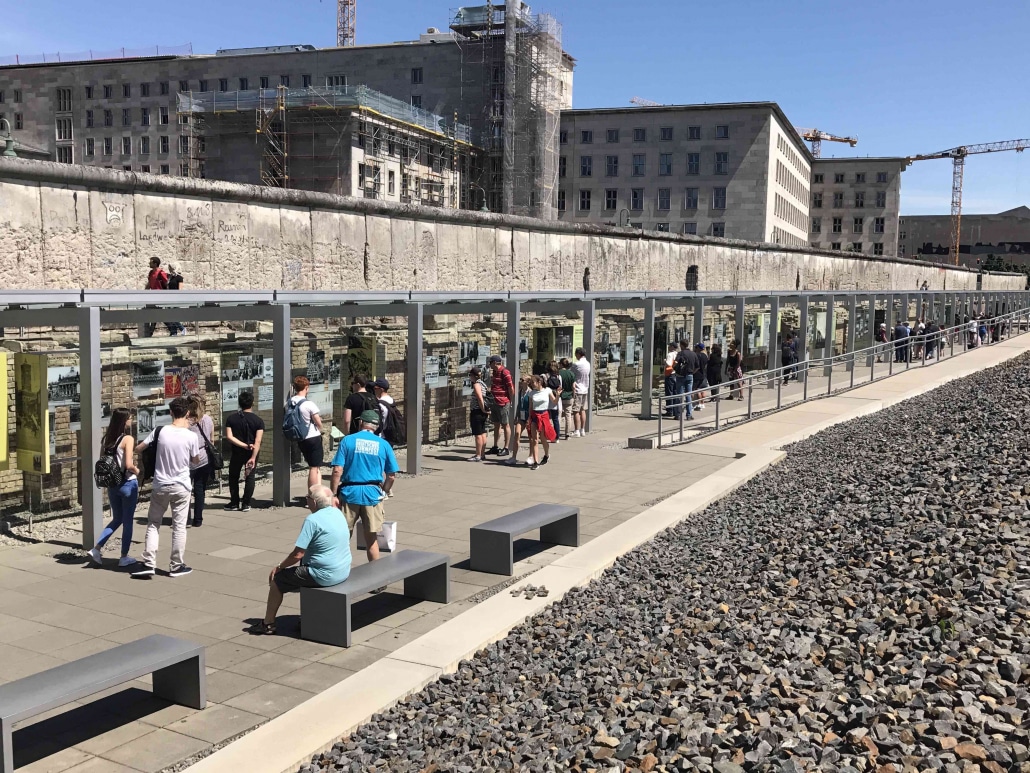
On the central site of the Gestapo and SS HQs, this exhibition space offers a comprehensive account of the rise of Nazism. Outside, set against a remaining fragment of the Berlin Wall, is an essential open air presentation of life in Berlin from 1933-45.

Gedenkstatte Berliner Mauer

Immediately upon reunification, the city bought a stretch of the Berlin Wall on Bernauerstrasse to keep as a memorial of the fortified dividing line that was suddenly imposed upon the city by the East German regime in 1961. The visitor centre charts how families were separated on that fateful day. Elsewhere across the city are preserved segments of the Wall. Within an easy canalside walk of my hotel near the Hauptbahnhof is the Invalidenhof, a 19th century graveyard poignantly preserved by being in the ‘death strip’. Here it was in 1962 that West German police shot dead an East German border guard to rescue a 15-year-old boy who was in the process of escaping.

Museum Island

Five great museums cluster on the site of the original Berlin river island settlement, now a Unesco World Heritage Site. You could spend an entire week exploring the collections. Pick one? Perhaps the Pergamon built over a century ago in the style of a Babylonian temple to house the treasures German archaeologists were plundering across the globe. Stand-outs are the ancient Pergamon altar itself unearthed in eastern Turkey and the reconstruction of Babylon’s Ishtar Gate with its eerily preserved deep blue bricks and and sculpted mythical beasts. If all this monumentalism leaves you cold slip into the nearby Alte Nationalgalerie, whose collection of predominantly 19th century art boasts some wonderful Romantic landscapes by Caspar David Friedrich.

Fact file 

Neil Sowerby stayed at Motel One Berlin Hauptbahnhof, Invalidenstrasse 54, 10557 Berlin, +49 30 36410050. It’s across from the transport hub of the central station. 

For full tourism information go to the Visit Berlin site and to book a Berlin Welcome Card, official tourist ticket giving access to public transport and many attractions plus 200 discount offers go to this link.

Jonathan Meades pontificating on Expressionist Architecture’s debt to the Gothic. Classic Meades. Against a backdrop exemplifying his polemic – Hamburg’s Chilehaus. Ten storey 1920s office block built on wealth from a South American saltpetre venture; ornate, curved showcase for 4.8 million dark bricks, UNESCO World Heritage Site. 

As Meades proclaims to camera in his 2008 travelogue, Magnetic North: “Expressionism was a variety of Modernism, which didn’t prevail against the rectilinear idiom of the International Style. No, Expressionism didn’t try to break with the past, it embraced it, reworked the practice.”

The two part Magnetic North took the maverick architecture/food critic from the Flanders flatlands to the old weird Baltic states via the independent North German cities that made up the Hanseatic League, mercantile confederation at its peak from the 13th to the 15th centuries. Meades’ verdict: “God’s first attempt at the EU.”

That Hamburg, the Bundesrepublik’s second city and biggest port, is still in thrall to its Hansa past is symbolised by its car number plates – HH (Hansestadt Hamburg) – and by a mindset that finds more in common with Antwerp or Copenhagen than, say, Munich.

Hence the Meades telly odyssey (or is that too Greek a word?). Reacting against the cultural seduction of the Mediterranean South with its sun, wine and olives, he went in search of the North, land of greyness, grain-based drinks and herring, territory pervaded by a dark, scatological, Grimm-like imagination. I am still with the great man on that journey.

So does Hamburg live up to the Baltic billing? Definitely. We are in Deichstrasse after dark. Across the Zollkanal waterway the great brick cliff faces of the Speicherstadt warehouse district are lit up a treat. The spice and carpet trades no longer rule in one of Europe’s most spectacular townscapes, but it still radiates mercantile imperatives. Rather like uncompromising Hamburg itself. Which makes it so refreshing for a weekend break. Real. Out there in the current docks, the giant container ships and cruise liners slide in up the River Elbe.

Deichstrasse was here before all this. This modest little street dates back to the 14th century and some of its lopsided properties are restored 17th century. We are torn between two Hanseatic culinary options. The Kartoffekeller (Potato Cellar) is a restaurant devoted entirely to the spud. From soups and souffles to pancakes and a shot of digestif spirit, all offerings are based on that tuber. Even the staff are clad in potato sacks. Its rival across the road is the Alt Hamburger Aalspeicher (Old Hamburg Eel House), offering eel soup, eel in green sauce, smoked eel… you get the message. Or, if you can wriggle out of eel, it serves that other Baltic favourite, the herring. (Note the latter eating house is ‘temporarily closed, as I write).

We said Nein to both places and resumed our evening Bummel – a lovely German word for sauntering aimlessly. Nothing to do with what goes on down along the Reeperbahn. We’d encountered Hamburg’s red light district in passing mid-afternoon. Perhaps window-framed hookers were flaunting it in broad daylight along notorious Herbertstrasse, closed off by a wall to women and minors. In solidarity with them I chose not to slip in even for a gawp.

Instead, we went for Art, drawn by the great Romantic works of Caspar David Friedrich and Philipp Otto Runge at the Hamburger Kunsthalle but found the gallery glum and difficult to navigate. The main station, the Hauptbahnof, next door was more exciting. Cultural compensation came the same evening with a delightful production of Mozart’s Don Giovanni at the Hamburg Staatsoper – at affordable (subsidised) prices compared with at home. 

Both institutions are in an upmarket quarter close to the two city centre lakes, the Binnenalster and the much larger Aussenalster. Here also is the Ratshaus (city hall), the Venetian-style Alster Arcades and the city’s luxury shopping district. It’s best to look beyond for a cutting edge place to dine. We fell for Vlet (above), with its Slow Food nod to North German culinary traditions and atmospheric warehouse location in Speicherstadt. Vlet is Old High German for “Fleet”, meaning a canal in a coastal city. Our two course set lunch featured dishes such as “beef brisket, oat sauce with a gratin of blue potatoes” or “lamb’s lettuce, marinated bread, liver of Heidschnucke (species of sheep), turnips”.

Still, no visit to Germany is complete without a huge plate of traditional Schweinebraten (roast pork) and cabbage. So when it featured on the menu as a lunchtime special at the Altes Madchen, there was only ever going to be one accompaniment to my pint of IPA. Even if it meant missing out on sandwiches, made with sourdough from this Braugasthaus’s in-house bakery.

For Braugasthaus, read brewery tap. Ratshernn, Hamburg’s own take on craft brewing, is based here and there’s a brilliant global beer boutique alongside the contemporary-styled beer hall, which is a far oompah from the old Hofbrauhaus variety (there is a dull offshoot of the Munich original on the Esplanade in Hamburg City centre).

It’s a trek by underground up to the Altes Madchen, but worth it. Nearby is Hamburg’s own “Northern Quarter”, the Sternschanze, full of interesting, offbeat shopping and bars. Continue south to St Pauli, Hamburg’s graffiti-daubed, libertarian heartland. From here cross the Reeperbahn and you are down on the river.

Early each Sunday morning the dockside Fischmarkt (Fish Market) hosts a huge party – really a continuation of all-night revels. We were there midweek, so missed the action. Still the walk along the riverfront, quite sober, is intoxicating enough, past the 10 floating pontoons of the Landungsbrucken (landing stages) to the three-masted sailing ship, the Rickmer Rickmers, now moored as a nautical museum. 

From here across the river in Speicherstadt the futuristic prow of the Elbephilharmonie concert hall rears up, its crystalline carapace resting on top of an old brick warehouse. The building of this landmark project was fraught with problems. Way behind schedule, Elphi, as the locals call it, finally opened early in 2017.

Stray inland from the Landungsbrucken and you are in the Neustadt (New Town) which, like the Old Town, looks neither particularly new or old. Traditional street corner bar decked out almost like an old wooden ship, the Thamers Stube is the best haunt for a restorative tipple after all that Bummeling. Try a Jever, a raspingly dry local beer speciality.

St Michaelis, five minutes away, is Hamburg’s iconic church, its 433ft high tower dominating the city skyline. You can climb it, but I’d recommend the altogether cheaper ascent at St Petri, the oldest (11th century) and most characterful of the city’s parish churches. It’s on Kreuslerstrasse. The spire is actually the 3ft higher than St Michaelis and the views of the city are awe-inspiring. We puffed our way to the eyrie inside the tip of the spire, feeling pleased with our efforts, to find it occupied by a group of kindergarten toddlers enjoying their packed lunches and not out of breath, like us.

There’s no escaping the sea in this city.  Another must-see that makes you reconsider your whole attitude to the humble brick is the city’s International Maritime Museum, the world’s largest seafaring homage with over 100,000 exhibits – hi-tech stuff as well as model ships – over 10 storeys.

We stayed at the 25 Hours Hafen City hotel, 200 metres away down the Osakaalle, on the edge of the giant building site transforming the “Harbour City” wasteland. Our lodging is part of an acclaimed German boutique chain. This one boasts a seafaring theme – held together with sailors’ yarns: 25 seafarers from around the world tell real-life stories of dangerous voyages, romantic encounters, violent storms and painful farewells. Anecdotal accessories and objects refer to these adventures, which are told in full in each cabin’s logbook.

One wall of the foyer is the side of a container, other nautical materials feature and the corridors are lined with images of unemployed fishermen (disconcertingly these were all English, we were told). It was cool to hang out in 25 Hours’ buzzing bar/kitchen, Heimat, but even cooler to batten down the hatches in our Captain’s Cabin suite.

Water is never far away. On our final morning, we trekked (this is a great walking city) to the larger of the city’s two artificial lakes, the Aussenalster, separated from the Binnenalster by road bridges. There is pedestrian access all round the 1.6 sq km lake, but the western side, mostly parkland paths, is the one to go for. In summer there are boat trips, too. Add the wealth of walking and river cruising along the Elbe and you have a city that breathes a sense of freedom. Perfect for a modern city break… with a large cargo of ‘Hansaland’ history in tow.

Neil Sowerby flew from Manchester to Hamburg with easyJet. He stayed at the 170 ’cabin’ 25 Hours Hafen City, Überseeallee 5, 20457 Hamburg, Germany. Hamburg Tourism information.

There are two commanding Bridges in Porto. The most conspicuous is the two-tier Ponte de Dom Luis I, whose metal arch dominates the skyline above the Douro river and links the city to Vila Nova de Gaia, hub of the Port wine industry. Eighty miles upstream are the precipitous vineyards that provide the grapes for the fortified classics and some equally remarkable Douro table wines.

The other Bridge is Adrian, CEO of the Fladgate Partnership, whose portfolio includes several Port houses, most notably Taylor’s, and the luxury Yeatman Hotel, all of whose 82 rooms command stunning views of Porto’s World Heritage cityscape. Big thanks to Adrian for arranging our stay there a while back. It boasts a two Michelin star restaurant, ‘library’ of 250,000 bottles, decanter-shaped infinity pool, wine spa… and Taylor’s Port lodge just across the way. Yes, there is a heaven.

But the hotel was just the start of Bridge’s ambitions to turn a workaday wine shippers warehouse district into an oenophile tourist destination to rival Bordeaux’s Cité du Vin. Some £100m later and with necessary pandemic patience after opening in 2020, the World of Wine has certainly injected a WOW! factor to the south bank of Portugal’s second city.  

It’s actually seven linked museums – like the Yeatman, created on repurposed lodge land – that add fashion, chocolate and culture to the wine-led experience which includes an exploration of cork and Bridge’s own collection of vintage and antique drinking vessels. After all of which there is the chance to unwind in one of the site’s nine restaurants with that view, naturally, of one of Europe’s most beautiful cities.

With travel restrictions easing all this is a magnet for me to return. And beyond WOW so much to enjoy all over again. As a stark contrast, roam the opposite riverfront district of Ribeira. It’s not the rough sailors’ haunt of yore, but the cobbled lanes and ancient dark houses are still far from gentrified as they might be in Lisbon. 

A cynic in me wonders if UNESCO pay a stipend to Porto’s housewives to spend half their day hanging picturesque washing out from their balconies. The flap of laundry is everywhere, high above even the narrowest, shadowiest of passages.

The quickest way up to the city proper is via the Funicular dos Guindais, which brings you out nerar the towering Se Cathedral and the medieval maze of the Barredo district. From here it’s no distance to three of the city’s star turns.

First there’s the Belle Epoque era railway station Sao Bento where azulejos tiles run rampant floor to ceiling, illustrating episodes of Portuguese history. Close by you’ll find one of the world’s most beautiful bookshops, Lello, which has a jolly little cafe on the top floor reached by ornate staircases.

Nothing, though, quite prepares you for Sao Francisco on the Rua do Infante D Henrique. The church was begun in the 1300s, but it is the 18th century Baroque interior that amazes. Over 200g of gold encrusts the high altar and pillars, culminating in the ornate carvings of the biblical Tree of Jesse. More sombrely, the opposite wall flaunts some gory images of martyrdom. The ticket includes a visit to the Catacombs that survive from a monastery on the site. Real memento mori stuff, carved skulls atop tombs and a well-stocked ossuary.

It’s a relief then to retreat to Vila Nova for an obligatory Port tasting at Calem and a stroll past the barcos rabelos bobbing on the Douro quayside. These are the traditional flat-bottomed boats once used to transport barrels of Port from the vineyards down to the city. Once it was a seriously dangerous voyage but the Douro has been tamed by locks and dams.


As an add-on to any stay in Porto I’d recommend a trip in the opposite direction–upstream to discover the wonderful scenery and wines of the Douro Valley. Meanwhile, here I recommend a clutch of the region’s opulent reds.

The Yeatman, Rua do Choupelo (Sta. Marinha), 4400-088 Vila Nova de Gaia, Porto.

The Douro region can hit 40 degrees in high summer, so its spectacular terraced vineyards are best suited to the production of rich, full-bodied reds. Traditionally the grapes were destined for Port, notably Touriga Nacional with its ability to withstand heat. The jury’s perennially out on whether it is rewarding a single varietal table red but, blended with the likes of Tinta Roriz (Tempranillo), Bastardo, Tinta Amarela, Touriga Franca and Tinta Barroca from the highest sites, its fruity exuberance can be channeled into real elegance.

Thee days you’ll find the Douro increasingly populated with luxury cruise vessels where you can sample such increasingly appreciated wines on board or stopping off at the various quintas (estates) dedicated to wine tourism. 

You can’t stay at the winery of Alves de Sousa, alas. Which is shame since they are spectacularly situated above the winding Douro. Te de Sousa family cultivate their five estates containing 110 hectares of vines, some over 100 years old. The winery, open to visitors is at the Quinta da Gaivosa. Visitors are welcome all year round, by appointment only (+351 254 822 111. The whole range is outstanding.

Our VIP visit culminated in a hair-raising four wheel dusk drive up 1 in 4, rutted mud tracks through pine and eucalyptus forests to the topmost vineyard, which produces their Vinho do Abandonado. Wine of the Abandoned, the first of my five recommended Douro Reds.

The slopes of old vines are a tough terrain to make wine with but the results can be stunning

Alves de Sousa, Abandonado, Douro, Douro Valley, 2015 (£80)

‘Abandoned’ because it took year to recover the 85 year-old site. It was worth the effort. The 2015,  a field blend (mixed vines in one plot) is inky, spicy intense yet surprisingly refined on the palate, with liquorice and black berry dominating. At this price, it’ one for the committed Dourophile. Count me in. All prices below re rrp.

Nat’Cool Voyeur Nierpoot 2019 (£30)

Very much at the opposite end of the Douro spectrum – from the region’s most restless groundbreaker, Dirk Neeport, now dipping his toes into the natural wine sector. Six amphora reds and whites, from vines 40-50 years old, and from six varying sites each year. Each site spent 6 months in 1000L Spanish amphora, lined with beeswax, prior to blending in stainless steel, returning to amphorae for a couple of months, and then bottling with minimal sulphur added. Result is a very fresh red with soft almost silky tannins, pale because of the presence of some white grapes in the blend. It bursts with redcurrant and raspberry fruit but it’s also quite earthy. Worth chilling slightly. If you seek a more traditional Neepoort red go for Redom Tinto 2018 (£40) or the top of the range Batuta 2017 (£80), both of which were in stunning form at a recent Manchester tasting.

Pouring the Quint do Vallado at a tasting in sunny Manchester; below, the even sunnier Vallado estate

Quinta do Vallado Reserva Field Blend 2018 (£33.90)

The entry level Tinto is a field blend too, but I’d recommend upgrading to the Reserva, always one of my favourite Douro reds, from a beautiful estate that dates back to 1716 but has moved with the times by hosting two highly recommended boutique hotels. Their elegance is shared by this fig-scented red that unleashes oodles of cherry and plum fruit.

Quinta de la Rosa Reserve Red 2017 (£38)

This estate upholds the old Portuguese tradition of treading the grapes in granite lagares – before transferring to stainless-steel vats for fermentation. After which it is matured for 20 months in used French oak casks. Result is a medium-bodied charmer with balanced acidity and a beguiling freshness.

Quinta do Crasto Reserva Old Vines 2017 (£29.95)

Complex and concentrated with a strong herbiness, this one needs a a couple of years but its juicy cherry fruit is tempting now. Maybe one to decant. Or just choose a simpler Crasto from lower in the range.

VISITING THE DOURO

If you ever get the chance travel up the valley from Porto. If you’re driving allow yourself plenty of time. Steepling hairpin bends offer spectacular views but make taxing motoring, particularly if you get stuck behind a tractor. Boat trip, as mentioned, offer a more laidback oenophile odyssey. Then there is the spectacular 175km Linha do Douro rail service up to Pochino by the Spanish border – one of the world’s great train journeys, much of it alongside the broad, swirling river, and on Saturdays offering a steam service from Regua to Tua (www.cp.pt).

Where to stay. In sleepy Pinhão, the heart of the quality vineyard area, where I recommend Vintage House Hotel, sister hotel to The Yeatman in Porto. This fomrer Port warehouse was repurchased and renovated in 2016 by the enterprising Fladgate Partnership, who own 500, hectares of vineyards nearby. So a great base to expand your knowledge of Douro wines.

BUT WHAT ABOUT PORT, YOU ASK?

OK, but let me stray leftfield to White Port. Served chilled, it makes a delightful aperitif. I first discovered its charms while staying at Vintage House. I’ve not drunk the Porto Quevedo since but a beautiful substitute, sharing the same honeyed colour and hints of pear drop on the palate with a long dry finish is The Quinta de la Rosa White Port (£15.95). It would be deceptively easy to sink the whole 50cl bottle but beware it’s 19.5 per cent.

The best foodie guide for any visitor to Portugal, with a strong section on Oporto and the Douro, is The Wine and Food Lovers’ Guide to Portugal by Charles Metcalfe and Kathryn McWhirter (Inn House Publishing, £16.95).

Portuguese wines. To discover where to buy the finest in Britain visit www.viniportugal.co.uk.

Chewing the fat, not literally, on a dinner date with a fellow food critic (her review bosses were paying) we inevitably strayed into the territory of ‘What’s been your most memorable meal?’, knowing on both sides of the table there had been plenty of contenders over the  years.

Memorable can mean many things, of course, not all of them positive, but we’ll pass on the shockers. And when we are just seeking superlatives, there is so much to factor in – setting, service, food and wine obviously, company, though if you are reviewing professionally that shouldn’t be taken into account. 

So when I say ‘boning’ clinched it for me I am not being naughty about my all-time favourite. I was swept off my feet by the whole ceremony of separating a turbot from its skeleton. Not just any turbot but the legendary wood-grilled rodaballo (wild turbot) of Getaria on the Basque coast. Elkano was the shrine we sought, arguably Spain’s finest fish restaurant. Unique for a Michelin starred establishment with its cast iron grills glowing intensely outside the front door.

There are several wood grill rivals in this working fishing village but all will doff their berets to this prow-like restaurant way back from the harbour where the legend was born 50 years ago. Founder Pedro Arregui’s magic formula – the fish sprayed with his own oil and vinegar elixir and then grilled for a precise 12 minutes.

Of late the rodaballo dish has travelled far. It’s the calling card of Brat in London, where chef Tomos Parry readily acknowledges its Basque origins; up north it’s a speciality of Joe Botham’s Baratxuri in Ramsbottom and Manchester’s Escape To Freight Island, while a steady stream of 4kg turbot are shipped up from Cornwall to the mighty Pennine grill of the Moorcock at Norland

All quite rewarding but in situ? Accept no substitutes. We had managed to get an Elkano lunch booking on a Monday. It was for 2.30pm, giving us plenty of time for a limbering up hike along the wild sea front to Zarautz and back through vine-clad hills producing the seafood-friendly, tart local white, Tzakoli.

Settling into the comfort of Elkano, we asked Pedro’s son and keeper of the flame Aitor to pick a Tzakoli for us from a dozen on the list, all at very affordable prices. He  recommended one particular example, whispering “it’s the only one not from the Getaria area. You’ll love it.” We did and it was a perfect match.

We did. It went well with an unforgettable ‘warm-up’ parade of seafood – notably txangurro (spider crab meat, sautéed with leeks and garlic, spiked with brandy, put back in the shell and browned) and the classic Basque treat, kokotxas (hake throats in a salsa verde). “Just tip them down your throat – it’s all about texture,” said our mentor. 

Yet, of course, this was just the supporting cast for our Wild Turbot to share. It had arrived on the quay at 8am with the rest of the catch. If it had been landed a few hours earlier it wouldn’t have made the cut. Elkano only sticks the freshest fish on its embers. 

Did our rodaballo rock? You bet. We were introduced to the fish by our server before it was salted, sprayed and grilled

Encountering the result on the plate was magical. Aitor, who now runs today’s more stylish restaurant, gave us a masterclass in the various constituents of the fish as he carved them – from the delicate fillets and dark fatty back sections, ribs from which he leached the gelatin with his knife and the succulence of the cheeks. The simple accompaniment just the sweetest of roasted red peppers. 

At dusk we walked off the long lunch around the San Anton headland, known as Getaria’s Mouse because of its shape. It protects the working harbour, once a famous whaling port,  from the Biscay swell. 

Our lodging was the Pension Katrapona. We had arrived the previous evening via a 50-mile shuttle from Bilbao Airport. Equidistant is San Sebastian. The Getaria grills greeted us. At nightcap time the wood smoke from two floors below forced us to retreat indoors from our balcony with its great view of the harbour. We found supper refuge at Jatatxea Iriba in the old town where we devoured a supper of house-cured anchovies, then langoustines and monkfish – from the outside grill naturally.

How did Elkano get its name? From one of Getaria’s two great sons. Balenciaga and Juan Sebastian Elcano make an unlikely pairing. One, the gay son of a sailor and a seamstress who rose to be Paris’s 20th century king of couture, the other an iron man mariner, who after Magellan’s death completed the first circumnavigation of the Earth with a skeleton crew. 

Born 400 years apart, both men are honoured in the town. Balenciaga with a vast modern museum housing 3,000 of his creations, attached incongruously to a palace once home to his aristocratic mentors. Elcano with two statues, the more impressive crowning an old bastion overlooking the port, and his name on the restaurant shrine to the blessed rodaballo.

He’s buried in a less secular place of worship, Getaria’s fortress-like seafront church, San Salvador, which dates from the 14th century and slopes oddly as if it’s about to launch like some fantastic Gothic galleon. How appropriate.

Factfile

Neil flew from Manchester to Bilbao with easyJet. Below, nearer home, a ‘wildharbour’ turbot at the Moorcock and expert carving at Baratxuri.

If you call a harbourside housing complex Isbjerget, ‘The Iceberg’, you must expect penguins to take advantage of its steeply sloping rooftops. Sliding, somersaulting, eventually discovering super powers to rocket into the grey waters off Aarhus. 

The place is strong in architecture, the final frontier being the redundant dockland of Denmark’s vibrant second city. So on our weekend break we’d trekked down to the tip of the rapidly developing Aaarhus Ø quarter and were struck by the angular singularity of Isbjerget, completed in 2013. So were the creatives of the French film studio 11h45, who based their 2017 penguin-centric animation around it, as if were a real hunk of ice cap. Have a look, enjoy.

2107 was Aarhus’ turn to be European City of Culture. Standard bearer from that perception-altering year has to be the ARoS Contemporary Art Museum, whose Your Rainbow Panorama – a 150-metre-long circular walkway, designed by Danish-Icelandic artist Olafur Eliasson – dominates the skyscape. An unrivalled 360 degree view of the city is filtered through various coloured glass panels. It adds an unearthly glow to the brutalist concrete clock tower of Arne Jacobsen’s City Hall.

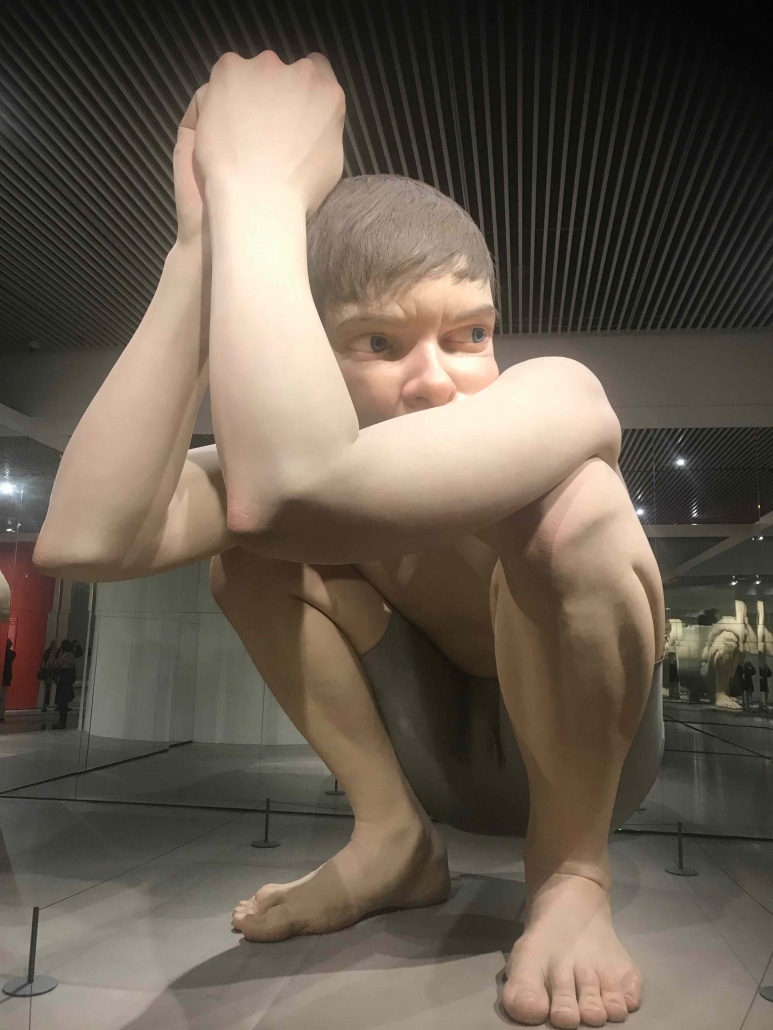
The rest of the world class collection, with the likes of Andy Warhol and Grayson Perry,  is equally rewarding and well set out. If time is short head for Ron Mueck’s five-metre-tall sculpture of a crouching boy, first exhibited at our own Millennium Dome in 2000. Oh, and you can play table tennis among the installations in the basement.

Afterwards we wandered up the hill to the city’s free-to-enter Botanical Gardens with butterfly-thronged tropical houses. From here there are further thrilling views across Aarhus.

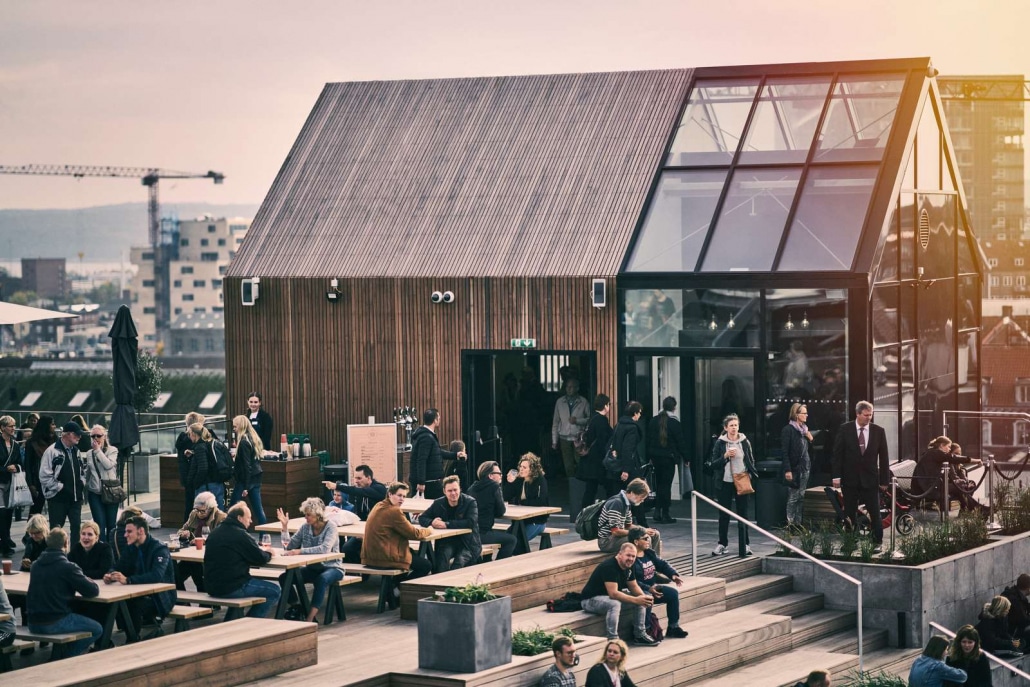
Panoramic viewpoints in the city proper include the rooftop terrace and skywalk at the city’s premier department store, Saaling on the Söndergarde. Just take the lift and stairs to the top floor and enjoy reasonably priced wines and cocktails while taking in the whole dock area, redeveloped or working.

Access is less frequent to the spired tower of the Domkirke, but it boasts another splendid view. The vast red brick expanse of this Cathedral dominates the main square, Store Torv. Originally built in Romanesque style in 1201, three centuries later it was given a Gothic makeover at which time it gained its magnificent Bernt Notke altarpiece, the font and frescoes. It’s dedicated to the patron saint of sailors, St Clemens appropriately enough with the waterfront just yards away. 

Our base, the budget hotel, Cabinn, was nearby, handy for the Latin Quarter. The oldest part of the city offers a maze of streets and concealed courtyards to explore, half-timbered, flower-bedecked. It’s laidback by day and fun after dusk when the bars and cafes are rammed.

Designer shopping seems to be centred around the picturesque Graven, where you can also get your Nordic coffee fix at La Cabra, but our favourite thoroughfare was the Mejlgade, home to our Aarhus ‘local’, Mig og Ølsnedkeren, a craft beer mecca.

The Latin Quarter hosts a couple of hip but eye-wateringly expensive Michelin-starred  restaurants, Gastromé and Domestic. We dined handsomely at a more casual New Nordic spot, Langhoff og Juul in Guldsmedgade.

Even more on-trend was Pondus, a bistro spawned by Substans, arguably the city’s best Michelin joint and relocating to the resurgent waterside. Pondus’s set menu was deceptively simple and classy compared with rival establishments along the dining-focused Aarhus Canal.

We visited two food halls too – Aarhus Central Food Market (tip: go for the award-winning Hungry Dane Burgers) and, much jollier, Aarhus Street Food, a more recent arrival, inevitably based in recycled shipping containers. Our visit to the latter coincided with the city’s annual Royal Run, offering a range of sweaty challenges up to 10K. Participants thronged the 30 or stalls in the hall just behind the bus station on Ny Banegaardsgade.

We fought shy of ordering one unique local delicacy, curry dumplings, from ‘Grandma’s House’, settling instead for banh-mi and bao buns, washed down with local micro brews from the Ølfred bar.

To sample a retail produce market with fish, cheese and organic veg head down to Ingerslevs Boulevard in trendy Frederiksbjerg, south of the station. The open air market  is open Wednesday and Saturday 8am-2pm. On the way back where better than a hoppy refresher on trendy Jægergårdsgade at the Mikkeler Bar – an outpost of the globally famous Copenhagen gypsy brewers.

Elsewhere there is so much quirkiness to celebrate. We loved the Dome of Visions on the waterftront Inge Lehmanns Gade. It arrived from Copenhagen seven years ago as a sustainable timber round house, comprised of 588 curved beams with 186 different shapes. Inside it’s a lush greenhouse, hosting a cafe which looks across the harbour at the still working shipping docks. Next door among gardens is a mushroom farm based on spent coffee grounds.

You suspect this whole waterfront site will eventually be developed commercially, bridging the gap between Aaarhus Ø and Dokk1, a monumental events space/library that opened in 2015. It too has its own special Danish eccentricities. Its artwork centrepiece is a 3 ton bronze pipe bell, The Gong, which new parents can ring remotely from the University Hospital maternity ward when a child is born, while the ceiling of the underground car park features a large art installation known as Magic Mushrooms, a downscaled model of an imaginary city turned upside down. Cap that, capital Copenhagen.

A day trip out to the ‘Killing Fields’

All eye-catching but our day had been dominated by an out-of-town homage not on everyone’s bucket list… back into prehistory. Just a bus ride away 30 minutes south, inside another remarkable (Seventies) building, grass roofed and hunkered into the landscape – the Moesgaard Museum.

Awaiting us there ‘Grauballe Man’. Dug from the Jutland bogs in 1952, the body eerily preserved by peat since the third century BC, the throat slashed, suggesting he might have been a human sacrifice. 

The photographs burn into your mind; to see this leathery-tanned Iron Age icon in the flesh, so to speak, is among the most moving experiences on the planet. And blessedly for a while we had the room where he is exhibited to ourselves to mouth the opening lines of Seamus Heaney’s great poem: ‘As if he had been poured in tar, he lies on a pillow of turf and seems to weep the black river of himself.”

The rest of the Moesgaard is a thrilling, interactive journey into Danish, Scandinavian and European history and culture, Stone Age, Bronze Age, Iron Age and onwards – a treasure house of artefacts but also pandering to the inner kid with some thundering, plundering Viking recreations.

Fact file

Neil Sowerby flew to Aarhus with SAS Scandinavian Airlines, which runs a regular service most of the year from Manchester Airport. For full tourist information visit www.visitaarhus.com and www.visitdenmark.com. An AarhusCard gives unlimited travel, plus free or discounted entry to many of the city’s headline attractions, and costs Dkr 329 (£40) for 24 hours to Dkr 749 (£90) for 120 hours. Cards can be purchased at the bus station and most attractions. The main tourist centre can be found at Dokk1, where you can use free online touch screens for information and ideas.

When revolutionaries ambushed and assassinated the Baron of Pädaste, Imperial Hunting Master to Tsar Nicholas II, in 1919 it froze in time the manor house that was his summer home. History, often bloody history, now passed it by.

Axel von Buxhoeveden’s heartbroken widow, the Siemens heiress Charlotte, left to live in Germany, never to return, and as a turbulent century saw Estonia crushed by war and Soviet domination, medieval Pädaste Manor sank slowly into decay. Destined, it seemed, to be submerged in the marshes of Muhu island. Trees took root in its lofty halls.

But like the sleeping beauty in the fairytale it has been magically reawakened as a hotel, mirroring the Baltic state itself shaking off the years of repression, rediscovering its roots.

If the beautiful heart of capital Tallinn has turned into a kind of tourist toytown, seducing the cruise ship parties (the stag and hen hordes have thankfully moved on), then Muhu and the other islands out to the west seem the keepers of Estonia’s rebellious pagan flame against a backdrop of the brooding Baltic Sea.

We arrived to stay at Pädaste Manor, now a five-star luxury hideaway like no other, a couple of weeks before the great celebration of the White Nights, 19 hours of daylight demanding much tree-hugging and vodka swilling. It hits you that Christianity was late coming to these northerly parts.

Wild boar and moose roam the woods of Muhu, along with the huntsmen who track them. Rare butterflies flit among the juniper trees, even rarer orchids carpet the woodland clearings. Half of Estonia is forest, a valuable source of mushrooms and herbs. A wild larder just waiting to be foraged. A landscape with much to tell.

One man who has listened is Martin Breuer. A quarter of a century ago the erudite Dutchman had a vision for Pädaste. It has taken a lot of sweat and toil to realise it, along with a welcome cash injection from the European Union.

The result is captivating. We arrived late. A journey from capital Tallinn that had promised to take little over two hours on blissfully quiet roads had been extended by our foolishly not taking the pre-booked lane on the Virtsu quayside.

We missed the boat and looked like missing lunch, but Kuivastu where the next ferry dropped us is just 10 minutes from Pädaste and the Manor kitchen stayed open to accommodate us. Our first taste of the Manor’s take on ‘Nordic Islands’ cuisine. 

Nordic Islands’ cuisine – venison tartare with Muhu Island’s ‘bottarga’ (cured fish roe)

Think good game and fish, wild greens, birch sap, all palate-tinglingly pure. The hotel’s ground floor Alexander Restaurant has regularly been voted Estonia’s best and goes from strength to strength under current Chef de Cuisine Diogo Caetano. This elegant room with high ceilings opens into a spectacular winter garden and offers sweeping views over the park with its ancient trees.

More casual but also impressive was the simpler fare at the Pädaste Yacht Club on the  Sea House Terrace down by the marshes. A good start. So too, our suite, which sported a terrific bathroom, with a free-standing tub, and a balcony overlooking woodland.

No two rooms are the same at Pädaste, either in the art-filled Manor House itself or in the Carriage House in the grounds – a consequence of the quirky, organic feel to the place Martin has been determined to maintain. Even the sauna, in a separate cottage brings a smiling, homely feel to state of the art facilities.

The position helps, convenient yet remote feeling. We soon ventured beyond the gate and into a piece of unspoiled Muhu. Despite, or perhaps because of the unseasonal heat, mist cloaked the distant creek. After lunch and a beer we took our books out to the loungers on a little jetty and drifted off to the sound of birdsong and bee hum. 

If shacking up in a lost domain is your thing, then there’s no need to venture out. We took the hire car for a morning’s spin around Muhu, which is really just a staging post en route for Estonia’s largest island, Saaremaa.

Our favourite spot was Koguva fishing village, a lovingly preserved gaggle of farmhouses. There’s a museum of island life with staff in traditional costume and an art gallery but really it’s just an idyllic maze of lanes to wander around. It helps that it’s mostly inhabited by locals whose families have been here for generations.

This feels like the true Estonia, rather than Tallinn Old Town. Strikingly beautiful, yes, but just a mite plastic. Pädaste’s park and shoreline form part of a nature protection zone which is well known for its biodiversity. The shoreline is a stopover location for migratory geese, cranes, ducks and swans. Three breeding couples of the rare and majestic sea eagle nest nearby, the nightingale takes centre stage in the evenings of early June. 

The park is home to owls, woodpeckers, squirrels and bats. Deer, wild boar and moose inhabit the surrounding forest. They occasionally can be seen crossing into the park, specially during cold winters.

Alas, the hotel is closed during the winter months, shuttered against the ice. Ready to reawaken when the abundant spring flowers are again in bloom and the lucky visitors return. Nowhere I know is quite like it.

Fact file

Pädaste Manor – a Small Luxury Resort & Spa, Pädaste Mõis, Muhu Island, 94716 Estonia. +372 45 48 800. A member of Relais & Chateaux. Doubles from 280 euros (Carriage House) and 387 euros (Manor House). Junior suite from 459 euros, including breakfast with the Grand Suite at 965 euros. The hotel can arrange a private limousine transfer for the two hour journey from Tallinn or you can book car hire via the hotel website to get a discounted rate and complimentary upgrade depending on availability. Finnair has regular flights from Manchester to Helsink with connections to Tallinn. 

To celebrate the hotel’s 25th birthday this profile of Pädaste is extracted from a travel piece of mine on Estonia, first published in Manchester Confidential.

©2021-23 Copyright Neil Sowerby unless otherwise indicated. All right reserved.