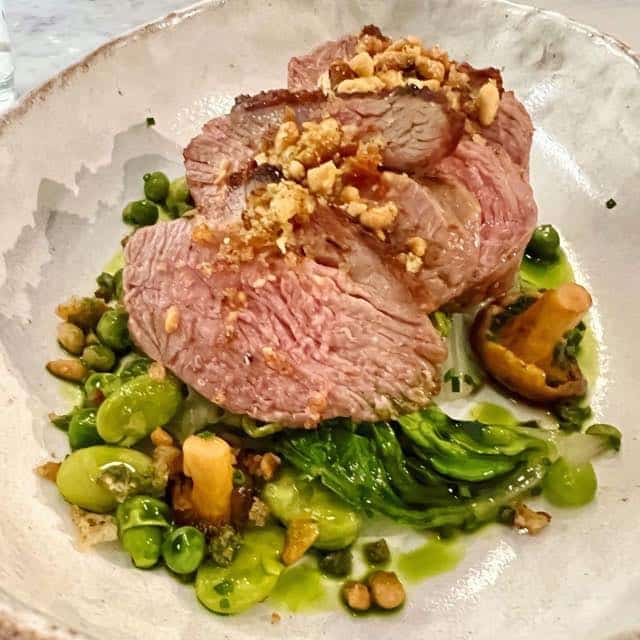
The above is wagyu steak on sourdough toast. Charred thick slices, smeared with mustard mayo, scattered with radish discs, IPA pickled gherkins and those tiny capers that explode on your tongue. The wagyu? Marinated in (making a welcome return to the limelight) coal oil. I was expecting an ashtray element from the coal oil marinade, but, no, the flavour was all subtle mesquite. It’s a kind of delicious homage to Simon Rogan’s signature dish at The French a decade ago. The one that has Times critic Giles Coren swooning: “I tell you what, I would walk to Manchester barefoot in the rain for one more mouthful of the chopped raw ribeye of ox in coal oil.”

Did the wagyu on toast  make up for the absence of Squid Bolognese on my return to Fold in Marple Bridge near Stockport? Most definitely. That ‘deconstruction’ was touted as their signature dish back at their March launch, but it has obviously not stood the test of time as the menu has evolved. Maybe it had vague roots in the great Pierre Koffmann’s fishy riff on spag bol, but here ribbons of squid mimicking pasta in a rich ragu with garlic bread didn’t quite hit the mark. Still there’s langoustine scampi fries (in a scampi fry crumb) with lobster aioli and chip shop croquettes to champion Fold’s playful nostalgic takes on  snacks and classic dishes.

All this and my vote wasn’t enough to leapfrog this smart addition to Marple Bridge into the Good Food Guide’s 100 Best Local Restaurants 2023 list.In that particular bunfight a place called Tallow in Kent was national number one. And I’ve no quibble with Manchester’s rather lovely The Spärrows scooping the top North West award with Fold just missing the 100 Best cut. Still I did feel that various city centre establishments that squeezed it out didn’t qualify as ‘local’.

Sean Finnegan’s self-styled Bistro and Bottle Shop on Town Street certainly does. It attracts the morning coffee crowd as much as the wine aficionado seeking a leftfield bottle.

Certainly you can snack on a roster of small plates or make a special evening occasion of it. Just five minutes (steep) walk to Marple Station and it’s a rapid 20 minutes to Piccadilly. Though if you make the trek, as I did for this second time, you’ll find yourself jostling with a seriously local clientele. That’s my definition of neighbourhood. Fold’s exec chef Ryan Stafford actually hails from Marple, but the culinary palette he works from is the opposite of parochial. This former Masterchef finalist is often back in London for his lucrative day job as a private chef (for world leaders, rock stars and folk with expansive yachts). That means that head chef Craig Sherrington (Great British Menu) has the dominant say in the upcoming autumn menu. 

I hope he keeps those croquettes, in particular. On the outside they could be any old fried object on a corporate menu. Bite into them and they are a delicate thing of wonder, a chippie madeleine (sic) moment when shards of monkfish, a Champagne chip shop curry sauce, smashed peas and malt vinegar dust cohere. 

There are so many joys among the cold plates and snacks, but don’t ignore the hot plates. Maybe £21 for Exmoor caviar on baked jersey royals with mashed potatoes brings a touch of Paris’s Kaspia Caviar to Marple Bridge but I’d recommend instead a generous helping of salt marsh lamb with a classic summer accompaniment of peas, beans, gem lettuce and tarragon (£22) or ‘China Town’, a sensational salt n’ pepper sea bass dish (£24).

All this and a terrific drinks selection from craft beer to natural wine and beyond. That wagyu on toast found its perfect match in Thistledown She’s Electric, an organic old bush vine Grenache from South Australia’s McLaren Vale. A Fold plus that sets it apart from many other casual small plate rivals is that bottle shop wine list.

For the record, this is my Best Local Restaurant (even though it’s trek away from my locality).

Fold Bistro and Bottle Shop, 14-16 Town St, Marple Bridge, Stockport SK6 5AA.

A head for heights? Most certainly as long as I‘ve a cocktail in my hand or, better still, a series of small plates arriving against a panoramic backdrop. To satisfy my needs, every high rise development these days seems to come with a rooftop bar or restaurant. At the Manchester version of Soho House, due later this year, they are even throwing in a swimming pool eight storeys up below its bar and I note that the ubiquitous Gino D’Acampo has been getting in on the act over in Liverpool, opening an eponymous Sky Bar Terrace at the top of the INNSiDE by Meliá hotel.

It may be that city’s highest alfresco restaurant and bar, but at 270 ft it’s a mere molehill compared with the tallest viewpoint I’ve visited – Chicago’s Willis Tower, the Western Hemisphere’s third highest building at 1,730ft. One caveat, its Sky Deck with jutting-out glass Ledge is the same height (1,450ft) as the top of that old stager, New York’s Empire State.

Both dwarf our own Shard in London, which stands at a mere 1,020ft. One advantage is that the 72nd floor viewing gallery is partially open air, offering views of the pinnacle, as well as 360-degree views around the building. I’m still gob struck by how tiny Tower Bridge looked from 800ft above.

All of which brings us to Manchester’s 20 Stories, whose major selling point is its huge outdoor terrace and bar (with appropriate shelters for when the city’s weather lives up to its reputation). At 300ft, it’s a glamorous, stunning spot to take in the ever-changing skyline and cityscape (see main image). You can understand its appeal as a special place for a drink and a people watch. The wine list is arguably the best in town, but food quality has been variable with a constant change of head chefs since its inception in 2018. 

I dined there recently, road-testing their new five-course tasting menu, available Monday to Thursday, 5.30pm-8.pm. It started well with a vegan opener of broccoli steak with horseradish and lemon, but after that it didn’t live up to its £65 a head price. A better bet is to pick from the more casual Terrace Menu, perhaps mixing and matching tomato, basil and parmesan arancini, truffle fries and BBQ flat iron steak tacos with a tipple or two from their Aperol Cocktail Menu.

Black Friar, Salford – keeping it down to earth

Casual and al fresco is a good way to go in this sweltering summer and the maturing  ground-level garden of the re-born Black Friar is a choice spot, even if there is no view to speak of. Well, who would want to ogle the traffic hurtling down Trinity Way? By chance, it has chef connections with 20 Stories. Aiden Byrne, launch chef there, was scheduled to do the same for the Black Friar but pulled out around Pandemic time; his replacement Ben Chaplin came from… you guessed it. 

His 20 Stories fine dining pedigree was obvious when I first sat down to eat in the newly planted garden with its big fence two summers ago. A couple of dishes were over-elaborate for what was aimed as a gastropub. The menu has since settled down  from trying to balance all this with ‘pub classics’, maintaining high quality ingredients while  taking fewer risks.

It is good they are still making the most of their urban greenery, though when we went recently to sample their summer ‘Garden Menu’ gusty showers weren’t doing it any favours.This particular menu is served straight from the outdoor bars, so we benefited from its canopy and ski heaters. And a couple of goblets of holy Gavi to heal the soul. There’s a choice of three amply topped flatbreads, including an artichoke version for vegans, who can also dive into a Falafel Friar Bowl. Alongside the charcuterie and cheese platters sat our big extra temptation, definitely not plant-based: Honey-glazed Ham Hock with Welsh rarebit and pickled onions. The Black Friar is very generous with its pickles and, alas with a mountain of coleslaw that accompanied the hock. As a £17 sharing plate this was a meal in itself. We took the half-stripped bone home with us. Combined with yellow split peas and stock, it formed an un-seasonally  ballasting soup that lasted us all next day. As blazing sunshine reappeared.

Queen Bee with a red dot, signature vol au vents – it must be Climat

The other end of Blackftriars Street and Chris Laidler is showing off his stings on the rooftop terrace of Climat, now home to four hives and 40,000 bees, including a Queen, marked with a red dot. The wine-led restaurant’s founder and his exec chef Luke Richardson also brought back from Hampshire a further 50,000 bees that are now ensconced at their respective homes in Wrexham and Chester – all contributing honey to Climat and sister restaurant Covino in Chester, a place I also really love.

Chris tells me they expect the total of 90,000 bees will swell to 500,000 over the summer before reducing in size to weather the winter months. He’s resigned to the occupational hazards of bee-keeping – despite wearing the full gear to handle them. He’s more worried that there’ll be enough opportunities for his charges to pollinate in Manchester city centre, even though it’s leafier than you think.

And there is competition. Chris points across the road to the roof of the car park behind the brutalist former Ramada Renaissance, slowly being transformed into the Treehouse Hotel. Here Manchester Cathedral have installed a total of 10 hives in addition to the six already on the cathedral’s roof producing ‘Heavenly Honey’.

It’s amazing what your eye takes in from a great height. On the eighth floor of Blackfriars House, Climat actually benefits from not being up in the stratosphere. I prefer the more intimate nosiness of being level or slightly above rival rooftops, so you don’t miss intricate features. Seen from the outside terrace (well away from the swarms) or through floor-to -ceiling plate glass. Perhaps with a 500cl carafe of Bourgogne Aligoté at your elbow – ‘is that honey on the nose?’ – and a signature vol au vent while awaiting a small plates parade of what Luke dubs his ‘Parisian expat food’.

I called it my winter wonderland windfall. The Christmas before last I won the Christmas draw at Tipples of Manchester. Delivered to my door, before Santa had even harnessed up the reindeer, £1,000 worth of mixed spirits, genuinely artisan stuff. The gin quota has long since gone, servicing my Negroni habit, ditto the Donegal vodka to create my Bloody Mary of choice, while the bourbons/whiskies assiteded greatly in my quest for the perfect Old-Fashioned. Bizarrely the handful of bottles that remain in the cellar are primarily of rum, which I like to sip neat, the darker the better, but only when the weather is braw.

Still I have been a touch neglectful. It’s not as if I haven’t been a champion of rum in my writing. Take this article from five years ago  – Getting the Abbey rum habit in the heart of old Barbados. . Or from my last overseas trip before lockdown – Spice up your life with a rum ramble around  St Lucia (2020). The previous year I’d even dared to question the hegemony of gin in the company of rum’s great and good – Dark Spirits. Rum Rocks, but could it take over from gin? Who could doubt the wisdom of one of those gurus I quizzed, Ian ‘Rum’ Burrell, of Channel 4 Sunday Bruch fame: “My three favourite rums are the one in my glass, the next one, and a free one”?

On Saturday, July 8. World Rum Day, comes the chance to live that dream (on repeat!) as Manchester Rum Festival returns to the Mercure hotel, Piccadilly. The 2023 version looks packed with delights. Check out the exhibitors here. It’s not just about access to some truly rare tipples. Also part of the package are Caribbean Street Food from Nyammin’ and calypso-inspired DJ sets. With some hats and shirts that awesomely get into the spirit of it all. Tickets are great value at £25 plus booking fee for seven hours of spirited exploration (12pm-7pm). Buy them here.

A big bonus is the chance for fest revellers to purchase a one-off, limited-edition bottle of the official Festival rum, which is a collaboration with Outlier Distilling Company of the Isle of Man. Named ‘Punk Croc’, this 41% limited edition blend is a Manx rum with a cask-aged bite. Blended exclusively from rum made in Outlier’s 160L wood-fired still, Punk Croc features rum aged in Sauternes, New American Oak and Islay casks. Perfect for Mojitos and Daiquiris with attitude, the bottling will only be available at the festival.

Additionally, Distillers Direct will be joining the summer festival with a very special limited edition single cask of Chairman’s Reserve Rum, which has been produced in partnership with The Drinks Trust. Festival founder Dave ‘Drinks Enthusiast’ Marsland is brand ambassador for St Lucia Rum, whose flagship product is Chairman’s Reserve.

 The UK’s largest rum distillery, DropWorks, which is based on the Welbeck Estate in Nottinghamshire, will be making their very first rum festival appearance after launching at the latter end of May! They bring in the finest molasses, ferment it with their own cultivated trinity yeast strain, distil it in their bespoke stills, then blend and mature it in their own barrels across their three unique ageing locations.

Also debuting at the festival are Rhum JM, an historic rum from Martinique in the Caribbean with a super sustainable background focusing on biodiversity and the preservation of nature, and Takamaka, the first ever rum from the Seychelles to join the Manchester line-up. Two rums from Madeira  – 970 and Tristão Vaz Teixeira – will become the first brands ever to exhibit from the Portuguese Island. Manchester debuts too  for Ron Piet from Panama, Tilambic from Mauritius, Eminente from Cuba and Paranubes from the mountainous Oaxaca region in Mexico and Bone Idyll – a rum distillery based in less exotic Kingston upon Thames.

A Proustian madeleine moment? With hops? Not quite. The lager in the iconic Budweiser Budvar tankard glass flaunted all the right credentials, including the distinctive huge frothy head, bringing back glorious travel memories. Yet the taste was subtly different from what you’d expect of the classic Czech beer. 

Adam Brož, the brewmaster of that state-run enterprise was at my elbow to explain their unique link-up with Derbyshire’s finest, Thornbridge. Our native Golding hops and Maris Otter malt give Czech Mates (a bit of an ouch name, but hey) its own tang, benefiting from the legendary Budvar yeast. Cheers – or, as they say in South Bohemia ‘Na zdraví’!

Budvar’s first ever collab outside its home country is not meant to replicate the original. At 4.8 per cent it is weaker and the maturation period is shorter, though considerably longer than most lagers including even Czech rival Pilsener Urquell. And don’t even mention the dreaded American Budweiser, which perennially bombards Budvar with legal challenges over the brand.

I am at a Czech Mates launch night in a Thornbridge tied house in Leeds, The Bankers Cat, and Budvar global ambassador Ridem is generously plying us with samples of Thornbridge’s crisp, well balanced labour of love. Like Adam, he is delighted that I have visited their iconic brewery in České Budějovice. I tell them how it was the final destination of an eye-opening pilgrimage to the Czech Republic (or Czechia as it now styles itself). That was in 2016. My previous visit to their country had been in 1976, just eight years after the Prague Spring and the Soviet crushing of Czech dreams of freedom. How different it all felt…

A land of fairy tales and golden lager

Advent Sunday in Český Krumlov (main picture) and the bells are ringing. The first sighting of blue sky in this most misty of autumns in South Bohemia has lured me out into the old town before breakfast. Winding alleys that had breathed mystery after dark are equally entrancing by day. Who needs Prague when you can have a place like this to yourself?

Except around the corner comes a selfie-driven Japanese coach pack. UNESCO World Heritage status means off the beaten track just doesn’t happen these days. Still this historic city, set in a horseshoe bend of the River Vltava (Moldau) and lorded over by an immense 13th century castle, wears its tourist honeypot trappings lightly. 

We are 170km south of the Czech capital, not far from the Austrian border. This has been territory fought over for centuries. When Germans ruled the roost it was called  Krummau an der Moldau just as the region’s main centre, České Budějovice, was Budweis (hence the brewery name, more of which anon). 

After the collapse of the Soviet empire and the splitting of Czechoslovakia into the Czech Republic and Slovakia Český Krumlov arose from decades of decay like some Sleeping Beauty. Which seems quite apt in a land entwined in folklore and fairytale.

Especially around Christmas when it all takes off. Well, Flying Baby Jesus does. When the Velvet Revolution kicked out Communism there was a rush to introduce Czechs to that burly guy in red with the white beard. They were having none of it. Their festive bringer of gifts is Ježíšek, variously depicted as a baby, toddler, and young lad (see the image below from a church we visited). 

On Christmas Eve families deck the tree and share a traditional Czech dinner of carp and potato salad, then the children are sent to scan the skies for Ježíšek. When a bell rings they rush back to find their presents have arrived.

Snacking on the Christmas Markets

The Czechs have the highest beer consumption in the world – 129 litres a head. Their food, from pretzels to goulasch via dumplings, sauerkraut, grilled meats and sausages, seems custom-built to match the foaming brews.

We were there at Christmas Markets time, more home-made affairs than the ersatz ones inflicted on the UK every November and December. In both Český Krumlov and České Budějovice I sampled these Czech snacks for the first time:

Trdelnik: a hybrid of cake and sweet pastry made from rolled dough that is wrapped around a stick, then grilled and topped with a sugar and spice mix.

Sazanka: a thin omelette on rye with gherkins and browned spring onions.

Kapri Hranolky: carp fries, the fish chunks spiced with cumin and ginger then floured and deep-fried. Delicious with a noggin of mulled mead, but I opted for a bottle of Krumlov’s own local beer, Eggenberg. 

Green man riding a catfish and other tall tales

My best present was discovering the unanticipated wonders of Český Krumlov. After being captivated by the view from the Castle of its close clustered rooftops encircled by the river came the defining focus of the stay: the Fairytale House – Puppet Museum. Here you could learn about contemporary puppeteering, even try your hand, but it is the marionette mausoleum aspect – some tableaux dating back to the 18th century – that captivated. Czech childhoods seem populated by sprites, witches and demons. None more creepy than the water spirit ”vodník”. This green man riding a catfish drowns unwary folk and captures their souls in a jar. 

Equally spooky is the White Lady who haunts the Castle and makes appearances in the nearby Hotel Růže. If the spirit is smiling, good news will follow; if she looks serious, and wears or carries black gloves, the news will be bad. Legend has it she threw herself off a cliff when her father refused to allow her to marry the man she loved.

Another Krumlov story, much more horrific, featured deranged Don Julius, bastard son of the Hapsburg Emperor Rudolf II. When he took up residence in the Castle in 1607 he was joined by the local barber’s daughter, Markéta Pichlerová, with her family’s permission. 

Tiring of her, he beat her up and threw her from a turret window – she escaped death only because a rubbish heap broke her fall. After she recovered from terrible injuries, the tyrant demanded her back – and then cut her into tiny pieces. In subsequent captivity in the Castle he degenerated into a human wreck and was probably murdered on the Emperor’s orders.

Near the knuckle – St Reparatus and Egon Schiele

A dark past but visiting the Castle nowadays is a jolly experience. The exuberant Baroque theatre is only open for occasional concerts and the two resident bears penned below the battlements are coy about showing themselves, but the 29 room Museum in the colourful tower is equally colourful and eccentric. Don’t miss the reliquary of St Reparatus, his bones gaudily embellished by nuns.

Just as near the knuckle is some of the raw, explicit imagery inside the Egon Schiele Art Centrum. The Austrian painter died in the Spanish flu epidemic, at just 28, in 1918, the same year as his inspirational mentor, Gustav Klimt. This gallery in a former brewery exists because Schiele’s mother came from the town and he spent time here, enraptured by the Bohemian forests, before being driven out because of his bohemian (as in unorthodox) lifestyle. This is charted in exemplary fashion alongside changing exhibitions of current artists.

The Museum Fotoatelier Seidel is an altogether sedater affair. This house/studio of early 20th century photographic pioneer Josef Seidel is a time warp with its abundance of original cameras and props. He was a chronicler of a pre-war, pre-Soviet age and the images are fascinating. 

All these attractions are within close walking distance. The best passport to seeing them is the Český Krumlov Card, covering five museums and the Krumlov monastery complex. For a single adult it costs £15

Czech craft beers and a castle crammed with antlers

Visiting castles is bound to work up an appetite… and a thirst. Hluboká nad Vlatou, 10km north of České Budějovice, is home to a very stately pile. The 13th century Hluboká Castle was transformed into its current Neo-Gothic Windsor look in the 19th century by the Schwarzenberg family. They had downsized from Český Krumlov Castle to this 11 tower, 140 room, glorified ‘hunting lodge’. In the hall the Schwarzenbergs pose en masse in a family photograph of the time, the menfolk itching to get away and blast the life out of all the stags they can bag. You can’t move for trophy antlers and gun racks throughout the public rooms, only the odd manic boar’s head breaking the plush monotony. 

There are various tours on offer, after which you will probably be ready for a  substantial repast at the village’s characterful restaurant, Solidní Šance. Specilaity is potato pancakes stuffed with cabbage and pork. The house strudel is benchmark stuff, too. To accompany there’s a range of unfiltered and unpasteurized ‘Czech-style craft beers’ brewed in-house at the Pivovar Hluboká, using Budvar yeast, Czech or Bavarian malts and Žatec hops. Go for their Žatec semi-early red, if available.

Some 20km to the west of České Budějovice is another UNESCO heritage gem, the model village of Holašovice. Ranked around a village green are several dozen houses refashioned in the 19th century in the ‘Folk Baroque’ style aping noble mansions. Think lacy, colourful gables.

I’m told the number of houses has remained constant throughout Holašovice’s  800 years of existence and most are still lived in by villagers. Two taverns, a chapel and a blacksmith are here to serve them, and No.6 of the 17 farms in the village offers a fascinating collection of bygone rural tackle. Thought-provoking indeed our lugubrious guide’s demo (without animal) of how to castrate a sheep.

Our journey’s end – the refreshing city of České Budějovice

But then the whole trip was full of quirky revelations. The main purpose of our visit to České Budějovice 25km north of Český Krumlov was to visit the brewery but on a guided tour around the town every building seemed to boast an odd back story. Climb the 250 steps to the top of the Italianate Gothic-Renaissance Black Tower (1577) and you are rewarded with a spectacular view over Budějovice’s vast main square and the Blanský Forest in the distance. The abiding memory, though, is of the goat who once shared the tower apartment with the guardian.

Walk over to Piarist Square. On one side is the steeply gabled Salt Warehouse, once an armoury, today a motorcycle museum. Inset randomly in the facade are three reliefs of stone faces, believed to represent a trio of thieves beheaded.  On the other side, high on the exterior of the Church of the Sacrifice of Our Lady, a frog-like gargoyle bulges just below the roof. It recreates a frog crawled into the foundations of the Dominican church during construction and kept causing the church walls to crumble; in the end, it was ejected from the foundations. It is said that its sculpture used to be placed lower, but the stone frog has been crawling upwards step by step until it reaches the roof and then the church will collapse and it will be the end of the world.

An equivalent doom will arrive when the vast underground lake that supplies the perfect, pure soft water for making Budvar beer runs out. It’s not going to happen any time soon but it’s a nagging long-term quandary for the state-owned brewery that upholds the country’s beer traditions, lagering (slow conditioning) its top-fermented, burnished gold beer for 90 days in comparison with just 25 for arch-rival corporate-owned Pilsener Urquell in the northern town of Plzeň, where the classic beer style was created.

Budvar are meticulous, too, in sourcing locally only pale Moravian malt and Saaz whole hops (not the pellets used by most brewers, even the of the artisan craft persuasion). It was a glorious sight watching hops being loaded into one of the gleaming copper vessels.

So does Budvar Budweiser taste better at hallowed source?

At the end of our Budvar Visitor Centre Tour we tasted the end product in the cellar. Patiently conditioned and unpasteurised, lacily frothy fresh from the tanks, it lived up to Garrett Oliver’s tasting note in his magisterial Oxford Companion to Beer: “Refreshing, showing a rich malt and vanilla aroma, and fine, floral hop character. The finish has a fine balance of juicy malt, tangy hop resins, and a delicate hint of apple fruit.” Quite.

Oliver touches at length on the decades-long legal wrangling over naming rights with the US brewing giants Anheuser-Busch, who produce their own (vastly inferior) ‘Budweiser’ and Bud Lite. At the height of the squabble Budvar was saved from a takeover by them after the intervention of then president Vaclac Havel and today worldwide sales are soaring. In the fairy tale land of Bohemia they like happy endings.

Budějovický Budvar Brewery, n. p.K. Světlé 512/4 370 04 České Budějovice. To plan your (highly recommended) Brewery Tour visit here. End your tour with a meal at Budvar’s own restaurant 100 metres away on the corner of Pražská and K. Světlé streets. The rich, dry Budvar dark lager is a consummate match for the house speciality, goulasch. For full tourism information about Czechia visit this link. Jet2.com fly regularly from Manchester to Prague. České Budějovice is two hours south of the Czech capital with Český Krumlov a further half hour away.

My memories of Indy Man Beer Con 2022 remain vivid, culminating in a desperate tumble down uneven Edwardian stone steps as I scrambled to use up my remaining drinks tokens at the end of the Saturday afternoon session. Miraculously, like some charmed mountain goat, I arose unscathed. Most of my tokens had been spent at the 3 Fonteinen stand, supping their sublime Belgian qeuzes. I hope this year’s emphasis on sustainability at the UK’s best craft beer festival doesn’t preclude such overseas legends.

This year’s IMBC, returning to Manchester’s Victoria Baths for its 10th year, is all about discoveries. Last year’s joyful event introduced me to the ‘honeyed epiphany’ of wasp yeast. Thanks Wild Beer Co (a sign of the difficult times for the industry it has since collapsed into administration).

There’s already a sweet smell of success about Indy Man 2023 (October 5-8). Tickets, frozen at 2022 prices, went on sale on Thursday, May 18 and already both Saturday sessions are sold out with tickets ‘running low’ for both Thursday and Friday evening sessions. There is greater availability for the Friday afternoon and Sunday afternoons, where tickets cost £14.50, as opposed to £19. For true devotees there are also Full Fat tikcets for all sessions at £75. To snap up your slot before it’s too late (plus advance deals on token bundles) visit this link. Breweries involved will be named nearer the time. International participants will have to guarantee their beers are transported to the festival in a way that uses the most carbon efficient modes of freight.

Tokens will function in the same way as they did in 2022: namely, that it’ll be one token for one third of a beer across all three days. Organisers will also be reinstating the ability to sell back unused tokens to the festival at the end of each session. Which could save this over-keen punter from ale-addled dismemberment!

Sup up! Communal beer fun before Indy Man

Real ale diehards will, of course, home in on London’s Olympia for the Great British Beer Festival (August 1-5). Personally, I find supping on this kind of scale overwhelming. More manageable is a local CAMRA event such as the 35th Stockport Beer Festival (June 22-24) at its new venue, the Masonic Guildhall. One of the best trad gatherings, it promises over 250 beers ciders and perries. 

Still, I don’t expect I’ll make it there either, but I have purchased advance tickets for two delightful festivals at once under the radar breweries, respectively in Lancashire and Derbyshire, that book-end big brother Greater Manchester.

Rivington Brewing Co Farm Trip (August 31-September 3)

I’ve voiced my admiration before for this farm-based craft brewery with its scenic hilltop beer garden. Across one special long weekend they fill it to the brim to showcase their favourite beer peers. This year they welcome over  60 breweries from across the globe, pouring across 50+ lines, natural wines, gin and cocktail bars, local street food vendors and live music. Book here. There is availability (£12.50) on the opening Thursday and the Sunday (Family Day) and a few tickets for the Friday, but Saturday is sold out. Also a limited amount of caravan/campervan packages remain.

Torrside Smokefest (September 16-17)

Franconia is the German home of Rauchbier. Hence this single-minded New Mills brewery have named one of their beers after it, brewed with 85 per cent smoked malt. Each year across two eight hour sessions they replicate the Bamberg heartland of this style. You have to book in advance an there are £15 tickets left for the Sunday. Book here. For your £15 you get a memorial glass and your first distinctly smoky third, then access to over 20 similar tipples plus smoked toppings on your pizza.

Summer Beer Thing (June 30-July 2)

Meanwhile, there’s always Indy Man’s little brother, which used to be based in Sadler’s Yard before Cloudwater Brewing picked up the Pilcrow and turned it into Sadler’s Cat. Now  Kampus’s canalside garden will be host its eclectic range of craft beers from across the UK. A big plus in this buzzing urban neighbourhood are ballast options from the likes of The Great North Pie Co, Nell’s Pizza, Madre and Pollen Bakery. Tickets for the three weekend sessions range from £6 to £10 (including branded glass). Buy them here.

Poretti, Moretti, Peroni? As if they were concocted on a Scrabble board (big score for Mezzogiorno, but I digress), all those big Italian beer brand names sort of morph into one generic light lager. That’s what they taste like to me. Still, on a (let’s pray) sunny August Bank Holiday Weekend in Manchester’s Cathedral Gardens they hit the spot to accompany pizza slices, arancini, even gelato. Yes, Festa Italiana (August 25-27) is back for its sixth outing. With, you guessed it, sponsors Poretti offering a new upfront attraction.

Equally refreshing is the presence of newer blood at the demo counters. Yes, there will be returning veterans such as Jamie Oliver mentor and UK brand ambassador for Parmigiano Reggiano Gennaro Contaldo and Giancarlo Caldesi (Return to Tuscany, Saturday Kitchen, Sunday Brunch), alongside Festa founder Maurizio Cecco. But they will be joined by rising stars such as Great British Bake Off 2021 winner Giuseppe Dell’Anno and Masterchef UK 2021 quarter-finalist/ICG Cooking Competition Award winner Sofia Gallo. Another huge Festa fave is pastaia Carmela Sereno Hayes offering pasta classes for all ages.

The line-up has been announced in a week when Maurizio has also been celebrating the first birthday of the latest outpost of his Manchester empire, Salvi’s, set among the four colossal towers of Deansgate Square. Prosecco and Poretti (naturally) flowed freely at the big party in this sleek, buzzing restaurant.

Festa Italiana offers an alternative immersion in all things authentic Italian and gastronomic . Think al fresco meets dolce vita in the shadow of the National Football Museum and the Corn Exchange. Street food and workshops aplenty. Music is also very much part of this very family-friendly, free-to enter festival. Want to sing along to That’s Amore? Or Tu Vuo’ Fa L’Americano?At the live music stage your chance will come. Possibly fuelled by ample sips of Poretti…

The Birrificio Angelo Poretti will be pouring at its ‘iconic Piazza’, pairing its beer with food at a sit-down dining spot. This ‘Grande Tavole’ experience is a ticketed event on Saturday 26th with the area open to all on Sunday 27th. 

Intimidated? Not easily. Yet there have been occasions. I recall a stay in a Mayfair apartment with our own private butler. “Order me a cab for Loftus Road.” An eyebrow-raised response: “Might that be the soccer stadium? Will sir be requiring a scarf and rattle?” Thankfully, in the midst of the away support, you are enveloped in a communal support system. Buoyed by some Blackburn Rovers umbilical cord. There’s not quite the same safety net when you are dining solo in the capital.

The legendary Henry Harris couldn’t be happier chalking up a new era for Racine

I tell myself I’ve alway found it a test of a restaurant how they handle a ‘Gourmet No Mates’. Maybe they’ll mistake me for a Michelin inspector and either up their game… or piss in my potage. But that’s all just fanciful. For my lone foray to Fallow in the autumn I was ushered to the chef’s table counter, as requested, and soon discovered I wasn’t alone in being alone. Next door, from Japan, was a fellow seeker after the sustainable culinary holy grail at London’s hottest restaurant. Just off Haymarket, it was bustling front of house and in the open kitchen right before me. To be on the safe side I ingratiated myself with the Irish sommelier by ordering a palate-cleansing pint of Guinness. Among the occupied throng I felt welcome and the whole food experience was worth the risk. 

Reassured, last month I struck out with a hat-trick of solo efforts in Farringdon, Soho and Shoreditch respectively – Bouchon Racine, reincarnation of Henry Harris’s legendary Parisian-style bistro in Knightsbridge; wine-led Noble Rot on the site of the old Gay Hussar; and Manteca, hippest of Italian nose-to-tail newcomers, ironically replacing a Pizza Express. The space almost became Rambutan, who’ve just opened near Borough Market, but that’s a whole different story. Rambutan

Manteca

Let’s start with the latter, heaving on a Sunday evening, where it was again my choice to bag a counter. My luck was in as they sat me next to the salumi slicer. Hypnotic. A bigger deal than you might imagine; they cure their charcuterie in-house. A couple my age, bearing no tats or facial hair, urged me to tuck into the Saddleback coppa and, at a hefty sounding £10, it was remarkably sweet and creamy after its sojourn in the basement hanging cabinet.

The sommelier this time was from the Southern Med via Leeds. His buttonholing me about was I from those parts (Yorkshire) put me at my ease, as did the red I ordered – a Dolcetto from AJ Vajra, a Piedmont winemaking family I know well. Light and fragrant, belying its deep purple hue, it was a a perfect companion for every morsel, from some pillowy focaccia through to the heartiest of pasta mains, fazzoletti with duck ragù and duck fat pangrattato (£15, I resisted the £10 winter truffle supplement). The wine list a a real thing of beauty, ranging from the reasonably priced rustic to stellar Tuscan royalty. Authentic credentials? 20 varieties of amaro. Cynar, Fernet Branca  knew, but Madame Milu, Ferro Chiva Baliva and Ramazzotti? Maybe another time.

Yes, you’d be right in assuming no Italian presence in the ownership or probably the kitchen brigade (though it was hard to make them out in the frantic blur of the open kitchen). The restaurant is a collab between Smokestak barbecue king David Carter and Chris Leach, once of another carnivorous joint, Pitt Cue. Both huge Italophiles, obviously.

Before the duo beached up in Shoredith Manteca had been a start-up project at 10 Heddon Street, then a standalone restaurant in Soho. But it is here among the bare, plastered walls it truly seems to have found its mojo. Dining on my tod, I obviously went for small plates, tempted though I was by a wood-fired whole John Dory or a Creedy Carver duck.

My healthy greens were puntarella alla romana, its bitter leaves given a gladiator’s thrust by anchovy and chilli (£8). Pig’s head fritti (£8) next, their over-the top spice hit down to a dollop of pilacca. The chilli heat was subtler in a slick portion of line caught pollock crudo (£12), blood orange giving it a Sicilian feel.

My £15 fazzoletti with ragù was slightly less in your snout than what became a Manteca signature dish when Shaun Moffat (now at the Edinburgh Castle, Ancoats) was chef there – a pig skin ragù topped with parmesan and served with a dipping chunk of the same skin crisped. Manteca comes from the Spanish word for pork fat or lard.  excpect you guessed something like that.

Manteca, 49-51 Curtain Road, London EC2A 3PT (020 7033 6642).

Noble Rot

You wait five years for a second Noble Rot restaurant to bob up and before you can find a gap to book your solitary table at the Soho version they’ve opened a third one – in Shepherd Market, Mayfair. I was hoping to make up for a disappointing experience, just before the Pandemic, in the original Lamb’s Conduit Street Rot, where the food didn’t match up to the wine or the atmosphere of the unreconstructed 1701 townhouse. I’d been buying the Noble Rot wine magazine, out of which it sprang in 2015, and still do, on occasion buying wine from its allied Shrine to Vine operation. The sophomore Soho site is, in contrast, an irregular old haunt of mine as The Gay Hussar. Not that I frequented it in the way that generations of Labour politicos and journalists did. Not for me the scheming cabals, who used the upstairs dining room as their canteen; I just enjoyed the goose-fat and goulasch, the veal stuffed cabbage and  sour cherry strudels of this very Hungarian restaurant, run by Victor Sassie for 34 years from 1953 until his death. General manager John Wrobel and others kept this time warp going until 2018. What is wonderful is how the rescuing Noble Rot team, whose backers included restaurant reviewing doyenne Marina O’Loughlin, have kept so much of the Georgian interior and atmosphere – albeit with a very different food and wine offering. 

Be gone Bull’s Blood and all who go sloshed on it. This being Noble Rot, there’s a comprehensive modern list, offering numerous leftfield wines by the glass. I indulged in a Pittnauer Blaufränkisch from Austria’s Burgenland after a palate refresher of classic Kernel table beer, offering remarkable flavour at just 3.5% ABV. Oh, and a glass of minerally biodynamic Crozes Hermitage Blanc from the brilliant Laurent Habrad in-between. 

Thankfully my three course supper was spot on this time. A risotto of palourde clams (£14) offered a sensory overload trinity of flavours – vermouth, fennel and bottarga. It followed by a generous confit duck leg with a classic accompaniment of cavolo nero, lentils and a sauce of Agen prunes and red wine. The £30 price a slight ouch factor. Prunes featured again with hazelnut in a biscuit for a dense wodge of chocolate mousse.

Modern British cuisine beautifully executed and a warm welcome to match. Who needs company? The narrow downstairs dining room accommodated a fellow solo diner, a family with young kids and, shades of the past, in the corner behind me, a couple plotting the political demise of a rival. Cue approval from the Martin Rowson caricatures of past habitués upstairs.

The feelgood aspect was clinched by The Green Scarf Factor. I was already on the Elizabeth Line when I got a text saying I’d left it. They’d stash it away for me. Next day when I dropped by to collect it couldn’t be found and I was in a train rush. Not to worry. When we locate it we’ll post it on to you, they said. And they did.

Noble Rot, 2 Greek St, London W1D 4NB. 020 7183 8190.

Bouchon Racine

Not just the French tragedian Jean famed for his alexandrines, Racine was also a much-loved bistro across from Brompton Oratory in Knightsbridge. The name translates as root and the roots of chef/patron Henry Harris’s culinary inspiration were definitely ‘à travers la Manche’. Alas that quartier beyond Harrods was already being colonised with oligarchs whose tastes ran more to property than French bistro classics and Racine shut in 2015, leaving so many memories. 

It was my perennial London bolthole. My wife Theresa and I even took a Paris-based copain there to shame him with this paradigm of ‘petits restaurants’. My dear late dining amie Sarah Hughes would fit in confession at the Oratory before boozy lunch. Even eating there on my own was a perfect comfort zone. Push through the front door’s heavy draught proof drape and you felt cosseted. A glass of Beaujolais at your elbow, a choice of Le Figaro or the Times proffered, while you awaited the likes of oysters, rillettes, rabbit with mustard and creamed spinach and a Valrhona chocolate pot.

All of which dishes, eight years on, I revisited in the upstairs dining room of the Three Compasses, Cowcross Street, opposite Farringdon Station. With Monsieur Harris himself, in front of the Bouchon Racine’s chalked menu board, beaming at the effrontery of reconvening when his fan base had nigh on given up on a permanent return. 

That fanbase was very much in evidence one Tuesday lunchtime. Mostly middle-aged trenchermen on the ample side with a long afternoon’s commitment to exploring the wine list. Service was informally impeccable and the simple dining room more Montmartre than you’d expect from a faded old London tavern. 

Whisper it, too, the food may be even better than of yore. My oysters were Carlingford’s finest – plump Louet Feissers au naturel, six for £22 – the Rillettes (£11) from Ibiaima pork, sourced from the French Basque country. Then so much tender flesh on the Lapin à la Moutarde (£23), cloaked in smoked bacon, its silkiest of sauces given extra succulence by my swamping the plate with an £8.50 side of spinach creamed with foie gras. Check out the menu board for all the treats I had to resist. No pudding I had told myself but, of course, the tiny two tone pot au chocolate (£8) with my double espresso was de rigueur – as they used to say in Knightsbridge. 

The origin of the word bouchon for such a bistro comes from Lyon. They were originally inns for silk workers and the name apparently derives not from corks, as you might imagine, but from a 16th century expression for a bundle of twisted straw. This featured in signs to designate the restaurants. In Farringdon steer your course via the Three Compasses. A solo voyage? You won’t feel marooned.

Bouchon Racine, 66 Cowcross Street, London EC1M 6BP (020 7253 3368).

Quite a day. Two Glasgow bucket list musts ticked off in a couple of hours: Crabshakk restaurant and Barrowland Ballroom. A reward – after two intense days of butcher awards judging – of a feast of fresh seafood in still hip Finnieston, then Father John Misty in full sardonic flow at the legendary Gallowgate venue. For all this I had the blessing earlier in the day of Salvador Dalí’s Christ of St John of the Cross, as breathtaking as ever on its astral perch in the Kelvingrove Museum.

It’s the kind of fervent embrace I’ve come to expect from that great sandstone city on the Clyde. On previous visits I’ve rigorously researched Glasgow’s thriving food and drink scene or thrown myself into its rich musical heritage. Yet there were always gaps to be filled. 

Thanks to the judging invitation from the Q Guild (from bacon to rib-eye via sausages, pies and stir-fries  it was a lot of fun) and a handy Merchant City base in the Moxy Hotel I had time to explore. Extra time thanks to rail strikes extending my stay.

King Tut’s, St Lukes, Oran Mor – I’d done them all on that specifically music trip but I’d only stared across at the Barrowland from The Gate cocktail bar opposite. In the absence of a gig that night, the famous Technicolor lights were out. The raucous Father John Misty concert more than made up (even if lonesome me was adopted by the Glaswegian equivalent of Beavis and Butt-Head bellowing out the lyrics they knew by heart).

Dining solo at Crabshakk was an altogether more sedate affair. Even if I probably needed a large bib as I messily ripped into a whole crab at the counter. Contender for most beautiful fish dish of the year so far followed – a tranche of halibut in a tomato miso with a draping of monksbeard.

This brilliant ‘high tea’ made up for a less convincing dining experience the previous evening (in company). Tucked into the Cathedral Hotel, Modern Italian Celetano’s came with a glowing recommendation from The Guardian’s Grace Dent but, fennel salami and a couple of accomplished pasta dishes aside, it didn’t deliver the promised bliss.

It is handy though for a mooch around the spooky Necropolis http://www.glasgownecropolis.org, which looks down on a cityscape packed with steeples and towers. This 19th century burial ground, inspired by Paris’s Pere Lachaise, lies on a ridge close to the city’s pre-industrial centre, rubbing shoulders with the magnificent Gothic Cathedral. For 700 years St Mungo’s tomb has drawn pilgrims there.

The Necropolis boasts 3,500 monuments, commemorating the city’s grandees. More than 50,000 other souls keep therm company from their unmarked graves. The cemetery upkeep is an ongoing challenge, my guide from the Friends of Glasgow Necropolis, told  me as we stood beneath the hulking monument to religious reformer John Knox (“he is Edinburgh, nothing to do with us really.”). 

Glasgow-based journalist Peter Ross in his great celebration of Britain’s graveyards, A Tomb With a View (Headline, £20), says the Knox statue “functions as a sort of Statute of llliberty, representing all that is stern and joyless and unbending about Scotland”.

His own favourite Glasgow cemetery is the gentler Cathcart on the Southside; for Gothic ghoulish, though, head for the Southern Necropolis, across the Clyde from Glasgow Green. Here the eerie marble figure known as The White Lady, marking the grave of two women killed by a tram in 1933, is said to turn its head to gaze at passers-by. It’s also the alleged haunt  of the Gorbals Vampire with its iron teeth and lust for the blood of local lads.

Such urban folklore is enough to make you turn to drink. Wee drams aside, in this city that’s traditionally been courtesy of Tennent, whose mass market lager brewery looms to the south of the Knox Necropolis. As a family business it predated the boneyard by centuries and there were once genuine fears the arrival of corpses would contaminate its spring water supply.

Tennent’s commitment to the present is undoubtedly its collab with Alloa indie brewers Williams Bros – Drygate, a converted box factory on its estate, now home to a US-style craft brewery tap. The Drygate labels are designed by students from the Glasgow School of Art.

Which leads us neatly to the on-going saga of the iconic Art School building designed by Charles Rennie Mackintosh. This was extensively damaged when a blaze broke out late in the summer of 2018 as it neared the end of a £35 million restoration project following a previous fire in May 2014. The scaffolds and tarpaulins remain in place. It will be years yet before the current rescue project is finished.

Born in 1868, policeman’s son Mackintosh had none of the advantages of his architect contemporaries, just more talent. To get a taste of the whole Art Nouveau-dabbling coterie sign up for one of the Mackintosh’s Glasgow Walking Tours or download as self-guided leaflet.They all offer an illuminating introduction to the city as a whole, particularly the Victorian and Edwardian era where the vast wealth raised through shipbuilding and the sugar and tobacco trade was lavished on elaborate architecture.

I like the fact that Mackintosh designed both the main newspaper offices – the Daily Record, all glazed brick down a dark lane (home to vegan cafe and gig venue Stereo) and the Glasgow Herald building, deftly transformed into the panoramic Lighthouse, Scotland’s Centre for Architecture and Design (alas still closed post-pandemic).

My favourite building on our tour had to be James Salmon Junior’s Gaudiesque 1902 St Vincent Street Chambers, nicknamed the ‘Hat Rack’. Small in stature, Salmon was nicknamed the ‘Wee Troot’. A recent bridge over the Clyde has been dubbed the ‘Squinty Bridge’. Yes, the city’s dry humour takes no prisoners.

So much architecture but Glasgow has a wealth of green spaces, too. I love Kelvingrove Park and the shady promenade along the River Kelvin, taking in Kelvingrove Museum. This fantastical Spanish Baroque pile, spring cleaned inside and out two decades ago, houses an eclectic collection of art and objects that takes your breath away – from Rembrandts, Van Goghs and Salvador Dali’s vertiginous Christ of St John of the Cross to armour collections, a stuffed elephant and a dangling Spitfire. It’s a great place to acquaint yourself with Mackintosh’s influence and the contemporaneous Glasgow Boys art movement.

The interior of the Glasgow house where Mackintosh lived with his wife and artistic collaborator Margaret Macdonald has been reassembled up the hill within the University of Glasgow’s Hunterian Museum, featuring a definitive collection of his austerely beautiful furniture. From here it’s a 10 minute walk to Byres Street and the West End – the 

Bohemian buzz of which would surely have delighted the dandy in Mackintosh.

Much quieter, in the southern approaches of the city, is another green oasis voted Europe’s best park in 2008, Pollok Country Park, home to elegant Pollok House, great walks and the remarkable Burrell Collection Museum – a Mackintosh-free zone.

It is a custom-built modern repository for more than 9,000 objects bought by Sir William Burrell, cannily using wealth from the family shipping business. Chinese, Muslim, Medieval and Gothic treasures rub shoulders with Impressionist masterworks. Unlike the Kelvingrove, it feels uncluttered, displaying at any one time only 20 per cent of the collection. The landmark building reopened last spring after four years shut for water damage repairs.

t is too far out to feature on Glasgow’s official hop on hop off (with commentary) City Sightseeing Tour. This double decker’s circular route takes in the East and West Ends as well as the revitalised banks of the Clyde with its award-winning, Zaha Hadid-designed Riverside Museum. Offering an even more fascinating insight into the city’s past is the People’s Palace on Glasgow Green in the East End. This sandstone working class cultural centre charts everything from tenement poverty to entertainment diversions. Attached to it is the elegant Victorian glasshouse of the Winter Garden. 

Nearby you’ll find the Templeton Carpet Factory, modelled on the Doge’s Palace in Venice, and, of course, The Barrowland Ballroom. Take them both in on a walk up to Merchant City, once home to mansions and markets and now reinvigorated as a creative hub after decades of decay, good for bars and people watching. 

It’s after here you start to recognise the grid system Victorian expansion built along. Look down long straight streets and you’ll inevitably see church towers or steeples framed at the end. It all feels uncannily American. Indeed when the cityscape turns hilly around Blythswood Square it might almost be San Francisco. Not quite sure John Knox would have approved.

Fleeting tips on food and drink in Glasgow

Crabshakk, as you already know. The Finnieston original has spawned a sibling up at the Botanical Gardens. Other fish restaurants of note – the veteran bistro Gamba on West George Street and the Finnieston Bar and Restaurant. Nearby Gannet, paragon of Scottish sourcing, is probably the pick of the Argyle Street eateries.

Pubs? My fave remains The State Bar, off Sauchiehall Street, with its glorious Victorian interior, fine cask ales and Glasgow’s longest-running blues jam. In the Merchant City, a short stroll from the Moxy Hotel, is the laid-back Babbity Bowster, named after an old Scottish wedding dance and offering a countrified beer garden at odds with its urban surroundings. Current craft beer mecca is down on Southside – Koelschip Yard with 14 cutting edge keg lines.

I’m on  a journey. Let’s call it The Honey Wine Trail. I don’t know where it will end. Currently it’s confined to Joule, the Salford craft beer bar run by Kev Fenton and Kym Dawson. They are The Mead Hunters. Their shelves groan with melomels, pyments, cysters and hydromels. Mostly bottles from the States, where there are now over 500 craft meaderies, but also from Norway and, nearer home, Eccles.

Their own quest started in downtown Portland, Oregon over a year ago, before they opened in Chapel Street. At a beer festival, in search of West Coast hoppiness, they noticed that the busiest stand was dispensing mead. They joined the throng and got the taste. Every Hail Ragnar/Wrath of Odin in a goblet cliche was axed as the variety and complexity of the fermented honey beverage were unveiled. Now Joule stocks around 40 meads, ranging from bone-dry to honeyed (of course) sweetness.  

Flash forward to January 2023 and the pair are over in The States again. In New York they drop in on the Evil Twin brewery, ostensibly to check out barrel-aged stouts and the like. There they run into team Nostrum, mead-making neighbours in Queens and were invited round to theirs to sample their range, including a cannabis example.

Back in downtown Salford, fresh off the plane, in honour of my own new-found interest in mead, Kev broaches a 15.8 per cent Nostrum cherry mead, fermented with orange blossom honey and both tart and sweet cherries. The label of this Volume 01 Chapter 05 mysteriously adds: “This batch was then conditioned on Sourwood honey and given our ‘cheesecake treatment’. 

So we are not just talking a straight honey flavour from arguably the world’s first fermented alcohol drink, dating back some 12,000 years (way way beyond our own Beowulf and his mead hall). Honey, mixed with water and yeast (preferably wild) at the basic level, will do the trick, but it really needs more than honey for a vigorous fermentation. Hence the need for fruits, herbs even beer for the yeast to gobble and that in turn encourages the flavour profiles sought by artisan mead makers.

Add fruit and it’s a melomel. Apples or cider make a cyser. Grapes create a pyment. Herbs result in a metheglin. And out of a mead-beer collab comes a braggot.

I first encountered a braggot five years ago when Manchester’s (now Stockport’s) Runaway Brewery created an 8.5 per cent smoked example in collaboration with Brew Wild, using raw and unfiltered local honey from local beekeepers and fermented with Belgian yeast. I enjoyed its soft hybrid taste but regarded it as an anachronistic curiosity.

I was complacent too about the highest profile meadery in the North West – Horwich-based Lancashire Mead Makers. It was the proper stuff, not tourist tat, and crafted by an actual druid, active in the local pagan moot, I was told, with the branding matching the drink titles – Dragonsbreath Mead and Thor Mead.

All of which hadn’t prepared me for the post Big Apple tasing that followed at Joule. Stars of the show were undoubtedly the bottles from Superstition. Book me a ticket to Phoenix, Arizona. Although they have a downtown mead and tapas pairing restaurant in the state capital Jeff and Jenn’s Herbert’s meadery is actually two hours north in Prescott, the first territorial capital. Among the historic edifices that survived a 1900 fire is the Burmister Building, Superstition’s base.

At Joule, on the ground floor of Salford’s spanking new The Filaments apartment block, Kev poured me shots of three Superstition meads  – Super Bee (12%) Marion and Blue Berry White (each 13.5 per cent). The first of these is made in the traditional Polish Trozniak style using rare Arizonan Ironwood’ honey from local apiarists Bee Dudes and offers a pure honey rush; red-purple Marion is a fruitfest featuring juice from blueberries, blackberries and raspberries along with wildflower homey. First impression is jamminess then the acidity kicks in and you gauge its complexity.

Yet more complex, but definitely on the dessert end of the mead spectrum is Blueberry White. It shares roses on the nose with Marion but the palate is all chocolate and berries. Quite beguiling.

All three bottles have garnered awards aplenty in the highly competitive US craft mead scene. Other big hitters on the Joule list include Florida duo Garagiste from Tampa and  Pye Road (Odessa), New Hampshire’s Sap House and – lucky old Ferndale, Michigan – local rivals there B.Nektar and Schramm’s. The latter’s owner, Ken Schramm, has even write a definitive book on the subject – Complete Meadmaker.

Garagiste could probably pen their own gospel on sheer gustatory ambition for the drink. I‘m just hoping Joule will bring over their Cilice De-Lux melomel. “A base of local honey is enlivened with red currants, raspberries, and cherries. Then it’s blasted with a thick maraschino glaze from imported Luxardo cherries and finished on Bourbon staves that impart a rich undercurrent of molasses and caramel.”

At the bar 70ml pours are £13 for the American imports, £10 to £12 for other countries’, reflecting their rarity value on what is arguably the UK’s finest mead list. It was interesting to compare the meadery with the most representatives, Norway’s Marlobobo. Who also major in Quirky. What better name for a blackberry mead with vanilla beans than Bumfuzzle Vanizzle?

Vanilla’s obviously a big deal and is up front in their Care Full cyser (11.5%), made with a caramelised wildflower/heather honey and apple reduction, vanilla beans and cinnamon.

Equally delightful but more complex was Marlobobo’s gin barrel-aged raspberry mead, Introverted Escapism (10.5%).

Allow me to ‘borrow’ the description of its intricate production from the notes by online drinks merchants Indie Beer.  A 375ml bottle will cost you £41.

“Ripe and juicy Glen Ample raspberries were drenched in wildflower honey and fermented slow and cool with a yeast chosen to preserve all the nuances both ingredients brought to the table. Not a droplet of water was added.

“Three months later, Marlobobo got their hands on a very special gin barrel that they are not allowed to state the name of, and filled it to the brim with the glorious nectar above. The barrel wasn’t juniper forward at all, but bursted of soft, sweet citrus fruits and floral botanicals. The mead took a six-month break in this very special and fragrant gin barrel, before it was ready to come back even stronger and be released to an extroverted world.

“As well as obviously bursting of fresh raspberries drenched in honey, the barrel brought it to another dimension in terms of complexity. Giving away new flavours and nuances from each and every sip. From the sweet and fruity notes of fragrant lemon verbena, citrus rinds, spruce shoots and coriander seeds. To bright notes of forest berries like lingonberries and cranberries, and flowery notes of jasmine, sage and lavender.”

So not the simple honey booze you thought, eh? For a generation rediscovering a whole, artisan hinterland of drinks Mead is an avenue being increasingly ignored. Kev an Kim at Joule stock the Lost Verses meads from up the road – at just £5 a tipple – and hope to champion the Brood range from ex-Cloudwater brewer Connor Seagrave (above), whose day job is at Sureshot. He took up mead making during lockdown – “I wasn’t going to brew beer in the free time I now had,” he told me. “There was kombucha, but mead seemed more interesting and challenging.”

Currently after moving house and in search of new premises he’s between mead engagements. That should change by the summer. For the moment you can get a taste of his back catalogue at the Sureshot Taproom. On the evidence of a wonderfully balanced example he opened for me there recently –  Ta-Ta And Farewell (a semi sweet mead made with Spanish orange blossom honey, cherries, blackberries, blackcurrants and grapes) – the return to production can’t come soon enough.

I seem to spend far more time in taprooms than actual pubs. Only the other day, in Manchester, I popped into Bundobust Brewery to sample their new Bombay Sandwich-led menu with a couple of in-house beer pairings, naturally, then sashayed the 300 metres down Oxford Road to check out the beer and bar formula at the new North taproom. This latest outlet of the Leeds brewery of that name opened a couple of weeks ago, but rail strikes and Biblical downpours deterred me from trekking in.

It was worth the wait, but does North’s count as a taproom proper? Perhaps we play a little fast and loose with the definition. Surely a taproom has to be an on-site bar in the brewery whose beers it pours? North now have a string of venues, but the taproom proper, in this pedant’s eyes, is at their Springwell production base alongside the brewing vessels.

After this nit-picking let’s salute the Age of the Taproom. No longer just a rickety bar and a fridge servicing some garden furniture among the mash tuns, in the teeth of a chilly blast whipping through an arch’s open doorway. 

Not that I’m knocking this prototype, habitually offering great beer at source. It’s just that some serious, and seriously brave, investment has also gone on of late. Trading up or key part of a fresh new package, they draw me in.

I’m not alone in being a devotee of those lavishly illustrated online compendiums (compendia?) of the world’s most beautiful independent bookshops or libraries. Lit porn, let’s call this fetish. From my own experience, nowhere beats the Livraria Lello & Irmão in Porto, with an honourable mention for Manchester’s own Portico Library. I’m biased there, though, as a card-carrying member.

Now I have a new crush. The other day social media granted me a peek at Wiper and True’s new Old Market taproom (above) in Bristol and I was smitten. No one’s going to recreate the look of  those palatial, ornate Victorian city pubs, even less centuries-old thatched and beamed country inns. But in the 2020s there’s a stream of spectacular (yet functional) taprooms created by the new wave craft breweries. 

The hypothesis is simple – when there’s a dwindling number of outlets for your wares in a competitive market invite your customers around to your place. Taste all the latest beers, meet the folk behind them, support the brand. Maybe grab a bite from the current street food operation in residency. Wood-fired pizza fuels that US bar-room feel.

Still with one UK brewery going under each week due to financial pressure (that’s according to my pal, Pete Brown, doyen of beer writers) a taproom can be a scary investment. I was shocked when ultra-cool Wild Beer Co went into administration recently, their planned, crowdfunded showcase mothballed for too long.

While I was compiling for Manchester Confidential (in tandem with staff writer Davey Brett) a piece on the city’s mooted ‘Piccadilly Beer Mile’ and its legacy (parts one, two and three) a mood of optimism against the odds was evident. Below I’ve widened my net to pick out some favourite taps across the land.

North Brewery, Leeds

Let me kick off my tap bucket list with the aforementioned Springwell, set in a former tannery along post-industrial Buslingthorpe Lane. North only unveiled their new site in November 2020, moving a mile up the road from the original brewery they had launched in 2015. Softy, softly. The brewing arrived a full 18 years after founders John Gyngell Christian Townsley had opened North Bar in town, arguably the UK’s first craft beer bar proper, but everything they have done has been worth the wait. Springwell has now doubled brewing capacity and created an airy taproom and beer garden, James Ooi’s formidable Little Bao Boy dishing up the ballast.

What to drink: ‘Transmission’, North’s signature tropical and piney IPA – East Coast meets West Coast.

Northern Monk, Leeds

Earlier than North they established a bar presence in Manchester but atmosphere-wise it’s not a patch on the original ‘Refectory’ above the brewery in The Old Flax Store of Marshall’s Mill, Holbeck. From Monk’s inception in 2014 the brewing operation and taproom worked in tandem, linked by founder Russell Bisset’s cute take on the traditional monkish bond with beer. I feel rival North has overtaken them in both profile and overall beer quality, but the bare brick taproom is still a sweet, off-the-beaten track spot to linger in. Yet it’s just a 10 minute walk from Leeds train station.

What to drink: Worship their decadent annual ‘Heaven’ – just the 12.5 per cent, featuring maple syrup, chocolate and vanilla, and aged in Heaven Hill bourbon barrels.

SALT Beer Factory, Saltaire

An old tram shed is home to this offshoot of Ossett Brewery but with its own distinctive, craftier range helmed by Colin Stronge. I know him from his time at Marble in Manchester before a peripatetic journey involving Black Isle, Buxton and, yes, Northern Monk, but it is his inspirational work at SALT that won him UK Brewer of the Year before Christmas. The £1.7 million micro-brewery opened up in October 2018. Its actual tap among the equipment only opens at weekends, but the Salt Bar + Kitchen at the front is open seven days a week, its wood-fired pizzas heartily recommended (my tip: the Moroccan lamb).

What to drink: ‘Tram Double New England IPA’. Not the obvious link, it’s a beer name-checked for a double twisted silk thread weaving term. Expect a lot of USA and New Zealand hops in the mix.

Verdant, near Falmouth 

Just the 400 miles from Saltaire, West Yorkshire to Penryn, Cornwall and the shiny new home of one of the UK’s great pioneers of US-style hop-driven beers. These hazy IPA  specialists were founded in Falmouth proper eight years go, but the swanky new state of the art brewery and taproom is four miles upstream in Penryn, the original port when Falmouth was just a marshy foreshore. It’s a 20 minute suburban trek to Verdant from Penryn Station. Well worth it; the interior is spectacular and, guess what?, there’s some toothsome wood-fired pizza.

What to drink: ‘Even Sharks Need Water’. Juicy hop and yeast driven  NE IPA that tastes of sherbet refresher sweets with lashings of peppery mango, lemon and grapefruit.  Smooth, full and fun to drink! That’s the brewery blurb, but they’re not wrong.

St Mars of the Desert, Sheffield

And back to God’s Country and the People’s Republic of South Yorkshire. Here in the former industrial heartland of Attercliffe, surrounded by ranks of contemporary factories/depots, you’ll find an unshiny taproom that’s so old school it has inkwells. Well, not quite, but you get my drift, as soon as you penetrate the picket fence, bearing the sign “Please don’t let Grimbold the dog out”. This brewery specialise in “hoppy koelship beers, foeder-soured stingos, rustic lagers, deep malty dark beers and Benelux-inspired creations”, according to their website. Koelship? Pronounced cool ship, it’s a long, slender, open top stainless steel vessel akin to those traditional Flemish/Dutch koelschips, originally made of wood, whose high surface-to-mass ratio allows for more efficient cooling of the wort in the brewing process. Full details in this report. Whatever, SMOD is a quirky, civilised boozing bolthole. The taproom will re-open in March 2023. 

What to drink: ‘Jack d’Or’ Belgian-style saison. Originally conceived at the Pretty Things brewery in Boston, original project of SMOD duo Dann Paquette and Martha Holley-Simpson.

Rivington, north of Bolton 

Let’s stay pretty rustic at a farm-based brewery that initially suffered profile-wise because it was just outside Greater Manchester. Ben Stubbs and his farmer brother-in-law Mick Richardson launched their brewery in 2014 next to the dairy operation and hilltop camping site with a spectacular view of Rivington reservoirs and Winter Hill that is now shared with the beer garden. The ‘taproom’ is a converted barn and find the marquee a more copacetic drinking hole, especially when the site is hosting the annual ‘Farm Trip’ festival. Dough ‘n’ Co are in residence serving burgers from Wednesday to Sunday and pizzas from 4pm Friday and all weekend.

What to drink: ‘tI has to be ‘Never Known Fog Like It’, a 5.2 per cent New England pale ale, whose success was instrumental in giving up his day job. Hazy and hopped with Citra, Mosaic, Simcoe and Chinook, it never fails to charm.

Wylam, Newcastle

Palace of the Arts is a posh address for a brewery. Factor in its tap serves Sunday roasts as well as burgers and is shortly hosting gigs by the likes of Kula Shaker and Mr Scruff and you realise what a unique venue this is even before you get stuck into the delicious range of beers brewed there. The Grade listed building in parkland was originally constructed for the Great North East Exhibition of 1929. Former music promoter Dave Stone has been the driving force since the brewery, once a run of the mill cask operation, moved into the Palace in 2016.

What to drink: Again let’s stick with the standard bearer, ‘Jakehead’, the first IPA the brewery ever created. Brewer Ben Wilkinson is proud of its mix of British malt character and a tropical US take.

Runaway, Stockport

After almost a decade in an arch on Manchester’s Dantzic Street, Mark Welsby’s pioneering craft operation, is currently moving to a sizeable new home in Stockport, so the taproom like the brewery and barrel store – is still very much a work in progress. When it opened as a pop-up (with pizza from the redoubtable Honest Crust) for three weekends before Christmas the response of local was ecstatic. Reassuring in troubled economic times, for Mark, who told me: “Taproom ambitions are key to the move. We’ll offer a food menu. The scene is not just about craft beer any more. Natural wine, proper cider, small plates all have their place at the table. We’ll have space for barrel ageing, too. More control over our destiny. If it doesn’t work, then it’s all down to us.”

What to drink: I’m tempted to recommend ‘Yuzu Sour’. based on a classic Berliner Weisse but substituting pure Japanese citrus for the usual sugar syrups, but with winter still engulfing us will plump for Runaway’s American Brown Ale. another transatlantic hybrid, robust British maltiness mating with Yankee pine and grapefruit pithiness.

Sureshot, Manchester

Even James Campbell, Manchester brewing royalty (Marble and Cloudwater) must be surprised at the rapturous reception for his new post-Pandemic project across the UK. Alongside a raft of playfully conceived and marketed hop-driven brews he has leapt in with a taproom that’s boldly open six days a week. It’s twice the size of the brewery next door in an arch once home to Track. The tap manager is Lucy Clarke, whose CV includes Cloudwater, Siren and bottle shop Epicurean. Draught cocktails (and mead from a member of the team) add to the jollity.

What to drink: A hard choice with such a hyperactive list so let’s go with the latest offering, a New England IPA,’Have Thee Nowt Moist?’, accompanied by the ‘dry’  wit of the Campbell spiel: “Our first (proper) release of the year is this worthy knight, questing for moisture in a land of dryness. Dripping with Bru-1 Lupomax, Citra BBC & Galaxy hops, pineapple and citrus joust for the favour of thy taste buds. Henceforth, this January shall be known as Moist January! As we banish the dry and embrace the damp.”

Track, Manchester

It’s not the right time of year to enjoy the large suntrap garden, but the stylish taproom itself, open six days a week, is dazzling and airy, a stunning repository of craft (and cask) curated by bar manager Dev Parmar. The current food pop-up from Greek specialists Taka Taka Mam is also worth the 15 minute trek up from Piccadilly. Ask for their epic ‘Zeus Platter’. Dog and family friendly, it’s a haven for cyclists too. The project was inspired by a two year round the world cycle ride by founder Sam Dyson where he discovered the craft breweries and taprooms of the States. Staying active, Track also offers its own running club, One Foot Forward (at the end of the 5km run there’s a welcoming glass).

What to drink: Sessionable pale ale Sonoma is the signature beer, particularly appealing in the cask version, but Track also excel in the stronger DIPAs. Try the new version of Sea of Stars, 8 per cent,100 per cent fresh Nelson Sauvin hops, so all resinous fruit on reamy base of pilsner malt, oats and wheat.

Torrside, New Mills

‘Eclectic’ doesn’t do justice to the range at this special place tucked away by the canal in a Derbyshire mill town. Smoked and barrel-aged beers are the speciality of this operation set up in 2015 by a trio of home brewers (one of them a Japanese translator). The taproom opening is sporadic. The next one is Friday, March 25 and Saturday, March 26. For the rest of the 2023 dates visit this link and look out for their annual Smokefest festival, which is what it says on the bottle. They even offer smoked snacks – cheeses, meats, nuts and tea cakes!

What to drink: Any of the ‘Dogs of War’ series in sharing bottle (you don’t have to share). To encourage a snooze on the train ride home perhaps go for the ‘Swiss Guard Sighthound Bourbon Barrel Aged Imperial Porter’ (10.5 per cent).

Bundobust Brewery, Manchester

Back to where we started in quest of a Bombay Sandwich. For the record this exotic toastie, available 12pm-4pm every day bar Saturday, is filled with potato and spinach, green chutney, red onion, tomato and vegan Cheddar, seasoned with chaat masala and served with sambhar. The combo of Gujarati vegan/veggie snacks and craft beer has been the group’s big selling point since the original Bundobust opened in Leeds in 2014. The Manchester Piccadilly branch followed a couple of years later, ahead of the Bundo Brewery ambitions being finally realised in September 2021. A basement of the city’s Grade II-listed St James Building has been transformed into a US brewpub style integrated brewing facility and bar dining room. Both Manchester venues stare up into a great glass atrium and share quirky design touches. Here each chair is made from 40 recycled plastic water bottles, while school-style desks have been repurposed into beer hall-style tables, complete with “I Woz ‘Ere” etchings.

What to drink: Brewer Dan Hocking, once of Holland’s world-renowned Uiltje Brewery, has been very active in collabs with other breweries, including a dark mild with Thornbridge, but the perfect match for the spicy food offering is the in-house, 4.8 per cent Dhania Pilsner with its hit of citrusy toasted coriander seeds.

©2021-23 Copyright Neil Sowerby unless otherwise indicated. All right reserved.