Tag Archive for: Sampa

The underground world of SAMPA Chef’s Table  is full of exotic flourishes. A Brazilian wonderland of toucan water jugs and vivid pink flamingo receptacles for your pre-dessert cashew apple ice lolly. That’s before chef patron Caroline Martins’s signature abstract expressionist finale – scrawls of coconut yoghurt, basil custard and mango across a slate, to be topped with meringue. That this performance takes place in a penumbral secret location in Manchester’s Northern Quarter adds to the sense of delightful disorientation.


A further mind scrambler. Where else in the UK would your pairing consist entirely of Brazilian wines? Former Great British Menu contender Caroline proudly flies the green, yellow and blue flag of her native land in the quality of ingredients she imports, so why not do the same with the wine list? 

Compared with South American cousins Argentina and Chile, Brazil as South America’s third largest wine producer is almost as much a mystery as the new SAMPA venue. Hard to remember a bottle on our supermarket shelves – despite Brazil boasting more vineyard area than New Zealand.
A vinous voyage into the dark

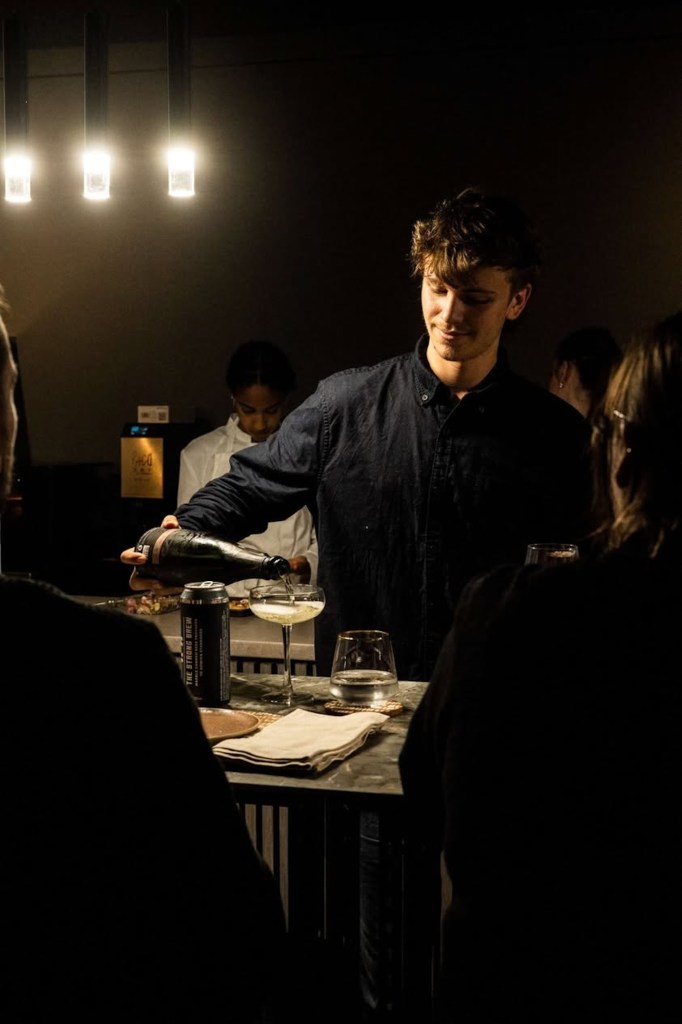
Book a SAMPA dinner and you’ll get the location sent to you just pre-arrival. Presumably the same applied to the intrepid wine lovers who had signed up for a  tutored tasting in the afternoon ahead of our evening meal. It was hosted by Go Brazil Wines’ Nicholas Corfe, who later poured his wares for us. He has championed the cause – along with national spirit cachaça – from his Suffolk base for 15 years. He cherry picks from small producers in the southernmost state of Rio Grande do Sul.

Vines were first planted in Brazil by the Portuguese in the 16th century. Then, in the 19th, came Italian immigrants, mainly from the Trento and Veneto regions of the north-east. In the Seventies an international player, Moët & Chandon, arrived to introduce modern vinification techniques.

There was nothing rustic about the four wine matches at SAMPA. What did I make of them?

The dinner was bookended by two sparklers, Amadeu Laranja Nature Traditional Method 2020 and a Don Guerino Moscatel NV 2022, the former on the orange spectrum, the result of extended maceration, refreshing and surprising complex, the latter a sweetie with counterbalancing acidity, weighing in at just 7.5. per cent ABV.

I enjoyed both, but had less joy from Pizzato Sauvignon Blanc 2024. Grassy on the nose, it promised more than it delivered, its tropical fruit muted, the mouthfeel quite coarse.

In contrast a red from the same Serra Gaúcha-based winery, the Pizzato Nervi Reserva Tannat 2020 was a terrific example of a heady grape variety associated with Madiran in South West France. Uruguay has proved a natural home for it in South America, but, based on this example, Brazil is giving it a run for its money.

From the great 2020 vintage, it has been aged for 11 months in new French oak barrels. Result: concentrated dark fruit and spice, soft tannins, a hint of leather perhaps. It would have coped well with a meatier main than Caroline’s (delightful) galinhada chicken. 

Pizzato own 45 hectares of vines split between their original Vale dos Vinhedos (Valley of the Vineyards) estate and the newer Dois Lajeados. The vines for Nervi are 25 years old, from the first plantings after the family switched from supplying grapes to big wineries to becoming an independent producer. Such a wine vindicates that bold decision.
Has maverick Martins found her perfect base?

Caroline Martins has made quite an impression since landing in Manchester some five years ago with husband Tim (who marshalled the troops brilliantly at the latest launch). She famously swapped a globetrotting career as a plasma physicist to go on Masterchef Brazil and train at Le Cordon Bleu in London. Check out the highs and lows of her career path in my recent interview with her, ‘Why female head chefs are flourishing around Manchester’.
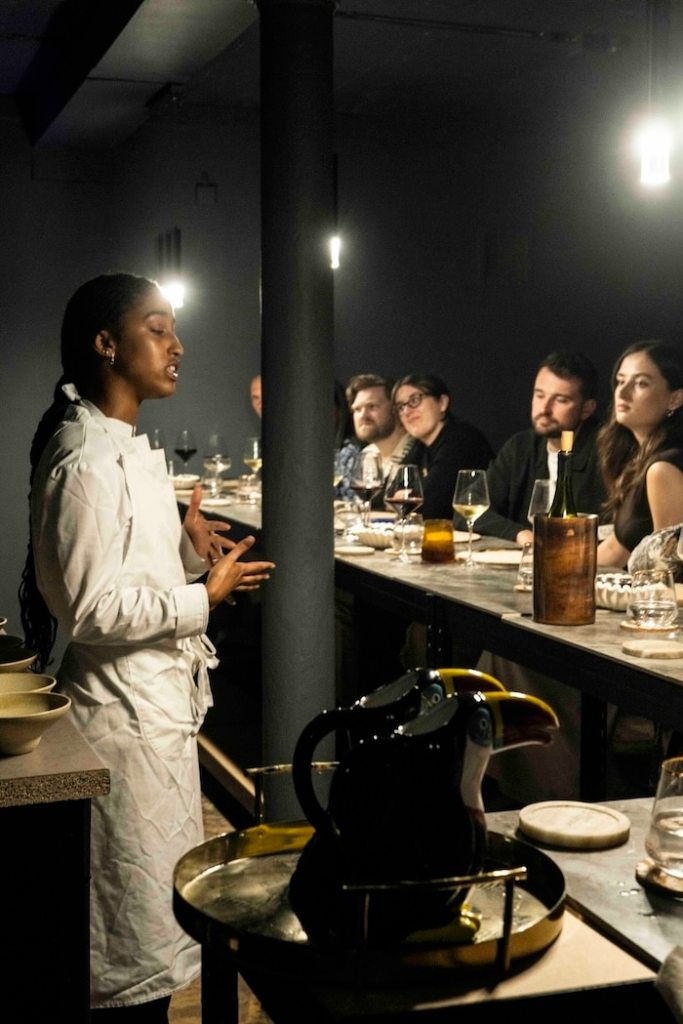
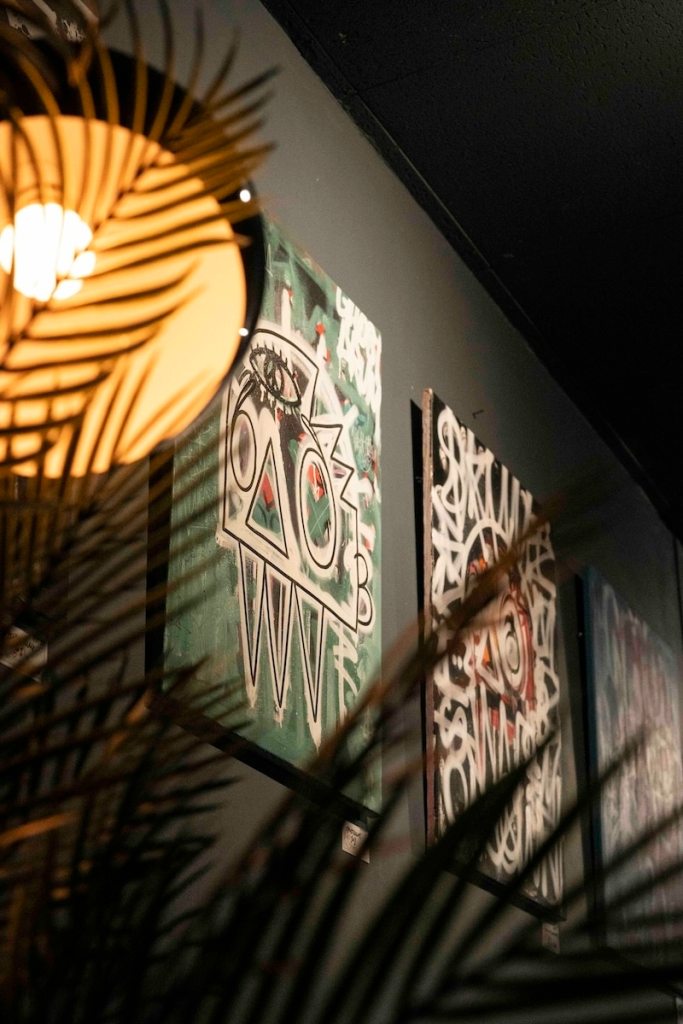
A trajectory that has encompassed numerous Brazilian-British fusion pop-ups led her to the unlikely Northern Quarter combo of Calcio Sports Bar on Dale Street with Chef’s Table experience for just eight folk in the cellar. It was a fine dining homage to the food of São Paulo (Sampa is its colloquial name). Now she has found a new home for her project, spacious enough to almost double her covers and include its own art gallery. The current exhibition, ‘Saudade’ is by one Pete Obsolete (below).
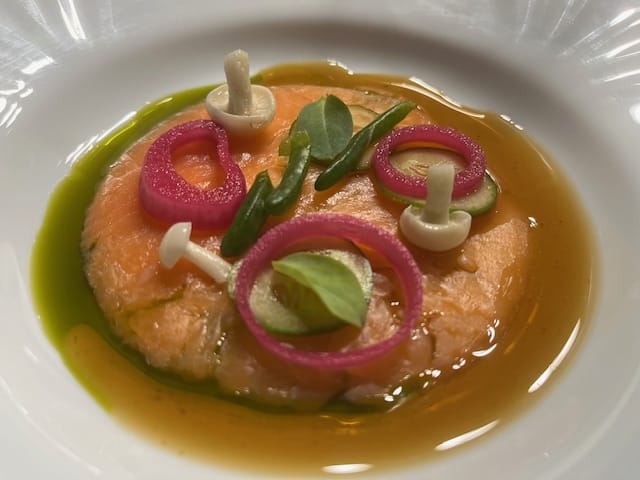
Caroline continues to refine her playful food offering. I particularly loved the laranja lima (a chalkstream trout carpaccio) and the ‘Garstang white cheese with fig leaf and Dan and The Bees honey, both evidence of our immaculate British sourcing.

PS Beware the potent Brazilian chilli that lurks among the snack starters of pineapple and pickles. Diito the fiery yellow dip with the pichanha tartare. Oh and prepare for a slight fuggy atmosphere in the underground lair. Caroline does love blow torches and smoking dishes!

A 12 course tasting menu comes in at a remarkably good value £58 (£69.60 inc VAT). The drinks pairing is £48. For £30 you can bravely match the dishes with a range of Cachaças. Book here.


At the end of a copacetically intimate Chef’s Table dinner deep under Manchester’s Northern Quarter our host, Caroline Martins, whispered to me that liquid nitrogen was back on her SAMPA bucket list. Which might mean the return of the psychedelic Jackson Pollock inspired dessert that wowed the crowd at the supper club she used to run at Blossom Street Social in Ancoats.

Maybe you recall this Brazilian chef’s signature splatfest on a platter that owed as much to the visual alchemy of Chicago super chef Grant Achatz as Pollock’s Abstract Expressionist peak. 

Our gourmet chihuahua Captain Smidge admired it from a distance. He wasn’t allowed a taste of the basil custard and coconut yoghurt scrawled across a huge black base or the dotted cubes of coconut candy, cassava biscuit and guava/banana candy. Definitely too rich for him the centrepiece – a smashed ‘bowl of, containing passion fruit mousse, rose petals, coconut granola, meringue and marshmallow.

Not just any chocolate. This was Dormouse, crafted inside the Great Northern by the city’s artisan chocolatier par excellence, Isobel Carse, using imported Brazilian cocoa beans. Great to see it remains a constant now Caroline has shifted her operation to Calcio on Dale Street, the sports she runs with husband Tim. It comes in the shape of another edible artwork – a chocolate and guava ‘mushroom’ mimicking a fly agaric.

That was the dessert climax of a 12 course tasting menu, served in the basement of the bar – remarkable value at £58 a head (drinks pairing, mostly Latin American  wines and spirits just £35, mixed cachaças £35, soft £25). When we first visited the new venue  the former Great British Menu contestant had cornered off a section of the screen-filled bar proper; the new set-up is far less distracting. 

Still, when I nipped upstairs for a ‘comfort break’ midway through I came upon a screen showing the Championship derby between Preston and my team, Blackburn Rovers. I might have been torn if the feast that was being served down the stairs was not so captivating. Eight diners at a counter, close to the kitchen action, being talked through ingredients and techniques with a vivacious passion.

In this latest manifestation of her talent Caroline, a former scientist from São Paulo, has restrained the molecular gastronomy wizardry without sacrificing the intense flavour profiles. Less showy now but her devotion to the exotic produce of her South American food heritage is, if anything, more evident.

She is keen to point out: “It is a deeply personal project, blending the rich culinary traditions of my hometown (Sampa was the city’s nickname), with incredible local ingredients and suppliers.” 


Evidence the ex-dairy cow ribeye sourced from cutting edge Littlewoods butchers in Heaton Chapel, out of which she conjured a remarkable steak experience. A big shout out also for  the locally traceable ‘Dan and the Bees’ raw honey, Chalkstream smoked trout and, further afield Eduardo Souza ethical foie gras from Spain’s Extremadura region. I first read about the latter in Dan Barber’s groundbreaking The Third Plate.

Key ingredients on the above menu, though, come from Brazil. I couldn’t resist requesting her to talk me through them.

Requeijão

“That’s a Brazilian-style cream cheese we make in the house by splitting whey/curd from Jersey milk using lime juice. After that, I emulsify the curd using butter. That’s a very traditional technique from in the state of Minas Gerais in Brazil. It goes well and is spreadable for bread and toast, but it also goes well with smoked fatty fish – that’s why I used it with smoked chalkstream trout.”

Cassava

“A Brazilian tuberculous vegetable. It’s very starchy and grows well in tropical countries. In Brazil we use more cassava than potatoes. I like to employ it in different forms. For the scallops I made a puree and used as a mousseline. We like to use it as a crumble for meats and fish (farofa). During summer it makes natura, chopped with mayo – like a potato salad.”

Biquinho pepper

“That’s a variety of chilli pepper used in Brazil but not very common to see here in the UK. They are sweet and fruity, with very mild hot notes. I like to use them because they are mild and don’t interfere with the flavours from other ingredients. They are also easy to ferment and preserve. I get my biquinhos fresh from Brazil and ferment them in 3 per cent brine for 1 month. After that, I preserve them in sugar cane vinegar. With a smoked quail egg they made  a perfect canapé.”

Heart of palm

“In Brazil we use the whole palm tree: the fruits for palm oil, the leaves to make recyclable plates/cups/forks for takeaways. We use the cores of the tree (heart-of-palm) by cooking them for hours in a pressure cooker until tender, then preserve in 3 per cent brine. I like to use heart of palm with scallops because the texture and mild sweetness reminds me of scallops.

Guava 

“Delicious tropical fruit – I usually see white-flash guavas here in Europe. But in Brazil we only use the pink-flesh guava. That’s my favourite fruit. I grew up eating guava fresh from the trees. In Brazil we use it fresh, or we make a paste called goiabada. For your meal I used fresh pink-flesh guava as an ice cream for dessert and also goiabada on top of the Extremadura foie gras.”

Acai berry

“That’s a berry from Amazonia, rich in antioxidants. Some people say they are one of those “superfoods” hence there are so many businesses profiting from acai bowls. In Brazil they are traditionally served with fish as pastes, marinades or in sauces, etc… With the hake I served it as a caponata by marinating black olives in acai puree and then chopping it. The ‘earthy’ notes from acai complement fishes such as hake that have mild fat content.”

Brazilian green fig 

“Brought to Brazil by the Portuguese when they colonised us. It’s a green fig slow cooked for hours in sugar syrup, then preserved in the same syrup. When we make it, I like to shave some cumaru (tonka bean) in the syrup to add another tasting dimension to the preparation.”

Canjica

“It’s a white corn, traditionally used in sweet preparations, but I’ve also been using it in savoury dishes. You had it cooked as a risotto, with lots of butter. I love the texture and the neutral flavour profile. It complements strong meats such as the wild mallard duck. I’ve been growing koji on canjica and it’s starting to taste great! I might use it as a petit four by dipping it in dark chocolate (inspired by chef Gareth Ward from Ynyshir. He does it with barley).”

Coalho 

“Colaho is a popular Brazilian cheese similar to paneer in texture. Everyone barbecues it because it does not melt away under strong heat. It’s usually served with steak in barbecues, that’s why I wanted to use it with the dairy cow ribeye, mixing it with winter truffle to stuff a raviolo.

Pão de queijo

“A Brazilian cheese bread made from cassava flour, eggs, milk and cheese. In Brazil we use ‘canastra cheese’, but here in the UK I like to use mild cheddar. It’s one of the staples of Brazilian gastronomy. Each family has their own recipe. Mine comes from my grandmother Thereza. She lived in the state of Minas Gerais (where pão de queijo was invented).”

SAMPA Brazilian-British Fusion Chef’s Table ,Calcio bar, 24 Dale Street, Manchester, M1 1FY.