Tag Archive for: Wine

1976. Up in Dry Creek Valley, Zinfandel heartland of Sonoma County, Joel Peterson was picking for his first solo foray into crafting that stalwart Californian red. A lightning storm drenched the 29-year-old amateur winemaker as he hoisted 50lb tubs of grapes into his truck while two ravens harassed him from a nearby tree. And thereby hangs an epiphany. 

Let Zinfandel chronicler David Darlington take up the story in his Angels’ Visits (1991): “At the time Joel was reading Sir Walter Scott’s The Bride of Lammermuir, a gothic novel whose hero, Lord Ravenswood, falls off a bridge and drowns in quicksand while coming to the rescue of his sweetheart.

“Under the circumstances it seemed to Joel that such a plot might also describe the start of a small winery. As he drove away… the setting sun squeezed beneath the clouds, igniting the landscape a surreal orange and painting two rainbows on the charcoal sky. In Joel’s mind Sir Walter Scott receded and Native Americans appeared as he recalled an Indian legend wherein man is discovered in a pod, and is instructed in the arts of survival by a raven.”

Ravenswood – Gothic birth of an iconic producer

Joel Peterson is a great survivor himself. The gestation of his Ravenswood brand might sound fuelled by waccy backy – this was seventies California after all – but Joel’s ‘drug of choice’ was always a certain heady, tannic red made from the State’s bedrock grape. Zinfandel is a thin-skinned, small grape which means less skin-to-juice ratio, so potentially higher tannins. It is also  notorious for uneven ripening, so bunches have to be left on the vine to ripen fully. This leads to high sugar in the berries, which makes for high-alcohol wines. Hence a now discredited trend for late harvest Zins, dry and sweet.

Peterson never went down that route. 600 cases were made from that initial harvest. After which he became a gypsy winemaker around the area until he eventually could create a winery of his own. His pride and joy were the single vineyard Zins he made, lauded by the likes of Robert Parker. The plan was for small open top, redwood fermenters, hand punch downs, extended macerations, native yeast, gentle transfer, minimal processing and small French oak aging – all done by hand. European with a Californian twist.

But he admits in the book that their ‘Chateau Cash Flow’ was the generic Ravenswood Vintners Blend, the cheaper early release version. Launched in 1983, annual production neared one million cases, at one point, making it the world’s  bestselling red Zinfandel. You’d find it in Morrisons and Tesco, maybe still can.  Dwarfed, though, by the big guns who dug a gold mine in creating White Zinfandel Blush. But that’s a whole other story.

Ravenswood itself was engulfed by drinks behemoths. first Constellation Brands and then on to Gallo (California-based, it’s the largest wine producer by volume on the planet). Ravenswood then went into limbo and Peterson founded a new boutique winery, Once & Future, to recapture the magic of Zinfandel, and his son, Morgan Twain-Peterson, became a Master of Wine with his own highly regarded winery, Bedrock Wine Co.

Serendipity that led me back to top-end Zinfandel

So is it a case of the Zinfandel Empire fights back? Ironically Gallo have resurrected Ravenswood as a fine Zinfandel with an initial annual production of 6,000 cases with Peterson as consultant. For his own project he remains an inveterate searcher out of off-the-radar old vine parcels. Hence the Wine Society bottle I’m about to sample. This latest example of their flagship ‘Exhibition’ range is the result of an abundant 2024 vintage leaving Peterson with more Zinfandel than usual. 

This bespoke blend lives up to its Society tasting notes: “With an average vine age of over 80 years, this full-flavoured, vibrant Zinfandel has a rich cherry, plum and blackberry perfume, bright acidity with rich soft tannins, and an evolving long finish. Made in small open top fermenters, and aged in about 10 per cent new oak the resulting wine has great balance and generosity.”

So quite a step up from the Vintners Blend. Beautifully balanced, it still weighs in at nearly 15 per cent ABV, but it wears the alcohol lightly. It proved a perfect accompaniment to a hot game pie. Serendipity? The special offer (£16) came into my e-mail box just the day after Angels’ Visits dropped through the letter box. I’d bought the book on a whim after it was extolled in the Substack of one of my favourite wine writers. Anyone who shares a podcast (Intoxicating History) with Tom Parker Bowles must be posh but Henry Jeffreys is a sharp and streetwise advocate of all things grape.

Grape rivals – Ridge Vineyards versus Ravenswood

I was captivated by Angels’ Visits because it tells stories of individual, very individual, Californian winemakers who have championed the Big Zin since the Sixties… and their vastly contrasting wine styles.. Essentially, though, it centres on Peterson’s Ravenswood and arch rivals, in the Santa Cruz Mountains (main picture) south of San Francisco, Ridge Vineyards. Their Zinfandels under well-travelled philosopher winemaker Paul Ridge aimed for a Bordeaux-style elegance over power. Matching its signature wine, the Monte Bello Cabernet Sauvignon. Draper, who turns 90 in March, has long been Emeritus.but his cerebral approach remains under the hands-off ownership of a Japanese pharmaceutical giant.

Last year I tasted half a dozen Ridge wines at a Berkmann Cellars trade event in Manchester – Zinfandels from their Lytton Springs and Geyserville particularly captivating, if just a mite polite. Angels’ Visits author Darlington does stray into  Jungian parlance of Apollo versus Dionysus. I see where he is coming from. His historical research into how Zinfandel wound up in the Golden State is more plodding. The jury really is out on whether it is the same grape as  – or a close relative of – the similarly thick-skinned Primitivo of Puglia in Italy.

He does debunk the once accepted theory that it came from Hungary or Croatia  via the colourful founder of Buena Vista winery, California’s first, dating back to 1857. Colonel Agoston Haraszthy’s portrait still hangs in their Sonoma base. The grape was also, quite boringly, believed to have originally been a table grape in New England.

When Haraszthy went bust he hopped off to Nicaragua to make spirits from sugar and met a bizarre end. Over to Angels’ Visits again: “On July 6. 1869 he went to meet a business associate on the banks of a Nicaraguan river. He never returned. His footprints were found leading to a tree whose limbs reached across the river: 

one of th/e branches, broken off in the middle, was presumed to have snapped as Haraszthy tried to cross on it.

“A few days earlier at the same spot a crocodile  had killed a cow, and to this day Agoston Haraszthy is assumed to have followed the unlucky bovine into the jaws of oblivion.”

You wait all your days for a debunking of the minerality’ in wine and then two come along. Both books, just published by the Academie du Vin Library, take a genuine tilt at accepted assumptions of terroir. 

The subtitle of Taste The Limestone, Smell The Slate by Alex Maltman (£35) is a mite off-putting: “A geologist wanders through the world of wine” Did my favourite wine writer,  Andrew Jefford, put me at ease with his summation? ‘“Rocks and soils haunt our thinking about wine. We see links, sniff origins, taste connections, digest differences. Is this cause and effect – or fantasy? Alex Maltman is ghostbuster-in-chief. This wide-ranging and clearly reasoned book shines a torch through cobwebs.”

Cobwebs initially entangled me as I waded through Professor Maltman’s links between terroir, geology and microbiology, but I was gripped once he put into scientific context wine writing’s insistence that minerals in the vineyard bedrock contribute to the eventual taste in the bottle.So many other factors are at play. His conclusion: ‘minerality’ is a pseudo-science.

Inescapable mind. In a recent copy of Decanter magazine Beverley Blanning MW, author of a new book on Wines of the Loire Valley, reviewed eight Sancerres from that limestone-clay terroir with a hint of flint in the east of the region. The Domaine Vacheron sample is spared, but in her short evaluations of the other seven ‘mineral’ features seven times, ‘minerality’ three.

So what does have a major impact according to Maltman? Check out the chapter, Four Elephants in the Wine Room”. The four key factors are soils, rootstock selection, choice of yeasts, and ambient factors affecting taste perceptions.

Book number two, which wields its debunking scythe much further, is Sunny Hodge’s The Cynic’s Guide To Wine (£25). As the title suggests it’s a rational antidote to romantic grape tosh, making use of the writer’s scientific background (in mechanical engineering) and running his two London wine bars – Diogenes the Dog and Aspen & Meursault.

Hodge is vituperous about the bullshit of wine speak: “‘The more we talk about wine in that way, the less we learn about wine. The more we understand why this tastes so “green-appley” because of the natural malic acid; why your Merlots and Cabernets taste so peppery, because of the pyrazines… I know it’s very technical food talk, but the more we talk about it normally, the less smoke and mirrors there are.” It’s a more approachable book than Maltman’s, ranging wider. I particularly liked the final chapter exploring taste perceptions and neurology.

I also enjoyed the sense of genuine personal engagement in the writing. Take this passage after he has pointed out that almost all rocks and minerals are essentially tasteless and odourless: “It is hard to believe that we conjured aroma associations with certain metals and rocks out of nowhere. I can myself recall the most distinct smell of lead from an unfortunate turn of events in Peckham.

“In my early twenties (he is now 35) I ended up with a couple of lead air rifle bullets lodged in the back of my head and jaw when I was the victim of a clichéd London robbery following a skate filming session… To this day the smell and taste of that alien object under my skin is unforgettable. How is possible that smell didn’t exist?”

After such polemics a recognisable vineyard journey from one of the great English wine writers. Sarah-Jane Evans’ The Wines of Northern Spain has long been an essential guide to regions that are among my favourites. Now seven years on comes The Wines of Central and Southern Spain (Academie du Vin Library, £35), which takes us from from Catalunya to Cadiz via the Levante and ends on the wilder shores of the Balearics. Trendy Sierra Gredos doesn’t make the cut, but the omission is slight when there is much else to savour in this encyclopaedic evaluation of arguably Europe’s most interesting wine country. In particular I love they way she tackles the recent transformation of traditionally hidebound sherry country in Andalucia,

Also new in the same series is The Wines of California (£35) by Elaine Chukan Brown. It is an in-depth look at what is the world’s fourth largest producer of wine, focusing not just on her base, Napa, and Sonoma but other viticulture areas emerging against the challenge of climate change, drought and the threat of wildfires. 

The book, heavyweight in every sense at nearly 500 pages, is divided into three major sections. The first presents the key ideas that help make sense of California wine as a whole, including the history of the state’s vineyards and how the topography delivers California’s climatic and soil conditions. The second tackles each major region in turn, spotlighting the most significant and interesting producers. A final section discusses the future of the industry across the state.

The Smart Traveller’s Wine Guide Series offer a pocket-sized, well-illustrated  wealth of information that can enhance a road trip or stay in any region. The latest volumes, each just £12.99, live up to that billing – Tuscany by Paul Caputo and Rioja by Fintan Kerr  (each £12.99). Both had me scanning cheap flights over.

Image credits: Chateauneuf du Pape galets (Megan Mallen); Sarah-Jane Evans and Sunny Hodge (Academie du Vin Library); Priorat (Antonio M Romero Dorado) and Sanlucar (Til F Teek).

Guardians of the Red Mountain sounds pure Lord of the Rings. So too the ritual planting of a sacred cow horn to thwart the dominance of the chemical Dark Lord. Easy on the Tolkien there. The biodynamic Hedges Family Estate is set not in some mythical Shires but in one of the prime viticultural sites of Washington State in the north west USA.

Mountain? More of a long mound apparently, coloured by reddish cheat grass in spring before the grapes take centre stage – true object of the family’s self-styled guardianship. This is as hot and dry as it gets with cool nights, the soil a mix of clay, loess and rocky granite, making it perfect for creating stellar, tannic red wines; Hedges are a rarity among their peers in going down the biodynamic route.

This means their five vineyards are farmed according to the eco-forward tenets of the Austrian philosopher, Rudolf Steiner (1861-1925). Probably the most divisive of these recommends the use of ‘preparation BD500’, where horns are filled with ox manure and buried in October to stay in the ground throughout the dormant season. The horn is later unearthed, diluted with water and sprayed onto the soil. 

However wacky it may sound the proof is surely in the wine quality and the 2020  vintage of La Haute Cuvee, their first certified biodynamic wine, is supple and savoury with masses of ripe blackcurrant under its tannic shield.

I am tasting it alongside a trio of other Hedges reds (including  a stunning Syrah ‘Les Gosses’) at a Pacific Peaks & Vines roadshow in Manchester, showcasing the wines of Washington and Oregon. I’m in the amiable company of the brand’s travelling ambassador, Christophe Hedges, who runs the estate with his winemaker sister Sarah. She led the charge to biodynamic practice and natural fermentation;  in a region of ‘big’ wines theirs possess a certain Old World finesse.

Maybe put that down the influence of their French mum Anne-Marie. She and husband Tom harvested their first vintage in 1987 before purchasing 50 acres on Red Mountain two years later to plant mainly Bordeaux varietals. These days (from their French chateau-like base) they are adapting to climate change by employing drought-resistant grape varieties and careful irrigation in an area that gets only eight to nine inches of rain a year.

All in stark contrast to Oregon, the other state participating in Pacific Peaks & Vines. There a more temperate, rainier microclimate close to the ocean is more suitable for the cultivation of Chardonnay and especially Pinot Noir. I was particularly impressed at the Manchester Side Street tasting by examples from Willamette Valley stalwarts Stoller.

Between them Oregon and Washington account for seven per cent of US production volumes, exports to the UK are growing but still tiny and we are talking premium prices, an average of £40 a bottle. 

If Willamette Pinot remains my target tipple I can now see the attraction of both ‘twin peaks’ of North Coast viticulture

Cherry pie is on the menu in the real-life Twin Peaks

And you thought Twin Peaks was just a hugely acclaimed TV show, created by David Lynch, who died last month. It’s also coincidentally the name given to wineries in Western Australia, California’s Sonoma and Mallorca while its star, Kyle MacLachlan himself dabbles in the wine trade with his private label, Pursued by Bear

I’d like to think his Columbia Valley Cabernet Sauvignon offers hints of cherry pie on the nose. That pie, in the company of “damn fine coffee”, was the chosen treat of MacLachlan’s character, Agent Dale Cooper.

Naturally, on our last visit to Washington State, we sampled both in the hotel that stood in for the Great Northern Hotel in David Lynch’s surreal TV series. We had been based in Yakima, epicentre of the Yakima Valley wine and hop-growing region, an hour’s drive to the west of Red Mountain.

The Salish Lodge was our lunchtime stop-off heading further west towards Seattle. After the desert climate of Yakima, we hit big rain crossing the Cascades range. The mountain murk was so dense we couldn’t even get a view of 14,411ft Mount Rainier, the USA’s fifth highest and one of the world’s great standalone peaks (we glimpsed it later from the equally iconic Space Needle in Seattle).

After slaloming down forested switchbacks it was a relief to reach Salish Lodge perched on the brink of the Snoqualmie Falls, one of Washington’s big visitor draws. The famous waterfall there, swollen by those rains, was in full spate as the clouds cleared enough for a proper view from the terrace path of, where we were booked in for lunch at its Attic restaurant.

First though we had to investigate this luxury inn’s Twin Peaks souvenir shop. Echoing some Lynchlike plot twist, one of the stars of the original and the recent follow-up series, Harry Dean Stanton, had died the previous day.

It was a mark of respect to a great actor that, after oysters, clams and stone hearth fired pizza, we had to find room for that pie.

What are the secrets of biodynamic wine?

Biodynamics is often referred to as ‘super-charged organic’. Rather than simply reducing chemical inputs, biodynamic production is a proactive attempt to bring life to the soil with the use of natural composts and organic preparations. 

It’s more than just an agricultural system, rather an altered world view that then impacts on the practice of agriculture. Winemakers drawn to this philosophy tend to be creative, spiritual types, deeply connected to their land and always experimenting to see what works best.

Demeter biodynamic certification is the reward for going down this radical route, which forbids chemical fertilisers, pesticides, herbicides or fungicides. Instead insect life and spiders are encouraged to control pests; manure encourages organic growth. After hand-harvesting the grapes the wine is produced in a gravity-fed cellar without winemaking additives. Ambient yeasts are used, with no or scant sulfites and no fining.

More controversially all significant vineyard activities –  soil preparation, planting, pruning, harvesting – are done in accordance with the influence on earth by the moon, stars and planets. Finally, the aspect that can spark scepticism – the use of nine preparations 500-508 (a bit like homeopathy), using  plants such as nettles, dandelion and chamomile, to be applied in powdered form or as sprays. And then there is the afore-mentioned Preparation 500.

One French winemaker of my acquaintance wrote of the Steiner strictures: “It is important to understand that 50 percent is symbolic and 50 percent is real… it all helps focus.” 

All of which reminds me of a memorable trip to Ted Lemon’s Littorai winery in Sonoma, California. In Ted’s absence his young deputy confessed to not being a total convert to biodynamics (the perfection of the Pinot Noir was proof enough for us). And yet, as he put it, “It sure does make you pay attention.” 

The damn good wines of Hedges Family Estate sure grabbed mine.

• A range of Hedges Family Estate Wines is available in the UK from Guildford-based sustainable merchant Wine & Earth.

Jerez is an entrancing Spanish city in its own right. Amazing tapas, Andalusian horses, flamenco. And as the Capital of Sherry, it offers a unique wine culture to explore and fall in love with. Richard Oakley, on a random visit, did. It has inspired his new online venture, Sherry Amor, providing an insider’s introduction through a range of mixed sherry cases.

The first three on sale showcase very different producers – venerable Valdespino (1430), specialists in single vineyard and aged sherries; Jerez bastions Williams and Humbert (founded by Englishmen in 1877) and Sanchez Romate (family-owned since 1781) offering dry styles; and Barbadillo.

The latter bodega is steeped in history, too. Dating back to 1821, it is now run by the seventh generation of the family in Sanlúcar de Barrameda, 25km north west of Jerez. Sanlúcar is the epicentre of Manzanilla, the bone dry sherry whose saline finish is attributed to the vineyards’ position on the Guadalquivir estuary, from where Columbus and Magellan once set sail.


I have a Sherry Amor Barbadillo case worth £122, to give away

The company’s Solear is Spain’s best-selling Manzanilla and is included in Sherry Amor’s mixed case of six Barbadillo half bottles (37.5 cl) that also features two of their aged dry sherries, a medium-sweet Oloroso, sweet Moscatel… and  a Manzanilla Pasada En Rama de la Pastora. The extra ageing on a ‘pasada’ wine adds complexity and body. ‘En Rama’ means bottling straight from the cask with no fining or filtration.

Just answer this simple question: Which town is the centre of Manzanilla sherry production?

Email your answer (with name and postal address) to neil@neilsowerby.co.uk  by midnight on December 31. Winner will be notified the following week.

What makes sherry so special? I asked Richard Oakley…

It’s nearly Christmas. Time to dust off the Bristol Cream at the back of the drinks cabinet. Doesn’t sherry still suffer from an image problem? The drink of an elderly demographic? Or is that changing?

I don’t think sherry has an image problem. More and more people are discovering the range of styles that are available and loving them. They’re unique wines, full of complexity and flavour, great value and practical, too – they keep very well once opened. Oh, and I have nothing against Harvey’s Bristol Cream!

There are so many different sherry styles, from bone-dry to lusciously sweet. You are focusing on the drier ones. Why is that?

I’m offering more dry styles of sherry as I generally find them more interesting to drink, and hope other people do, too. Most of the six-bottle mixed cases I’m offering have maybe one sweet and five dry styles. In addition, I think the dry styles are perhaps less well-known, so there is more to discover.

I think most folk know fino as a dry aperitif, but explain the difference between amontillado, oloroso and palo cortado. So drinkers know what to expect.

All three are all made from the same grape, Palomino Fino, but one main difference is in the amount of oxygen they are exposed to during development. Amontillado is initially aged under a thick layer of yeast, known as flor, whereas Oloroso is aged in full contact with oxygen. This results in a more nutty, oaky and aromatic flavour for Amontillado and a more toasty, balsamic and dried fruit flavour for Oloroso. Palo Cortado is produced when the flor goes a bit rogue, doesn’t develop fully and is a flavour combination of the two, often with a very dry, saline character. 

Half of the Valdespino case is devoted to wines with some age on them. Why are they worth the premium? Is sherry as a whole good value?

Some, but not many, unfortified wines are drinkable when 20 or 30 years old. If you compare sherry with the prices of an aged red or white wine, sherry is incredible value. You’re getting a ton of complexity and flavour for your money in a 20 or 30-year-old sherry! I’m planning to add more aged sherry products to the Sherry Amor list in 2025. 

Not just for sipping on their own, how food-friendly are sherries? What are the best matches?

Dry sherries are incredibly savoury and therefore versatile food wines. Fino and Manzanilla are the same alcoholic strength as some unfortified white wines, so think seafood. I like to enjoy Amontillado with cured meats, especially Iberico jamon, as there’s a nuttiness to both. Oloroso is great with a roast chicken; sometimes I add a splash to the roasting pan. Palo Cortado can stand up to some highly-spiced Asian dishes, especially classic home-cooked Indian dishes such as keema peas. On the dessert front, Pedro Ximenez with vanilla ice cream and raisins is a classic. Aged sherry wines also make for a great aperitif or digestif. But nobody should feel obliged to follow any rules.

Setting up Sherry Amor demonstrates your passion for this classic tipple in a world of so many wine choices. Sum up what makes sherry so special?

Sherry is a unique style of drink, in terms of production and flavour, from a very specific geographical area. Its production and consumption is very closely intertwined with Britain, having been mentioned by Chaucer, Shakespeare and Dickens. I think you can taste some of that history when you drink the wines.

What a vintage innings. Kate Goodman opened Reserve Wines just months before her brother Mark was appointed Lancashire Cricket Club captain (and there have been seven since). That was 20 years ago this autumn and the one-time BBC Food and Drink Programme grape guru has never looked back. Think of her as the presiding angel over the progress of Manchester (suburbs and all) towards its current status as a serious wine-celebrating destination.

Reserve’s personal 20th celebrations are only just beginning and they will stretch out across Kate’s innovative empire – the Burton Road mothership, outlets at the NQ’s Mackie Mayor, Altrincham Market and Picturedrome Macclesfield food halls plus Bents Garden & Home, Daresbury. Kate is second left in this Alty celebration.

There are two more projects on the way. When we catch up – alas not over a bottle of our beloved Côte-Rôtie – she is coy about these. Just as she won’t spill the beans on which stuffy, old school Manchester merchants intimidated her enough to go away and start up her own business in 2003. The route forward was not scowling your way through a phalanx of dusty racks but sharing your enthusiasm via fun YouTube takes. These days she popu;ates Twitter too with her pithy bottle tips.

Those obvious presentation skills earned her a slot on Food and Drink alongside the likes of Michel Roux nearly a decade ago. But it has been the day job that has consolidated the passion for wine seeded by impressionable years spent in France after a European Studies degree at Hull.

“But surely these days you don’t sell the same amount of French wine as when you opened Reserve… the world has moved on?” I ask her. It’s a meant as a tease for her Reserve buyer, Frenchman Nic Rezzouk. Kate is diplomatic.

“Ah, French wine. It is sometimes about identity. Recently we were chatting with a colleague working his way to a Master of Wine qualification. He told us how difficult it was to blind taste between Old and New World wines. The styles were so similar it was often hard to differentiate.”

But then with the New World there has been a backlash since those heady 2003 days. “When we started the shelves were full of big fruit explosive wines from Australia, Barossa Valley Shiraz and the like. Tastes have evolved; nowadays there’s a trend to lower alcohol, more elegant styles. South African, Australia wines are often fresher in style.”

One constant across he two decades of Reserve has been punters’ perennial devotion to Kiwi Sauvignon Blanc, followed more recently by the easily pronounceable (and let’s admit it, consistently fruity) Argentine Malbec. What of the third in the wine shelf ‘holy trinity’? “We were discussing it the other day. When we opened we didn’t stock one bottle of Prosecco. Amazing to think back now.”

So what else do we have now we didn’t have back then? “Well, natural wine has only become a big thing over the last decade. And orange wine. Reserve has always attracted curious customers, looking for something different, seeking different layers of story about the folk who make the wine. Sustainability and methods of making wine are important to our customers too.”

English wine? “Making big strides all the time. Sparklers and now still wines. I can recall one of our suppliers in the early days, he brought in a bottle from a new client, Nyetimber. It was the first English wine I’d tasted.  It was really good then and it’s gone from strength to strength, as has the rest of our native industry. Reds were a challenge, but they are starting to blossom. I recently tasted a Bacchus (our aromatic white rival to Sauvignon) and it was so lovely. English wine is still quite niche but it has a bright future and I‘m proud to promote it at Reserve. At Mackie and Alty our basic sparkler by the glass is an Italian, but the next bubbly up is Gusborne from Kent. Gorgeous.”

In the press releasee founder Kate calls Reserve’s 20th anniversary “a monumental milestone – it has always been more than just a shop; it’s a community of wine enthusiasts where everyone is welcome.”

That local wine community extends beyond the one business, mind. “We are not alone in being passionate about giving people options that can guide them on their wine journey,” she tells me. “The evolution of the Manchester scene is remarkable – great people, a vibrant market, more and more tastings coming to us, impressive restaurant  wine lists everywhere. 20 years has seen a huge step up.”

Reserve’s 20th anniversary celebrations

There’s so much going on, kicking off with a private birthday celebration for loyal customers at Reserve Wines, Didsbury on Thursday, February 9, the Winter Wine Fair at Didsbury Sports Ground, with over 100 wines and spirits to taste, the following Thursday, and on Friday, November 17 a 20th anniversary tasting event, exploring Reserve Didsbury’s best-sellers. Check availability via this link.

Plus there are vinous prizes to be won via their social media channels. And with Christmas in mind there’s a variety of drop-in tastings across all the venues.

Time for turkey – Kate’s Christmas tried and tested wine tips

Don’t miss Reserve’s ‘Premium Red Wine Duo’, showcasing the Bodegas Palacio Glorioso Reserva Rioja (£17.50 from Spain – smooth and rich with aromas of ripe red fruits, vanilla and spices alongside the Amie Rouge Carignan (£15) from Southern France, a juicy and fruity wine with pure notes of blackberry, plum and pepper.

What is the Greek for to over-enthuse? I caught up with Jamie Oliver on the box the other night. Primarily because his new Channel 4 series on Mediterranean food kicked off in Thessaloniki, a city I developed a deep love for after a random visit.  Out of it arose an obsession with the country’s flagship red variety, Xinomavro, whose spiritual home is 75 miles north in mountainous Naoussa.

Greece’s second city got 10 minutes of Oliver attention before he heeded the pukka siren call of the Islands and was ferried south. There was no name check of the wine that accompanied the seafront fish platter Jamie gushed over. It may well have been the high profile white equivalent of Xin – Assyrtiko. 

Aldi put it on the supermarket map with a £6.99 version, described by one critic as “like Chablis with super powers”. A snip from a high altitude, sustainable single vineyard, this mainland version ticked lots of boxes – herbaceous, floral, citrussy, a hint of pepper, supple – without ever attaining the saline minerality and complexity, at a premium price, associated with examples from the volcanic vineyards of Santorini, that dazzlingly white holiday haven.

(Those Santorini selling points may soon be in short supply or hiked up in price – the difficult 2023 harvest is likely to yield only 30 per cent of the normal output).

At a Wines of Greece tasting in Manchester, the day after Jamie’s telly Odyssey, there was a plethora (word of Ancient Greek origin) of Assyrtikos from assorted regions, influenced by widely differing terroirs, but remarkably few Xinomavros. There were some 90 wines to sample at Blossom Street Social in Ancoats, so maybe I had been distracted by the whites – Malaqousia, Savatiano, Kydonitsa and the like. Among the reds, though, the stand-out grape turned out to be Agiorgitiko, which is Greece’s most widely planted red varietal. Its origins, though, are in the deep south of the the Peloponnese.

Its nickname is apparently ‘Blood of Hercules’. It doesn’t take a Herculean effort to appreciate its qualities. It reeks of mountain herbs and tastes of blackberry and cherry, usually with some oak spice involved. A beautiful expression on the day was the Nemea Grande Cuvee 2019 (£29.40) from Domaine Skouras, established almost 40 years ago by the redoubtable, Dijon-trained George of that ilk. 

Matching it stride for stride, from young tyro and Nemea neighbour Evengelia Palivou, was Palivou Estate Nemea 2020. It has years ahead of it but already it is a rich expression of cherry, chocolate and vanilla flavours. She and her sister Vassiliki have taken over the running of the 40 acres or organically farmed vineyards. They and the rest of a new, more open generation are the reason Greek wine is suddenly on a surge. Promoting indigenous grapes, rather than pandering to ‘international’ varietals.

A lovely Palivou mission statement of this was on the table. La Vie en Rose is made from 100 per cent Moschofilero. A colleague detected Turkish delight on the nose; I loved the lemon and pear flavours unusual in a pink.

My third and final winery tip from the tasting is Estate Argyros, the largest vineyard owner on Santorini with more than 120 hectares of ungrafted vines up to 200 years in age. It’s now in the hands of fourth generation family winemaker Matthew Argyros and the trio of wines created from his new 2015 winery demonstrated the voluptuousness Assyrtiko can attain.

Expect to pay £50 for the Cuvee Monsignori, 14.5 per cent but beautifully balance packed with flavours of preserved lemons and wild herbs. At twice that price, offering a unique tatse of old Santorini, Assyrtiko combines with fellow native varietals Athiri and Aidani for the heavenly, honeyed Vin Santo Late Release 2002. Sourced from 200-year-old vineyards and aged for at least16 years, it’s very special.

Fenix on the rise in Manchester

Leaving aside perennial reservations about rough taverna retsina, Hellenic wine’s profile has been hindered by the absence of top end Greek restaurants. That will be remedied soon in Manchester by the arrival of Fenix. It’s a complete change of tack from the brothers behind the Modern Chinese fusion brand Tattu.

Fenix’s wine list offers a global roll call of crowd pleasers but the Greek element is shrewdly chosen from some of the country’s highest profile wineries – Thymiopoulos, Gaia, Hatzidakis, Alpha and that aforementioned Skouras Grande Cuvee (it will cost you £67, not a dramatic mark-up). More approachably priced are a series of blends from the Cretan winery Karavitakis, championing that island’s indigenous grape varieties such as Vilana, Vidiano, Kotsifali  Mandilari and Liatiko.

Apostolos Thymiopoulos (above) is the king of Xinomavro in all its styles and an ambassador for all the new wave Greek winemakers. His own wines are widely available (try the entry level ‘Jeunes Vignes’ Xinomavro), An equally charismatic figure was Haridimos Hatzidakis, his life cut short aged just 50 in 2017. Born in Crete, he is credited with putting Santorini wine on the world map after replanting a vineyard abandoned after a 1956 earthquake and releasing his first bottles in 1999. Century-old indigenous vines from volcanic terroir, organic farming and minimal intervention in the winery. Result: Assyrtikos with a challenging saline minerality that I loved from my first sip. Noble Rot’s Shrine to the Vine online shop stocks the family’s single vineyard wines. Start with the Nykteri 2020.

Grandes Pagos de Espana is a prestige association of single estate Spanish wineries. A broad church indeed as I discovered at a recent public tasting at Manchester’s hub of all things Iberian, the Instituto Cervantes. The seven bottles we sampled ranged from a new wave richer-style Txakoli white from the Basque Country to a minimal intervention Mencia-led old vines field blend from Leon. I particularly liked the 100 per cent Garnacha Secastilla from the Somontano region.

Unsurprisingly though it was a trio of reds from a different but very familar grape that finished proceedings, culminating in the Pago Negralada from Abadia Retuerta. 

Wines from this estate are regularly supplied to winemaking schools as benchmark examples of Tempranillo, Spain’s most widely planted premium varietal. That information came from Miguel Gavita, who had guided through the Pagos tasting. No false modesty here – Miguel works for Abadia – but he can be forgiven. I know first hand, in situ, how good their wines can be. Perhaps the wonderful setting influenced my judgement when I stayed there one glorious late spring. It’s all coming back.

My planned visit to this luxury hotel with its own winery two hours north of Madrid had been nipped in the bud when a journalists’ press trip was cancelled. Then I ran into the Abadia head honcho at a Relais & Chateaux bash in Cheshire and he said: go on, we’ll host you solo. Le Domaine lodging project was still a work in progress when I arrived

Heavenly Retreat Among Spain’s Great Vineyards

Storks and cranes, the skyline of an abbey fortress surrounded by vineyard. The storks are nesting busily in the 12th century belltower; the cranes, the giant mechanical sort, are at rest. This is a Spanish bank holiday and work will resume tomorrow on turning former monks’ dwellings and stables into eight new guest rooms and the Sanctuario spa/pool complex. To complete the transformation into one of Spain’s finest hotels. 

Welcome to Abadia Retuerta, westernmost of the wineries producing some of Spain’s greatest reds along the River Duero’s Golden Mile. Le Domaine, is the place to stay around here with just 22 rooms and a cuisine curated by one of the country’s Michelin-starred greats.

I’ve only just arrived and barely settled in my room, pausing open to fling open the shuttered windows for an eyeful of vines before I am out among them for a pre-prandial stroll. The view back is equally enchanting – pale, honeyed stone cunningly renovated, harmonising Romanesque and Baroque.

Such evenings of mellow sun and blue skies have been rare this spring. At 800m above sea-level here they expect nights to be cold, but it has been uncommonly wet, too, bad for the grapes planted across 700 hectares upon which Abadia’s fortunes are built.

In 2005 their flagship wine, the Seleccion Especial conquered all at the International Wine Challenge, capping a remarkable fast track rise for an operation only begun in 1995 on land previously part of the legendary Vega Sicilia estate. 

The winning  wine was from the 2001 vintage. I never expected to be served a bottle from that year with my dinner in the Refectorio, but there it was, still vigorous yet elegant, the quintessence of Tempranillo (with the support of some Cabernet Sauvignon).

The Refectorio was where the monks ate (and occasionally kept their livestock). Now these soaring white stone vaults are home to Le Domaine’s fine dining restaurant. For the holy men’s simple gruel, root veg and pond fish substitute sauteed cuttlefish with a reduction of its own juice, cod cheeks whitened with gelatine with a honey emulsion, market fish with seasonal ragout and its toasted bone juice, then crispy baby lamb with quinoa.

(Abadia owners Swiss pharmaceutical giant Novartis originally enlisted Andoni Luis Aduriz of Michelin-starred Mugaritz to launch the kitchen operation. It retains a star to this day plus one of those sustainability-savvy green stars. Similarly, the winery was designed by Bordeaux legend Pascal Delbeck, the man who revived Chateau Ausone.)

The estate is actually just outside the borders of the official Ribera del Duero wine denominacion, meaning the wines bear the name of the nearest town, Sardon del Duero.

This actually gives the winery more flexibility in the vines it plants and a portal for innovation. Alongside, Abadia Retuerta really feels like the cradle of winemaking in the region.

The Santa Maria de Retuerta abbey was originally founded in 1145, by Doña Mayor, wealthy daughter of Count Ansúrez, Lord of Valladolid – one of many fortified religious houses built during the Christian “Re- conquest” of Castile from the Moors. The Ansurez family left “terras et vineas” (land and vines) to the French-based order of St Norbert, which was the beginning of the estate’s long history of producing wine. 

The abbey, though, after splendid additional building work during the Baroque era, fell into a steep decline until the current sensitive renovation that marries light-filled chic interiors (lots of marble, linen and luxury fittings) in the bedrooms in the Baroque half with the miraculously preserved original church and sacristy. 

Off the utterly calm cloisters you’ll find an even calmer yoga room, hi-tech meeting rooms and the Vinoteca casual dining space new and old stone all seamlessly joined… while high above the resident stork family keep a beady eye on guests.

Most of these come with wine in mind, sampling first at the Abadia Retuerta’s own tasting room in the winery and then visiting rival establishments along the route to “wine capital” Penafiel. Le Domaine offers a unique personal butler service that can sort out all arrangements for you. Hot air balloon trip, helicopter tour or, closer to the soil a horseback ride? Just ask.

My butler Juan ferried me east to Penafiel to see the remarkable, elongated white castle on the hill and the Richard Rogers-designed Protos winery. It’s a workaday place, as wine towns often are, but with lots of attractive tapas haunts and an astonishing enclosed medieval square called the Plaza del Coso. Folk hire the balconies of its private houses when bullfights are held there. On our visit the shutters were closed, a couple of cats snoozed and it shimmered in the sun like the epitome of Old Castile.

Delightful, too, my last walk before departure at Le Domaine – along a raised path between the Duero Canal and the river proper. The birdlife is abundant and the spring flowers are glorious. The estate pays the same meticulous attention to stewarding the environment as it does to producing proper wine and pampering luxury guests. 

Mummy stork suddenly takes wing and flaps across the vineyards under a cloudless sky. A final glass of Seleccion Especial awaits me in my cool room. I think I’ve gone to heaven.

Abadia Retuerta, Carretera Nacional, 47340 Sardon de Duero, Spain. 

An image of the humble vol-au-vent dropped into my inbox today and I almost swooned, giving it some retro love. Surprisingly the dinky, filled puff pastry didn’t make it onto the buffet of Abigail’s Party, nor did it feature in Simon Hopkinson and Lindsey Bareham’s 1997 retro recipe homage, The Prawn Cocktail Years

Naff image, though? Yes. Yet it has never really gone away as a buffet stalwart despite often languishing in the unfashionable tray. Certainly no one’s going to blame you for buying in a batch of ready-made bases to stuff with chicken, ham or mushrooms in a creamy sauce. One big plus – unlike the prawn cocktail, it’s resistant to ‘deconstruction’.

Variations, savoury and sweet, have been myriad ever since the dish’s invention in early 1800s Paris, credited to the great Antonin Carême. Originally a larger pie, the smaller cocktail party version we now know as a vol-au vent was then called a bouchée.

A testimony to its lightness, the name translates as ‘windblown’. Mrs Beeton (1861) offers us her strawberry version; we’re in naffer territory with Constance Spry (1956), her curry powder and boiled egg filling constituting vol-au-vent à l’indienne.

I expect much better from Climat when it opens in Manchester on Monday, December 5 on the eighth floor of Bruntwood’s Blackfriars House. Suppliers of this morning’s succulent j-peg, this rooftop restaurant/wine mecca is trumpeting the vol-au-vent as its signature snack. Following in the footsteps of the gougère, which serves in the same capacity at the team’s original base in Chester, Covino. That savoury carb, flavoured with Comte cheese, is made from choux pastry like its sweet cousin, the profiterole (which is in The Prawn Cocktail Years).

Luke Richardson, exec chef of Covino and Climat, tells me: “We want to have a different signature snack at each restaurant we open. The gougère will continue to serve Covino, while we’ve opted to resurrect the vol-au-vent for Climat, owing to their complete versatility throughout the seasons. They can literally be stuffed with anything. Beef tartare, parfait, truffle and ricotta, to name just a few.

“Both myself and Simon Ulph (Climat head chef) have worked closely together to develop an opening menu we are both super proud of and we think does justice to the building and the surroundings. We believe we offer something completely different to the Manchester restaurant scene.” 

I can vouch for the quality of food and wine at Michelin-rated Covino. Check out my report on a September visit. The setting there is cosy bistro; Climat is an altogether different beast – major selling points being the ninth floor panoramic view across Manchester city centre and a 250-strong wine list that itself stretches across the horizon. A substantial chunk of these will be Burgundies, a passion of Climat owner Christopher Laidler. Magnifique, I say. Equally promising is the regularly changing ‘modern’ menu with influences from across the world, described by chef Luke describes as ‘Parisian expat food’.

Feasting sized dishes aimed at tables of three or more to share will be a prominent feature in the 100-cover restaurant. Think whole turbot, slow cooked lamb shoulder or ex-dairy cuts on-the-bone. Alongside, Climat will follow the Covino small plates formula. Besides the vol au vents, the snack menu could include fresh malted loaves, seasonal oysters and charcuterie to match that comprehensive wine list.

So what’s on that wine list? Asking for a friend…

The name ‘Climat’ derives from the term used to describe a single vineyard site in Burgundy, which has its own microclimate and specific geological conditions. It’s the region that 40 per cent of the wine list will be allocated to. From some of the world’s best Chardonnays and Pinot Noirs, to the region’s lesser-known varieties and appellations. Who’s for a cheeky Mercurey, Montagny or St Aubin? From elsewhere expect to find at least 15 different grower’s Champagnes and the exciting wines of Jura. 

Climat, Blackfriars House, St Marys Parsonage, Manchester M3 2JA. The restaurant will be open Monday, 5pm-1pm; Tuesday-Saturday, 12pm-3pm, with snacks available -in-between before the kitchen reopens 5pm-11pm. Sundays the kitchen will be open 12pm-8pm, with the bar remaining open until 10pm. To book visit this link. Soft launches will also take place on December 2, 3 or 4, where guests will receive 25 per cent off their food bill.

Just a tiny shoal of fried whitebait tossed with house-grown Sichuan pepper, crisped garlic and coriander – snack prelude to another fascinating Moorcock at Norland lunch. In three months it will be no more, taking with it not only one of the UK’s great food experiences but also a rarely equalled adventurous drinks offering.

On this occasion it is the latter that has lured us to the squally hilltop above Sowerby Bridge. I’ve spent the weekend engrossed in Aaron Ayscough’s The World of Natural Wine (Artisan, £31.99), thus impressionable me can’t resist the prospect of tasting a clutch of minimal intervention reds and whites from France’s Jura and Savoie regions. They don’t disappoint.

Surprisingly Les Dolomies, profiled at length in Wink Lorch’s definitive Jura Wine (Wine Travel Media, £25pb), doesn’t get a mention in the comprehensive, France-centric new book from Not Drinking Poison blogger Ayscough. But then my beloved Jura is a maverick stronghold of natural wine and 15 pages only scratches the surface.

Savoie and neighbouring Bugey are more under the radar, but Domaine Partagé does get a glowing mention as one of five individual profiles. The author, a US expat, is based in Beaujolais, the crucible of the natural wine movement thanks to certain key figures over the past four decades. He traces that timeline in depth, exhaustively explaining what make this   alternative ethos superior to mainstream ‘manipulative’ winemaking. It certainly opened my eyes to the myriad dodgy practices employed in commercial production.

What you get is over 400 pages of (copiously illustrated) polemic. Ayscough pulls no punches in naming and shaming one-time natural crusaders, who have deviated from the true path. Sulfites anyone? The rest of Europe gets only a cursory over-view at the end, but that doesn’t detract from the most comprehensive exploration of a millennial phenomenon. Still the proof is in the pudding… or rather the glass. So back to the Moorcock, where any trepidation about haziness, excess brett and funk, vinegary volatile acidity, nail polish remover stinks or the dreaded ‘mouse breath are dispelled as quickly as the whitebait are despatched.

The four wines (above) we taste are exemplary. Yet each is no comfort blanket. Purity of fruit dominates with a certain attractive wildness. There’s acidity aplenty in the two whites that copes with the whitebait spice and later both the house nduja with roast Jerusalem artichokes and a smoked mackerel tartare. Both the Premice from Les Dolomies and Domaine Partagé’s Cricri were available by the glass at £8 all weekend.

The first uses the characteristic Jura grape, Savagnin, which here is hand harvested, whole bunch pressed and fermented in large tanks, taking advantage of wild yeasts. Terroir in abundance – Les Dolomies is named after the local salty, magnesium-rich limestone rock. Apricot, gooseberries and a white pepper tingle on the tongue.

The Cricri is quite a contrast, almondy, preserved lemony with a decidedly creamy aftertaste that I love. Tech stuff: direct press of whole cluster Jacquere grapes fermented and aged in fibreglass eggs. 

Both reds, at £12.50, are equally contrasting. Le Dolomie’s Bordel C’est Bon is from the Trousseau grape and translates loosely as ‘God that’s good!’. Grapes, de-stalked by hand, are fermented in stainless steel before being given 10 months’ élevage in old Burgundy barrels. For Jura it’s quite a substantial red, definitely damson and smoke on the nose, and  a plummy roundness to the palate.

Bibi from Domaine Partagé was served chilled, appropriate for a lighter carbonic macreation blend of Gamay and Savoie speciality Mondeuse that reeks of cherries and violets. Thanks to Moorcock co-founder and sommelier Aimee Tufford for the tip-off about lingering liquorice notes.

Partagé’s World of Natural Wine profile adds a human dimension. Vigneron Gilles Berlioz is “a fanatic for vineyard work with immense sideburns and a permanent suntan.” In 2016 he and his wife Christine (who work their land with a horse) “took the curious step of changing the name of their estate to Domaine Partagé (‘The Shared Estate’) to honour the co-operative input of all their employees and interns.”

Apologies then if I’ve given the impression of a rather earnest gospel to the converted. There are lots of diversions along the way from Ayscough. It’s wonderful to discover another Jura producer, Philippe Bornard, is “actually more famous outside the wine scene thanks to his 2012 appearance on L’Amour est dans le Pré (love is in the Field), long-running French dating show featuring farmers.” Just one of many eccentricities that go with the territory. 

Some of the author’s analogies are equally quirky. Take Loire producer Patrick Desplats, whose “output since he and Patrick Dervieux parted ways is like that of Andre 3000 since leaving Outkast; slim, indulgent and wildly inconsistent.” Elsewhere one vigneron’s early releases are compared with Cat Power’s – “shrill” – but the later output is as compelling as hers!

Where to buy natural wine in the north…

For the Confidentials website series I have written extensively about the best places to source minimum intervention bottles in the North and explained what constitutes unregulated ‘natural wine’. Follow these links: Manchester Part 1, Manchester Part 2 and Yorkshire. The latter piece profiled the wonderful Kwas in Huddersfield. Alas, it has since folded.

Showing my age. Just realised it’s 30 years since I sat down in the cinema to watch Delicatessen. I expected a celebration of pastrami on rye and coffee-toting waitresses with attitude. Instead I was served a post-apocalyptic, cannibalistic black comedy packed with butchered body parts. 

I blame a movie made two years earlier for my cinematic naïveté. The one where the Meg Ryan character simulates orgasmic cries. The one I always think of as When Harry Met Deli because that scene was set inside Katz’s on New York’s Lower East Side. And, yes, I have visited that apotheosis of all the kosher eateries recalibrating the Old Country in the New World. The touristy sign quotes the film dialogue: “Hope you have what she had.” We ordered differently.

There was a cluttered buzz to the joint, the queues to get in filtered through a ticketing system. The food? Not really star quality. And not really the global template for the Deli  these day, definitely a devalued catch-all term just like bistro and brasserie. Yet neither of these are synonymous with a sandwich shop.

A more positive perspective is the combo of grocer’s and cafe, ideally the latter feeding off the raw materials and store cupboard essentials of the former. A good example (with the bonus of a well-stocked wine shop and bar) was the late, lamented Lunya in Manchester, the original of which is still going strong in Liverpool. That is Spanish with a Catalan influence; the Italian equivalent, equally family-run, is Salvis’ Corn Exchange outpost in Manchester’s Corn Exchange.

My ideal deli though would be a suburban provisioner. The supplier of an impulse wine purchase, a decent cheeseboard, charcuterie, olives and bread to carry home around the corner. Even better, if the budget allows, to be able to tuck into all that stuff upstairs above the shop, augmented by an eclectic beer offering, including the owner’s own acclaimed lager.

Factor in the natural progression 100m away of a sibling butchers/fishmonger with its own eat-in small plates deli counter and it could only be Wandering Palate – The Movie and Farm & Fish – The Sequel. Location? Upwardly mobile Monton, the posh banlieue beyond Eccles. The first is the debut deli of Will and Emma Evans; the second their collab with The Butcher’s Quarter, which has two further outlets in the city centre.

It has taken me a while to trek here. As I sit in the window of Wandering Palate at 190 Monton Road, first with a De Koninck Bolleke, a Belgian amber-coloured pale in the glass of that name, then with a Bodegas Manzanos Gran Reserva Rioja Will brings me a selection of ‘picky bits’.

They are his Manc version of pintxos or cicchetti. The baguette bases are from Holy Grain, arguably Manchester’ best bakery, like Wandering Palate shortlisted at this year’s Manchester Food and Drink Awards. The toppings are sourced from the deli shelves. My favourites the Trealy Farm venison and juniper pâté with salsa verde and truffled Baron Bigod cheese with baby onions.

Time for browsing. A smaller beer collection (“we needed the fridge space for other items”) than you’d expect from Will, who co-founded Manchester Union Lager. That’s on tap here ahead of its unveiling in tank form at Manchester’s new Exhibition food hall this November.

Wine is a major player, though with a substantial natural wine offering, much of it sourced from Les Caves De Pyrene. Coffee comes from Yorkshire’s Dark Woods, charcuterie from Manchester’s own Northern Cure, cheese from The Crafty Cheese Man and much more.

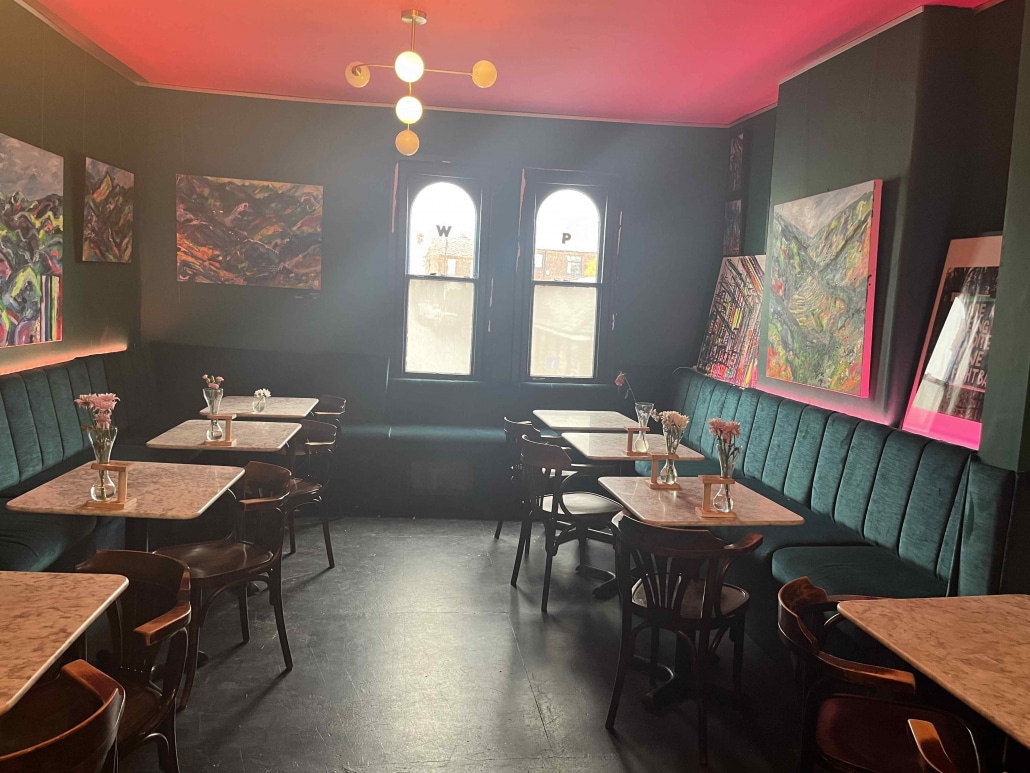
Emma Evans is an acclaimed artist, whose canvases you can check out in the upstairs bar. She also hosts regular life drawing classes there. Probably more my thing is Wandering Palate’s Wine Club Wednesdays with free corkage.

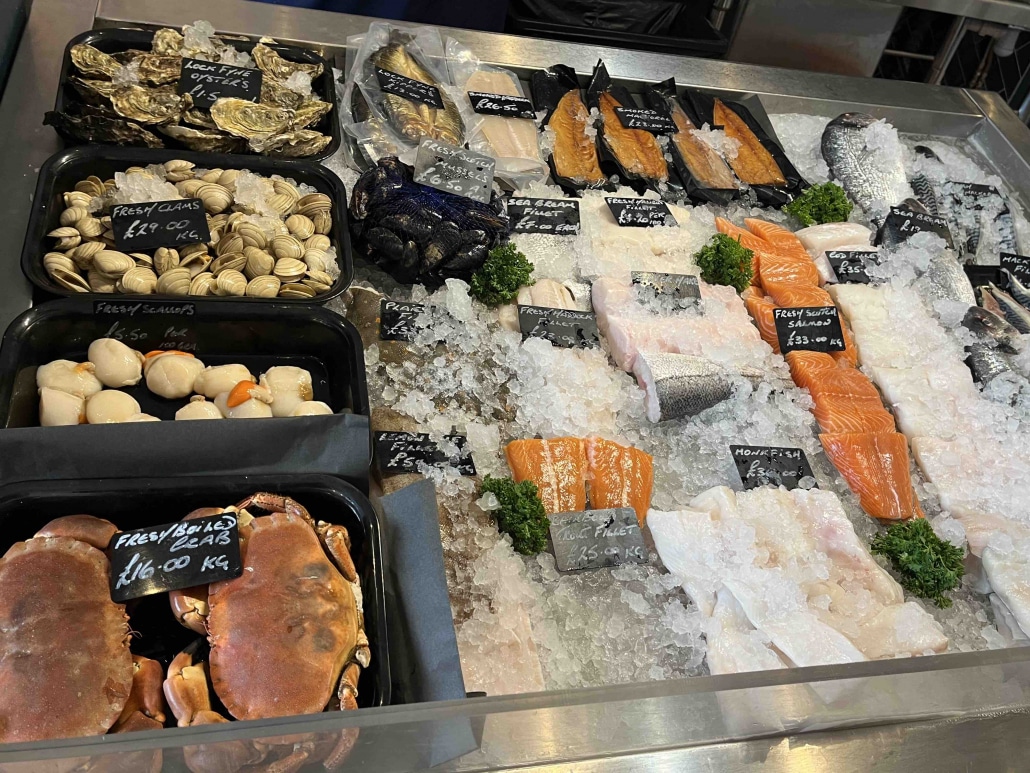
Farm & Fish at 190 Monton Road equally aspires to be a community hub. It recently hosted a Polish wine tasting. But my eyes were for the meat and fish counters. I inevitably splashed the cash, coming away with a kilo of  ox cheeks and a robust boiled crab. I could happily have sat in the window there with a further wine as evening fell… to survey the Monton ‘paseo’.