Tag Archive for: seafood

Always, always, ‘Next Christmas we’re going to celebrate beyond the confines of home, that’s the plan.” And always we dust off the tree, have a heritage turkey (or goose) delivered to the door and I somehow defy frazzling in a long kitchen stint, where I inevitably overcook the roasties… etcetera.

A family commitment for the ages, it won’t be any different this year. Toasts will be raised to missing friends and a special one to Captain Smidge, the gourmet chihuahua, who left us in June 2023. We finally scattered his ashes on his favourite stretch of path above the Colden Valley on my wife’s birthday last summer (Champagne was involved). 

He was always a Christmas dog (yet not just for Christmas). For various festive therapy reasons he suffered being dressed up as Santa or an elf, but we placated  him with chunks of his favourite partridge or pheasant. One Boxing Day on our head-clearing amble to Hebden Bridge a daft whippet off the leash bundled him into the canal. He enjoyed drying off in the pub and being made much of by strangers. He made friends easily.

Which brings us to the East Neuk of Fife. Smidge never made it there. It was made for him. Our stay on that stretch of the Scottish coast was to be the perfect dog-friendly travel writing assignment. Then 10 days before, his 16-year-old heart gave out. We went ahead with our glamping booking outside beautiful Crail with his beautiful ghost by our side over four blazing June days. 

It enabled us to make the most of the Fife Coastal Path, but we wished he could have scuttled by our side. Our favourite spot (main picture, above) was the tip of Ruby Bay – home to the impossibly romantic legend of naked bather Lady Janet Anstruther. Full story to follow!

There’s still much of the 117 mile path to tackle. Now that’s an incentive to return. 

A December up there will inevitably be different. The latest plan, is to celebrate Christmas 2026 in a sea view cottage I’ve got my eye on. In Crail, jewel in this necklace of colourful fishing villages strung along the North Sea coast below St Andrew’s. King James II of Scotland described them as “a fringe of gold on a beggar’s mantle”.

Ideally there would be a log fire… and a couple of local lobsters and South African Chenin Blanc in the fridge. And, of course, the Captain’s spirit will be vividly with us. Ghost of Christmas Always Present (without the costume, I promise, Smidgey). 

Just 10 miles separates Elie (closest town to Ruby Bay) in the south to Crail in the north with buses every hour if you want to walk some of the loveliest stretches of the Coastal Path without doubling back on yourself. Let me introduce you to Crail, Cellardyke and Anstruther, St Monans and Elie/Earlsferry…

A quest for the wholly Crail

This is golfing country. The two courses at the tip of Fife Ness belonging to the Crail Golfing Society, seventh oldest club in the world. It was founded in 1786 by 11 solid citizens in the Crail Golf Hotel, still there on High Street, offering a fine example of the town’s predominant 17th century architectural style, crow-stepped gables, often whitewashed. These, pantiled roofs and mature tree-lined avenues lend a very continental feel to the place. Given a royal charter by Robert the Bruce in 1310, Crail was an important medieval trading post, despatching cargoes of coal, textiles and salted herring to the Low Countries. 

Gaze up at the weathervane above Crail Tolbooth’s Dutch tower and instead of the customary cockerel you’ll find the shape of a ‘Crail capon’. These were haddock smoked traditionally in a chimney ‘lum’. There’s an auld Scot expression “lang may yer lum reek” (long may your chimney burn), wishing you long life. 

Wander down to the sheltered harbour along cobbled streets, taking in the colourful courtyard of Crail Pottery. Or approach via Castle Walk, which gives you the best photo opportunity. At weekends in season Reilly Shellfish Shack will sell you freshly landed and cooked crab and lobster.

Ancient Cellardyke and newbie Anstruther

A storm at the end of the19th century trashed atmospheric Cellardyke’s own harbour, so the herring fleet shifted down to adjacent Anstruther (pronounced Anster). Today the bobbing boats are mostly pleasure craft and there are two terrific tourist magnets. The Scottish Fishing Museum is a hugely informative portal into a life at sea that even today is fraught with peril  We took coffee in its smart cafe as we awaited our morning Sea Safari with Isle of May Boat Trips.  

From £30 a head you get a one hour 15 minute seaborne circuit of this National Nature Reserve, six miles out in the Firth of Forth, with informed commentary from the skipper. The craft, a rigid inflatable, holds 12 and hits some impressive speeds to add a thrill element, but the real reason to visit May is the wildlife. It has a history involving monks, vikings, smugglers and a lighthouse built by Robert Louis Stevenson’s dad, but all play second fiddle when, as we did, you come upon basking seals, a cormorant colony and cliffs teeming with guillemots, terns, razorbills and the uncommon black-backed gull. 

Star of the show, though, has to be the puffin (one collective name an ‘improbabilty’). These colourful, comical birds arrive on the Isle in April and depart by the end of summer; we caught them at their zenith, surfing the choppy waves then upturning into the deep in search of sand eels and the like. In the distance a real bonus – a minke whale briefly cresting the waves.

All that fresh sea air and spume had unleashed the inner gannet in us, so after disembarking we piled into the award-winning Anstruther Fish Bar. The battered haddock and chips were as good as it gets – believe the hype. It’s not the only Premier League chippie in town but, as elsewhere, the tradition is under threat. Read Tom Lamont’s quite brilliant East Neuk-centric long read in The Guardian.

Traditional pubs may be struggling too and in truth this isn’t good cask beer territory, but the Fife Gold was in fine, foamy fettle in the secluded garden of The Dreel Tavern, which dates back to the 18th century. As does so much of Pittenweem, next stop on the trek, the last working harbour.

Pittenweem is a quirky delight

St Fillan had his own version of a phone torch. His left arm mysteriously lit up, allowing him  to accomplish his seventh century holy tasks in his cavern tucked into the rock face off Bruce’s Wynd, the steep descent to the harbour. You pay a quid for a key at the Pittenweem Chocolate Company or The Little Gallery on High Street. St Fillan’s Cave is a mite underwhelming like Father Ted’s Holy Stone of Clonrichert, but overall I liked the understated charm of Pittenweem, a great place to putter around. Life beyond fish and chips? Gentrification on the way? The smart harbour front Dory Bistro and Gallery is one of the Good Food Guide’s 100 Best Local Restaurants.

Or if you just fancy a picnic pick up some cheese from the St Andrews Cheese Company from their farm just outside the town. Their Anster cheese is handmade to a traditional recipe using unpasteurised milk from their Friesian Holstein cows.

Salt of the earth on the way to St Monans

In the 1790S, salt was Scotland’s third-largest export, after wool and fish. Local coal heated the evaporation pans where sea water was boiled into sea salt. At the end of the mile and a half coastal walk from Pittenweem you encounter the St Monans Windmill, used to pump up the water. Almost ancient history now – the industry was abandoned in 1823. The settlement itself takes its name from a 9th century hermit who landed here and built a cell; later a Dominican monastery sprang up and, tucked into the cliffs above the waves, the Auld Kirk (1256) is among Scotland’s most ancient churches. We were keen to see the famous 18th-century model of a ship suspended from its ceiling, but the great door was locked.

The multi-coloured seafront of St Monans proper is very much of today, a perfect seaside retreat. A good place to chill with small plates, coffee and craft beer is the Giddy Gannet, but the real foodie draw is East Pier Smokehouse on the quayside, painted a vivid powder blue. To sit on its top deck terrace with the sea lapping behind you and a large whole lobster to yourself (great value at £50) is crustacean bliss. It comes in a cardboard box with proper chips or potato salad and implements to lever the tastiest bits from crevices. Chef patron James Robb smokes seafood Scandinavian-style in the downstairs kitchen and everything on the menu is desirable, down to the well-chosen wine and beer offering.

Elie – here life really is a beach

What saves St Monans from the crowds is the lack of a beach. Ellie makes up for it with its sweeping demerara coloured strand that attracts the affluent weekenders up from Edinburgh. You can appreciate its vastness from the terrace of the excellent Ship Inn. More sheltered is Ruby Bay on the approach. This was where in the 1770s the beautiful Lady Janet Anstruther indulged in naked bathing from Lady’s Tower on the headland (nowadays a gaunt ruin). A bell-ringer paraded through town to warn ’no peeking’ at this wild swimming pioneer. 

‘Good walk spoiled’ and all that, the town and its extension Earlesferry draw in the golfing crowd to two acclaimed courses. My own personal magnets lie on the A917 coming in – all of them foodie, naturally.

First there’s the top quality Ardross Farm Shop (access also from the Coastal Path), then one of Scotland’s best seafood merchants, David Lowrie, on an industrial estate on the fringe of St Monans – it supplies Manchester’s wonderful new Bar Shrimp – and finally the food and culture complex called wryly Bowhouse.

Rising from flat fields, it resembles a gargantuan barn. The small food and drink businesses occupying spring into life mostly from Thursday onwards, though the impressive organic butchery is open from Tuesday. 

On the second weekend of each month Bowhouse hosts a popular market with traders streaming in from across Scotland, but it is also home to regulars such as the Baern Bakery, Scotland the Bread’s flours and much more. Central to the whole project is Futtle organic brewers They run a taproom, vinyl stall, bottle shop for artisan ciders and natural wine, alongside a catalogue of DJs and performers. They also brew unfiltered beer flavoured with foraged seaweed or yarrow and a green hop pale ale from “fresh, Fife-grown organic hops, which went from the bine into the beer on the same day.” Coolest kids on the Neuk? You got it.

Where to have our Christmas feast if the dream comes true

The best place in East Neuk has to be the Kinneuchar Inn, which recently came in at No.2 in the Good Food Guide’s Top 100 Pubs. This whitewashed 7th century hostelry lies a couple of miles north of Elie. Its logo references the local custom of curling on the frozen waters of nearby Loch Kilconquhar. A much better idea is to curl up in the Inn and enjoy chef patron James Ferguson immaculately sourced, daily changing menu. Seafood, as you’d expect, is a star attraction. They are closed  on Christmas Day but this year’s Christmas Eve menu offers the likes of Chargrilled Inshore Squid & Skordalia, Rotisserie Lamb Leg & Tzatziki or Baked Cod & Roast Red Peppers. Who needs turkey? Well, perhaps Captain Smidge might have preferred it.

For full tourism information on the area visit Welcome to Fife.

There are many approaches to eating and drinking in Glasgow. At the elevated end the city finally boasts two Michelin-starred restaurants – Cail Bruich in the West End and Unalome by Graeme Cheevers in still hip Finnieston. At the other end of the Clydeside spectrum you could test out the old Glasgae  stereotypes, deep-fried Mars Bars and Lorne Sausages, Buckfast and Irn Bru. I don’t expect these fixtures feature if you sign up for any of the recommended Glasgow Food and Drink Tours run by Gillian Morrison. In their palce you’ll be left with the sense of a city celebrating amazing Scottish produce and revelling in its burgeoning food and drink culture.
I’ve been lucky to visit the city frequently in recent years and have charted the sea change (yes, fresh seafood is to the fore). Below are my personal tips. In no away definitive, especially where pubs are concerned. As everywhere, hospitality is in a state of flux.  Along the way old stagers such as Rogano have gone and Gamba up for sale, while new places are springing up post-Pandemic. Next time I’m up Brett on Great Western Road is first on my bucket list after a rave review by Grace Dent in The Guardian.

THREE OLD FAVOURITES

If you’d asked me two years ago, The Ubiquitous Chip would have been nailed on. Since its launch in 1971 this converted stables had championed Scottish cuisine from homemade haggis with champit tatties, carrot crisp and neep cream to more contemporary takes on seafood such as seared Islay scallops with pumpkin fondant, malt crumble and seaweed butter. The glorious courtyard dining space only enhances the dining experience  – though I am also partial to the dram-filled warren that is the Wee Pub at the Chip. 

The culinary emphasis didn’t shift after founder Ronnie Clydesdale, the ‘Godfather of Scottish Cooking’, died in 2010, then two years ago his family sold the Chop to Greene Kings Metropolitan Pub Company. Ouch. Cheeringly head chef Doug Lindsay stayed on, but a recent scan of the menu didn’t encourage, so I’ve not been back.

The Gannet is a fledgling in comparison. Its chef/patron Peter McKenna gets credited with kickstarting the vibrant Finnieston dining scene from this narrow converted tenement. Also championing the best of Scottish produce? It goes with the territory. Now over a decade old, The Gannet stays true to its original mission statement: “Something that evokes Scotland’s Hebridean coastlines, giving a sense of place and landscape and at the same time offering a cheeky culinary reference as a moniker for those with large appetites: ‘The Gannet’ was christened.” For a sophisticated  take on those fecund fishing grounds check out the Cured Wild Halibut/Soy /Yuzu/Horseradish or the Tarbert Lobster/Barra Cockles/Summer Vegetables.  

My other two stalwart faves are near neighbours in the revitalised Merchant City (home to my recent hotel base, The Social Hub). A real pioneer in this quarter is Hebridean Seamas Macinnes, since 1983 at the helm of the Cafe Gandolfi in Albion Street with his sons now joining him. The L-shaped room offers a stylish rusticity featuring Tim Stead wooden furniture and quirky artwork. I particularly love the stained glass ‘A Flock of Fishes’ by Glasgow School of Art alumnus John Clark in the dining room (my main image).  Comfortable in its own skin, Gandolfi? Definitely. A snip of a house white, a Veneto Bianco, went equally well with a dish of Mull scallops and mackerel and a fillet of coley in an Arbroath smokies cream. Stornoway black pudding with potato rosti and pickled mushroom was equally comforting. In another season I might have gone for the Haggis (from Cockburn’s of Dingwall), neeps and tatties. The name, by the way, is nothing to do with Lord of the Rings. It’s a homage to the legendary camera maker. 

Just around the corner on Blackfriars Street, the Babbity Bowster  pub takes its name from an old Scottish wedding dance. If the weather’s warm the temptation is to linger in its countrified beer garden at odds with the urban surroundings. That would be to neglect the high-ceilinged cool white bar with a fine array of Scottish ales. The building itself, converted in 1985, is a 1790 tobacco merchant’s house, all that remains of an entire street built by Robert Adam. There is a restaurant and en-suite bedrooms upstairs.

SEAFOOD

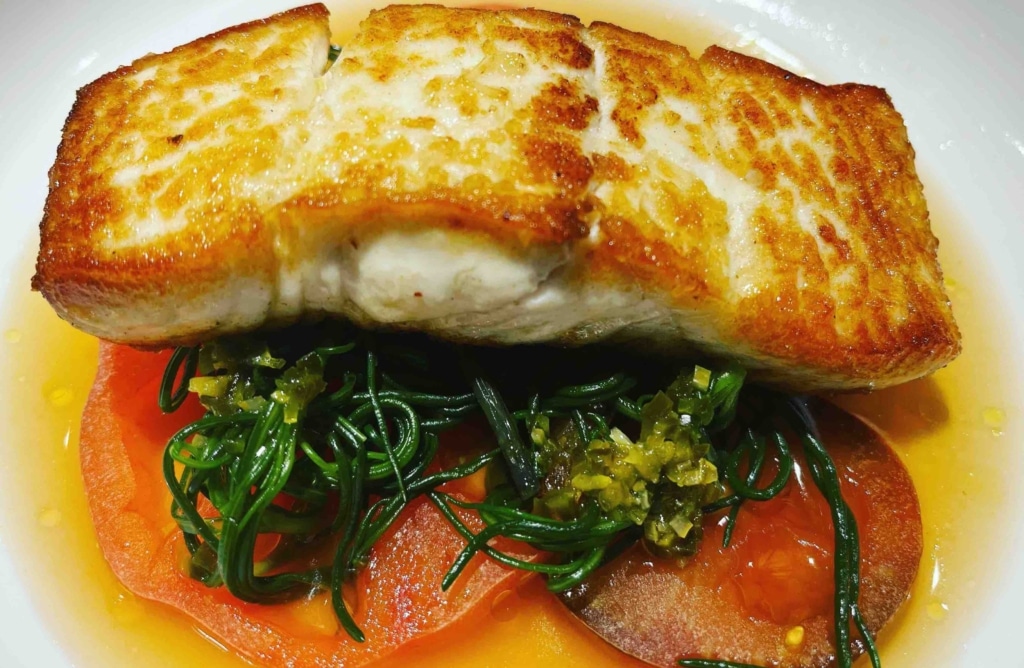
There are fine seafood places along Argyle Street – among them the aforementioned Gannet and The Finnieston – but the pick of the catch for me is Crabshakk, This stripped back temple to fish has a sibling up at The Botanic Gardens, but I‘m in my happy plaice (sic) here. On my last visit, eating solo in this narrow space, I regretted not begging a large bib as I messily tucked into a whole crab at the counter, followed by a quite wonderful tranche of halibut in a tomato miso with a draping of monksbeard.

PIZZA

You do wonder when a hugely successful indie food business is sold. Take Manchester’s own Rudy’s Pizza, currently being rolled out across the land. Three months on from their own sale Glasgow’s own Neapolitan crust champions Paeseano still boasts just the two outlets – each with its own oven installed by Gianna Acunto,of Naples, no less. After a torrid train journey up I’m given a quiet corner table in the heaving Miller Street original, off George Square, self-medicating with a Negroni before demolishing a very large anchovy-caper-olive overload pizza at a modest price. Magnifico. 

PASTA

In the shadow of that great Victorian boneyard, The Necropolis  (3,500 monuments and  commemorating the city’s grandees plus 50,000 other soulsin unmarked graves) you’ll find Celentano’s, tucked away inside the sandstone pile of the Cathedral House Hotel. It’s the dream project of chef Dean Parker and his wife Anna, whose two-week Italian honeymoon inspired them towards this pasta-led project. Too dreamy? They also worked at some serious restaurants in London before moving to Glasgow a couple of years ago, swiftly earning a Michelin Bib Gourmand. Antipasti, primi, secondi are on the menu but there’s not a check tablecloth in sight. Their home-made pasta is the draw. Who could resists a Dexter beef ragu with your papardelle? Sourcing is immaculate – Mossgiel organic farm provides the ricotta for the agnolotti with cavolo nero and squash.

MEAT

Glasgow is not short of steakhouses. My own favourite for dry-aged prime cuts is 

Porter and Rye on the Argyle Street strip. A regular on the World’s Best Steak Restaurants list, it is a carnivore’s dream with side dishes such as bone marrow mac and cheese and beef dripping thick cut chips. The cocktails too are among the city’s best. Another carnivore’s treat is the Beef Wellington with beef fat carrots and horseradish (£90 for two to share but worth it) at Glaschu Restaurant & Bar, which takes its name from the Gaelic word for Glasgow, meaning “dear green place”. It’s set in the building of the 19th-century Western Club and is technically the club’s restaurant, but, unlike other members’ rooms, is open to the public.

VEGAN

Stereois housed in a Rennie Mackintosh building once home to The Daily Record in a lane near Glasgow Central Station, this bar combines a vegan kitchen with a basement live music space. Pair a Queer Brewing Fight Like Hell DIPA with an arepa with mole and tomato salsa or banana blossom tacos before taking in an indie gig downstairs. Under the same ownership, big brother Mono Cafe Bar is half a mile way

CRAFT BEER AND TAPROOMS

If Stereo gives you the taste for craft beer, the rest of Glasgow doesn’t disappoint. Current  mecca is down on Southside – Koelschip Yard with 14 cutting edge keg lines. Centrally try The Shilling Brewing Company, a groundbreaking brew pub in former bank premises. Order a flight of four third pints, ranging from the crisp blonde ale The Steamie to the more complex, coconut-roasted porter Black Star Teleporter. Pizzas are the main ballast, but they also offer ‘crust dippers’  that tip the hat to Glasgow with a chilli and Irn Bru flavour jam. An even more spectacular brewpub setting is to be found on Glasgow Green in the East End. The West Brewery and Restaurant occupies a corner of a carpet factory built to echo the Doge’s Palace in Venice. Why? That’s the only way wealthy citizens living nearby back in the 1890s, would allow such commerce to sully Glasgow Green. Today they’d have to put up with the clink of glasses in one of the city’s best beer gardens, serving tipples brewed according to the Reinheitsgebot – the German Pure Beer Law of 1516, specifying the use of only malt, hops and water. ‘Glasgow Heart, German Head’ is one slogan. There’s lots of Teutonic fodder to accompany. Ideal accompaniment? Their St Mungo, a full-bodied hoppy hybrid of a Bavarian Helles and a North German Pils

In sharp contrast a converted box factory is the base for the Drygate Brewing Company – a collaboration between acclaimed independent Williams Bros of Alloa and big brother Tennent’s. It is Glasgow’s interpretation of a US-style tap with 16 keg and four cask lines from the in-house brewery, viewed through a glass panel, and the requisite amount of bearded hopheads. Some excellent value food, too. On the sunny afternoon of our visit we just lazed on the large rooftop beer garden and supped pints of Bearface Lager. It is the antithesis of the mass market Tennent’s lager brewed next door, just to the south of the Necropolis. As a family business it predated the graveyard by centuries and there were once genuine fears the arrival of corpses would contaminate its spring water supply.

OLD SCHOOL PUBS

My fave remains The State Bar, off Sauchiehall Street, with its glorious Victorian interior, fine cask ales, Oakham Green Devil IPA a regular, and Glasgow’s longest-running blues jam. Some legendary musical talent has graced The Scotia on Stockwell Street, arguably the city oldest pub. All back in the day – the likes of John Martyn, Hamish Imlach and the Sensational Alex Harvey Band plus Billy Connolly and Gerry Rafferty when they were still folk duo The Humblebums. The look of the place, low and dark, has barely changed since the Sixties – the 1860s when there was a famous music hall next door. In 1792 when the Scotia was established, it was a favourite watering hole for sailors and folk heading for the Clyde penny ferry. Such ghosts of the past live on here – recorded paranormal activity is off the scale. 

INDIAN

Traditionally, a night of Glaswegian excess involving Tennent’s and dram chasers would end in the generic curry house. Like the rest of the UK there’s now a choice of Indians reflecting the subcontinents’s regional cuisines. For me the most attractive is that of the South – the land of coconut and curry leaves, dosas and moilees. In the Merchant City Dakhin has the menu for me. Recommended dish the palkatti dosa, where the rice and lentil batter crepe is filled with their homemade paneer. They also own the shinier Dhabba further down Candleriggs, which champions the very different food styles of North India.

FACT FILE: The latter was arguably the closest restaurant to my most recent hotel base, The Social Hub. Shiny new, this is the first UK venue for the Social Hub network, founded in Amsterdam over a decade ago by a Scot with a vision of combining affordable hotel space with student accommodation. There are now 23 scattered across Europe.  

I travelled from Manchester to Glasgow courtesy of Transpennine Express and sampled their new addition to the First Class experience, their West Coast Kitchen Menu.

For full Glasgow tourism information visit Peoplemakeglasgow.com and, if it is your first time, go for the City Sightseeing Tour, which you can hop on and off.

I pen this ode to the Gurnard on the day Sir Ian McKellen has decided not to return to the West End stage as Falstaff. Understandable fears were raised for the 85-year-old legend, AKA Gandolf,  after he crashed into the orchestra pit during a performance at the Noel Coward Theatre and was rushed to hospital.

Robert Icke’s Player Kings is an unashamed showcase for Sir Ian, compressing into one play Sir John Falstaff’s ‘star turns’ across Shakespeare’s King Henry IV Parts One and Two (plus his poignantly reported demise at the start of Henry V). We saw the production  at Manchester Opera House and were transfixed by this bravura, fat-padded tour de force.

So how does this tally with arguably the most unprepossessing of our sustainable fish? Well, think unsustainable PM Rishi Sunak’s cunning plan for National Service. On the eve of the Battle of Shrewsbury Sir John regrets lining his own pockets through his ‘recruitment policy’: “If I be not ashamed of my soldiers, I am a soused gurnet.”

Typically Tudor, the gurnard’s fillets have been marinated in vinegar. This week in the Medlock Canteen, one of Manchester’s most interesting new eating places, I was served it whole off the barbecue as a fish special of the day, the bulging eyes in its large, prehistoric head staring regretfully up at me from a pool of melted butter, infused with lemon and chive. It was quite glorious, the firm white flesh easily detached from its bony, spiny frame. It’s not so easy to fillet the fish raw,

My fine specimen was apparently fresh in that day, so no qualms about ordering, Once home, though, I checked the Marine Stewardship Council sustainability charts to find the red gurnard fishery may be in choppier waters than I envisaged. I was certain it was the red common in the Irish Sea and off Cornwall, not the larger grey or tub varieties found elsewhere. The Project Inshore assessment, based on MSC sustainability standards? “Red gurnard – often a favourite among those encouraging consumers to choose alternative species – fared less well in the report (than cod and cockles). A shortage of data about fish stocks and limited management of catches mean that there is an urgent case for investment to improve our understanding of this fishery. While a shortage of data doesn’t mean that the fisheries are inherently unsustainable, that data will be increasingly important as the species gains in popularity and catches increase.”

Further choppy waters as I discover a Wildlife Trusts warning to avoid during the breeding season, May-July, while the Cornwall Seafood Guide advises against eating during the spawning season, April 20 August. Whatever, only consume mature gurnard, ie longer than 24cm. My lunch certainly measures up to that

My old friend Clarissa Hyman has written the most scholarly appreciation of the gurnard: “(The red’s) bright-red coloration and pinkish-silver mottling has led to it being called the ‘grondin rouge’ in France and the ‘Engelse soldaat’ in the Netherlands, a reminder perhaps of the uniforms their former red-coated enemies across the Channel once wore…

“One immediately noticeable, and somewhat unnerving, feature is the fish’s long, thin lower rays or tentacles of the pectoral fins. These contain sensory organs used to sweep the sea bed for dinner – the small fish, crustaceans and other invertebrates that lurk in the sediment. They derive their more gentle, alternate American name of sea robin from the large pectoral fins with which they seemingly ‘fly’ through the seas.” 

Once they are caught, then, what’s the best cooking method? The usual fillets fried, grilled poached or baked, all taking advantage of its firm white flesh, almost stickily akin to monkfish, that other ugly bruiser from the deep. Bouillabaise or soup would certainly accommodate the gurnard. Gone are the days when they seemd only fit for lobster bait. Endorsed by chefs, the gurnard is upwardly mobile. Quite a feat for a bottom-dwelling species given to making an unappetising croaking noise. Moral of the tale – who needs Sexy Fish when you’ve got Ugly Fish?

Quiz time. David Beckham and arguably the finest 18th century Falstaff – what have they in common? Answer: a fierce looking fish bearing the thumbprint of St Peter. 

Back in 2015 Becks took a then teenage Brooklyn fishing off Dorset. There’s a picture of the pair proudly brandishing their catch – the second biggest John Dory ever landed on that particular boat, the skipper told them. That might make it 3kg. It’s hard to tell given the bizarre body. This delicious expensive fish is certainly no looker. So thin, head on it is nigh invisible as it sneaks up on prey, rapidly sucking up the likes of shrimp and squid.

Those distinctive black marks on either side of its dark olive yellow body, clustered with spines? Supposedly they are the thumb and finger-prints of Apostle Peter, who snatched the fish out of the Sea of Galilee and removed a gold coin from its mouth to pay taxes he owed. Its Latin name is Zeus Faber. So godlike connections but that hasn’t saved it from nicknames. The French traditionally dubbed it ‘l’horrible’ or “poulet de mer”.  One theory from a certain Jules Verne has its proper name springing from ‘janitore’, St Peter’s role at the gates of Heaven, but it’s more than likely an anglicisation of Jaune Doré (golden yellow).

It certainly shone brightly for the Irish-born Shakespearean actor James Quin, maybe bested as Lear to David Garrick but a legendary champion of the John Dory’s merits. When asked what sauce suited its surprisingly fleshy fillets he responded by announcing the banns of marriage between ‘delicate Ann Chovy, and good John Dory’. 

You’ll find the tomb of this maverick ham, accused of both murder and manslaughter in his roistering prime, in the Abbey Church, Bath. Where, as quoted by Alan Davidson in his scholarly North Atlantic Seafood, “Quin’s celebrity as the prince of epicures was well known, and where his palate finished its voluptuous career.”

So a man after my own heart. I’ve been been basking in a kind of John Dory afterglow since acquiring, at Wellgate Fisheries, Clitheroe, the best specimen I’ve ever had. Carefully avoiding those nasty barbs, owner Giles Shaw filleted it from its heavy bones and substantial head, which later yielded a perfect fumet for a paella.

Just 40 per cent of body weight left, but what to do with the slightly sticky but firm flesh? The mercurial Quin recommended poaching in sea water and serving with a lobster or shrimp sauce, according to Davidson, who suggests cider and cream might be the way to go. Instead I reverted to Mistress Ann Chovy and followed the Mitch Tonks recipe for Grilled Dory with Anchovy Vinaigrette, replacing the customary braised fennel (a sprinkle of fennel pollen sufficing) with steamed spinach. I also scattered over a few mussels from the batch destined for the paella. Thanks to the quality of fish it was the equal of the dish we ate at Tonks’ flagship, The Seahorse, on Dartmouth Embankment. https://seahorserestaurant.co.uk

By all means follow my lead but wait until autumn. John Dory is not on any endangered quota, but breeding season is May to August… You can purchase it online  from Tonks’ own Rockfish Seafood Market. Another good John Dory source is Trident Fresh Fish Or maybe give Giles a ring and enjoy the drive up to Clitheroe to collect.

Eliza Acton noted in Modern Cookery for Private Families (1845) that John Dory, “though of uninviting appearance is considered by some persons as the most delicious fish that appears at table”. I concur heartily.

GRILLED DORY WITH ANCHOVY VINAIGRETTE AND BRAISED FENNEL

Ingredients:

150 ml /¼ pt olive oil

150 ml/ ¼ pt white wine vinegar

150 ml/ ¼ pt white wine

2 bay leaves

1 tsp fennel seeds

1 tsp coriander seeds

1 sliced lemon

1 small onion, finely sliced

3 cloves garlic, finely sliced

3 Florence fennel bulbs

John Dory fillets – they will vary in size but allow about 180g / 6 oz per person

Salt

For the anchovy vinaigrette:

6 salted anchovy fillets

1 tsp Dijon mustard

3 tbsp white wine vinegar

100 ml double cream

1 tbsp parsley, finely chopped

Squeeze of lemon

Black pepper

Method:

Pre-heat the oven to 175C. First braise the fennel by gently heating the olive oil, wine vinegar, wine, bay leaf, fennel seeds and coriander seeds in a pan.   Then add the sliced lemon, onion, sliced garlic and fennel.  Cover and cook in the oven for about an hour until the fennel is tender. Remove from the oven and allow to cool at room temperature in the braising liquid.

Make the anchovy vinaigrette by pounding the anchovy fillets in a pestle and mortar.  Then put the mustard in a bowl with the vinegar and whisk together slowly adding the olive oil until those the three ingredients emulsify. Then add the anchovy paste and gently whisk in the cream. Add the parsley, a squeeze of lemon and plenty of black pepper.

 Heat the grill then brush the John Dory fillets with a little olive oil and season with salt.  Grill for 6-7 minutes until lightly golden.

To serve put two or three chunks of braised fennel and onion mixture on a plate, place the fish alongside and drizzle with the anchovy vinaigrette.

Quite a day. Two Glasgow bucket list musts ticked off in a couple of hours: Crabshakk restaurant and Barrowland Ballroom. A reward – after two intense days of butcher awards judging – of a feast of fresh seafood in still hip Finnieston, then Father John Misty in full sardonic flow at the legendary Gallowgate venue. For all this I had the blessing earlier in the day of Salvador Dalí’s Christ of St John of the Cross, as breathtaking as ever on its astral perch in the Kelvingrove Museum.

It’s the kind of fervent embrace I’ve come to expect from that great sandstone city on the Clyde. On previous visits I’ve rigorously researched Glasgow’s thriving food and drink scene or thrown myself into its rich musical heritage. Yet there were always gaps to be filled. 

Thanks to the judging invitation from the Q Guild (from bacon to rib-eye via sausages, pies and stir-fries  it was a lot of fun) and a handy Merchant City base in the Moxy Hotel I had time to explore. Extra time thanks to rail strikes extending my stay.

King Tut’s, St Lukes, Oran Mor – I’d done them all on that specifically music trip but I’d only stared across at the Barrowland from The Gate cocktail bar opposite. In the absence of a gig that night, the famous Technicolor lights were out. The raucous Father John Misty concert more than made up (even if lonesome me was adopted by the Glaswegian equivalent of Beavis and Butt-Head bellowing out the lyrics they knew by heart).

Dining solo at Crabshakk was an altogether more sedate affair. Even if I probably needed a large bib as I messily ripped into a whole crab at the counter. Contender for most beautiful fish dish of the year so far followed – a tranche of halibut in a tomato miso with a draping of monksbeard.

This brilliant ‘high tea’ made up for a less convincing dining experience the previous evening (in company). Tucked into the Cathedral Hotel, Modern Italian Celetano’s came with a glowing recommendation from The Guardian’s Grace Dent but, fennel salami and a couple of accomplished pasta dishes aside, it didn’t deliver the promised bliss.

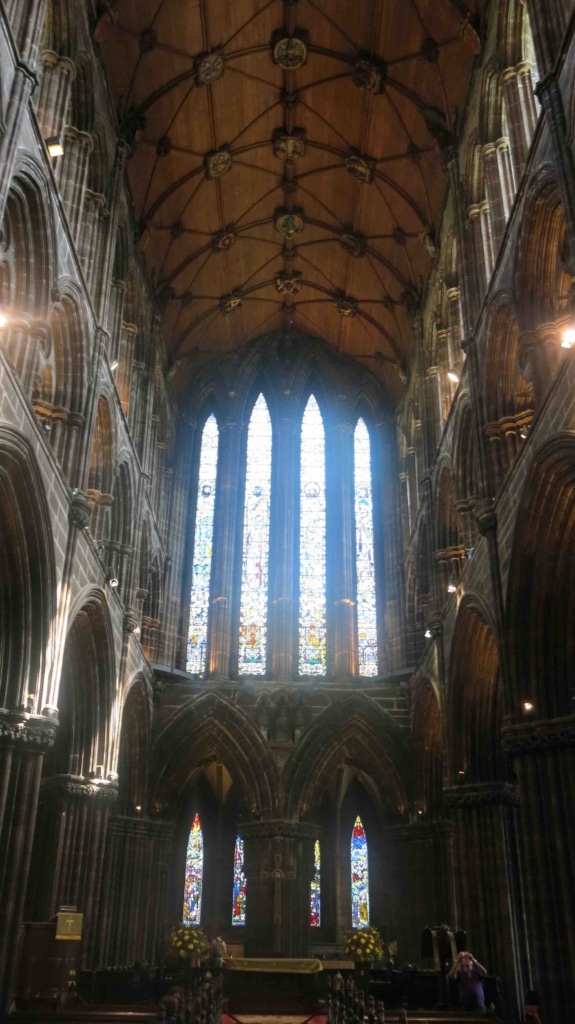
It is handy though for a mooch around the spooky Necropolis http://www.glasgownecropolis.org, which looks down on a cityscape packed with steeples and towers. This 19th century burial ground, inspired by Paris’s Pere Lachaise, lies on a ridge close to the city’s pre-industrial centre, rubbing shoulders with the magnificent Gothic Cathedral. For 700 years St Mungo’s tomb has drawn pilgrims there.

The Necropolis boasts 3,500 monuments, commemorating the city’s grandees. More than 50,000 other souls keep therm company from their unmarked graves. The cemetery upkeep is an ongoing challenge, my guide from the Friends of Glasgow Necropolis, told  me as we stood beneath the hulking monument to religious reformer John Knox (“he is Edinburgh, nothing to do with us really.”). 

Glasgow-based journalist Peter Ross in his great celebration of Britain’s graveyards, A Tomb With a View (Headline, £20), says the Knox statue “functions as a sort of Statute of llliberty, representing all that is stern and joyless and unbending about Scotland”.

His own favourite Glasgow cemetery is the gentler Cathcart on the Southside; for Gothic ghoulish, though, head for the Southern Necropolis, across the Clyde from Glasgow Green. Here the eerie marble figure known as The White Lady, marking the grave of two women killed by a tram in 1933, is said to turn its head to gaze at passers-by. It’s also the alleged haunt  of the Gorbals Vampire with its iron teeth and lust for the blood of local lads.

Such urban folklore is enough to make you turn to drink. Wee drams aside, in this city that’s traditionally been courtesy of Tennent, whose mass market lager brewery looms to the south of the Knox Necropolis. As a family business it predated the boneyard by centuries and there were once genuine fears the arrival of corpses would contaminate its spring water supply.

Tennent’s commitment to the present is undoubtedly its collab with Alloa indie brewers Williams Bros – Drygate, a converted box factory on its estate, now home to a US-style craft brewery tap. The Drygate labels are designed by students from the Glasgow School of Art.

Which leads us neatly to the on-going saga of the iconic Art School building designed by Charles Rennie Mackintosh. This was extensively damaged when a blaze broke out late in the summer of 2018 as it neared the end of a £35 million restoration project following a previous fire in May 2014. The scaffolds and tarpaulins remain in place. It will be years yet before the current rescue project is finished.

Born in 1868, policeman’s son Mackintosh had none of the advantages of his architect contemporaries, just more talent. To get a taste of the whole Art Nouveau-dabbling coterie sign up for one of the Mackintosh’s Glasgow Walking Tours or download as self-guided leaflet.They all offer an illuminating introduction to the city as a whole, particularly the Victorian and Edwardian era where the vast wealth raised through shipbuilding and the sugar and tobacco trade was lavished on elaborate architecture.

I like the fact that Mackintosh designed both the main newspaper offices – the Daily Record, all glazed brick down a dark lane (home to vegan cafe and gig venue Stereo) and the Glasgow Herald building, deftly transformed into the panoramic Lighthouse, Scotland’s Centre for Architecture and Design (alas still closed post-pandemic).

My favourite building on our tour had to be James Salmon Junior’s Gaudiesque 1902 St Vincent Street Chambers, nicknamed the ‘Hat Rack’. Small in stature, Salmon was nicknamed the ‘Wee Troot’. A recent bridge over the Clyde has been dubbed the ‘Squinty Bridge’. Yes, the city’s dry humour takes no prisoners.

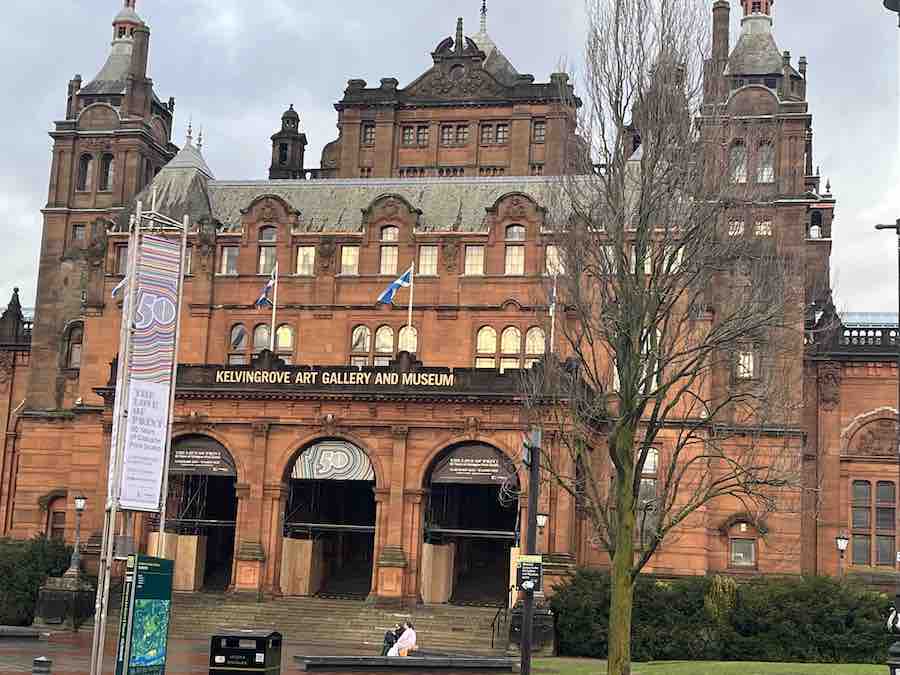
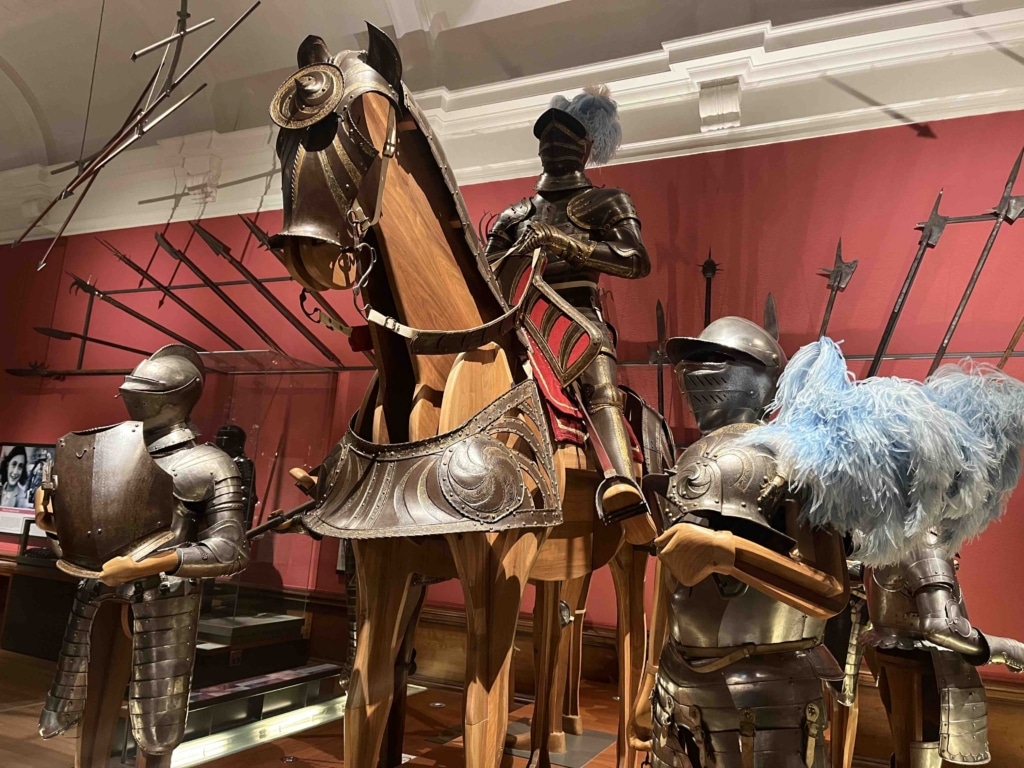
So much architecture but Glasgow has a wealth of green spaces, too. I love Kelvingrove Park and the shady promenade along the River Kelvin, taking in Kelvingrove Museum. This fantastical Spanish Baroque pile, spring cleaned inside and out two decades ago, houses an eclectic collection of art and objects that takes your breath away – from Rembrandts, Van Goghs and Salvador Dali’s vertiginous Christ of St John of the Cross to armour collections, a stuffed elephant and a dangling Spitfire. It’s a great place to acquaint yourself with Mackintosh’s influence and the contemporaneous Glasgow Boys art movement.

The interior of the Glasgow house where Mackintosh lived with his wife and artistic collaborator Margaret Macdonald has been reassembled up the hill within the University of Glasgow’s Hunterian Museum, featuring a definitive collection of his austerely beautiful furniture. From here it’s a 10 minute walk to Byres Street and the West End – the 

Bohemian buzz of which would surely have delighted the dandy in Mackintosh.

Much quieter, in the southern approaches of the city, is another green oasis voted Europe’s best park in 2008, Pollok Country Park, home to elegant Pollok House, great walks and the remarkable Burrell Collection Museum – a Mackintosh-free zone.

It is a custom-built modern repository for more than 9,000 objects bought by Sir William Burrell, cannily using wealth from the family shipping business. Chinese, Muslim, Medieval and Gothic treasures rub shoulders with Impressionist masterworks. Unlike the Kelvingrove, it feels uncluttered, displaying at any one time only 20 per cent of the collection. The landmark building reopened last spring after four years shut for water damage repairs.

t is too far out to feature on Glasgow’s official hop on hop off (with commentary) City Sightseeing Tour. This double decker’s circular route takes in the East and West Ends as well as the revitalised banks of the Clyde with its award-winning, Zaha Hadid-designed Riverside Museum. Offering an even more fascinating insight into the city’s past is the People’s Palace on Glasgow Green in the East End. This sandstone working class cultural centre charts everything from tenement poverty to entertainment diversions. Attached to it is the elegant Victorian glasshouse of the Winter Garden. 

Nearby you’ll find the Templeton Carpet Factory, modelled on the Doge’s Palace in Venice, and, of course, The Barrowland Ballroom. Take them both in on a walk up to Merchant City, once home to mansions and markets and now reinvigorated as a creative hub after decades of decay, good for bars and people watching. 

It’s after here you start to recognise the grid system Victorian expansion built along. Look down long straight streets and you’ll inevitably see church towers or steeples framed at the end. It all feels uncannily American. Indeed when the cityscape turns hilly around Blythswood Square it might almost be San Francisco. Not quite sure John Knox would have approved.

Fleeting tips on food and drink in Glasgow

Crabshakk, as you already know. The Finnieston original has spawned a sibling up at the Botanical Gardens. Other fish restaurants of note – the veteran bistro Gamba on West George Street and the Finnieston Bar and Restaurant. Nearby Gannet, paragon of Scottish sourcing, is probably the pick of the Argyle Street eateries.

Pubs? My fave remains The State Bar, off Sauchiehall Street, with its glorious Victorian interior, fine cask ales and Glasgow’s longest-running blues jam. In the Merchant City, a short stroll from the Moxy Hotel, is the laid-back Babbity Bowster, named after an old Scottish wedding dance and offering a countrified beer garden at odds with its urban surroundings. Current craft beer mecca is down on Southside – Koelschip Yard with 14 cutting edge keg lines.

Chewing the fat, not literally, on a dinner date with a fellow food critic (her review bosses were paying) we inevitably strayed into the territory of ‘What’s been your most memorable meal?’, knowing on both sides of the table there had been plenty of contenders over the  years.

Memorable can mean many things, of course, not all of them positive, but we’ll pass on the shockers. And when we are just seeking superlatives, there is so much to factor in – setting, service, food and wine obviously, company, though if you are reviewing professionally that shouldn’t be taken into account. 

So when I say ‘boning’ clinched it for me I am not being naughty about my all-time favourite. I was swept off my feet by the whole ceremony of separating a turbot from its skeleton. Not just any turbot but the legendary wood-grilled rodaballo (wild turbot) of Getaria on the Basque coast. Elkano was the shrine we sought, arguably Spain’s finest fish restaurant. Unique for a Michelin starred establishment with its cast iron grills glowing intensely outside the front door.

There are several wood grill rivals in this working fishing village but all will doff their berets to this prow-like restaurant way back from the harbour where the legend was born 50 years ago. Founder Pedro Arregui’s magic formula – the fish sprayed with his own oil and vinegar elixir and then grilled for a precise 12 minutes.

Of late the rodaballo dish has travelled far. It’s the calling card of Brat in London, where chef Tomos Parry readily acknowledges its Basque origins; up north it’s a speciality of Joe Botham’s Baratxuri in Ramsbottom and Manchester’s Escape To Freight Island, while a steady stream of 4kg turbot are shipped up from Cornwall to the mighty Pennine grill of the Moorcock at Norland

All quite rewarding but in situ? Accept no substitutes. We had managed to get an Elkano lunch booking on a Monday. It was for 2.30pm, giving us plenty of time for a limbering up hike along the wild sea front to Zarautz and back through vine-clad hills producing the seafood-friendly, tart local white, Tzakoli.

Settling into the comfort of Elkano, we asked Pedro’s son and keeper of the flame Aitor to pick a Tzakoli for us from a dozen on the list, all at very affordable prices. He  recommended one particular example, whispering “it’s the only one not from the Getaria area. You’ll love it.” We did and it was a perfect match.

We did. It went well with an unforgettable ‘warm-up’ parade of seafood – notably txangurro (spider crab meat, sautéed with leeks and garlic, spiked with brandy, put back in the shell and browned) and the classic Basque treat, kokotxas (hake throats in a salsa verde). “Just tip them down your throat – it’s all about texture,” said our mentor. 

Yet, of course, this was just the supporting cast for our Wild Turbot to share. It had arrived on the quay at 8am with the rest of the catch. If it had been landed a few hours earlier it wouldn’t have made the cut. Elkano only sticks the freshest fish on its embers. 

Did our rodaballo rock? You bet. We were introduced to the fish by our server before it was salted, sprayed and grilled

Encountering the result on the plate was magical. Aitor, who now runs today’s more stylish restaurant, gave us a masterclass in the various constituents of the fish as he carved them – from the delicate fillets and dark fatty back sections, ribs from which he leached the gelatin with his knife and the succulence of the cheeks. The simple accompaniment just the sweetest of roasted red peppers. 

At dusk we walked off the long lunch around the San Anton headland, known as Getaria’s Mouse because of its shape. It protects the working harbour, once a famous whaling port,  from the Biscay swell. 

Our lodging was the Pension Katrapona. We had arrived the previous evening via a 50-mile shuttle from Bilbao Airport. Equidistant is San Sebastian. The Getaria grills greeted us. At nightcap time the wood smoke from two floors below forced us to retreat indoors from our balcony with its great view of the harbour. We found supper refuge at Jatatxea Iriba in the old town where we devoured a supper of house-cured anchovies, then langoustines and monkfish – from the outside grill naturally.

How did Elkano get its name? From one of Getaria’s two great sons. Balenciaga and Juan Sebastian Elcano make an unlikely pairing. One, the gay son of a sailor and a seamstress who rose to be Paris’s 20th century king of couture, the other an iron man mariner, who after Magellan’s death completed the first circumnavigation of the Earth with a skeleton crew. 

Born 400 years apart, both men are honoured in the town. Balenciaga with a vast modern museum housing 3,000 of his creations, attached incongruously to a palace once home to his aristocratic mentors. Elcano with two statues, the more impressive crowning an old bastion overlooking the port, and his name on the restaurant shrine to the blessed rodaballo.

He’s buried in a less secular place of worship, Getaria’s fortress-like seafront church, San Salvador, which dates from the 14th century and slopes oddly as if it’s about to launch like some fantastic Gothic galleon. How appropriate.

Factfile

Neil flew from Manchester to Bilbao with easyJet. Below, nearer home, a ‘wildharbour’ turbot at the Moorcock and expert carving at Baratxuri.