Tag Archive for: Manchester

Of late I’ve been spending more time than usual inside Manchester railway arches. The usual hop-driven hideaways once promoted as The Piccadilly Beer Mile? Indeed, yes, but checking out a new wave of craft breweries with their roots in the first wave.

In what was the original Track premises on Sheffield Street I got previews of crowd-pleasing IPAs from Sureshot, new venture from James Campbell, a key figure in the rise of both Marble an Cloudwater.

That brewery is now safely launched and causing quite a stir. Next in the pipeline is a very different operation, Balance Brewing & Blending – an ambitious, barrel-fermenting labour of love from two brewers, whose day jobs are at Squawk and Track respectively. James Horrocks and Will Harris both share a common thread in their CVs that is a pointer to their leftfield brewing direction. Both worked for a certain Mike Marcus, regarded as the Che Guevara of the sour beer revolution. When Donald Trump was elected President maverick Mike cut all American hops out of his brewing process. Come Covid he mothballed his Chorlton Brewing Company and decamped to the Continent. Whispers have it Belgium or Estonia may be its next home. 

It was never in Chorlton, but at  69 North Western Street, three arches down from Manchester Brewing Company, where James and Will rent brewing kit and store the key to their operation, 30 neutral barrels, where the wood won’t overwhelm their blends’ fruit. It has been a patient past 12 months or more waiting for the contents to mature to attain the right balance. For the duo, committed to barrel fermented, mixed culture beers, BALANCE is more than just a slogan. 

Funky doesn’t have to mean over the top and their commitment to British ingredients is not  a radical political stance. Their use of malt from Fawcetts in Yorkshire, hops from Brookhouse in Herefordshire and British grown fruit makes a sustainable statement about terroir. Early days yet, but tasting their first release, from bottle, it all made immediate sense. 

Will Harris and James Horrocks have invested in quality barrels to pursue their brewing dream

The quietly glorious Saison de Maison will be launched at Cafe Beermoth in Manchester city centre from 6pm on Thursday, May 19. This is what Horrocks and Harris say about it: “It’s is a 6 per cent bretted saison, blended from beer fermented and conditioned in ex-red wine barrels before being dry-hopped with fresh UK Goldings. It is the first iteration of our house saison, which will be a regular release. The base beers were brewed using low colour Maris Otter and torrefied wheat to put a British spin on a classic Lambic-inspired base. The beer was hopped in the kettle with aged British Goldings and fresh Bramling Cross before being transferred to barrel to undergo fermentation with a carefully selected blend of Saccharomyces, Brettanomyces and Lactobacillus which we propagated in-house. 

“After the fermentation and conditioning phase we selected barrels which offered the particular funky saison characteristics we desired and developed a final blend. This blend was transferred onto fresh Goldings and stayed on the hops for a week before being bottled with nothing but priming sugar added. The bottle conditioning phase allowed all of the flavours to marry and develop until we were happy that the beer was well balanced and ready to release. 

“The end result is a beer with bright carbonation and pleasing acidity leading into a layered, fruit forward brett and hop character. We get funky pineapple up front with hoppy notes of gingerbread, ripe peach and subtle Perry pear. Gentle bitterness and herbal, woodruff notes meander into the long, clean yet complex finish. This is the first beer we envisaged as we dreamed of brewing our own beer and we are so pleased with how it has come out.”

So what tipped the balance to get the right blend for this project?

James Horrocks and Will Harris laid the foundation in 2021, working evenings and weekends to get Balance off the ground. It helped that their niche ‘side project’ was not in competition with the core range of their employers, Squawk and Track. The pair were buoyed by their shared enthusiasm for sour, wild and funky beer nurtured at Chorlton. It also helps to heve some serious brewing chops. Will has a first degree in biochemistry and an MSc in Brewing and Distilling from Herriot Watt University. So what can we expect from the 750ml sharing bottles they will be releasing, roughly a beer a month over the next year? 

Over to James: “Our aim is to produce nuanced sour and funky beers in a range of styles, from bretted saisons to Lambic-inspired creations, utilising both wild captured and lab propagated yeasts and bacteria. After fermenting in barrels for anywhere from four months to several years, we carefully select blends and move them onto hops, fruit or straight into bottle. The outcome is tart, complex, funky, fruity and ultimately an expression of our passion for these styles of beer and for the complexity that can be achieved through simple ingredients. Our next release is already in bottle too: Jam, a blend of saisons fermented in barrel then aged on damsons for four months.”

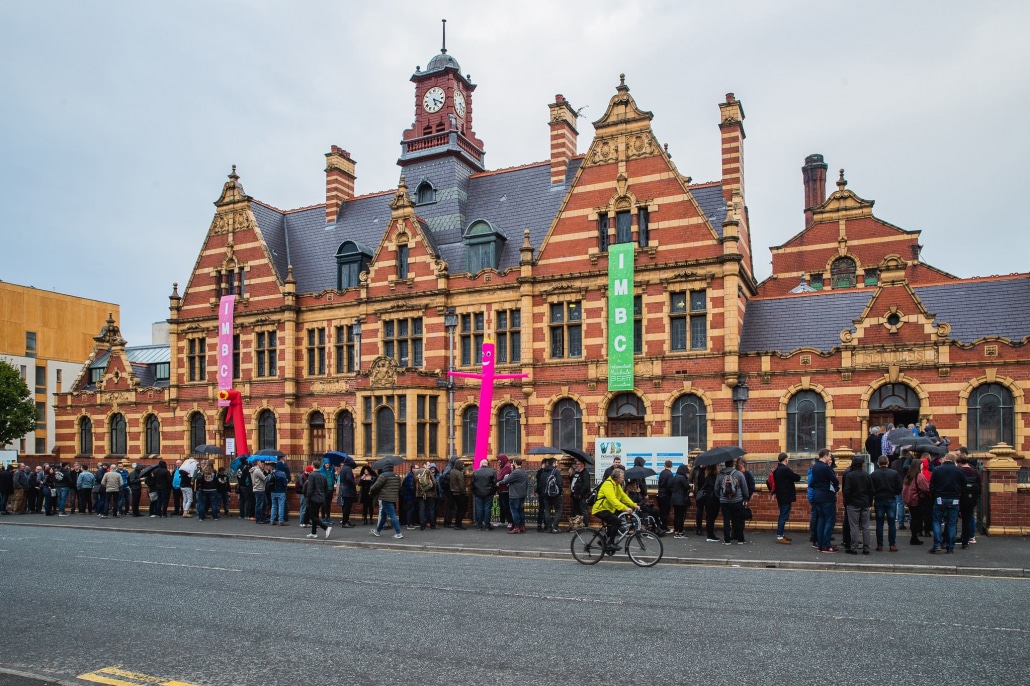
Saturday, October 5, 2019 was a blast. As we staggered out into a blurry Hathersage Road, clutching our souvenir glasses, to let the evening session brigade into Victoria Baths it was ‘see you again next year’ time all round. Little did we know then that the next Indy Man Beer Con would not be for another three years. The scheduled 2020 event never happened as the pandemic put up the shutters on boozy socialising (unless you were in Downing Street).

Now it’s back, the indoor Glastonbury of craft beer on our Manchester doorstep. The dates were announced in March (September 29-October 2) and this week on Thursday, April 14 the tickets go on sale, priced between £14.50 and £19, via this link. I recommend you don’t hang around. There’ll be a huge thirst for this four day event.

Victoria Baths has proved the perfect venue for arguably Britain’s finest beer festival

Early Bird tickets will be available, with both Port Street Beer House in the Northern Quarter, and The Beagle in Chorlton running pre-sale events on Wednesday April, 15 between 6pm and 9pm. To celebrate, the two venues will each be giving free treats out to those in attendance: Port Street will have slices of Nell’s NYC 22” pizza, while The Beagle will be cracking open mystery sharing bottles from past IMBC’s for some free tasters. 

Since its inception in 2012 Independent Manchester Beer Convention (Indy Man Beer Con/IMBC) has proved a world class showcase for the most forward thinking breweries from the UK and beyond. Everything about it (apart from the amount consumed) is different from the traditional beer festival. Not least the venue – the Grade II listed, architectural gem Victoria Baths.

Inclusivity and diversity are part of its appeal. And great street food. This year’s focus on sustainability and environmental awareness of the impact of the brewing industry sees special, cross-Atlantic collaborative brewing and innovative approaches to recycling spent products.

It’s a big step up from that first pioneering IMBC, created by Jonny Heyes, founder of Common & Co (Common, The Beagle, Nell’s Pizza, Summer Beer Thing). Just two rooms were used, hosting only 20 breweries. Nowadays more than 60 breweries will occupy every nook and cranny . From the main ‘stages’ in the old swimming pools to tasting areas and snug bars in the Turkish Baths, the breweries will pour a selection of their beers to thousands of beer lovers and converts alike.

Tickets are available for the following sessions: evenings 17:30-22:30, Thursday/Friday/Saturday; daytimes 11:00-16:00, Friday/ Saturday; and on Sunday 13.00-18.00.

Thanks to Jody Hartley for two of the images.

The unlikely spectres of Cliff Richard and Paul Kitching haunt my imagination as I dine (magnificently) in a new Manchester hotel that restores my faith in exposed brickwork and small plates. Both the 81-year-old former poster boy of British pop and the one-time enfant terrible of Michelin tasting menus are still going strong. So this is no elegy.

My whimsical connection is The Alan’s former incarnation as the Arora hotel, in which Sir Cliff was a stakeholder, and the cv of current chef Iain Thomas (below), who learnt his trade under Kitching, once of Juniper in Altrincham, a restaurant that married wackiness with true one star quality. A bit like Cliff?

All this was back in the early part of this century and Manchester has moved on. Well, not always. Many incoming hospitality operators feel the need for bee motifs, Hacienda colour schemes and gratuitous homages to Emmeline Pankhurst, Alan Turing or Tony Wilson. 

That could have happened to the old Arora, later the Princess Street Hotel, which had long shed its star appeal. I can’t ascertain when the five Cliff-themed rooms were consigned to history – there ought to be a plaque.

Briefly in the basement the Arora was home to a ‘destination restaurant’, Obsidian. How dated neon-raked images of that doomed project look now. What a contrast to the sustainable core of the refit from the new owners, which strikes you as soon as you enter off Princess Street. The outside sign is so discreet that the ambition of the opened-out lobby/bar takes you aback. Welcome to a relaxed, Shoreditch vibe that continues across the 137 bedrooms of this six storey Grade II listed edifice, all vibrant brickwork and distressed paint.

Congratulations (and jubilations) to the raft of designers name-checked on the website. I was particularly smitten with the lobby floor made from a collage of fragmented and discarded marble pieces, and a bar front “inspired by the M62 that runs round our city” (do they really mean the M60?) consisting of cigarette butts, weeds, flowers all set in a resin.

It is all a playfully welcoming surprise. Yet my object in visiting is to check our Chef Iain’s all-day seasonal menu, with more ambitious small and larger plates in the evening. I first met him when he hosted a game dinner at reinvented old boozer The Edinburgh Castle in Manchester’s Ancoats neighbourhood. As with his predecessor in the kitchen there, Julian Pfizer (now of Another Hand) he was given his head and then the owners seemed to get cold feet about culinary ambition.

The Alan strikes just the right balance. From the off it seems just the kind of relaxed setting and offering if you are a hotel guest but there’s plenty of well-sourced interest on the menu to make it a destination in its own right. Ah, the sourcing. Iain name-checks the city centre Butcher’s Quarter for his meat, while mushrooms are from Polyspore, and  microgreens from Aztec Farms, the vertical farming start-up based at Manchester Science Park. On the drinks list there’s beer from the city’s own Pomona Island and Cloudwater with caffeine input from Ancoats Coffee. The wine list, understandably from further afield, is uninspiring, alas.

Then, provenance one-upmanship. As spring gathers pace expect a very special vegetable input from the chef’s own allotment in Tameside’s Hattersley Projects. I trust him to make the most of it all on the evidence of his impressive track record – in kitchens since 16 with stints at Establishment in Manchester (where Rosso now is), at the “amazing” Paul Kitching’s Michelin-starred 21212 in Edinburgh and s sidekick to Davey Aspin, one of the iconic chef names in Scotland.

At The Alan we asked to try all eight small plates on the menu, all priced around £5 to  £6.50. Attractive looking snacks and meat could await another visit. The plan was to sit at the chef’s table with a perfect eye-line onto the open kitchen, but old bones dictated we retrenched to a booth. 

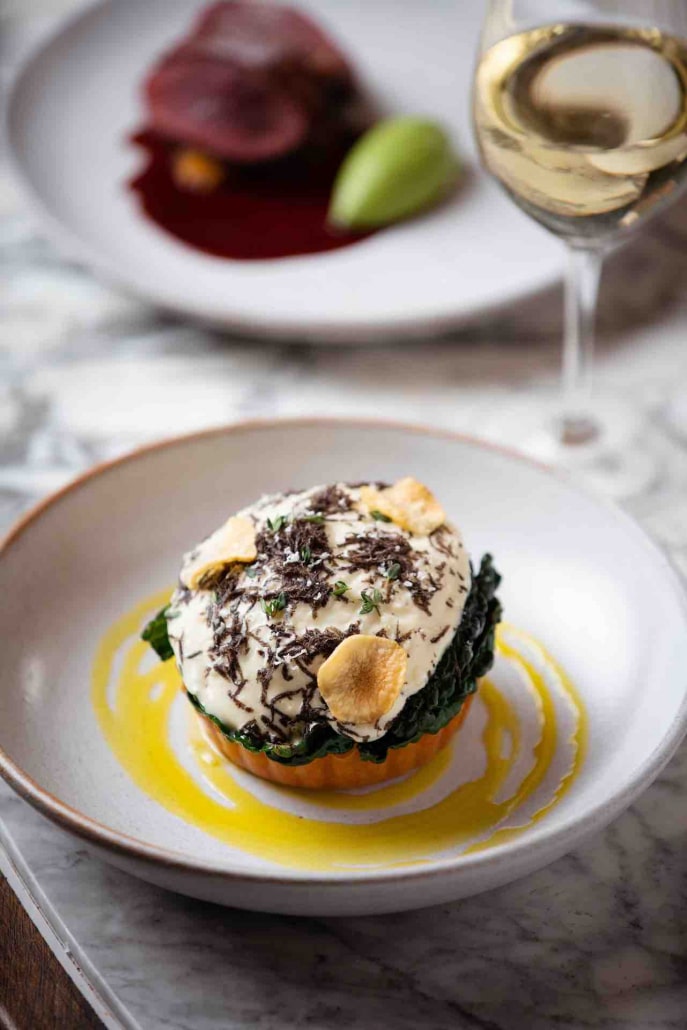
The dishes came in pairs and were a well-judged mixture of plant-based and flesh. No  duff note with either direction but we were most impressed with the vegan salt-baked celeriac with truffle and sherry vinegar and the cauliflower tikka with cumin, coriander and pomegranate, both managing to be earthy and yet delicate at the same time. Punchier was what threatens to become a Thomas signature dish – lamb fat hispi cabbage. Here lamb trimmings are rendered down and the fat is used to sous vide the cabbage, which is then warmed up in a lamb fat cream emulsion with braised shoulder.

There’s an equal richness to a potato and ox cheek terrine, an elaborate confection where 10 butter-brushed layers of finely sliced potato, a layer of ox cheek and a further 10 spud layers are sandwiched together, and served with blobs of French’s mustard and dill pickle gel.

Undoubtedly there’s an Ottolenghi influence going on. The likes of Confit thighs of Goosnargh chicken are glazed with pomegranate molasses, soy sauce aand mushroom ketchup and, also garnished with nasturtium leaves, that simple Turkish aubergine and tomato dishImam  Bayildi, that translates as “the Imam fainted”.

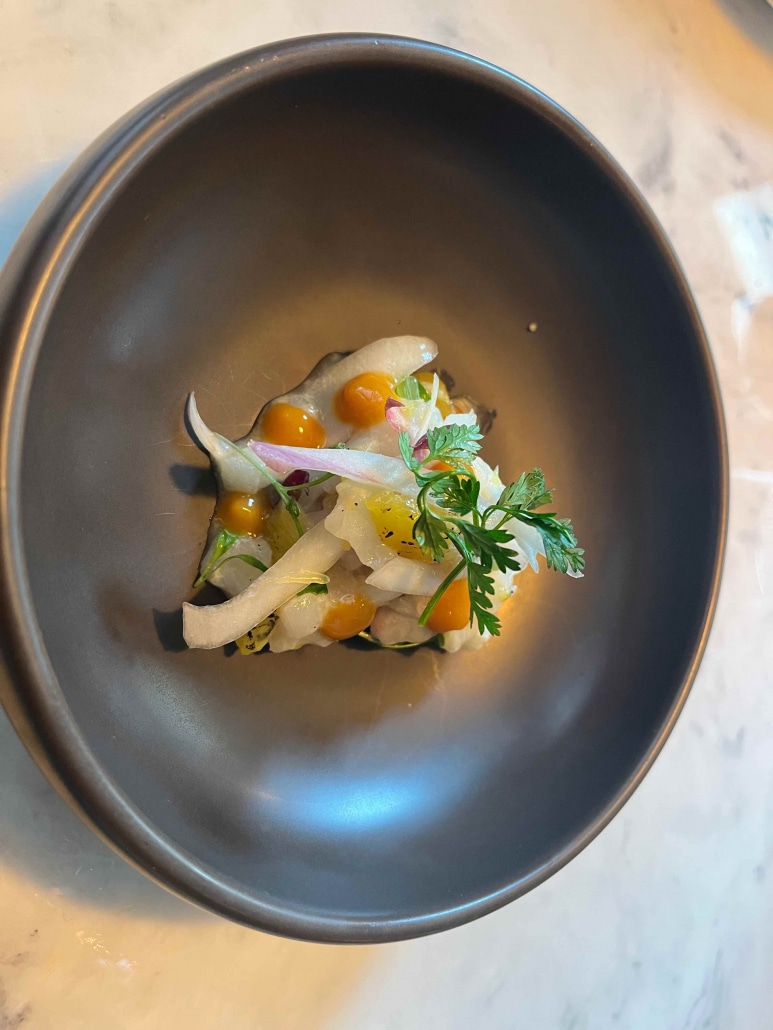
The Levantine spice palette of cumin, coriander, along with pomegranate arils also permeate Iain’s otherwise classical Cheshire beef tartare, but it’s all lightly handled. Ditto a ceviche of Scottish halibut, where chicory and but orange partner the fish rather than overwhelm. Is any hotel dining menu in Manchester (the obvious exception of Adam Reid at The French apart) better than this?

The Alan, 18 Princess Street, M1 4LG. 0161 236 8999. All rooms feature Emperor sized beds dressed in 200 thread count Egyptian cotton, 50” Samsung Smart TVs with Google Chromecast and pay-per-view movies, superfast Wi-Fi and Audio Pro Bluetooth speakers. The tech-forward hotel is also one of only four in the UK to offer Google Nest smart concierge in all its rooms. There are a variety of rooms on offer, the affordability of which gained The Alan a place in the ’40 UK Hotels For Under £100’ list in the latest Sunday Times.

Such an old chestnut that one about ‘policemen are getting younger’. Stats say different and anyway the phrase is a reflection of our own mortality creeping up on us. Chefs, now that’s another matter. Especially when they’ve been fast-tracked by a shrewd mentor. Step forward Tom Kerridge and Connor Black. The first is a ubiquitous figure across the English food and drink scene, his latest telegenic showcase judging on the revamped Great British Menu; the second, a 25-year-old who first entered the Kerridge orbit aged just 15, has just made the leap forward to Head Chef at The Bull & Bear, in Manchester’s Stock Exchange Hotel.

What immediately appeals on dipping into Connor’ debut menu is the sense that he is very much his own man. From the start, in the summer of 2019, the northern outpost of the Kerridge has borne the big man’s stamp. Less the standard of food (at a price) that brought him two Michelin stars at The Hand and Flowers in Marlow; more the accomplished pub food you’ll find at his second operation in that town, The Coach.

Connor worked his way up to be sous-chef at The Hand before becoming Head Chef of The Shed, that posh pub’s intimate 10-cover private dining room. His meteoric rise stated much earlier. At 13 he was working part-time in kitchens on the Isle of Wight; at 15 he arrived at the Hand and Flowers for work experience and stayed; two years later he was named Hospitality Guild Apprentice of the Year. All the while contributing to menu development. A spell away working on the continent contributed to his development.

So what does all this bring to the plate in Manchester? A smaller menu, like so many places post-pandemic, yes, but the dishes are noticeably less hearty, though following the Kerridge “refined pub grub” template.

Definitely a good thing in these eyes as I accept starter advice and sample  Roasted Hand Dived Orkney Scallop with Pickled Crown Prince Pumpkin and Smoked Butter Sauce (£24.50) It’s exquisite. Only 60 of these very superior scallops are delivered each week and the storms have stymied even that until, luckily the day of my lunch. A ‘table snack’ of Cheddar Cheese Scones with Marmite Butter is less successful. Dry scones and I’d forgotten how Marmite Marmite is.

 A pre-opening journo jolly to Marlow showed me how seriously the Kerridge team sources. Witness this again with my main Dry Aged Udale Duck Breast off the rotisserie with Caramelised Endive, Rhubarb and Garlic Sausage ‘Cassoulet’ (£34). Up to 40 days in Udale’s Himalayan Salt Ageing Chamber intensifies the flavour of an already benchmark Creedy Carver duck. But the dish is enhanced by the subtle bittersweet/sharp flavours Connor brings to the accompaniments.

Belly of Blythburgh Pork with Marmite Glazed Hasselback Artichoke, Smoked Hazelnuts and Pear Ketchup (£34) and Roast Cornish Cod with Sweet Garlic Puree, Lemon Braised Leeks, Shiitake and Mushroom Consommé (£33.50) also take the eye.

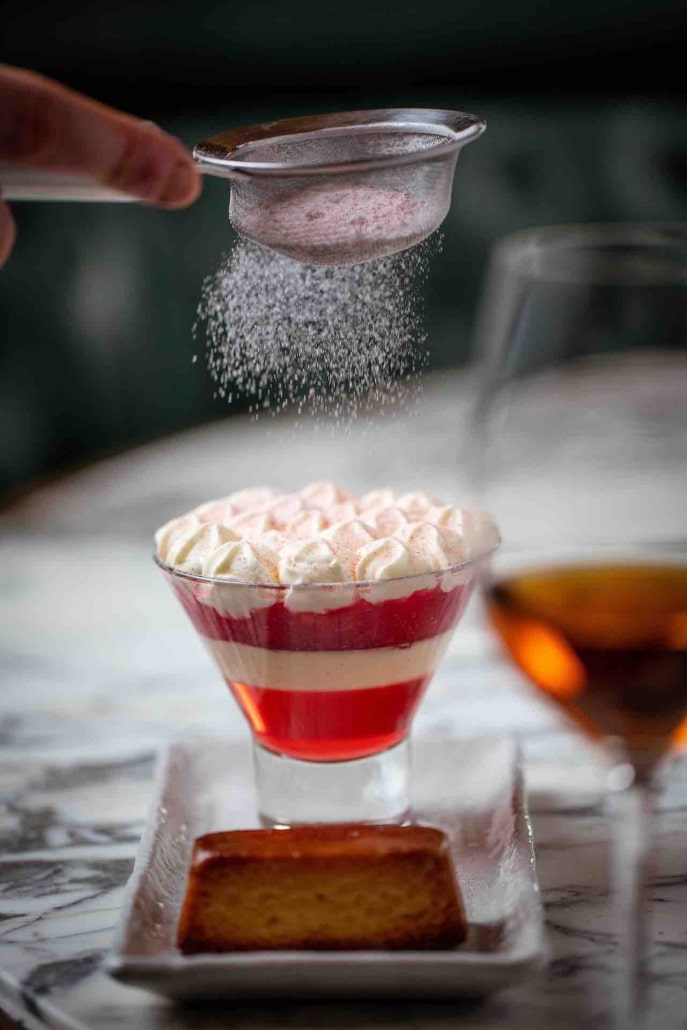
Rhubarb, bang in season, reappears in my retro trifle. All the puddings are £11.50, ranging from Warm Baked Eccles Cake with Lancashire Black Bomb Cheese to a Peanut Butter Crème Brûlée with Raspberry Jelly and Banana Yoghurt Sorbet.

The trading floor of the Grade II listed former Stock Exchange, is as imposing as ever, the large  open kitchen built to cater for a substantial number of covers. Meshed into the revamped B&B regime is a new Head of Food and Beverage, Matthew Griffin, who has previously worked under Jason Atherton. And Group Exec Chef the vastly experienced Warren Geraghty is regularly up from London. As a potential safety net? Will any of this phase young Connor? I doubt it.

The Bull & Bear, Stock Exchange Hotel, 4 Norfolk St, Manchester M2 1DW. 0161 470 902.

It is still hard to credit how much city development has escaped my attention while locked down in my Pennine fastness. Returning gradually to Manchester, I can suddenly feel adrift – and not always in a pleasurable way. Take Circle Square, a brooding behemoth of an apartment complex on the old BBC site off Oxford Road. 

OK, I first crossed its portals on a sullen, drizzly day but didn’t get the vibe promised by Vita Living: “Contemporary apartments and unreal amenities, all neighboured by leafy-green space in the form of the brand-new Symphony Park. Artisan shops, independent bars and restaurants surround Circle Square and make it a true urban oasis for everyone to enjoy.”

On the same day’s trail the ‘tropical garden’ at rival development Kampus looked ominously, bedraggled but the site opposite Canal Street offers a quirky mixed bag of living spaces, while formidable food and drink offerings (Pollen, Cloudwater, Beeswing) are on their way. Similarly, the giant towers of Deansgate Square are being serviced by quality delis (to spare the upmarket residents the trek to the Hulme Asda).

Circle Square’s own newly opened food hall is its most striking feature. Hello Oriental, an architecturally swirling three-floor, subterranean complex. boasts an Asian inspired bakery and café, a Vietnamese restaurant, a whole gallimaufry of East Asian street food options and a supermarket stocking an Instagrammable selection of packaged foodstuffs and colourful snacks hitherto available online. I suspect the small plate dining opportunities will prove more of a draw than the basement shop.

Strangely sterile the physical shop. Hardly anything on the shelves that counts as fresh. For that I’ll still be making my way down to ramshackle old Chinatown. We all have our favourite stores there. Mine is the Hang Won Hong on the corner of George Street and Booth Street. Chinese ingredients apart, it offers enough Thai and Korean staples to fuel my store cupboard. 

For my Chinese recipe needs I usually turn to Fuchsia Dunlop, for Korean Jordan Bourke and Rejina Pyo, for Japanese home cooking and ramen Ivan Orkin. Online for pan-Asian I’ve recently discovered mycookinghut.com/, an acclaimed blog by Leemei Tan-Boisgillot.

Here are a couple of her recipes, which feature in her latest cookbook, due out in June.

Korean Spicy Seafood Noodle Soup

Ingredients

1 tbsp sesame seeds; 15g dried wakame; 500g mussels, scrubbed and debearded; 1 tbsp sunflower oil; 1 onion, sliced; 3 garlic cloves, finely chopped; 1cm piece of root ginger, peeled and finely chopped; 4 dried shiitake mushrooms, soaked, drained and cut into thin strips; 1 tbsp Korean red pepper powder or cayenne pepper; chicken stock ¼ Chinese cabbage, core removed and cut into bite-sized pieces; 1 tbsp light soy sauce; 1 tbsp chilli oil; 300g raw, peeled large king prawns, tails left on, deveined; 400g squid, scored with a crisscross pattern and cut into bite-sized pieces; 500g cooked fresh fine egg noodles or 350g dried fine egg noodles; 2 spring onions, finely chopped.

Method

Heat a frying pan over a medium-high heat, then add the sesame seeds and dry-fry for a few minutes until the seeds begin to pop.Tip onto a plate and leave to one side.

Soak the dried wakame in a small bowl in warm water for about 10 minutes until it rehydrates. Drain, rinse and leave to one side.

Tap any mussels that are only partly opened and discard any that don’t shut. Put the mussels in a saucepan over a high heat and steam for 3–4 minutes, or until the shells open. Discard any that don’t open fully. There is no need to add any additional liquid to the pan, as the mussels will release their own liquid to steam in. Remove the mussels from their shells and leave to one side.

Heat the sunflower oil in a large saucepan over a medium-high heat. Add the onion and cook for 2–3 minutes until soft and translucent, then add the garlic and ginger and cook for 2 minutes, or until fragrant. Add the shiitake mushrooms and Korean red pepper powder and cook, stirring continuously, for 1 minute. Remove from the heat and add the chicken stock.

Return the pan to the heat and bring the stock to the boil. Add the Chinese cabbage and cook for 3–4 minutes until tender. Add the soy sauce and chilli oil and then add the prawns and squid. Bring to the boil for a few seconds, then reduce the heat to low, cover and simmer for 5–6 minutes, or until the prawns turn pink and are cooked through and the squid is tender. Three minutes before the end of cooking, add the mussels to heat through.

Divide the hot, cooked noodles into deep soup bowls, then spoon the prawns, squid, cabbage and mussels into the bowls.

Bring the chicken stock to a vigorous boil. Add the spring onions and prepared wakame to the bowls, then ladle in the piping hot stock. Sprinkle over the toasted sesame seeds and serve immediately.

Sichuan Mapo Tofu

This is a famous Sichuan dish that comes with a story. It is said that during the Qing dynasty, a restaurant on the outskirts of Chengdu was well known for a delicious, very spicy tofu dish, which was made by the restaurateur’s wife. She had pockmarks on her face, and as a result was called Mapo – ma means ‘pockmark’ and po means ‘elderly woman’, and her signature dish was called Mapo Dou Fu.

Ingredients

300g soft silken tofu, cut into bite-sized cubes; 1 tbsp sunflower oil; 1 cm piece of root ginger, peeled and finely chopped; 3 garlic cloves, finely chopped; 200g beef or pork mince; 2 tbsp chilli bean paste; 1 tbsp light soy sauce; 1 tsp granulated sugar; 1 tsp ground toasted Sichuan pepper; 1 tsp cornflour; 2 spring onions, roughly chopped. Serve with 400g cooked egg noodles

Method

Bring a large saucepan of water to the boil, then remove from the heat. Carefully tip the tofu into the water and leave to one side.

Heat the oil in a wok or frying pan over a medium-high heat. Add the ginger and garlic and stir-fry for 1–2 minutes until fragrant but not coloured. Add the mince, break up the lumps and cook, stirring occasionally, for 5 minutes, or until starting to brown. Add the chilli bean paste, soy sauce, sugar, ground Sichuan pepper and 200ml water, stir to combine and slowly bring to the boil.

Carefully drain the tofu and add it to the wok. Gently push the ingredients around the wok until the tofu pieces are coated with the sauce. Do not stir as it may break up the delicate tofu. Let it simmer for 3–5 minutes until heated through.

Meanwhile, combine the cornflour with 1 tablespoon water in a small bowl. Slowly pour the cornflour mixture into the wok or pan and gently fold through. Sprinkle over the spring onions and serve immediately with noodles.

• Both recipes are fromThe Asian Home Kitchen by Leemei Tan-Boisgillot, to be published by Nourish in hardback, price £20, on June 14, 2022. Leemai is a recipe writer, food stylist

The Manchester Rum Festival 2022 is on my birthday. Saturday, June 18. No need to bake a cake then – unless it’s laced with an abundance of Plantation Pineapple or the like.

Last year’s event, the fifth, was a gas. The city was awash with thousands of Pride revellers, all just glad to flash the rainbow after months of crossing their legs in lockdown. Not that the Mercure Manchester Piccadilly was some sedate refuge from party central. The rum flowed. As it will again next June, pandemics permitting – at the same venue.

I was so happy to touch base with producers I’d met before in the Caribbean, Colorado or even up on Manchester’s Red Bank. So much jollier than those commercial suburban gin rallies which end with couples just a tonic short of oblivion.

My preview for this website was on the global  peripatetic side. No need to be blase. In 2022 I’m going to be introduced to world’s biggest-selling rum in Tanduay from the Philippines and local newcomers Tameside Distillers. Debuts for Streamertail from Jamaica and Trinidad and Scratch (from tropical Hertfordshire) are also confirmed by festival organiser Dave Marsland. No idea but I’m willing to give them a sip. Whatever, live dangerously. Buy tickets here.

Salford Rum pop-up

Meanwhile, if you are feeling ‘rum-bunctuous’, there’s a Christmas-themed bar from the Salford Rum Company called Bar Rumbug, launching on Thursday, December 2. It’s located at their forthcoming Dirty Old Town Distillery and rum garden at Arch 33 on Viaduct Street, Salford and will be open throughout December, Wednesdays to Sundays (12pm-12am). 

The atmosphere will be eclectic at the upcoming Red Bank Festive Trail, the only slightly off the beaten track antidote to the fake jollity and craven rapacity of Manchester Christmas Markets. As 2021 draws to its uncertain close it has never been more important to support the city’s independents and I can’t think of any more indie stretch than the arches above the ‘Green Quarter’ (but don’t get me started on that nomenclature).

Contributing to the Festive Trail celebrations (Saturday December 4, 12pm-6pm) are The Spärrows, Blackjack Brewery, Beatnikz Republic, Popup Bikes, Base Bar, Runaway Brewery, Chapeltown Picture House, GFFdamian Dance Studio and admirable street food champions GRUB, who are the very definition of grass roots.

I’ve been along for the rollercoaster ride with founders Jason and Juliana Bailey from the start back in 2014 across a variety of pop-ups and venues, with a constantly shifting roster of vendors they have supported and mentored. It’s great to see them in a permanent home  now at the top of Red Bank – its bar, events space and street food garden a beacon of sustainability. 

In a Manchester scene where corporate developers pay lip service to ‘street food’ and ‘artisans’, hosting them for fixed terms to give cool cachet to their building schemes, GRUB is the real deal.

This Saturday afternoon may offer a promenade of brewery tours, live music, dance performances, street food, cinema screenings, fresh produce stalls and a record fair, but such vitality is not a one-off thanks to an eclectic (that word again) calendar of events and fairs GRUB generates. I recently attended a packed wine and cheese matching at their Red Bank HQ featuring Reserve Wines and Chorlton Cheesemongers.

GRUB have led the way in plant-based promotion, so no surprise to see they are hosting a 100 per cent Vegan New Year’s Party.

GRUB’S EXTRA FOR CONTACT

The Baileys’ events company also reaches out across the region in collaborations. Its latest project epitomises their approach. Following their major reopening earlier this year, Contact performing arts venue on Oxford Road has sought to reenergise its catering. 

GRUB have recruited for them a street food chef to watch – Michael Anderson, owner and creator of Tikka Chance On Me. Describing himself as “a gobby Irish Mancunian with a big belly and an even bigger mouth who loves life and lives to eat”, he quit his day job in 2019 and has since been creating ‘Northern’ dishes inspired by Indian ingredients, until recently from an Ardwick base. To match his culinary creations at Contact beers will be local, cocktails from the GRUB team. Opening hours will be 10am-8pm Monday-Friday, 12pm-8pm Saturday.

GRUB, The Red Bank Project, 50 Red Bank, Manchester, M4 4HF. Wednesday-Friday 4pm-10pm, Saturday 12pm-10pm, Sunday 12pm-6pm.

Priest Stranglers and Little Sparrows are not quite the odd bedfellows they sound. Both find common ground in the North Italian city of Trento (above), glorious gateway to the Dolomites. The Trentino has always been wrangled over by Italy and Austria; reaching its blood-stained apogee during the Great War. Witness the trenches and obsolete weaponry that still litter the mountain ridges. 

A benevolent legacy, though, is the intermingling of Germanic and Italian Alpine cuisines. That’s why you’ll find Strangolapreti (stranglers) and Spätzle (sparrows) sharing equal billing on the menus. The former, also known Strozzapreti, are usually a twisty pasta made up of just flour water and salt – but no eggs. Legend has it these were taken by the Church as tithes, leaving the peasants to fulminate against ‘priest-chokers’ or ‘priest-stranglers’ in anti-clerical hotbeds such as Emilia Romagna. Or maybe it’s just a reference to how you shape them by hand.

Up in Trento my Strangolapreti turned out to be a delicious local variant – spinach gnocchi. In truth, they weren’t a far remove from the Spätzle, noodles which do benefit from the presence of eggs. In the Swabian-German dialect the name translates as ‘little sparrows’, which they resemble in flight when shaped by a spoon in the traditional way.

From its South West German birthplace the dish has flown across all the Alpine regions, establishing itself everywhere and, most handily, is now nesting in a restaurant in Manchester, paying its own homage – The Spärrows.

Up on Red Bank chef/co-owner Franco Concli stays true to his own Trentino roots by making the Spätzle the traditional way, hand scraping them off the floury board and dropping them into simmering water. They are available both as savoury and, very apres ski, as a sweet, with cinammon, brown sugar and butter.

I like both the Spätzle and Gnocchi served simply with butter and sage (£7 for 110g), but on a recent visit chose the £9 version with guanciale (cured pork cheek), which was fabulously soothing. So too was a special of beetroot-tinctured agnoletti filled with ricotta and lemon. 

Russian style pelmeni dumplings with beef/pork garlic breadcrumbs (£8.50) were less satisfying. I should have gone for the Polish pierogi, little dumplings filled with melted cottage cheese and potato with soured cream and sauerkraut, a favourite from The Spärrows’ early days in a small archway near Manchester’s Victoria Station.

Since then the drinks list has gone from strength to strength under the stewardship of co-owner, Polish-born Kasia Hitchcock. It is as focused as the cool but cosy fit-out of a much larger arch space. A sake and spirits expert, she has been very canny with a wine list that majors in the very Alpine territory occupied by most of the food. Reds such as Lagrein, Teroldego and a Pinot Nero, are all there, from the Trentino/Alto Adige with their better known country cousin, Zweigelt from Austria. Its producer Sepp Moser also supplies the well-priced house white, a moreish Gruner Veltliner (the thinking person’s Sauvignon Blanc).

It all takes me back to Trento. I was in town for the annual Mostra dei Vini, the spring festival celebrating the wines of the Trentino region. After dark I mingled with the winemakers and was astonished at the variety of styles and local grape varieties used. Among the reds I liked the chunky Marzeminos, the more ethereal Pinot Neros and the flagship Teroldegos, with Muller-Thurgau outstanding among the whites. The delicate Nosiola, grown in a small corner of Trentino only, fared better as the base for the dessert wine Vino Santo (not Vin Santo, that’s Tuscan).

The jolly fest was held in the stunning Castello del Buonconsiglio. The original 13th century Castelvecchio (“old castle”) is in contrast to all the Renaissance add-ons in different styles erected to the glory of various Prince-Bishops who ruled here in the name of the Holy Roman Empire. Cardinal Bernardio Clesio, the greatest of these, was responsible for its vast artistic treasure house, the Palazzo Magno. I liked the earlier Gothic-Venetian loggia.

The castle also houses a grim reminder of the bloody Italian campaign during the Great War – the dungeon that housed patriot martyr Cesare Battisti before he was hanged  in the castle grounds. This was Austrian territory then and they regarded him as a traitor for fighting on the Italian side. A Battisti mausoleum tops a hill outside Trento. As I write this piece on our own Remembrance Day I’ve opened a bottle of Teroldego to salute the fallen on a front that most Britons have never heard of.

The Spärrows, 16 Red Bank (Green Quarter), Manchester, M4 4HF. 0161 302 6267. Word of warning: access is via a plain door with minimal signage.

One bane of a food writer’s life is reviewing a restaurant only to discover post haste that the menu’s about to change. Big time. Fortunately when I wrote up a September visit to Kala in Manchester my focus was on the glories of their featherblade steak, a signature dish across all the Elite Bistros group. 

This perennial stalwart remains on the new Autumn Menu, along with the obligatory truffle and parmesan chips, but there’s a whole raft of new dishes. I was alerted to their arrival by a chance meeting at a wine tasting of an old sommelier friend, who works out of Hispi, Kala’s sister restaurant in Didsbury. He was raving about a dish just created by Elite exec chef Richard Sharples  – a spiced field mushroom doughnut with sesame creamed spinach and caramelised celeriac gravy.

Solid reason to swiftly revisit Kala. It felt like fate when an invitation to sample the new menu suddenly dropped in my inbox. The doughnut turned out to be terrific, but the surprise package – and what a package – was the whole stuffed guinea fowl to share. OK, we were gannets to order both this and the surprisingly substantial doughnut as mains, ‘Mais nous ne regrettons rien’ as they say in Montparnasse or Montpellier.

Indeed there was something quintessential French bistro about this bird (let’s call it Le Pintade), while the fennel and apricot stuffing summoned up all our Christmases coming early. Better early than never with the current prophecies of festive dearth this year.

Our bird, encrusted with fennel and caraway seed, the moist stuffing lubricating the legs, came boned and ready to slice, a pool of pickled pear puree a neat enhancement for its  succulent interior. I couldn’t resist ordering the chips, but the bowl of the most delicate sauerkraut would have sufficed as a side.

We’d preceded the guinea fowl with that doughnut, its stretchy carapace harbouring  a teeming interior of braised fungi. Did it count as vegan? Jury’s out on the earthy creamed spinach, but the celeriac gravy was an inspired plant-based conceit.

Since the return to comparative dining room normality Elite Bistros boss Gary Usher has given his six venues leeway to branch out from the standard group menu, particularly with changing fish of the day picks. At Kala that Wednesday it was a choice of grilled whole plaice or pan-fried stone bass. 

My starter came from the fish specials because I’m a sucker for octopus and I was curious about how Kala’s daring combo would work, pitting the flamed cephalod against equally charred smoked corn and pickled currants. Maybe a red currant hot sauce gilded the piquant lily too much, but it’s typical of a hugely to be trusted menu that is still not afraid to push bistro boundaries.

An unqualified success was my partner’s starter, even if her initial qualm was: doughnut and dumpling in the same lunch? Fear unfounded. The dumpling was a light, gnudi-like pillow of great delicacy, as beautiful to look at as it was to eat, topped with grated Killeen cheese, all nutty and floral, a cauliflower puree base dotted with blobs of lemon and chive oils plus pickled shallot.

We finished off with Chocolate ‘Oblivion’ and poached pear with Sauternes jelly, the former with mint choc chip ice cream, the latter with walnut praline ice. Comforting autumnal bistro staples both. Wines by the glass had been appropriate for each dish and special mention for the Delicioso ‘En Rama’ Manzanilla that got us off to the perfect start, partnering Gordal olives and Don Bocarte anchovies. Isn’t autumn really rather wonderful?

Kala, 55 King Street, Manchester, M2 4LQ. 0161 839 3030. Reservations 0800 160 1811. The three course menu costs £40 for three courses, £35 for two. There’s a £16 supplement for that guinea fowl. There’s a limited choice bistro set meal available lunch and early evening.

Denver, San Diego, Portland, Seattle, Boston, and in a few one horse towns in between, the magnet of new wave American brewhouses and tap rooms has proved irresistible. So much less concentration required compared with serious winery tastings. Not that I don’t take beer seriously – but more as serious refreshment. No swirling, sniffing and spitting involved.

Sonoma County in California, with its Pinot Noirs and Chardonnays, is the laidback alternative to Napa. It’s the New World wine country of my dreams. If recent trips have involved dodging raging bush fires or coastal fog stifling the Pacific’s famous sunsets, well every paradise can slip into occasional purgatory.

But why would you name a signature beer after Sonoma, as Manchester brewers Track have? Could it be the presence in county seat Santa Rosa of Russian River Brewing Company, whose Pliny The Elder, technically a double IPA, is one of the most sought-after beers on the planet? For any geeks reading, it’s named after the Roman natural philosopher, one of the first to reference hops in his writings.

My own go-to West Coast IPA, on a less stratospheric level is Racer 5 from Bear Republic in downtown Healdsburg 15 miles north of Santa Rosa. Malty but hoppy, floral, resinous and bitter, it has always made me happy as did the original Bear Republic brewpub, now forced out of an upmarket tourist town because of running costs.

Clever Track Brewing Company in Manchester for opening their new tap room at Unit 18, Piccadilly Trading Estate, definitely not a tourist honeypot but, close to the equally revered Cloudwater at 7-8. I’ve loved their Unit 9 taproom as a cool space, but Track’s (see pictures below) has trumped it. It is quite beautiful. Seven years after launching in a Sheffield Street arch, and a succession of not quite appropriate bars, it has a home fit for its beers.

And at the recent launch Sonoma Pale Ale, as befits a beer synonymous with contemporary Manc beer culture, was available as both keg and cask. 

I prefer it as cask. All my lockdown beer dreams were of hand-pulled real ale, hopefully  through a tight sparkler. These came true when I interviewed Matthew Curtis about his Modern British Beer (CAMRA Books, £15.99). A superb range of Cloudwater beers were on the lines at Sadler’s Cat but I stuck to three pints of cask Sonoma, described by Matthew in his book as “A beer that revels in the softness of a smoother pour, while losing none of its strolling-in-a-citrus-grove character. Its gentle ABV of just 3.8% also makes it accessible.” No wonder it accounts for half of Track’s production.

Matthew was at the preview with us. Unlike Track founder Sam Dyson, who is laid up with a horrendous fracture sustained playing five-aside, and wife Mel, in the final throes of pregnancy. We toasted them royally in their absence across a beer range that is testimony to Sam’s love of hoppy American beers. And the Patel Pies residency provided the necessary ballast.

• If you love breweries with an on-site bar and great food check out another new arrival in Manchester, The Bundobust Brewery. And it does its own facsimile of Racer 5. Here’s my welcome to it.

©2021-23 Copyright Neil Sowerby unless otherwise indicated. All right reserved.