Tag Archive for: Hawksmoor

I’d wager Brian Boru was a prime steak man. As High King of Ireland you wouldn’t go into bloody battle against the Vikings on a plant-based diet. The hero’s full name indeed, Brian Boruma, means ‘Brian of the cattle tributes’. Owning beef on the hoof was a boost in the medieval bragging rights. 

Flash forward a thousand years to a new invader from across the sea. Hawksmoor has landed on Dublin’s College Green to a hero’s welcome. The upmarket UK steak  restaurant sets out its stall on its Dublin website: “Beef from small community farms from all corners of the island, grazing cattle on rotation on fertile Irish soil.” Apparently it has been easier to source premium grass fed, properly aged stuff in Ireland than for sister ventures in New York and Chicago.

Gazing up at the dramatic domed ceiling we were just glad they have also sourced such an amazing venue. So many of these vast bank recalibrations don’t quite get it right (witness the recent  Cut and Craft in Manchester). Here the petrol blue of the bar stool leather and the velvet banquettes is a classy match to all the wood panelling and Corinthian columns. Co-founder Will Beckett reckons it is the most striking of the 13 Hawksmoors (seven in London). It was at the 10th birthday party of their Manchester venue that Will invited us over. Impossible to resist and the food and service more than lived up to Hawksmoor’s own 20 year heritage. 

Of course, history is in these halls too. This was the great Bank of Ireland established in 1835 by Daniel O’Connell, ‘The Liberator’. They named Dublin’s main thoroughfare after this astute politico, who probably turned over in his hallowed grave when for a while the premises hosted a branch of Abercrombie and Fitch.

I like to think the ghost of Brian Boru was at our side as we shared a Chateaubriand  with beef dripping fries and creamed spinach after starters of native lobster and roasted currach scallops. Did he enjoy the Raul Perez Mencia red from Bierzo? We certainly did. He wasn’t having any of my Cherry Negroni.

We live the Castle dream near the site of an epic battle

In 1014 Brian Boru smashed a Norse-Leinster alliance at the great Battle of Clontarf, losing his own life in the process. 10,000 others fell in the slaughter that ended Viking rule in Ireland. Hours before our Feast of Hawksmoor we had visited Boru’s Well in Clontarf. The ‘Well’ is a drinking fountain erected in 1850 to mark where the Irish warriors refreshed themselves before triumphing on the battlefield. Allegedly.

A further bovine footnote: Clontarf, pronounced Cluain Tarbh in ancient Gaelic, translates as ‘Meadow of the Bull’ because the waves crashing into the beach were said to  sound like a panting bull. Hard to reconcile all this with today’s affluent coastal suburb.

With its view across to the Docks and the distant Wicklow Mountains the seafront promenade is perfect for joggers and dog walkers. Keep heading north and you’ll cross a wooden bridge that takes you to Dollymount Beach with its 5km of dunes and North Bull Island Nature Reserve, a sand spit described as a bird watcher’s paradise. Clontarf village has its share of boutique shopping and people-watching cafes.

Walk inland, though, along Castle Avenue past that Well and you come upon a historic castle almost incongruous among the posh new residences that hem it in. Clontarf Castle was erected some 150 years after the battle as part of Dublin’s outer defences and in the early 14th century passed into the hands of the Knights Templar, who made it a monastery. In the 17th century John Vernon, quartermaster of Cromwell’s invading army acquired it and for 300 years it was the family home. One of its chatelaines, Dolly Vernon, captivated Handel, who stayed here prior to the world premiere of the Messiah in Dublin. On a further musical note the first track on Thin Lizzy’s debut album is called The  Friendly Ranger at Clontarf Castle.

The building Handel saw (and JMW Turner painted) is no longer there. The Vernons hired the gloriously named architect William Vetruvius Morrison to rebuild it in 1837. This is the Gothic/medieval style structure that may well have inspired Dracula’s Castle. Creator Bram Stoker grew up close by.

Luxurious, arty and handily placed – Clontarf Castle Hotel

Today’s Castle has metamorphosed further as a luxury four star hotel, incorporating a contemporary wing housing its 111 bedrooms. The mod cons in our top floor Junior Suite were state of the art but, aided by the presence of a four poster bed and mullioned windows, it felt of another age.

This was more than compounded by the public rooms beyond the soaring lobby where the family motto has been retained on a banner, “Vernon Semper Viret” (Vernon Always Flourishes). It’s all a mixture or old and new, so alongside the suits of armour and Boru references, each floor of the hotel offers a riot of contemporary art. Often quite quirky. ‘Owls with hats’ outside our suite, particularly so.

In the absence of old family retainers, the hotel staff were terrific. From the front desk man who provided us with in depth guides to the Castle and wider Clontarf to the old school barman who poured a perfect Guinness for me in the Knight’s Bar. A shame not to be able to dine in Fahrenheit, the lauded main restaurant, but Hawksmoor called.

One reason for choosing Clontarf, its amazing history apart, was easy public transport access to central Dublin, not the easiest place to park in. It was a 15 minute walk to the DART commuter line and a 10 minute ride to Parnell Street Station. What better appetiser for the glorious meal ahead than a stroll through the grounds of Trinity College.

The other reason: Clontarf is only a quiet 15 minute drive back to Dublin Ferry Port. Time on your hands first? Half an hour north of the Castle is breezy Howth with a fine headland walk and great fish dining options. On past evidence I’d go for lobster at the upmarket King Sitric restaurant with rooms. The name commemorates Norse king Sigtrygg Silkbeard, an arch-rival of Brian Boru. Defeated but lived to tell the tale and created Ireland’s first coinage. A history lesson there.

Factfile

Neil Sowerby travelled to Dublin with Irish Ferries. Short break return fares to Ireland start from £214. He took the Dublin Swift, a high speed catamaran which travels from Holyhead to Dublin in just 135 minutes, making it the fastest Irish Sea crossing. It’s the best ferry experience I can recall with a highly efficient boarding process for our car at either end. To be admired too Irish Ferries’ quest for greater sustainability; the Swift has transitioned to using Hydrotreated Vegetable Oil, a fossil-free biofuel, as an alternative to conventional diesel.

Highly recommended for this trip is an upgrade to Club Class from £18 per person. It includes priority vehicle boarding, an executive lounge bar (get there early to snap up a panoramic window seat), free wifi, complimentary soft drinks and snacks (and wines on the Irish Sea and Dover-Calais routes).

If you fancy a full meal check out Boylan’s Brasserie, which offers a range from a  Full Irish Breakfast at 16.95 euros to mains at 21 euros.

Clontarf Castle Hotel, Castle Ave, Clontarf East, Dublin 3, D03 W5NO, Ireland. +353 1 833 2321.

Hawksmoor, 34 College Green, Dublin 2.

For tourist information go to Visit Ireland and Visit Dublin.

Consider the Rag Pudding? I never had until a decade ago when I was doing the words for chef Robert Owen Brown’s Crispy Squirrel and Vimto Trifle (MCR Books £12.99). Among 50 recipes celebrating the traditional food of the north, this speciality of Oldham millworkers was one of Rob’s less glamorous dishes. Just mince and onions in a suet crust steamed inside a ‘rag’. No need even for a pudding bowl, just freely available muslin or cotton cloth. Poor folk’s food, dispensing with even herbs or spices. 

This Saturday on our beloved Bracewell’s butcher’s stall on Todmorden Market there were  rag puddings on sale, sourced from the sole surviving commercial producer – Jackson’s Farm Fayre of Milnrow, who sell direct boil in the bag (or microwave) eight packs for £12.80. They are made by hand but using a hi-tech material instead of the original `rags’.

Suet remains essential also to more ambitious meat puddings and two high-profile specimens were mine to compare two days apart. First up was Ox Cheek and Guinness at The Devonshire pub in Soho, then Braised Short Rib with Red Wine and Somerset Cider Brandy at the Manchester outpost of Hawksmoor

This was hardly thrifty fare. The Devonshire pudding in its pool of jus cost £26, but duck fat chips were £6 extra and other veg sides a fiver;  the Hawksmoor came in at £25, but it was more substantial and the whole deal included beef dripping chips, mushy peas and extra gravy. Very chippy tea – in a restaurant. Pubbier than the Devonshire, which has arrived in the capital to great fanfare as the epitome of an old school dining hostelry.

Two of its co-founders bring impeccable food skills. Heston Blumenthal acolyte Ashley Palmer-Watts, once of the Fat Duck and Dinner, is there to elevate gastropub staples, Charlie ‘Flatiron’ Carroll to ensure the live fire cooking in the Grill Room does justice to the in-house butcher’s sourcing. But it is the the third of the Devonshire trio that has sparked all the social media attention. Oisin Rogers created the legend that is the Guinea Grill Mayfair, deservedly so. 

He has a thing about Guinness. In the Devonshire downstairs bar I witnessed the unbelievable amount of the dark stuff pouring through the pumps. Quite a buzz about the place. Maybe I prefer the pint you’ll get at the less manic Cock Tavern in Phoenix Street near King’s Cross, but it’s great to see Oisin’s well-tended stout playing an essential role in the ox cheek filling for the Devonshire’s suet pudding. Tasty, yet perhaps the reduction was too sticky for me, just as the chips were too dry and flakey. Collapse of all those Metropolitan stout parties bigging them up up.

The chips were better, fluffier inside, at Hawksmoor as I sampled their new lunchtime specials, which include that – superior – slow-braised short rib and root veg pudding. What tickles me about this total triumph on a plate is Oisin Rogers’ own accolade for it. When my fellow Manchester Food and Drink Awards judge and committed carnivore, Louise Rhind-Tutt Tweeted about the Three Year Aged Somerset Brandy twist to the filling he replied: “I wished we’d thought of this. Kinda genius.” And it is.

Suet and its savoury secrets

The distinctive blue, yellow and red packaging of Atora is the supermarket standard bearer for beef suet. From it tumble pellets of the shredded stuff, base for “for fluffy dumplings, pastries, puddings and pies”. Plant-based alternative on the shelves is vegetable suet, but there are issues with the presence of environmentally unfriendly palm oil. 

Nothing for me, though, is as satisfying as the real deal – the soft fat from around the kidneys that protects them from damage. Deep yellow in colour, it is rich in vitamins and essential fatty aids. Order it fresh from a proper butcher’s; they can remove impurities and mince it for you. Or you can grate it yourself. It keeps in the freezer. The umbrella term is tallow but that includes dripping, which is rendered fat from across the beast. 

Fresh beef suet has a bland taste (the mutton variety is more challengingly sheepish) and a dry, crumbly texture. When it’s incorporated into sweet dishes – think traditional Christmas Pudding – it brings a richness, yet somehow avoids making them taste meaty. For pie crusts, it creates a flaky and crispy texture that absorbs filling juices beguilingly.

Introducing the other new Hawksmoor lunchtime specials

Rump steak and chips keeps its place on the menu and is joined by, alongside the suet pudding, at prices ranging from £16 to £22…

Shortrib au poivre 

Slow-cooked for 10 hours until tender, brushed in mustard, dipped in cracked pepper and coated in peppercorn sauce then served with buttery mash or our beef-dripping fries.  

Flat iron steak

This tender shoulder cut  is char-grilled and served in the style of the hottest restaurant in 1930s Geneva: Café de Paris – with beef dripping fries and a salad of watercress, shaved radishes and cornichons in a mustard dressing. 

Charcoal-roasted hake

With slow-cooked peppers, onion, garlic, thyme and olive oil and finished with fresh basil leaves. 

Tunworth Royale patty melt

This burger/toasted cheese sandwich hybrid was invented in 1950s LA by William Wallace ‘Tiny’ Naylor (nerds note: he’s on the cover of the Beastie Boy’s 1994 album, Ill Communication). Hawksmoor makes theirs between slices of Texas Toast. with their stalwart burger patty, plus unctuous Tunworth and mozzarella for ‘maximum string factor’.  

Salt-baked celeriac

The veggie option, served with Hen of the Woods mushrooms glazed with soy and whipped ricotta celery leaves, capers and fresh marjoram.

The recent consignment from Swaledale Butchers that brought me my epic St John Haggis also included a quartet of marrow bone canoes – perfect receptacles for another all-time Fergus Henderson classic. 

Since my epiphany at his St John Smithfield restaurant 20 years ago I‘ve wolfed molten ox marrow topped with herby crumbs and garlic (pictured above) everywhere from various Hawksmoors to the now vanished Spotted Pig in New York’s West Village, which used to host an annual Fergus-Stock event with its culinary hero in attendance.

The canoes are cut from the the femur and split lengthways through the bone fully exposing the marrow. Less fiddly access and perfect for roasting. Seven minutes in a medium oven will do. Don’t over-cook. A single canoe can accompany a steak, but scooping the ooze out of it with sourdough toast is perhaps the most satisfying approach, raw onion, capers and parsley on the side. In his inimitable prose Fergus suggests: “Lightly chop your parsley, just enough to discipline it.”

So what did I do with my marrowy haul? Went all Sri Lankan instead. Adapted arguably the most popular dish on the menu at the Hoppers group in London. In my Christmas food and drink book recommendations I rated Cynthia Shanmugalingam’s Rambutan as the only Sri Lankan cookbook you need. I’ve ignored my own advice and also acquired the gorgeously produced Hoppers: The Cookbook (Hardie Grant, £30) by its founder Karan Gokani. There on page 256 I discovered Bone Marrow Varuval. High octane spice. Its contents perfect for tipping into the signature hoppers, the fermented rice flour crepes (often served with an egg) namechecked for the brand.

As so often happens, my attempt doesn’t look as gorgeous as the restaurant version but still tasted wonderful (see the sequence below). Without a specialist hopper pan I didn’t risk that element.

BONE MARROW VARUVAL

Ingredients

For the curry: 6 five inch shin bones, split lengthways, 300g red onions, finely sliced, 10 curry leaves, 1 tbsp minced garlic, 1 tsp minced ginger, ½ tsp turmeric, 2 tsp red chilli powder, 1½ tbsp double concentrated tomato paste, 2 green chillies, deseeded and cut in half lengthways, 200ml beef stock, 100ml coconut milk, salt to taste.

Spice paste: 100g freshly grated coconut, 1 tsp fennel seeds, 4 green cardamom pods, 2 tbsp coriander seeds, 4 red chillies, deseeded, ½ tsp cumin seeds, 5 tbsp oil.

Garnish: 2 tbsp oil, 10 curry leaves.

Method

Deep fry the sliced onions for a few minutes, or until golden brown. Drain on kitchen paper. Lay the marrow bones out in a tray and sprinkle a pinch of sea salt over the cut side. Roast for six minutes.

To make the spice paste heat 2 tbsp oil in a heavy bottomed saucepan over medium heat. Add the coconut to it and fry until golden brown. Set aside in a bowl and wipe down the pan.

Heat another tablespoon of oil in the same pan and fry all the remaining ingredients for the spice paste on medium-low heat for 2 minutes. Add them to the coconut and blitz everything to a thick paste, adding a little bit of water.

Heat a wide heavy bottomed saucepan over medium-high heat. Add 1 tbsp of oil to it and add the curry leaves, fried onions, ginger and garlic and fry for a couple of minutes, adding a splash of beef stock if it looks dry. Add the turmeric and red chilli powder and fry for 30 seconds. Tip in the tomato paste and green chillies and cook for about 2 minutes. Add the spice paste along with the remaining beef stock and coconut milk. Simmer it all until it reduces to a thick sauce. Season to taste. Transfer the roasted bones to the curry sauce and simmer for 5-8 minutes. Once the bone marrow has finished cooking through, garnish with the fried curry leaves.

Hoppers has three restaurants across London – in Soho, King’s Cross and Marylebone. The latter district is also home to the latest outpost of Fergus Henderson’s St John.

We went for dinner to Hawksmoor Manchester the other night. It’s been a while. We avoided Monday because that’s BYOB day with just £5 corkage to pay, so I guessed it might be rammed. ‘Slowish’ Tuesday it was then and, to our amazement, there wasn’t a table to be had by mid-evening… or a dry glass in the house. We were in the roaring dining room by 6.30pm and the last sharing porterhouse had already been snaffled 20 minutes before. Damn you, carnivores of impeccable taste.

If you associate Hawksmoor only with steaks think again and settle down in the Manchester bar

No regrets, though, that we’d been detained in the penumbral clutches of the bar to sample the five fresh cocktails that constitute the upmarket steakhouse’s Summer Collection. You wouldn’t consider Miller & Carter or even Gaucho (and definitely not your local Toby Carvery) on the strength of the mixology team. At Hawksmoor it’s different. Quick flashback to a vanished age before vegans roamed the high street. Seven years ago I joined a charm offensive press pack ferried to London to gauge what all the fuss was about on the eve of this critically acclaimed outfit’s arrival in Manchester. Their latest conquest has been New York but no plane tickets in the mail, as yet, alas.

The food quality blew us away, especially the meat, with wines that made a splendid match. We visited four of their venues in the day. Somewhere along the line, probably in the Spitalfields original (above), we encountered the cocktail list that was an integral part of the Hawksmoor experience. The original list was created back in 2006 by the legendary Nick Strangeway and Liam Davy, who is still going strong as Head of Bars (his son Jack is now manager  of the Deansgate Manchester venue). Check out the Hawksmoor classics and you’ll find the hardy perennial, Shaky Pete’s Ginger Brew, the ultimate gin-fuelled ‘power shandy’ and the Fuller-Fat Old Fashioned, which I explored in a recent blog.

For the Father’s Day just past Liam devised Midsummer Old Fashioned, mixing Johnnie Walker Blue Label, salted Oxfordshire honey and cold brew camomile tea, topped with a cube of white chocolate fudge. 

That’s now off the menu because it’s not really seasonal. So how did the Summery Five –  launched at the same time and available until mid-September – fare?

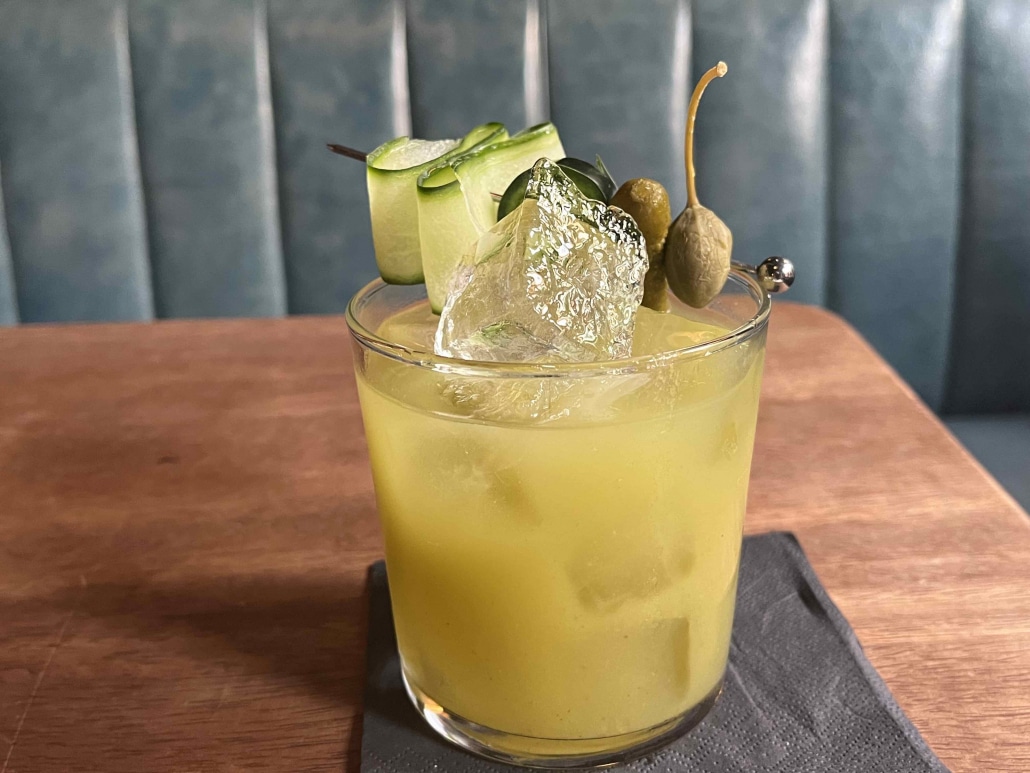
Green Snapper is a verdant riff on Bloody Mary. Five a day in a glass almost to send chlorophyll coursing through my veins. Forgive any nutritional, botanical inaccuracies;  this is a zinger. Beefeater Gin’s the base, muddled with green tomato, jalapeno, lime, cucumber and lovage.

Factor 50 Fizz pales in comparison, but then I’m not a spritz fan. It hardly feels alcoholic this mix of Lillet Rose, strawberry, cucumber and sparkling coconut water.

Rimini Iced Tea – Fellini’s home town (Amarcord in the movie of the name) is the tenuous inspiration for this cooler because of the reputation of its peaches. That fruit, basil and sparkling Darjeellng tea make a refreshing  match with ultra-sustainable Avallen Calvados.

R.A.C. Aviation is a classic rhubarb & custard combo. Made with Bombay Sapphire 1er Cru, rhubarb cordial, vanilla, lemon and maraschino. Surprisingly tart, it’s properly summery.

Moselle Martini is my favourite of the five, mellow and approachable with an indefinable complexity. It’s made with Fords gin, cucumber, Riesling vermouth and pear eau de vie.

No Porterhouse – how did we pull through?

Our daughter’s dog Toro gnawed our doggie bag T-bone with great gusto. We adored the steak that was once attached in the company of a soft, summery Pinot Noir from the Loire. Creamed spinach, anchovy hollandaise, triple-cooked chips, heritage tomato salad. To start we shared beef carpaccio and scallops cooked in the shell with White Port. Never lets you down.

Hawksmoor Manchester, 184-186 Deansgate, M3 3WB. 0161 836 6980.