What’s Italian for après le déluge? What I recall of the last Festa Italiana in 2019 was struggling out of sodden summer wear after some very non-Med weather drenched Cathedral Square. I’d have happily braved rain squalls in 2020 if Manchester’s most family friendly food event could have gone ahead, but that pesky pandemic played damp squib.

Still the forecast looks set fair for the August Bank Holiday weekend this year, with restrictions lifting. Fingers crossed then for th premed heatwave; the line-up looks a treat. OK, it’s not the place to catch up with the bright young masters of Italian cuisine. But a veteran trio of celeb chefs is always good value – step forward Gennaro Contaldo, Aldo Zilli and Giancarlo Caldesi to join those mere striplings, Festa organiser Maurizio Cecco (Salvi’s) and Fran Scafuri  (Tre Ciccio) in the on-site kitchen.

And if cookery demos are not your thing there’s a wealth of other foodie treats to get you salivating across the Festa (Fri-Sun Aug 27-29, 11am-11pm each day).

“The Festa is born out of Manchester’s Italian community and heritage; drawing huge inspiration from the traditional festivals in Italy and adding a touch of Mancunian flavour to create a weekend dedicated to bringing people together to enjoy authentic Italian food and drink, cooking masterclasses, banquets, movies and live music.” That’s what the organisers say and they’re not wrong on past evidence. Here’s the full programme:

Banquet – Festa Marquee

On Saturday, August 28, in partnership with Parmigiano Reggiano, legendary Italian restaurateurs, authors and UK TV favourites Gennaro Contaldo (Saturday Kitchen, Two Greedy Italians, Jamie and Jimmy’s Friday Night Feast), and Giancarlo Caldesi (Return to Tuscany, Saturday Kitchen, Sunday Brunch), will be joining Maurizio Cecco to talk guests through the menu. Buy tickets here.

Masterclasses – Festa Marquee

On Friday August 27 there will be a series of family masterclasses for those attending with children. At 1:30pm Sienna Cecco, Maurizio’s 12-year-old daughter, a talented chef with her own YouTube channel and TV appearances under her belt, will be hosting a cooking demo to teach kids how to make simple and tasty dishes with ease, and at 2:30pm, Julia Martinelli from Pasta Factory will deliver a fun kids pasta masterclass.

Sienna is back the next day at 12:30pm with another family masterclass. Then there will be back-to-back workshops and book signings hosted by Gennaro Contaldo at 1.30pm and Giancarlo Caldesi at 2:30pm. On the Sunday Gennaro will be back at 12:30pm with another masterclass and book signing, and at 1:30pm Tre Ciccio’s Fran Scafuri will be taking guests through a very special recipe. At 2:30pm, celebrity chef and award-winning restaurateur, Aldo Zilli, above, (The One Show, This Morning, Celebrity Masterchef) will be hosting a masterclass and book signing.

Food

Throughout the weekend Café Cannoli will be selling cannoli made using authentic ingredients imported directly from Sicily, local lads Paul and Mike from I Knead Pizza will be bringing their wood-fired oven along to serve up their Neapolitan pizza, while NQ Sicilian will be serving artisan gelato, coppa della casa, brioche gelato and brioche col tuppo. Pasta Factory will be serving up simple dishes, paired with handmade sauces inspired by Puglia. Paradiso Authentic Italian will be contributing its fresh tiramisú range. Festa stalwarts Proove will provide Neapolitan wood-fired pizza, while Lucky Mama’s will debut with their extruded pasta, homemade sauces and signature savoury/sweet dough balls. Not forgetting T’arricrii’s Sicilian specialities arancini and fritto misto and Tre Ciccio’s traditional Italian deli.

Movies

Peroni doesn’t just do drinks; the brew-based showstoppers will be popping up their portable cinema throughout the weekend, complete with bean bags, deck chairs, popcorn, Peroni on tap and themed classic movie screenings of Cinema Paradiso, Romeo and Juliet and La Dolce Vita. The cinema will be located in Cathedral Gardens trees with a Peroni bar adjacent.

Exploring Italy beyond pasta and pizza

This website is a homage to Italian specialities. Read about my passions for Cotechino, Bottarga and Colatura d’Alici.

Two years ago I discovered the leftfield cocktail bar of my dreams and alerted the world to its marvels. It felt like being kidnapped into a playground of flavours and aromas hosted by some Avengers mixology squad in their commitedly vegan hideaway. That seems a bizarre galaxy away. I’m naturally tremulous on my post-lockdown return to Speak In Code, where all its superheroes have been laid low by Covid at one point and commercial survival must have seemed precarious, too. 

Flash back to that pre-lapsarian summer of ’19 when I wrote of Nathan Larkin’s new city centre bar: “Ever wanted to kick in the tumblers all those compilers of the ‘Top Ten Hidden Gem Bars Only Cool Dudes Like Ourselves Can Let You Into The Secret Of’? Quell your wrath. Take a walk up Jackson’s Row, after confusedly seeking an entrance in Lloyd Street, and you’ll arrive at the restrainedly Gothic looking entrance to Speak In Code. 

“There’s a sign. No big secret. It’s not the portal into Cocktail Narnia, just your average Game of Thrones set much given to hip hop and the drip drop of mixologists’ tinctures, Oh and its totally vegan, too, food and drinks, which are symbiotically, sustainably linked. Order a Pornstar Martini at your peril.”

There’s still not an obvious hen party crowd pleaser on the drinks menu, but it all feels more accessible with a £10 Classics Menu occupying a quarter of the majorly revamped list. OK, it’s not your entry level Negroni you’re getting (equal parts, gin, Campari, Martini Rosso); instead it’s a blend of Chamomile Capucana Cachaça, Cynar Amaro and sweet vermouth.

Nathan is over his Covid bout and understandably excited by the new cocktail menu they have created

Sounds enticing but I’m really back at SIC to taste the more challenging elements of a record-sleeve inspired menu that styles itself Selective-Interpretation-Cocktails. Still a palate cleanser is in order, so I take Nathan’s advice and test out that sparkling Negroni offshoot, the Sbagliato. In Italian it means ‘mistake’. It was apparently created in the 1980s by Mirko Stocchetti at his Bar Basso in Milan; when making a Negroni he mistakenly reached for a bottle of spumante instead of gin.

Sbagliato, a bubbly take on Count Negroni’s classic cocktail

Prosecco provides the base bubbles here and sweet vermouth is in the mix. After which it gets more complicated. To create an amaro the team lacto ferment strawberries with non-iodised salt, a starter culture (tofu brine), and SIC’s home-made honey (from birch and quince). They let this sit for five days in an airtight bag until the bag balloons up, then they separate the juices, turn the juice into a 1:1 ratio syrup. They then reuse the fermented strawberry pulp by dehydrating and infusing into the Amaro for 24 hours for a ‘rich strawberries and cream vibe’. 

To complete it they make an oil (oleo) by peeling oranges, massaging the peels in sugar and again leaving for 24 hours for the skin oils to seep out and dissolve the sugar. PS It was delicious. 

Before a similar exploration of the further three cocktails I essayed – Track 5, Track 6 and Track 10 – a brief explanation of that ‘track listing’… I hope I got the drift, Nathan. It was a quick run through before you had to rush off to pick up your Romanian rescue dog, Cheddar. Still I was left in the safe hands of your oppo, Jamaican-Irish Brummie Connan.

Sleeve notes from Speak In Code

The new three part drinks brochure – Signatures (forward thinking), B-Sides (present), ClasSICs (past) comes inside an EP sleeve. The back cover details the plant-based food menu, which retains the cauli wings in buffalo sauce and adds the likes of ‘Neatballs’ and the stand-out jackfruit-led mock duck steamed buns. The front is a green/blue amoebic image created by placing a canvas on top of a bass amp and Nathan playing Dr.Dre – Forgot About Dre on bass, letting acrylic paints fall into this pattern. Well, I did say leftfield. But it mirrors the creativity of the cocktail offering.

The bar’s hip-hop inspiration has been there from the start and Nathan’s innovative bar career (that began with Hard Rock Cafe) has gone hand in hand with his development as a designer and photographer. Each drinks section has an appropriate symbolic image; linking to a music studio come bar; the eight B-sides (£11 each) are labelled Untitled 1 to 8; I’m here to sample three Tracks from the 16 Signatures (£12).

Track 5

Shiitake & plant butter washed bourbon; toasted sunflower sweet vermouth; corn purée, foamer; mushroom jerky

Bourbon is infused with dried shiitake mushrooms for 24 hours, strained and then melted plant butter is added before blast chilling. You’re left with a savoury, slightly sweet and salt bourbon with a creamy mouthfeel. Toasted sunflower seeds are added to a sweet vermouth, for their oil and fat properties. The strained sunflower seeds are rehydrated as part of the garnish. The house corn purée is citrus boosted to add bite, and tastes like pineapples and passionfruit. The bourbon soaked shiitake mushrooms are blended down with dark soy, maple syrup, apple cider vinegar, salt and smoked paprika, then spread out on baking paper and dried out to make a bourbon mushroom jerky to garnish with the sunflower seeds. It’s a mad tropical meets umami experience.

Track 6 

Coconut yogurt washed aged rum; Spanish brandy;  Tio Pepe fino; salted vanilla & coffee bean cordial; dark chocolate & coffee coin

This is an indulgent drink thanks to the infusion of fatty, creamy, acidic non-dairy coconutyoghurt into an aged rum. For the syrup they use both roasted and unroasted coffee beans, with a pinch of salt and a dash of vanilla. The unroasted coffee brings a vegetal and earthy tone to the drink. Dark chocolate is mixed with rock salt and coffee and added to silicone moulds with the SIC logo to garnish.

Track 10

Toasted sunflower Japanese whisky;  Quinquina aperitif; Soju infused with chai and Thai basil; purple sweet potato orgeat; polenta chip garnish 

Japanese whisky this time embraces the toasted sunflower seeds for their oil and fat properties, the Quinquina providing bitter herbiness, the infused Korean Soju floral hints, the orgeat syrup an unguent texture in a cocktail that pretty much sums up the playful SIC ethos of contrasting salty, sour and sweet.

Speak in Code, 7 Jackson’s Row Manchester M2 5ND. 07767 658690. Open Sun-Thu 5pm-12am, Fri-Sat  5pm-2am.

So you think you know what Provencal rosé is all about? At the pale end of pale pink, ripe fruit with (you hope) some fresh acidity and a dry aftertaste? There will be a wide price range but a reassuring homogeneity, especially when chilled to within an inch of its roseate existence. 

Every summer now there seems to be a mad scramble to think pink, especially Provence. Hence an obligatory tasting of 300 in the current issue of Decanter magazine. Verdict of their rosé expert, Elizabeth Gabay MW: “Quality was consistently high, with some squeaky clean wines at all price points. The downside was an almost unending monotony of style.”

In the resultant Top 30 recommendations the rosé at No.5 (with 93 points) stands out as a ruddy maverick interloper among the pale brigade.

She describes Château Gasqui, Silice, Côtes de Provence Rosé 2019 as: “Pale red copper. Perfumed, almost grapey, red fruit aromas. On the palate a beautiful explosion of ripe red fruit, creamy apple compote, a touch of orange peel, marmalade, crushed citrus and some pretty leafy acidity. Quirkily different, intensely fruity and fresh. A gorgeous wine from a biodynamic producer, who is not afraid of ripe fruit and who makes wines which age with ease.”

What did also surprise was the UK supplier, https://www.owtleeds.comOWT of Leeds. Weren’t they the outfit that set up in the city’s Kirkgate Market with a menu generated from what was freshest on the stalls daily? ‘Owt!’ being the answer to what was available. It was a natural extension of co-owner James’s time as a volunteer chef at Real Junk Food Project flagship Armley Junk-tion. 

How does all this link to Southern France’s fields of lavender, sunflowers and vines? Bear with me for a paragraph. Well, OWT has now decamped from the Kirkgate to a cafe unit in the nearby Corn Exchange, Grade 1 listed, domed Victorian gem. The casual but precise food offering remains much the same – from breakfast to late afternoon but with a more expansive Thursday evening menu that wasn’t possible under market hours. 

Esther and James are, step by simple step, rising stars of the Leeds food scene

Oh and on the left as you go in among some chic OWT merchandise you’ll find a trio of exclusive Provencal wines from the family vineyard of James’s partner, Esther. Her surname, Miglio, is a clue to an Italian bloodline way back, but she is the very French daughter of Francois, winemaker for 30 years at Château Gasqui.

She’s proud of the Gasqui wines and so she should be. After hopping on a train to Leeds I can confirm what a complex belter the ‘Silice’ rosé is, like the Roche d’ Enfer! red, dominated by the Grenache grape. Yet just as striking was Esther’s favourite, the Roche d’ Enfer! white from 2013. The ageing has obviously benefited the Semillon that forms part of the cepage with  Rolle and Clairette. What struck was a hint of jasmine on the nose, a waxy mouthfeel and spice notes among the honeyed peachy fruit.

Château Gasqui’s vineyards are set in and support an idyllic natural landscape in the South of France

All three wines are available by the glass at £5, £25 the bottle (which is also the takeaway price). Not cheap but worth it for the purity of fruit extracted by Francois, driving force behind Gasqui being one of only two biodynamic producers in the region. Pictures of the vineyards radiate healthy, blossomig terroir. The brand-heavy fleshpots of Saint-Tropez and the Med Coast may be only 40km to the east but this is a world away, a sustainable enterprise, the antithesis of vinous bling. 

OWT’s food is a perfect complement to the wines. I lunched mid-afternoon off a small menu offering a choice of summer tartelette, aioli with prawns, ‘pepper patchwork’ or panzanella. I went for(and didn’t regret) the £10 steak plate that consisted of a 7oz Yorkshire rump steak, properly rare as requested, plus a herb salad and salsa verde. Fries had run out for the day (it was 3.30pm), so I ordered a side of OWT pickles at £3.50. Carrot, cucumber, ginger and red onion, all fresh and tangy as Esther recounted how after a history course at Marseille University she decided to check out Manchester and fell in love with it gigs and bars. There she met James and he persuaded her a future together lay in his native Yorkshire. God’s Own Country got the best of the deal, you feel, when you taste the wines she has brought with her.

OWT, Unit C12A&B Leeds Corn Exchange, Call Lane, Leeds LS1 7BR. 0113. 247 0706.

A swift guide to biodynamic winemaking and how it benefits Gasqui

Biodynamics is often referred to as ‘super-charged organic’. Its roots are in the theories  of the Austrian philosopher, Rudolf Steiner (1861-1925). Rather than simply reducing chemical inputs, biodynamic production is a proactive attempt to bring life to the soil with the use of natural composts and organic preparations. 

It’s more than just an agricultural system, rather an altered world view that then impacts on the practice of agriculture. Winemakers drawn to this philosophy tend to be creative, spiritual types, deeply connected to their land and always experimenting to see what works best. Which seems to sum up Francois Miglio’s approach.

Gasqui holds Demeter biodynamic certification after the Château’s owner was persuaded to go down this radical route, which forbids chemical fertilisers, pesticides, herbicides or fungicides. Instead insect life and spiders are encouraged to control pests; manure encourages organic growth. After hand-harvesting the grapes the wine is produced in a gravity-fed cellar without winemaking additives. Ambient yeasts are used, with no or scant sulfites and no fining.

More controversially all significant vineyard activities –  soil preparation, planting, pruning, harvesting – are done in accordance with the influence on earth by the moon, stars and planets. Finally, the aspect that can spark scepticism – the use of nine preparations 500-508 (a bit like homeopathy), using  plants such as nettles, dandelion and chamomile, to be applied in powdered form or as sprays. Most divisive is Preparation 500’, where cow horns are filled with cow manure and buried in October to stay in the ground throughout the dormant season. The horn is later unearthed, diluted with water and sprayed onto the soil.

In a magazine interview Francois said of the Steiner strictures: “It is important to understand that 50 percent is symbolic and 50 percent is real… it all helps focus.” 

All of which reminds me of a memorable trip to Ted Lemon’s Littorai winery in Sonoma, California. In Ted’s absence his young deputy confessed to not being a total convert to biodynamics (the perfection of the Pinot Noir was proof enough for us). And yet, as he put it, “It sure does make you pay attention.” 

We loved the copper hue of Château Gasqui but if rosé has to be pale pink for you?

Much has been made of a celebrity influx of Provencal rosé providers, led by Brad and Angelina, whose Château Miraval is made by the Famille Perrin, Chateauneuf du Pape royalty at Chateau Beaucastel. Majestic have it at £19.99  bottle, £14.99 in a mixed six case.

My Provencal pink alternative from a celebrity duo would be Domaine de Triennes, a joint venture by Aubert de Villaine of Domaine de la Romanée-Conti, and Jacques Seysses of Domaine Dujac in Burgundy. It’s a serious well structured wine without sacrificing all the  joyous fruit (£13.95 from Vin Cognito. A simpler favourite would be Coeur De Cardeline Rosé, better value at £8 than its Co-op stablemate, Brangelina’s ‘Studio de Miraval’ (£12).

There’s a fascinating interview in hospitality bible The Staff Canteen, where chef/patron Steven Smith explains how he has adapted The Freemasons at Wiswell for these difficult staffing times. 

We hadn’t read it when we rolled up for lunch at this exemplary gastropub on the fringes of the Ribble Valley. In retrospect it gives a valuable insight into our experience – which was very rewarding. Step forward the Wild Boar Bolognese, Hand Rolled Beetroot Rigatoni, Pickled Walnuts, Aged Parmesan that had me squealing with excitement.

A complimentary Isle of Wight Tomato Tea with a herby whipped curd cone was a delight

It’s a new starter on the remarkable value set lunch (£22 for two courses, £27 for three, also available early evening). ‘Cutting your cloth’ isn’t usually a benchmark for improvement but on the lunch evidence a serious kitchen rethink has paid off.

Steven Smith has adapted his regime to make the kitchen run more smoothly and help his staff’s well-being

He explains in the article: “We always were very mise en place heavy and then service was kept smooth, crisp and clean. but now we have more staff working Monday to Friday doing preparation than we have staff doing Saturday Sundays actually cooking.”

Not only has this helped them redress staffing issues… “We’re also cooking better than we ever have, we’ve slimmed down the menu, we’ve really thought about simplifying a lot of dishes and it’s made the food better.

“The food still has the same Freemasons touch and feel, we haven’t turned away from that, we’re still using all the same sauces we’ve always used and the concept of the dishes is the same, we’ve just refined it and taken a lot of stuff off the plate that didn’t need to be there.”

You’d have to road test the a la carte to properly confirm this. Certainly in the past Steven has seemed to be driven by Michelin aspirations and it has seemed unfair that many of his peers below the Freemasons in the Estrella Damm Top 50 Gastropubs list have secured a star. 

To celebrate 10 years at Wiswell, in summer 2019 Smith took the place up a notch with a big investment. Four luxury bedrooms were attached plus a state of the art kitchen as the hub of a new dining experience called ‘Mr Smith’s’… Here’s my glowing report on our stay for Manchester Confidential.

Our return is more back to basics, but what basics. A running thread through the meal is the vivid presence of in-season peas and broad beans. ‘Summer greens’ feature in a velouté starter and a complimentary Isle of Wight Tomato Tea (with its cute cones of whipped curd and herbs). Equally chlorophyll-rich are the simple accompaniments to a roast salmon loin – samphire, dill and an exquisite green forager’s sauce.

French style peas (not mushy) form a base with a mint sauce for my wife’s Suet Pudding with an unctuous filling of Herdwick Lamb Shoulder, while my rival main dunks Loin of Whitby Cod in a sharp vegetable and herb nage that’s a whole intense harvest of those peas and broad beans. No greens were apparent in that debutant Wild Boar, but it was the true star of the show. 

This half portion of chocolate device was enough – it was decadently rich

We stuck with the two courses but then shared a hard-to-resist Dark Chocolate Delice (£12.95) from the a la carte, a blackcurrant sorbet and cherries giving it a deconstructed Black Forest feel.

The Freemasons Menu, a model of deconstruction in it own right? We like it.

Freemasons at Wiswell, 8 Vicarage Fold, Wiswell, nr Clitheroe, BB7 9DF. 01254 822218.

Cut the mustard, keen as mustard – it’s certainly a condiment that keeps upbeat. But so often, from rustic wholegrain to the most delicate of Dijons, it’s a disappointment. ie. they don’t cut the mustard. For all the artisan labels you’re mostly getting an industrial product. Not as bland as supermarket bread made from the Chorleywood process or all those international beers that delight in being Lite. Yet when you’ve tasted the real thing…

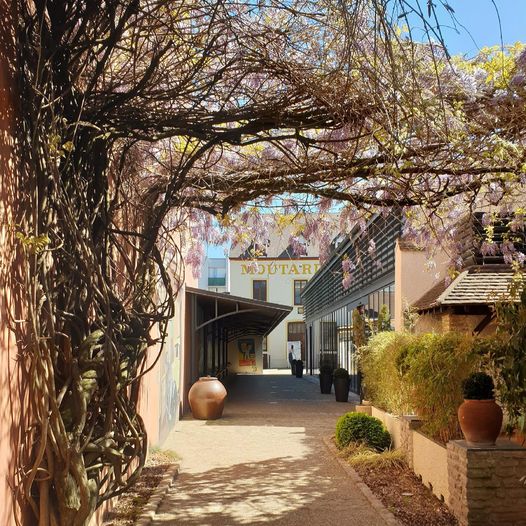
My Mustard Damascus Moment came in a small factory tucked away in downtown Beaune. I was in Burgundy’s epicentre to taste the wines (naturellement) but the true lipsmacking legacy was Edmond Fallot’s speciality Dijon mustards.

A shady courtyard leads to the Fallot Mustard Works

Dijon, 30 miles to the north, was the centre of medieval mustard making (must was often included) and was granted exclusive naming rights in the 17th century. The basic method is not complex – a combination of mustard seeds, white wine or wine vinegar, water and salt. A 1937 decree ruled that ‘Dijon mustard’ can be used as generic designation and has no link to a specific terroir.

Nor is there a stipulation about sticking to traditional methods. That’s what the Fallot family, unlike their rivals, have been doing in Beaune since 1840, today under the stewardship of Marc Désarménien, grandson of Edmond. They still go down the traditional route. Using antique millstones, they grind high quality brown mustard seeds mixed with verjuice, extracted from Burgundy grapes.

May I interest you in a sample of our typically Burgundian moutarde de yuzu?

After which they are at liberty to widen the palette. In their colourful tasting room/shop I worked my way through flavoured mustards that ranged from truffe de Bourgogne to cassis (blackcurrant), Espelette pepper to Madagascan green pepper, samples of which I brought home. There’s even a yuzu version (which I didn’t).

The one that won my heart, though, and remains the base for my Béarnaise and Poulet à L’Estragon is the Tarragon Mustard. Of all the flavours beyond the basic Fallot it is the easiest to source. It is made from black and brown mustard seeds blended with fresh tarragon leaves, giving it an extraordinary aroma and texture that also adds oomph when a powerful vinaigrette is called for.

The good news? You can buy a 310g jar for £6.50 at Harvey Nichols in-store or online. A good introduction to its joys is this simple Burgundian dish from Fallot’ own website:

A good introduction to its joys is this simple Burgundian dish from Fallot’s own website:

Chicken Fricassee with Fallot Dijon Tarragon Mustard

1 chicken (around 1kg)

30g flour

80g butter

100g small white onions

200ml chicken stock

fresh mixed herbs

100ml fresh cream

2 tbsp Fallot Dijon Tarragon Mustard

minced tarragon

salt and pepper.

Method:

Cut the chicken into pieces. Season and dust the pieces with flour. Brown them in a large casserole dish with hot butter. Add small white onions. Moisten with the chicken stock. Add mixed herbs. Bring to a boil. Cook for 35 minutes. Set aside chicken and onions in a dish. Keep them warm. Allow the sauce to reduce. Add cream and mustard. Bring to the boil. Season according to taste. Pour the sauce over chicken pieces and sprinkle with minced tarragon.

My wine recommendation is any affordable red Burgundy from Santenay or Marsannay.

Mustard cultivation is on the increase in Burgundy

A potted history of Mustard in Burgundy

Until the Second World War Burgundian woodland was where mustard was cultivated. Discarded ash from charcoal burning was rich in potash, perfect growing material. When the plants were mature the charcoal makers sold the strong and biting seeds on to the mustard manufacturers of Dijon and Beune.

Then the demand for charcoal waned, so those manufacturers were forced to look elsewhere in France, eventually outside to the United States and Canada. Recently, though, Burgundy Mustard Association, in which Fallot plays a major role, is giving new impetus to cultivation across the region again.

That has been boosted by the approval in 2009 of PGI (Protected Geographical Indication) status. So locally specific Moutarde à la Bourgogne can distance itself as a quality product, separate from the generic name Dijon Mustard. Think specific ‘West Country Cheddar’ as opposed to all those global takes on that cheese’s noble name. Tarragon mustard with Montgomery’s or Aged Keen’s. Must try.