
Golden fruit of the gods is the Hellenic sobriquet for the quince. I don’t know the Greek for knobbly but this hard fruit inevitably is that, just as its raw interior tastes tart and astringent, belying the heavenly scent from its skin. Cooking transforms it. So too distilling squeezes out something quite remarkable.
All this occupies my thoughts in a small plates bistro just off Columbia Road Flower Market in Bethnal Green as I sip a quince eau de vie made by Capreolus. Its yellow hue mirrors the mother fruit’s surface, the scent almost tropical with a lingering juicy taste unusual in a 43% spirit. It has been poured by the distillery’s founder Barney Wilzcak (who with his professional photographer hat on took the quince picture above). Barney describes it as ““possibly the most ethereal fruit we work with, astonishing in its nuance and elegance.”


At Brawn I am a guest of Les Caves de Pyrene, best known as natural wine specialists but this trade tasting puts the spotlight on four other artisan drinks makers on their roster. Three have come over from France – Caroline Rozes (Armagnac Laurensan), vermouth specialist Jean-luc Carrozes (Vinmouth) and Laurent Cazottes, whose biodynamic estate in Southern France produces grapes, fruits, flowers, grains, and plants from which he fashions wines, spirits and liqueurs. A tomato liqueur was particularly astonishing. You can see why his wares can be found on Michelin restaurant digestif lists across France and beyond (you’ll find several examples at lovely Bavette Bistro in Horsforth near Leeds).
A new organic orchard of their own for Capreolus
All Laurent’s samples taste exquisite, but I am here primarily for the fourth exhibitor, Capreolus. Seven of their eau de vies are on the (low intervention) list at Manchester’s Higher Ground – at between £9 and £16 a 25ml measure. Lunching there a fortnight before my Caves de Pyrene date I mentioned it to the restaurant’s Daniel and Ana. And – curse them! – they were just days away from a private visit to the distillery in deepest Gloucestershire. When next winter Higher Ground opens Bar Shrimp next door they are promising a special collaboration with Capreolus.


Thanks, Ana, for the promised picture of Barney on site and his new quince tree project. In his March newsletter he had revealed that after a two and a half year search Capreolus had purchased some five acres of lowland hay meadow, where they had planted 252 quince trees, representing four varieties never grown commercially in the UK before. A big welcome then to Ispolinskaja, Turunchukskaja (both Ukrainian), Limon Ayvasi (Turkish) and Cydora Robusta (German). The trees, one year old and eight feet tall when they arrived, are interspersed with crab apple trees for diversity’s sake. It is one of the largest UK quince orchards, but the plan is to restrict yields to five tons annually, a third of a commercial crop target.
It will plug a gap in their commitment to their own immediate terroir. At the moment this is the only fruit they buy in regularly from outside a 35 mile radius of their base at Stratton near Cirencester.


Foxwhelp is an awkward orchard customer but what a collab
Little Pomona Cider and Perry Mill is also outside that radius, lying 55 miles north west in Herefordshire. It’s a luminous spot that I have visited. That was just a few months before co-founder Susanna Forbes succumbed to cancer. We spent three fascinating hours in the company of her and husband James sampling their acclaimed boundary-pushing ciders and perries.
The pair came from a background in wine (James) and drinks journalism (Susanna) and across their range have not been afraid to incorporate hops, cherries and (you guessed it) quinces. Their ‘Still Life with Quince’ is an intense blend of barrel-aged cider and quince wine.
But when it came to a long-mooted collaboration with Capreolus their contribution was a single varietal cider made from an uncompromising apple called Foxwhelp. How come the evocative name? One cider apple historian attributes it to originating near a fox’s den where the cubs or whelps would play with the windfalls. Jury’s out.
Tannic and lashingly acidic, producing ciders with great ageing capacity, Foxwhelp has been around since the 17th century with its own hardcore admirers willing to pay premium prices. Susanna called it “the Riesling of the apple world”. Little Pomona have respected its qualities by barrel-ageing successive vintages in a solera system, akin to sherry making. Was this blend the base for 2022 Capreolus? I never get to ask at a crowded Brawn.

I do know some of what to expect when I taste the 2022 Capreolus x Little Pomona Foxwhelp Cider Eau-de-Vie (43%) and there it is – that mind-blowing aroma of wild strawberry and blood orange typical of the cider version. That strawberry rush continues on to the palate alongside a rounded appliness, as you’d expect. The concentration is down to wild yeast fermentation of meticulously sorted low-yielding fruits, preserving up to 45kg of fruit in each finished litre. Labour intensive isn’t the half of it for Barney and his partner Hannah Morrison. There’s a small child and dog to share the adventure, which began when he abandoned his job as a conservation issues photographer to develop the distillery on his family’s land.
His talent with words is evident too: “What enchanted me was how this elegant way of working, this capturing of pure essence, revealed so much. What I discovered was something that not only isolated a moment of peak ripeness but transported me to the parent plants and landscape in which I was raised.
“The elevation of flavours imperceptible in the raw fruit took me to standing in 300 year old perry pear orchards. The aroma of a Blackberry Eau de Vie to the autumnal warmth of the sun. The synesthetic link of aroma and flavour is something where language consistently fails.”
It sounds idyllic but to reach this point where their spirits (including a lovely gin) can command such high prices in prestigious places has taken prodigious efforts. Still there remains an idyllic aspect to housing two copper stills in an old lean-to greenhouse. Roe deer roam this land, hence the distillery borrowing the latin name for the breed: Capreolus Capreolus. “Delicate, slipping away, this animal is a constant accompaniment to picking in the surrounding countryside, a reminder of the fleeting nature of what we are trying to preserve.”


Barney has written an illuminating, evocative account of Capreolus for the Caves de Pyrenes blog. Do check it out.
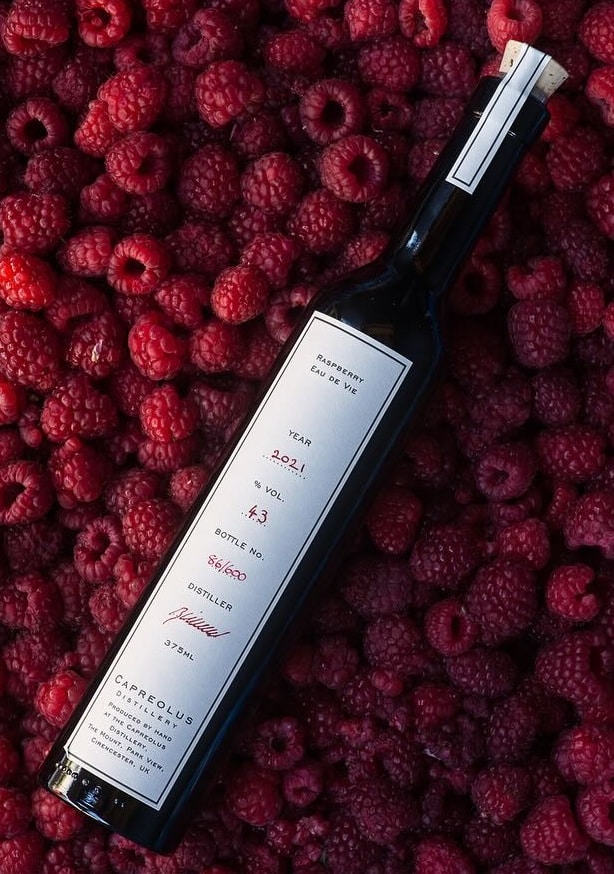
“In 2022, with my daughter 8 weeks old and bouncing beneath a tree in the garden where we work, we touched every single fruit of 3,000,000 raspberries as fingers felt for flaws and removed every single leaf, stem and hull. In the resulting eau de vie you can smell 1,000 seeds in your glass, crushed mint and raspberry leaf, lemon zest, and yes, the perfume of the most perfect fruit enveloping you – it is as if you were stood amongst the plants themselves.”
As I sip that particular spirit in the urban sprawl of East London I feel transported to the perfumed orchards of Gloucestershire.


